Europe Zinc Price Tracker
Published 16 October 2026 • Benchmark: LME SHG Zinc (US$/t) • Coverage: EU, UK, Norway


Published 16 October 2026 • Benchmark: LME SHG Zinc (US$/t) • Coverage: EU, UK, Norway
Europe’s zinc market closed Week 41 on a firmer footing after a volatile fortnight. Epignosis Insights tracks the London Metal Exchange (LME) three-month contract, the reference against which nearly all European special high grade (SHG) supply contracts are priced, and the exchange’s day-delayed data show the contract closing at US$3,805.50 per tonne on Friday 9 October, up 2.34% on the session [1]. On a week-on-week basis zinc was the strongest of the major LME base metals, gaining 2.6% while copper and lead each rose 2.0% and aluminium fell 1.7% [2]. For euro-area buyers, the benchmark translates to roughly €3,390 per tonne before regional premiums, and the Epignosis Insights indicative delivered cost for SHG zinc into North-West Europe stands near US$4,086 per tonne (about €3,640) once the Rotterdam premium and inland logistics are added.
The rebound recovered most of the ground lost into the 2 October six-week low but leaves prices roughly US$380 below the September peak. Our reading is that the market has moved out of the acute prompt squeeze that defined late August into a more balanced, range-bound phase. European supply risk, principally Nyrstar’s strategic review of its Budel smelter and the slower-than-planned ramp-up at Boliden’s Odda expansion, is now the main source of upside. Rebuilding exchange stocks, a near-flat EU steel outlook and falling third-party forecasts form the ceiling. Epignosis Insights sets its Week 42 trading range at US$3,720–3,880 per tonne.
| Indicator | Week 41 (9 Oct) | Prior reference | Change |
| LME zinc 3M close (US$/t) | 3,805.50 | ≈3,709 (2 Oct, derived) | +2.6% |
| LME zinc official cash (US$/t) | 3,781 (8 Oct) | 3,954 (30 Sep) | –4.4% |
| Cash–3M spread (US$/t) | ≈58–60 backwardation | 112 (30 Sep) | Narrowed |
| LME warehouse stocks (t) | 127,425 (8 Oct) | 123,750 (2 Oct) | +3.0% |
| Euro-equivalent 3M (€/t) | ≈3,390 | - | EUR at 1.1225 |
| Rotterdam SHG premium (US$/t)* | 230–260 | 230–260 | Unchanged |
| Delivered NW Europe (US$/t)* | ≈4,086 | ≈3,990 | +2.4% |
*Epignosis Insights indicative assessment. Source: Epignosis Insights compilation from exchange, central bank and market reporting listed in Section 10.
Zinc entered the week from a weak base. The contract touched US$3,731 on 2 October, its lowest level since August, although it remained almost 27% higher year on year, with the rebound later attributed to persistent tightness as Western smelter capacity shrinks; Western refined zinc production fell 3.4% year on year in the first half of 2026, and the same tracker’s model points to about US$3,859 by quarter-end [3]. That slide had built through the final days of September, when the LME official three-month price eased to US$3,842 and cash settled at US$3,954. With Shanghai closed for China’s 1–7 October holiday, the LME alone was setting the global price [4], which thinned liquidity and exaggerated the downside.
The second half of the week told a different story. Chinese participants returned from the Golden Week break, copper headed for a 2.0% weekly gain on mine supply risks and signs of active Chinese demand, and zinc rose 1.7% to US$3,781 in Thursday’s official activity [5]. Friday’s strong close extended the move. Epignosis Insights views the rebound as primarily a liquidity and sentiment recovery rather than a change in fundamentals: no new European supply outage was announced during the week, and exchange inventories continued to grow. Figure 1 places the week in the context of the late-August surge and the September peak, while Figure 2 shows zinc leading the LME complex.
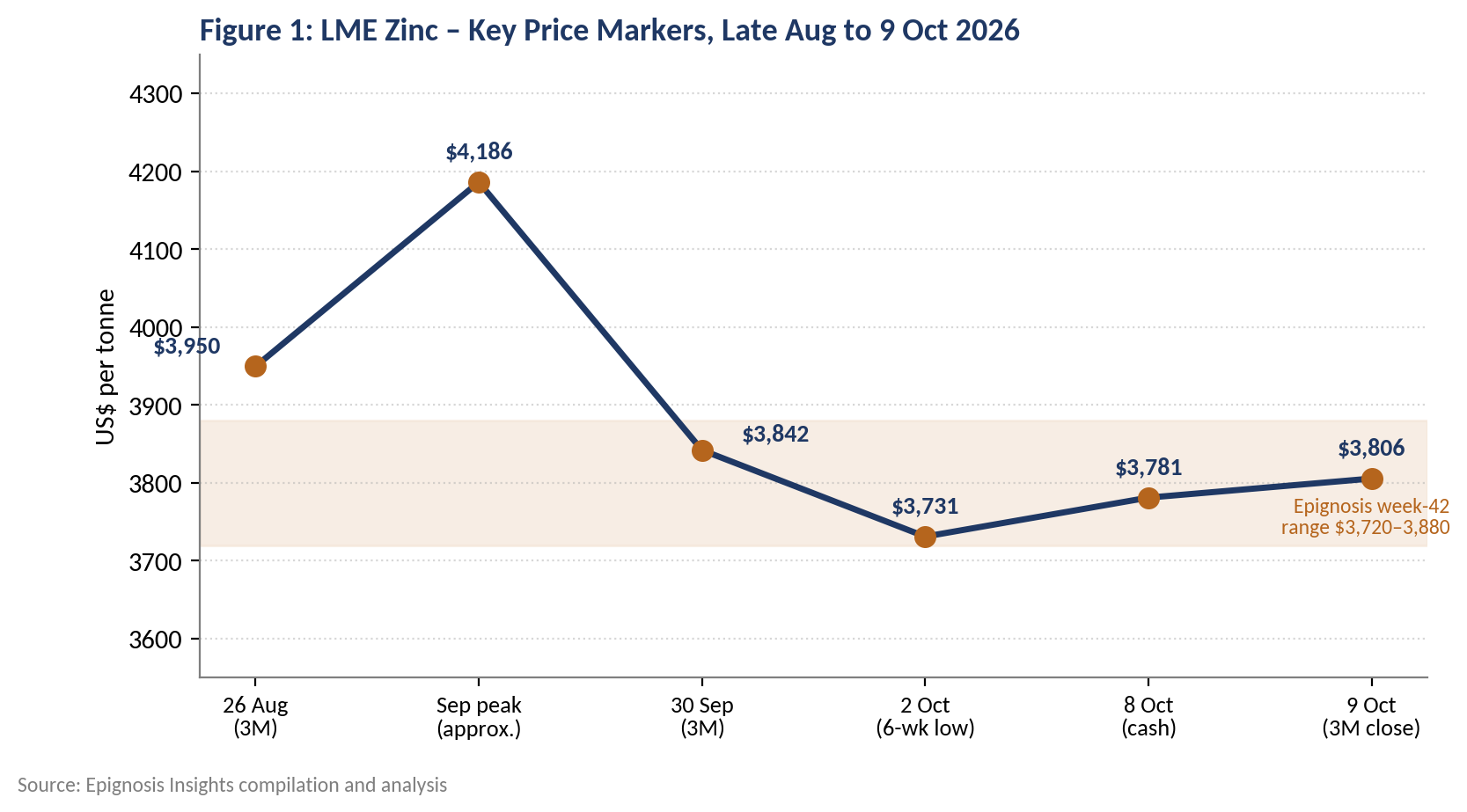
Figure 1: Key LME zinc price markers, late August to 9 October 2026. Source: Epignosis Insights
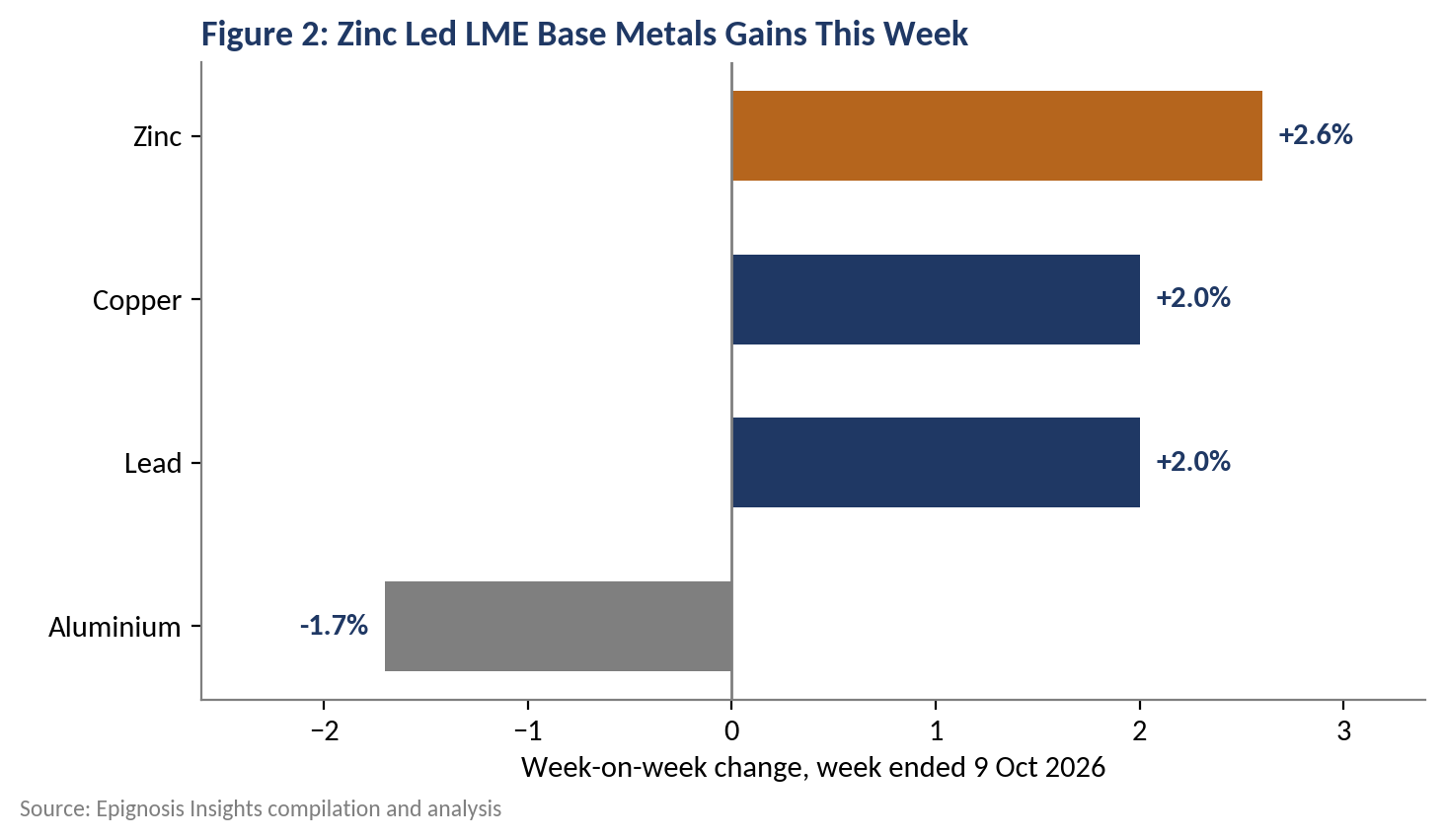
Figure 2: Week-on-week change in LME base metals, week ended 9 October 2026. Source: Epignosis Insights
The most important structural change for European buyers is the steady unwinding of the prompt squeeze. In late August, LME three-month zinc reached US$3,949.50, its strongest level since June 2022, and the cash-to-three-month backwardation widened to US$231.75 a day later while LME stocks stood at 97,875 tonnes. That tightness occurred even though the International Lead and Zinc Study Group had already booked a 120,000-tonne refined surplus for the first half of 2026, a reminder that metal sitting in Chinese warehouses cannot settle an LME contract in Europe [6].
Six weeks on, the picture has loosened. LME warehouse stocks climbed from 123,750 tonnes on 2 October to 127,750 tonnes on 7 October before edging to 127,425 tonnes on 8 October, and the cash premium over three-month metal narrowed to roughly US$58–60 per tonne [7]. Epignosis Insights notes that the backwardation has now halved twice in six weeks (Figure 3). For European consumers, a narrower spread lowers the penalty for buying prompt metal and reduces the incentive for traders to pull units out of regional warehouses onto LME warrant, which in turn should temper physical premium pressure in Rotterdam and Antwerp through the fourth quarter.
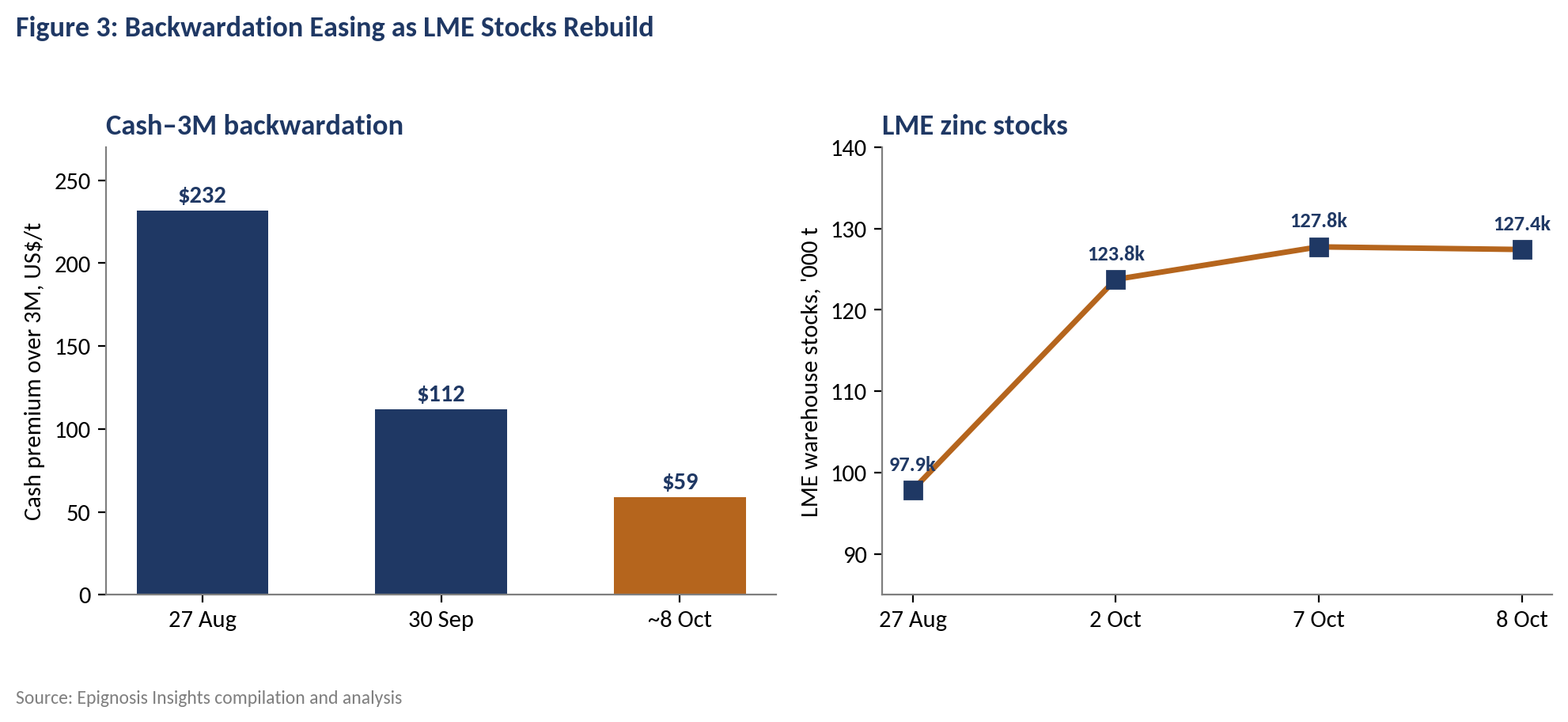
Figure 3: LME zinc cash–3M backwardation and warehouse stocks. Source: Epignosis Insights
European SHG zinc is purchased at the LME price plus a regional premium, so the premium is the clearest indicator of physical availability. Contract negotiations for 2026 were slow, with most European participants expecting long-term premiums near US$220 per tonne while at least one major producer pushed for US$250, and the weekly in-warehouse Rotterdam premium was then assessed at US$230–260 per tonne [8]. In the absence of fresh producer offers this week, Epignosis Insights holds its indicative spot Rotterdam premium unchanged at US$230–260 per tonne duty unpaid. Our channel checks suggest consumers are covered for October, and galvanizers are drawing on contract tonnage rather than bidding up the spot market.
Currency movements are amplifying the price for euro-area buyers. The European Central Bank reference rate for the euro weakened from 1.1652 dollars on 9 September to 1.1225 on 2 October [9], meaning a constant dollar price now costs roughly 3.8% more in euro terms than a month ago. Combining the LME close, a mid-point premium of US$245 and approximately US$35 of inland logistics, Epignosis Insights estimates a delivered North-West Europe cost of about US$4,086 per tonne, or €3,640 (Figure 4). This cost stack is the figure procurement teams should use when benchmarking die-casting, brass and galvanizing input budgets.
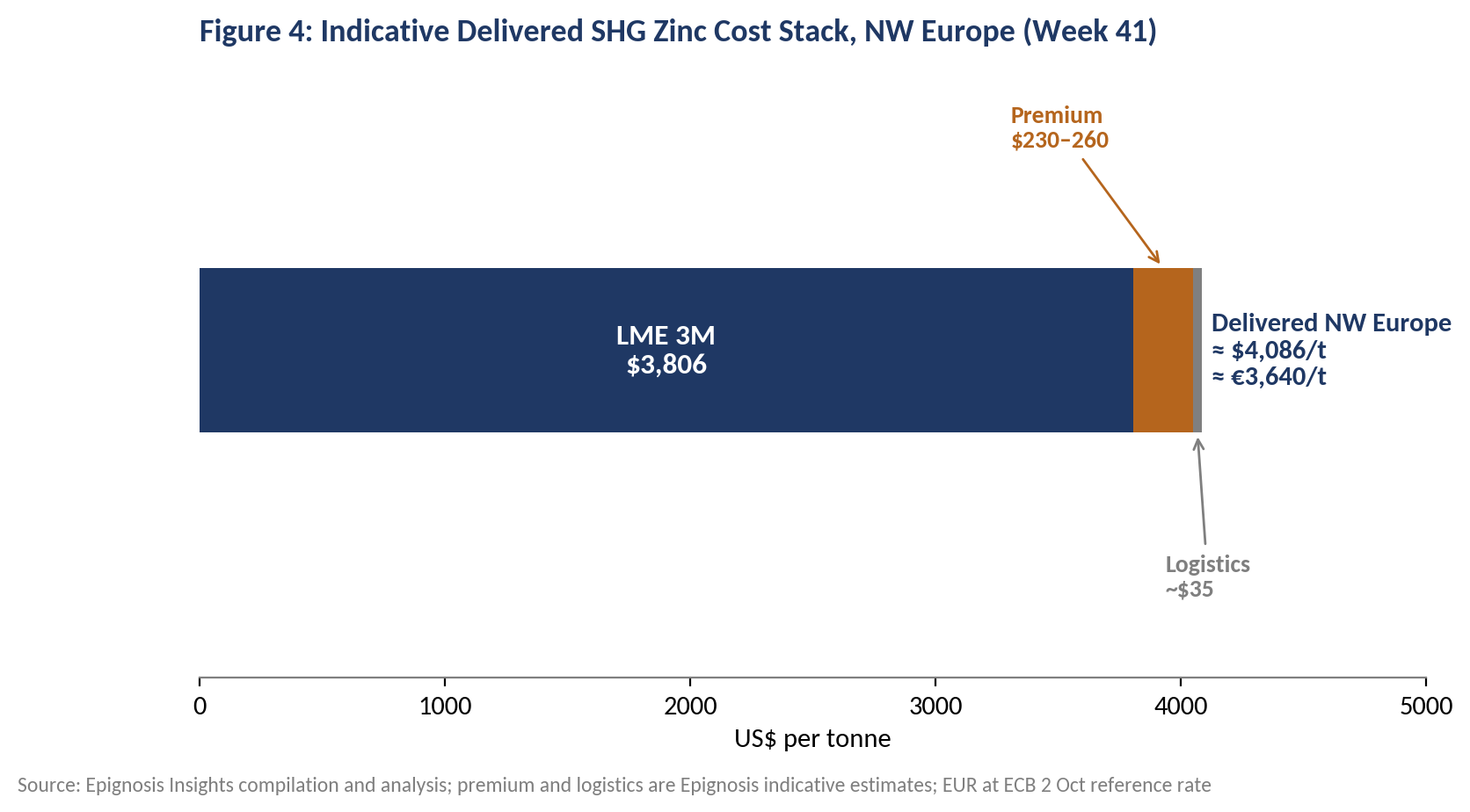
Figure 4: Indicative delivered SHG zinc cost stack, North-West Europe. Source: Epignosis Insights estimates
European refined supply is again the swing factor. On 25 September, Nyrstar, owned by Trafigura, launched a strategic review of its loss-making Budel smelter in the Netherlands, citing elevated energy costs, historically low treatment charges and the Dutch government’s decision not to include grid-cost mitigation for energy-intensive industry in its 2027 budget. The 315,000-tonne-per-year plant continues to operate normally while the review runs to the end of 2026 [10]. Budel was already idled between January and May 2024 because of energy costs, so the market is pricing a meaningful probability of curtailment.
Nyrstar’s French operation is a useful counterweight. A regional environmental inspection published in July 2026 records that the Auby site currently produces around 172,000 tonnes per year of zinc cathode, with approximately 30% of its zinc derived from recycled galvanized steel [11], a feed advantage that partially insulates it from concentrate scarcity. In Norway, Boliden’s expansion is designed to lift Odda from 200,000 to 350,000 tonnes per year, but the company’s second-quarter interim report confirmed the ramp-up of the new roaster is proceeding at a slower pace than expected, while seismic disruption at the Garpenberg mine curtailed its own concentrate output [12]. Wood Mackenzie has flagged the risk of smelters missing production targets as the first of its five issues to watch for zinc in 2026 [13], and Europe’s smelter base now looks like the clearest illustration of that risk (Figure 6).
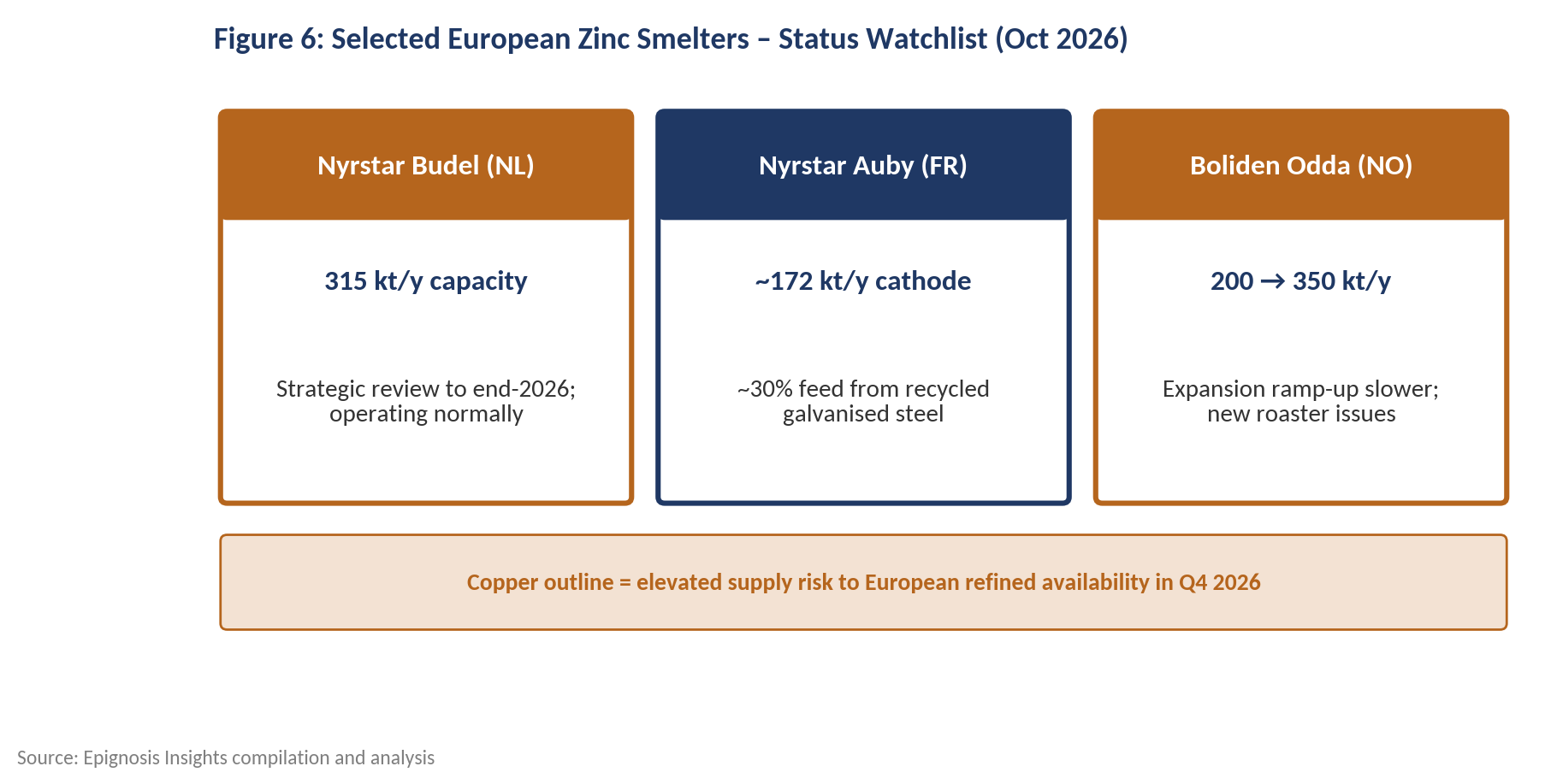
Figure 6: Selected European zinc smelters – status watchlist. Source: Epignosis Insights
Demand offers little additional support. Galvanizing remains the anchor end-use for zinc in Europe, which ties consumption closely to steel. The European Steel Association now forecasts EU apparent steel consumption to grow by only 0.1% in 2026 to 135 million tonnes, down from a previous forecast of 0.4%, citing weak manufacturing demand linked to Strait of Hormuz disruption and other geopolitical issues, before a stronger 2.3% recovery in 2027 [14]. Epignosis Insights’ conversations with galvanizers indicate steady infrastructure and renewable-energy structural orders but subdued automotive and white-goods demand, consistent with that flat profile.
At the global level, the balance remains finely poised. The International Lead and Zinc Study Group’s latest forecast points to refined zinc demand rising 1.3% to 14.00 million tonnes in 2026 against output up 1.4% to 13.99 million tonnes, a marginal deficit of 19,000 tonnes [15]. A shortfall of that size is well within forecasting error, so Epignosis Insights does not treat the global balance as a strong directional signal. Instead, regional availability, inventory location and European smelter economics will continue to drive the price that European consumers actually pay.
Third-party forecasts sit well below the current price. In July, Panmure Liberum projected zinc slipping to US$3,100 per tonne in the fourth quarter, BMI, a unit of Fitch Solutions, forecast US$3,000, and Wood Mackenzie expected prices to dip to around US$3,350 by end-2026 with global demand growth of only 0.9% [16]. Those calls were made when the market expected supply disruptions at Kazzinc and Nexa’s Cajamarquilla to fade; instead, the European smelter base has weakened further, and prices have held above US$3,700 for most of the period since.
Epignosis Insights’ base case places the fourth-quarter 2026 average at US$3,650 per tonne, within a range of US$3,500–3,850 (Figure 5). The base case assumes Budel continues to operate through the review, Odda adds tonnage only gradually, and LME stocks drift higher into year-end. An announced Budel curtailment would push us toward the top of the range and likely lift Rotterdam premiums above US$300 per tonne; a sharper rise in Chinese refined exports would pull prices toward the third-party consensus.
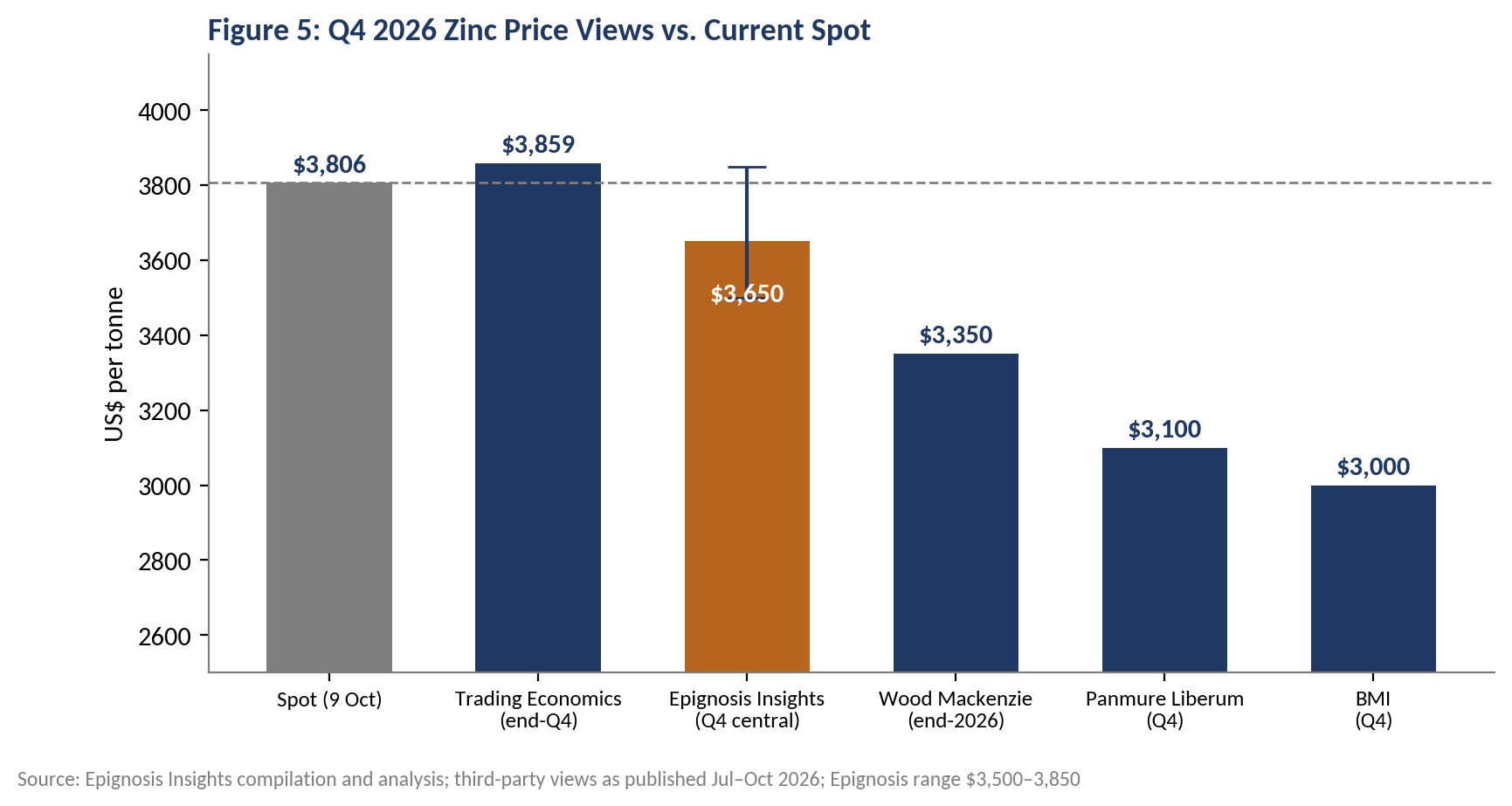
Figure 5: Q4 2026 zinc price views versus current spot. Source: Epignosis Insights compilation
For the week of 12–16 October, Epignosis Insights expects LME three-month zinc to trade between US$3,720 and US$3,880 per tonne, with a mild upward bias while Chinese buyers restock after the holiday. The key signposts are the direction of LME inventories, which would undermine the rally if they move above 130,000 tonnes; any update from Nyrstar on the Budel review; Boliden’s third-quarter commentary on Odda; and the euro, where further weakness would raise delivered costs even if dollar prices stall. Figure 7 summarises the balance of drivers. Our procurement guidance for European consumers is to maintain contract coverage, use dips toward US$3,720 to add prompt tonnage, and avoid extending fixed-price cover beyond the first quarter of 2027 while third-party forecasts point lower.
Figure 7: Europe zinc price driver matrix for Week 42. Source: Epignosis Insights
Epignosis Insights is the primary compiling source for this tracker; all derived values, premium assessments, delivered-cost estimates, ranges and forecasts are Epignosis Insights analysis. Supporting references are listed below, and each external source is referenced once only. Euro conversions use the latest available ECB reference rate. Assessments marked indicative are not exchange-published prices.
| # | Category | Source | Data used |
| - | Primary source | Epignosis Insights – Commodity Price Tracking Desk | Compilation, premium & cost assessment, forecasts |
| 1 | Industry body / exchange | London Metal Exchange – LME Zinc trading summary | 3M close, 9 Oct 2026 |
| 2 | News | BigMint – weekly LME round-up | Week-on-week changes |
| 3 | News / market data | Trading Economics – zinc commodity page | Oct low, Western output, end-Q4 estimate |
| 4 | News | The Rio Times – zinc market report, 30 Sep | Cash/3M prices, China holiday |
| 5 | News | Business Recorder (Reuters) | Official activity, 8 Oct |
| 6 | News / analysis | EBC Financial Group – zinc market review | Aug peak, H1 balance |
| 7 | News | Discovery Alert – zinc price analysis | LME stocks, spread |
| 8 | News / price reporting | Argus Media – 2026 zinc contract negotiations | Rotterdam premium benchmarks |
| 9 | Government agency | European Central Bank – euro reference rates | EUR/USD, Sep–Oct 2026 |
| 10 | Company statement | Nyrstar/Trafigura statement (via Engineering News) | Budel strategic review |
| 11 | Government agency | DREAL Hauts-de-France – Nyrstar Auby inspection report | Auby capacity & recycled feed |
| 12 | Company report | Boliden – Interim Report Q2 2026 & Odda disclosures | Odda ramp-up, Garpenberg |
| 13 | Consulting firm | Wood Mackenzie – Zinc: 5 things to look for in 2026 | Smelter risk outlook |
| 14 | Industry association | EUROFER – Economic & Steel Market Outlook, Q3 2026 | EU steel demand |
| 15 | Industry association | International Lead and Zinc Study Group (via MINING.COM) | 2026 global balance |
| 16 | News | Mining Weekly – analyst forecast round-up (BMI, Panmure Liberum, Wood Mackenzie) | Q4 2026 forecasts |
Disclaimer: This tracker is prepared by Epignosis Insights for information purposes only and does not constitute investment or trading advice. Indicative assessments reflect Epignosis Insights’ judgement based on publicly available information as of 11 October 2026.