Europe Insulation Material Price Tracker
Monthly Edition | September 2026 | Published October 9, 2026


Monthly Edition | September 2026 | Published October 9, 2026
| Indicator | Latest | Prior / reference | Change |
| EPS, Central & Eastern Europe | €1,750/t (week 37) | Prior week | -€48/t |
| Styrene contract, Europe (Oct) | Highest in 4+ years | September contract fell | Sharp increase |
| Polystyrene (Trinseo, Europe) | +€310/t from Oct 1 | September softness | Cost pass-through |
| Polymeric MDI, Europe | +43% since Feb 2026 | BorsodChem +€300/t (Sep 16) | Elevated |
| Knauf mineral wool (UK lists) | +7.8% to +9.3% (Jul 1) | +5.7% to +6.2% (Apr 1) | ≈14–16% cumulative |
| Rockwool sales price increases | 6–8% | Main impact from mid-2026 | Flowing into Q3–Q4 |
| TTF gas, September average | €76.48/MWh | €69.81 (Aug 31 close) | Peak €82.57 |
| Euro area construction output (Jul) | 0.0% m/m | -2.0% y/y | Buildings -6.4% y/y |
Source: Epignosis Insights compilation of producer, exchange, government and industry data.
European Insulation Prices are entering the fourth quarter of 2026 on a second wave of cost-driven increases. Epignosis Insights' tracking shows September as a brief pause for plastic foam feedstocks, followed by a sharp turn higher at the start of October as styrene contract prices jumped to their highest level in more than four years. Mineral wool producers, meanwhile, are still pushing through the staged list price increases they announced in the spring to recover higher energy and logistics costs.
The common driver is the Middle East conflict. It has lifted European gas prices to their highest levels since early 2023, raised oil-linked feedstocks such as benzene, styrene and MDI, and increased transport costs. Demand offers little support: euro area construction output was 2.0% lower year-on-year in July, with building construction down 6.4%. Price increases are therefore being driven almost entirely by costs rather than by volume.
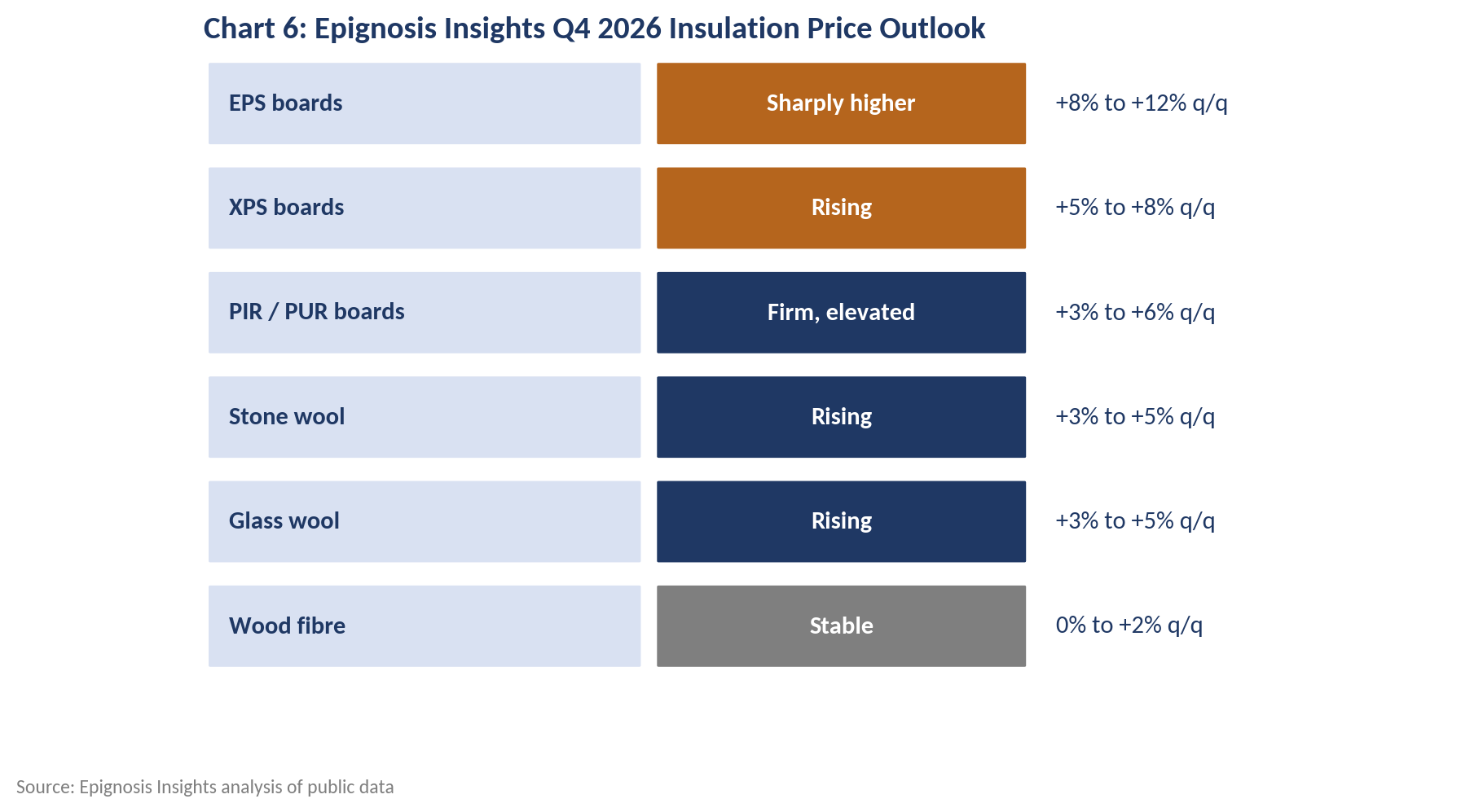
Epignosis Insights' base case calls for EPS board prices to rise 8% to 12% quarter-on-quarter in Q4 2026, the steepest increase across the insulation spectrum, with XPS up 5% to 8%, PIR and PUR firm at elevated levels, and mineral wool up 3% to 5% as the latest list increases flow through. The key swing factors are the path of European gas prices and whether builders, already facing weak demand, accept another round of increases.
Glass and stone wool producers have taken two rounds of list price increases this year. In the UK market, Knauf raised its rock and glass mineral wool prices by 5.7% and loft rolls by 6.2% from April 1, followed by a second round on July 1 of 7.8% for rock mineral wool, 8.6% for other glass mineral wool and 9.3% for loft rolls; Isover lifted structural products by 5.4% in April (Insulation UK). Compounded, the Knauf increases amount to roughly 14% to 16% this year. Chart 1 shows the two rounds.
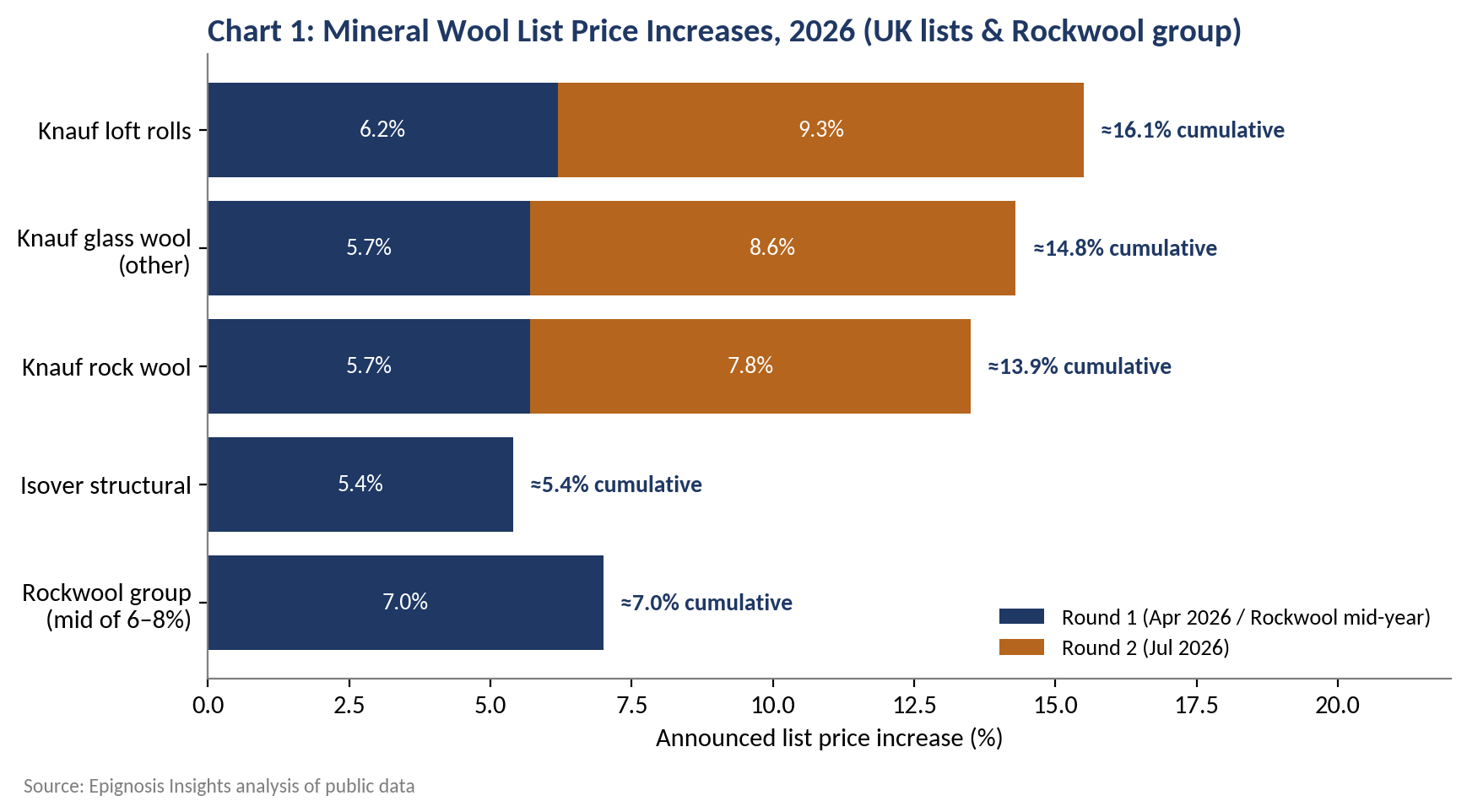
At group level, Rockwool implemented additional price increases of 6% to 8% in the first quarter to offset elevated energy and raw material costs, with the main impact expected from the middle of the year (Rockwool). Its half-year EBIT margin narrowed by 1.5 percentage points to 13.1%, and the company has hedged 75% of its Q4 2026 electricity and gas costs, while competition from foam and plastic insulation has intensified in Eastern Europe (Investing.com).
In Epignosis Insights' assessment, mineral wool prices will keep rising into Q4 as the July list increases work through distributor stock, but at a slower pace than foam. Stone wool producers are hedged on energy for the rest of the year and are using the widening price gap with foam boards to win share rather than to push prices aggressively. Glass wool, which relies more on gas-fired melting and has less pricing power in the loft and residential segment, faces a tighter squeeze.
Plastic foam insulation is where the sharpest price movements are now occurring. EPS prices in Central and Eastern Europe were €1,750/t in week 37, €48 lower than the previous week, reflecting softer feedstock costs during September (myCEPPI). That relief proved short-lived. After falling in September in the shadow of weaker benzene, the European styrene reference contract for October climbed to its highest level in more than four years (Plastics Information Europe).
Producers responded immediately. Trinseo raised prices for all European polystyrene grades by €310/t from October 1, citing the sharp rise in styrene costs together with elevated energy and transport costs (ChemAnalyst). Because styrene is the dominant cost in EPS and XPS, Epignosis Insights expects board manufacturers to announce increases of 8% to 12% for EPS and 5% to 8% for XPS during October and November. Chart 4 summarises the latest feedstock price actions.
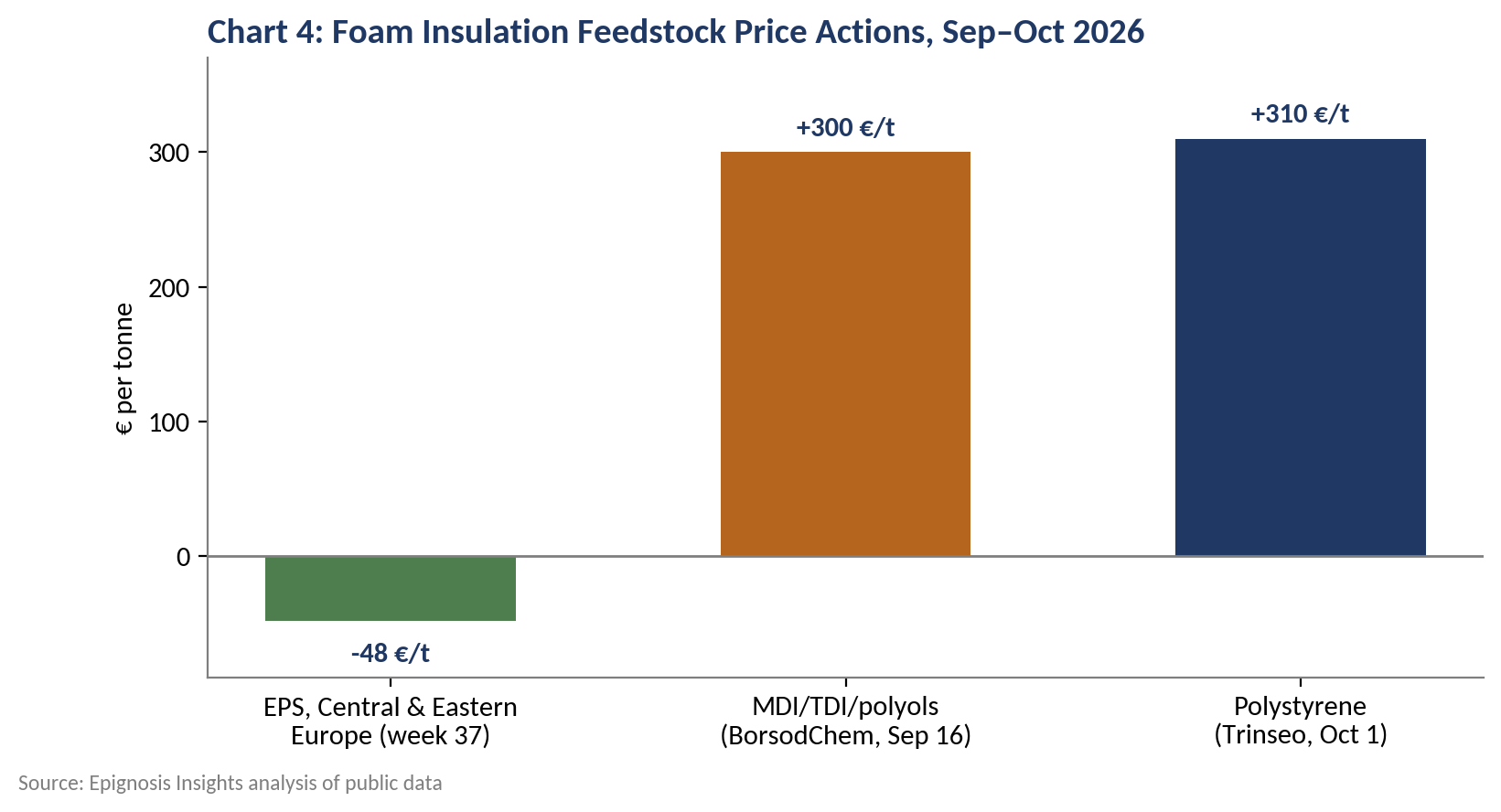
PIR and PUR boards face a different but equally difficult cost picture. Polymeric MDI prices in Europe have risen by 43% since February 2026, with the second-quarter average about 30% above the first quarter, as the Iran conflict and disruption to traffic through the Strait of Hormuz tightened supply (PricePedia). The pressure has not eased: BorsodChem announced a further €300/t increase across its European MDI, TDI and polyol portfolio from September 16, citing higher raw material and energy costs (Prismane Consulting). With MDI already near cycle highs, Epignosis Insights expects PIR board prices to stay firm at elevated levels, rising a further 3% to 6% in Q4.
The foam increases have an important side effect for material choice. Through 2024 and 2025, cheap petrochemical feedstocks kept EPS and PIR boards at a clear price discount to mineral wool in many applications. That discount is now narrowing quickly. In Epignosis Insights' view, this favours stone wool in flat roofs, facades and other uses where non-combustibility already carries a premium, and it raises the risk of margin pressure for foam board converters that cannot pass through the full October feedstock increase to builders operating on fixed-price contracts.
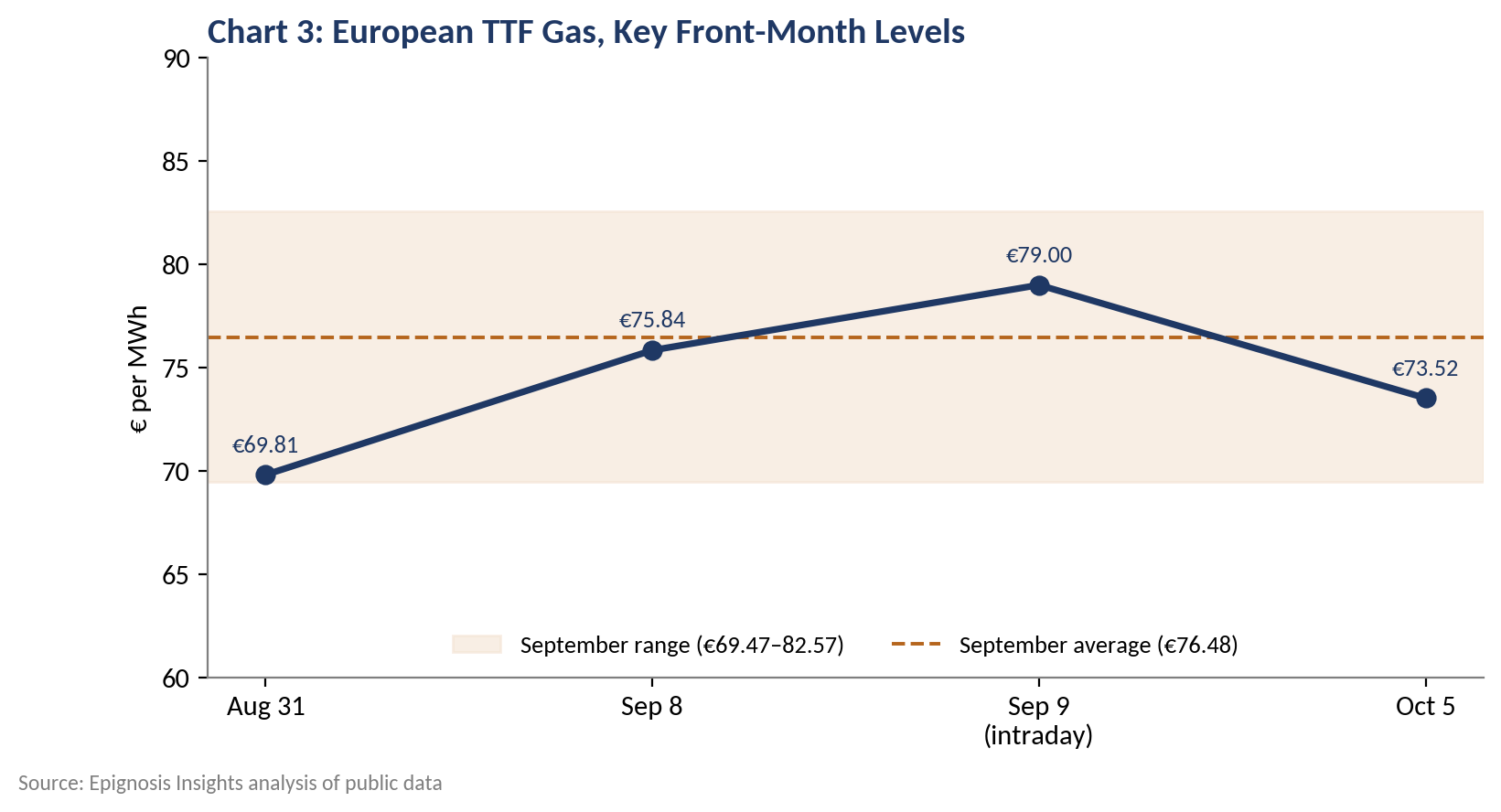
Energy is the single largest swing factor for insulation producers, particularly for mineral wool furnaces. European gas averaged €76.48/MWh in September, within a range of €69.47 to €82.57 (Cbonds). The front-month TTF contract climbed from €69.81/MWh on August 31 to €79.00/MWh intraday on September 9, its highest level since early 2023, as Middle East tensions intensified (AleaSoft Energy Forecasting). Chart 3 traces the move.
Forward expectations offer little relief. Goldman Sachs now expects European gas to average around €70/MWh through winter 2026–27, up sharply from its earlier range of €30–60/MWh (Goldman Sachs). For producers without full hedges, this means energy costs in the first half of 2027 will remain well above last year's levels. Epignosis Insights expects energy-linked surcharges or a third round of list increases in early 2027 if gas stays above €70/MWh.
The energy exposure differs sharply by material. Stone and glass wool are melted in gas- or electricity-fired furnaces, so their costs track TTF and power prices directly. EPS, XPS and PIR depend more on oil-linked chemical feedstocks, and their energy exposure arrives indirectly through styrene and MDI production costs. Wood fibre and other bio-based products use less process energy, which is why Epignosis Insights expects them to remain the most price-stable category through the winter.
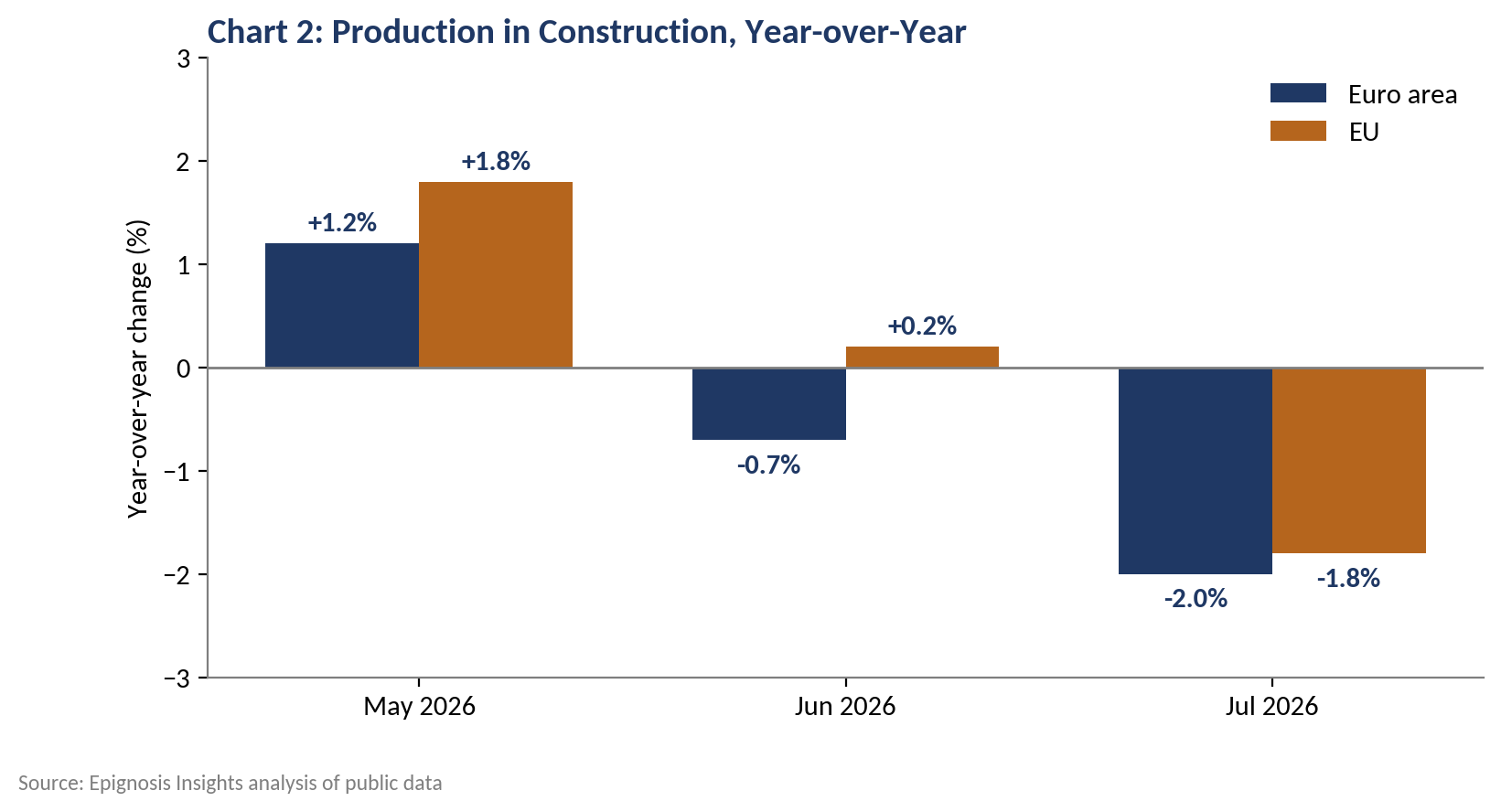
Demand remains the weak link. Seasonally adjusted construction output in the euro area was unchanged in July from June but 2.0% lower than a year earlier, with building construction down 6.4% year-on-year; the EU as a whole was 1.8% lower, with the largest annual falls in Hungary, Spain and France (Eurostat). Chart 2 shows the deterioration since May.
The UK picture is similar. The Construction Products Association downgraded its forecast for total construction activity to a 3.3% fall in 2026, citing the lagged impact of the Middle East conflict on both demand and costs, with private housing hit hardest as higher mortgage rates weaken homebuyer demand (Construction Products Association).
Policy provides the main medium-term support. EU member states were required to transpose the revised Energy Performance of Buildings Directive by May 29, 2026, and must submit final national building renovation plans by December 31, 2026 (European Commission). Implementation now matters more than legislation, as the success of the directive depends on effective transposition at national level (Buildings Performance Institute Europe). Epignosis Insights expects renovation demand to provide a floor for insulation volumes from 2027, but not enough to offset weak new-build activity in the current quarter.
The regional picture matters for procurement. Markets with the steepest construction declines, notably Spain, France and Hungary, are where distributors hold the most stock and buyers have the most leverage to resist price notices. Markets where activity is still growing, including Finland and parts of Central Europe, are likely to see increases pass through faster. Epignosis Insights therefore expects realised price increases in Q4 to vary by several percentage points across countries, even where list price announcements are pan-European.
Despite the weak market, the two largest listed insulation producers reported growth in the first half. Rockwool recorded record second-quarter revenue of €1,000 million, up 10%, and first-half revenue of €1,906 million, up 6% in local currencies, with volume gains supported by narrowing price gaps with competing insulation materials. Kingspan reported first-half revenue of €4.86 billion, up 8%, and trading profit of €487.2 million, up 10%, with insulated panel order intake 13% higher by volume and management stating that cost inflation had been largely recovered through pricing (Kingspan). Chart 5 compares the results.
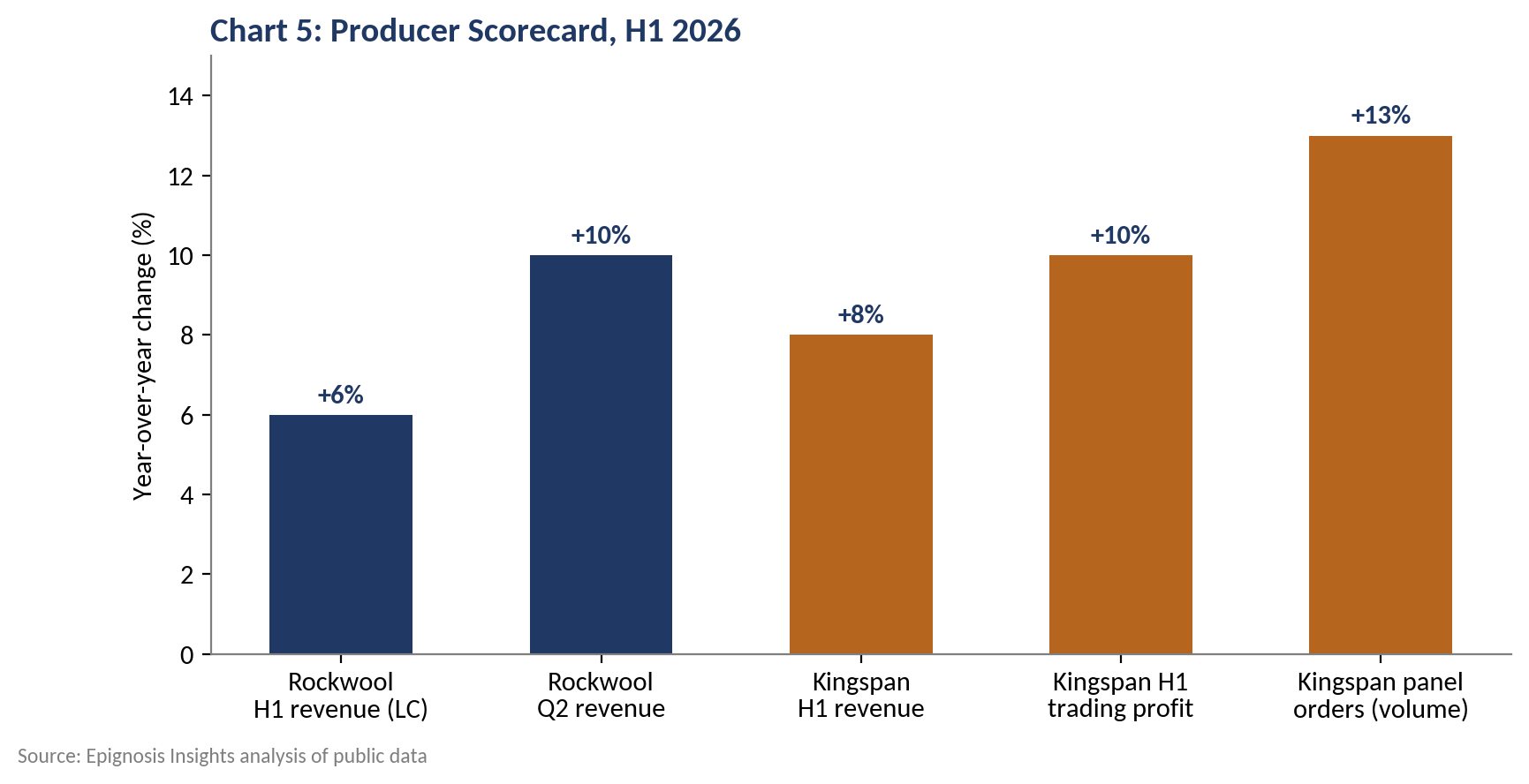
The results confirm that leading producers can still pass through cost increases, but margins are under pressure where pricing lags. Epignosis Insights notes that both companies flagged continuing inflation in chemicals, energy and transport for the second half, which supports the view that list prices will keep rising into 2027. The driver map below summarises how these cost and demand forces interact by material.
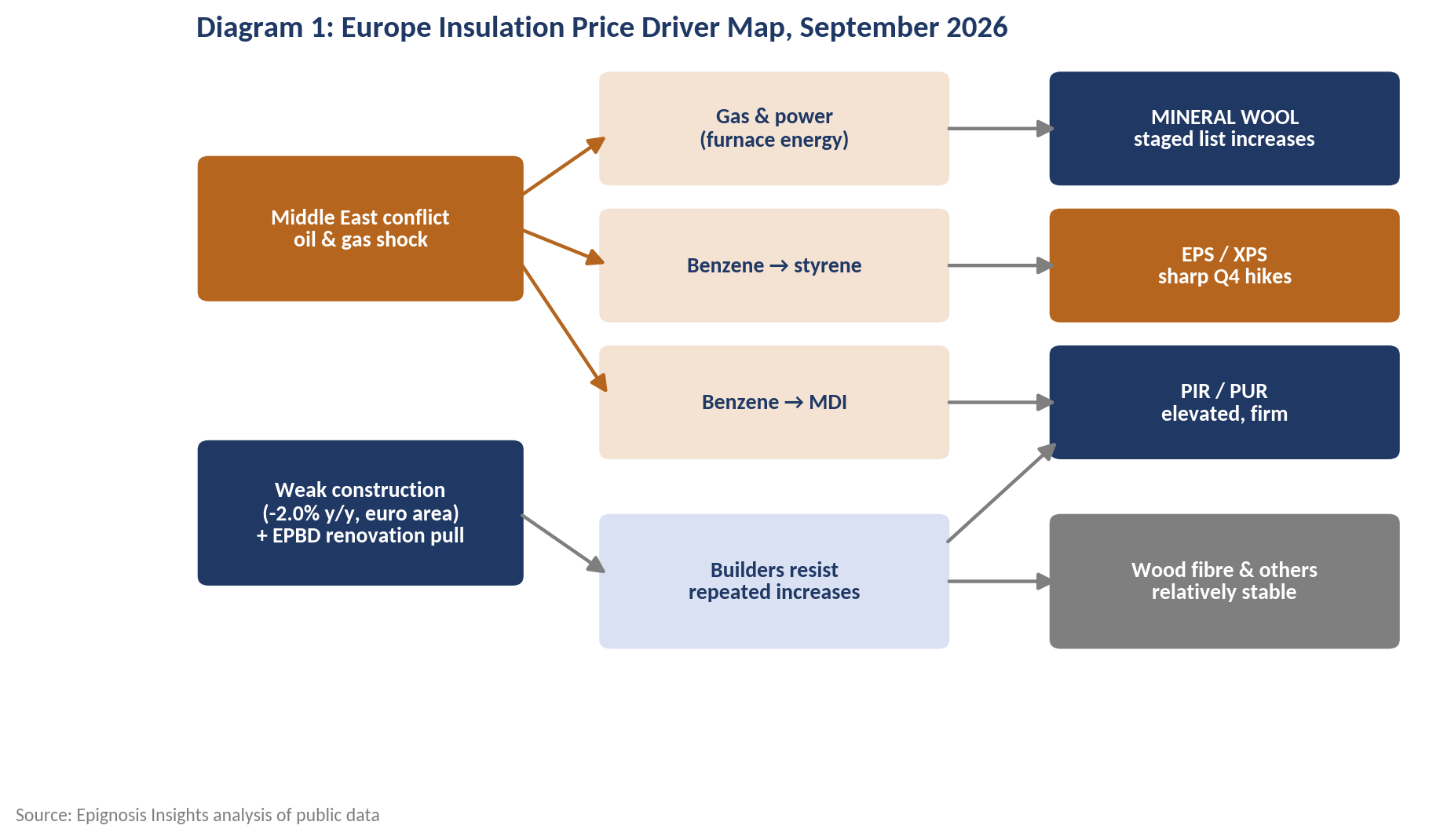
Epignosis Insights' base case for Q4 2026 is a further broad-based increase in European insulation prices, led by plastic foams. EPS boards are expected to rise 8% to 12% quarter-on-quarter as the October styrene spike passes through, XPS 5% to 8%, and PIR and PUR 3% to 6%. Stone wool and glass wool are expected to rise 3% to 5% as the July increases complete their pass-through, while wood fibre and other bio-based materials should remain broadly stable. Chart 6 summarises the outlook.
Two risks could shift this view. A de-escalation in the Middle East that restores energy and feedstock flows would pull styrene and gas prices lower and cap the foam increases. Conversely, weak demand could limit how much of the cost increase builders accept, compressing producer margins rather than raising prices. Epignosis Insights will track four signposts: the November styrene contract, weekly TTF settlements, board producers' price notices, and national renovation plans due by year-end.
Looking into 2027, Epignosis Insights expects the balance to shift gradually from costs to demand. If gas eases toward the €50–60/MWh range and feedstock markets normalise, price momentum should slow in the first half of the year. At the same time, national renovation plans and the seasonal recovery in building activity should support volumes from the spring. The most likely outcome is a plateau in insulation prices at the elevated levels reached in Q4 2026 rather than a meaningful decline.
Buyers should expect EPS and XPS increases in October and November and secure Q4 volumes before notices take effect where contract terms allow. Specifiers comparing materials should note that the price gap between foam boards and stone wool is narrowing, which may favour mineral wool on cost as well as fire performance. Contractors with fixed-price projects should build in cost escalation clauses for 2027. For producers, the priority is speed of pass-through: foam board makers must move quickly to recover the October feedstock spike, while mineral wool producers should prepare for higher energy costs once current hedges expire.