Global Manganese Sulphate Price Tracker
Monthly Edition — September 2026


Monthly Edition — September 2026
The Global Manganese Sulphate Market entered September 2026 in a phase of consolidation after an eight-month rally that lifted battery-grade prices by more than 20% from their January base. According to Epignosis Insights' monthly price assessment, battery-grade manganese sulphate (Mn ≥32%, ex-works China, VAT inclusive) averaged an estimated CNY 7,650 per tonne in September, approximately USD 1,117 per tonne, down 1.3% month-on-month from August's level of around CNY 7,750 but still 21% higher year-to-date. The softening reflects easing cost pressure from manganese ore, where major miners lowered their October offers to China, combined with cautious spot purchasing by cathode precursor producers ahead of the fourth-quarter long-term contract season.
Demand fundamentals remain constructive. China's new energy vehicle (NEV) sector posted double-digit growth in August and a record penetration rate, while cost support from sulphuric acid remains elevated. Epignosis Insights therefore characterises the September market as soft-to-stable rather than the start of a sustained downturn, with a base-case price range of CNY 7,300–7,900 per tonne for the fourth quarter of 2026.
| Indicator | Aug 2026 | Sep 2026 (E) | M/M Change | Trend Signal |
| Battery-grade MnSO₄, CNY/t | 7,750 | 7,650 | -1.3% | Soft / stable |
| Battery-grade MnSO₄, ≈USD/t | 1,131 | 1,117 | -1.3% | Soft / stable |
| Change vs Jan 2026 | +23.0% | +21.4% | - | Up-cycle intact |
| 3-month change | +6.2% | +4.8% | - | Positive |
| Producer margin (est.) | ~15–17% | ~13–15% | Narrowing | Watch |
| Epignosis monthly signal | Firm | Neutral | Downgrade | - |
Table 1 — Epignosis Insights monthly composite assessment; September figure is an Epignosis estimate; USD conversion at approximately CNY 6.85/USD.
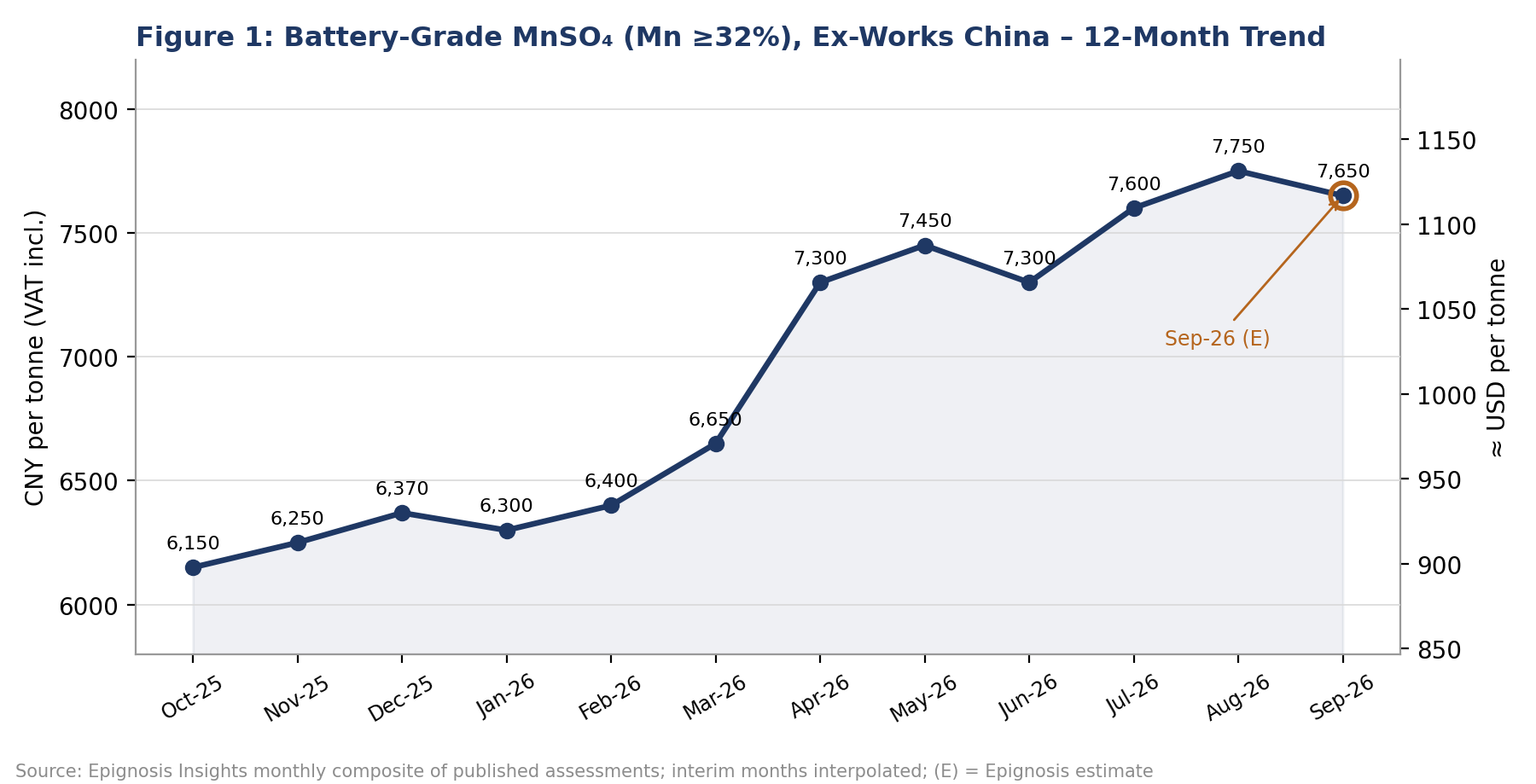
Figure 1 traces the 12-month trajectory. Prices were largely flat between October 2025 and February 2026, holding in a CNY 6,150–6,400 band, before breaking higher in March and accelerating sharply in April. Weekly assessments published by Mysteel [1] captured this move clearly: battery-grade material was offered at CNY 6,300 per tonne through January, rose to CNY 6,500 in early March and CNY 6,700 by mid-March, and reached CNY 7,500 per tonne by 22 April. Since then, the market has traded in a relatively narrow CNY 7,300–7,750 range, indicating that the step-change in price level driven by costs has largely been absorbed by downstream buyers.
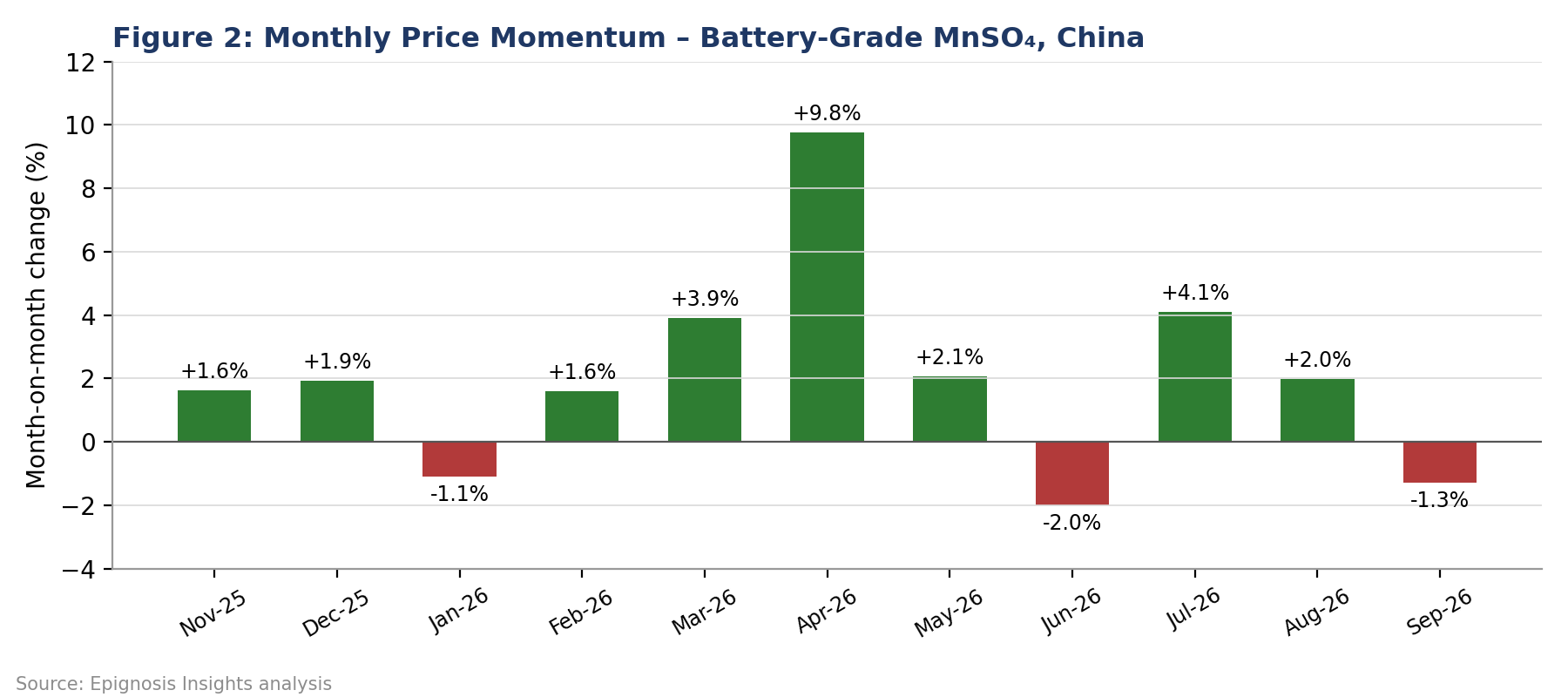
Month-on-month momentum shows that the rally was not linear. April stands out with an estimated gain of nearly 10%, driven by a surge in sulphuric acid and ore costs combined with front-loaded buying from battery exporters. Commentary from Shanghai Metals Market (SMM) [2] noted that battery-grade material entered its demand off-season in May and June with only mild downward corrections, as preferential export tax rebate policies for ternary batteries earlier in the half-year had pulled forward orders and kept plants running at full capacity. Prices rebounded in early July when sulphuric acid rose again, and the same source reported that in September three major miners, South32, CML and Comilog, lowered their October manganese ore offers to China amid high port stocks and weak alloy demand. September's decline is therefore the first cost-led easing since June and is modest in scale.
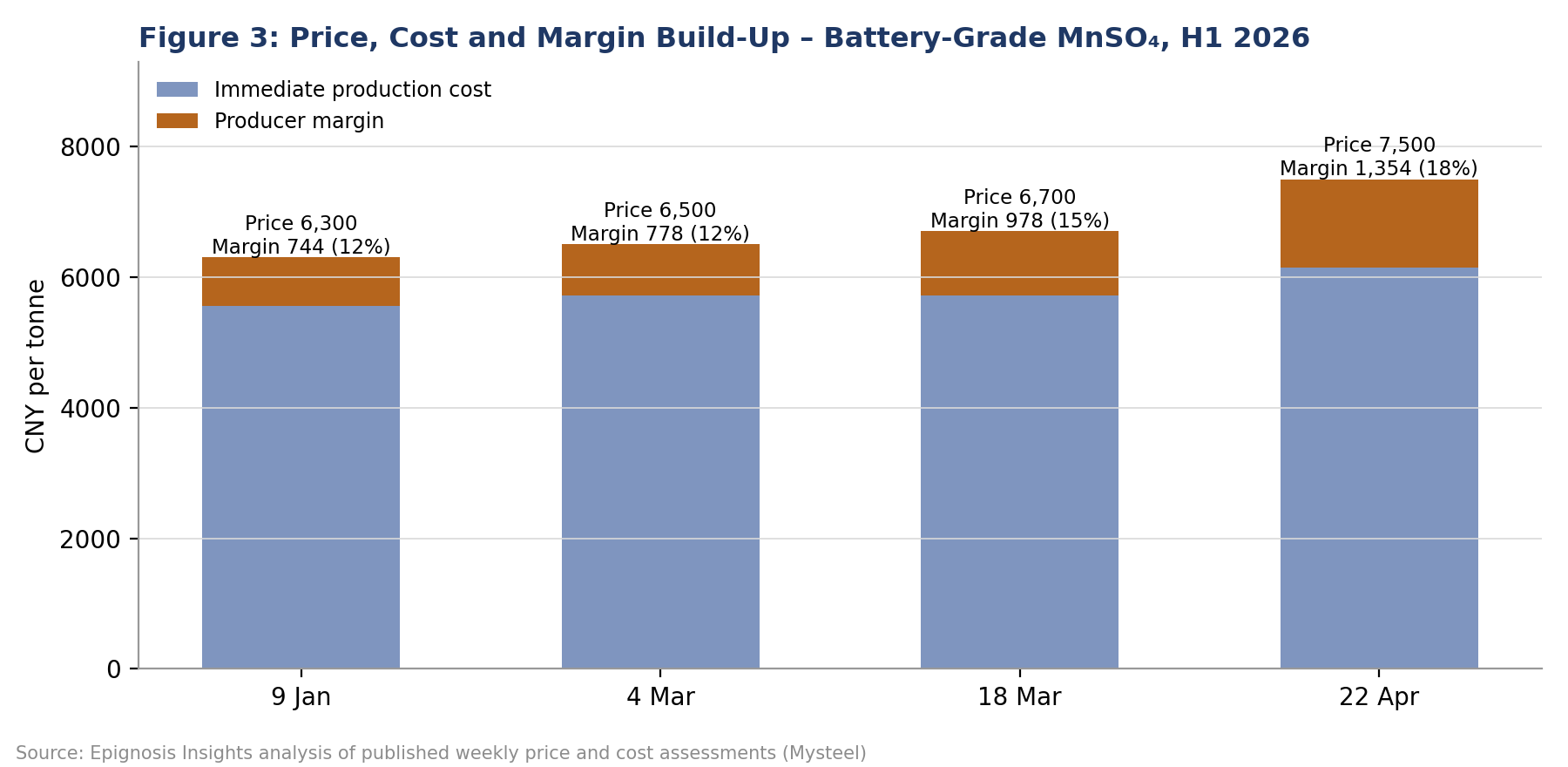
Manganese sulphate pricing in 2026 has been overwhelmingly cost-driven. Epignosis Insights' analysis of published price and cost data shows that immediate production cost rose from roughly CNY 5,556 per tonne in January to CNY 6,146 per tonne by late April, an increase of about 11%, as sulphuric acid prices climbed to multi-year highs and imported ore remained firm. Crucially, producers passed through more than the cost increase: estimated margins widened from about 12% of the selling price in January to about 18% in April, reflecting strong pricing discipline in a concentrated Chinese supply base. By September, Epignosis Insights estimates margins have narrowed to around 13–15% as spot prices eased faster than costs. This margin cushion is important because it suggests producers can tolerate modest further price declines without triggering the production cuts that would normally put a floor under the market.
Steel-sector pricing offers a useful parallel read on manganese costs. HBIS Group's [3] September 2026 silicomanganese tender price of CNY 6,050 per tonne was up from CNY 5,880 in August, signalling that metallurgical manganese demand has stabilised at low levels even as alloy producers report losses. This matters for sulphate producers because ore allocation between the steel and chemical sectors influences the availability and cost of feedstock.
Regional price perspective also matters for buyers outside China. Imported battery-grade material into Europe, North America, Japan and Korea typically carries freight, insurance, qualification and duty costs on top of Chinese ex-works levels, and Epignosis Insights estimates that landed costs for qualified material are generally 10–20% above domestic Chinese prices, with wider spreads for buyers requiring non-Chinese origin.
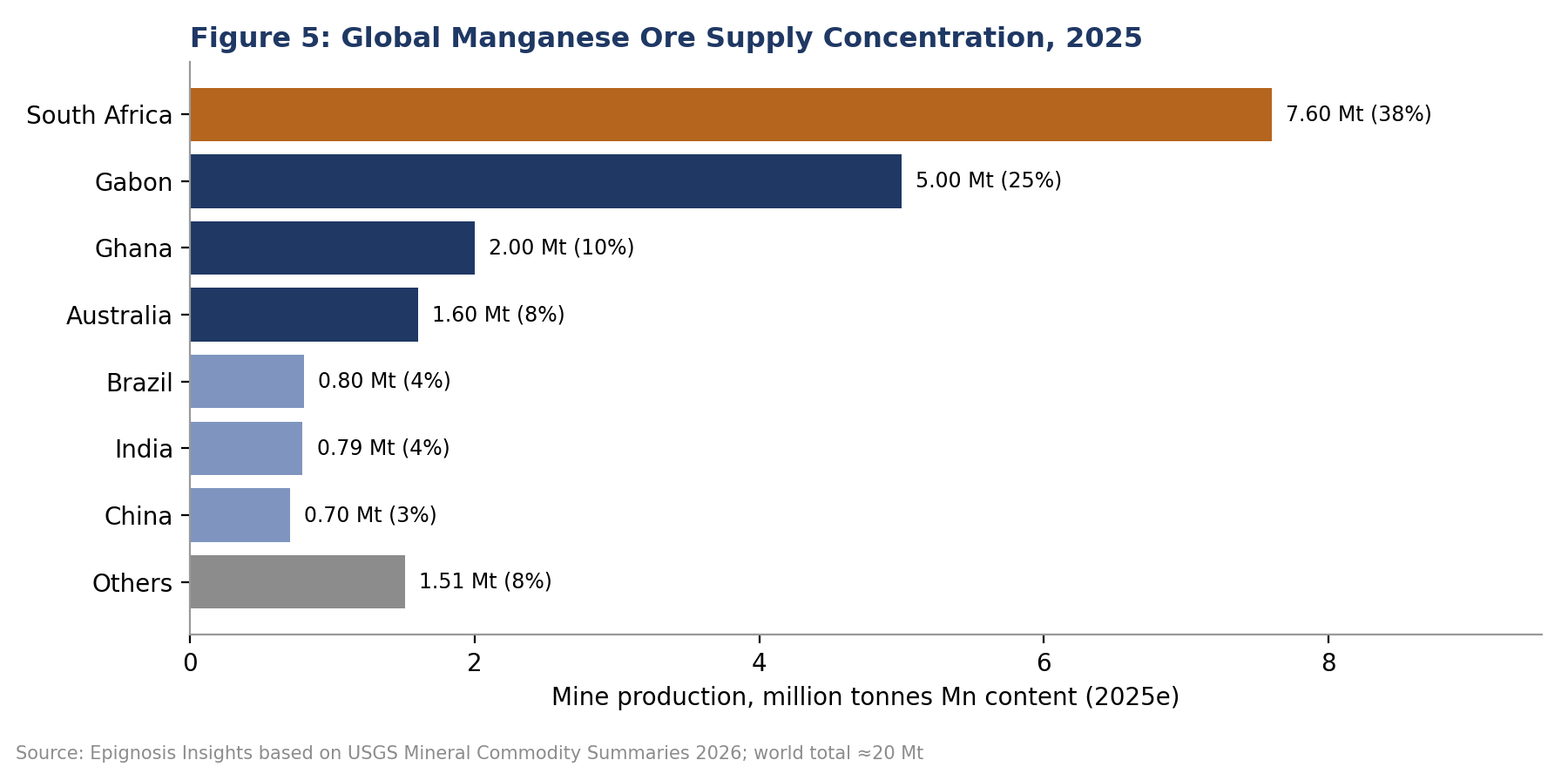
Manganese sulphate is produced mainly by leaching manganese ore with sulphuric acid, and Fastmarkets [4] estimates that around 90% of global sulphate output is ore-derived, making ore availability the primary structural supply variable. The U.S. Geological Survey's Mineral Commodity Summaries 2026 [5] estimates world mine production at approximately 20 million tonnes of manganese content in 2025, with South Africa alone contributing 7.6 million tonnes, or roughly 38%, followed by Gabon at 5.0 million tonnes and Ghana at 2.0 million tonnes. China, which dominates sulphate refining, produced only around 0.7 million tonnes domestically, leaving it heavily dependent on seaborne imports.
Major ore producers delivered solid output through mid-2026. South32 [6] reported that its Australian and South African manganese operations exceeded FY26 production guidance by 1% and 4% respectively, following the recovery of Australia Manganese from earlier weather-related disruptions, with Australian output reaching around 3.03 million wet metric tonnes. Strong producer volumes, combined with elevated Chinese port inventories, explain why ore suppliers are now more willing to trim offers, which in turn reduces the cost floor for sulphate refiners.
Outside China, policy is driving new investment in high-purity manganese sulphate monohydrate (HPMSM). The European Commission's Critical Raw Materials Act [7] classifies battery-grade high-purity manganese as a strategic raw material, while CRU Group [8] notes that ex-China HPMSM projects are motivated primarily by supply-chain de-risking rather than any physical shortage, and that their success depends on whether automakers will pay a premium for geographically diversified material. Epignosis Insights expects this regional premium to become an increasingly visible feature of contract pricing in Europe and North America from 2027 onwards.
Demand-Side Analysis
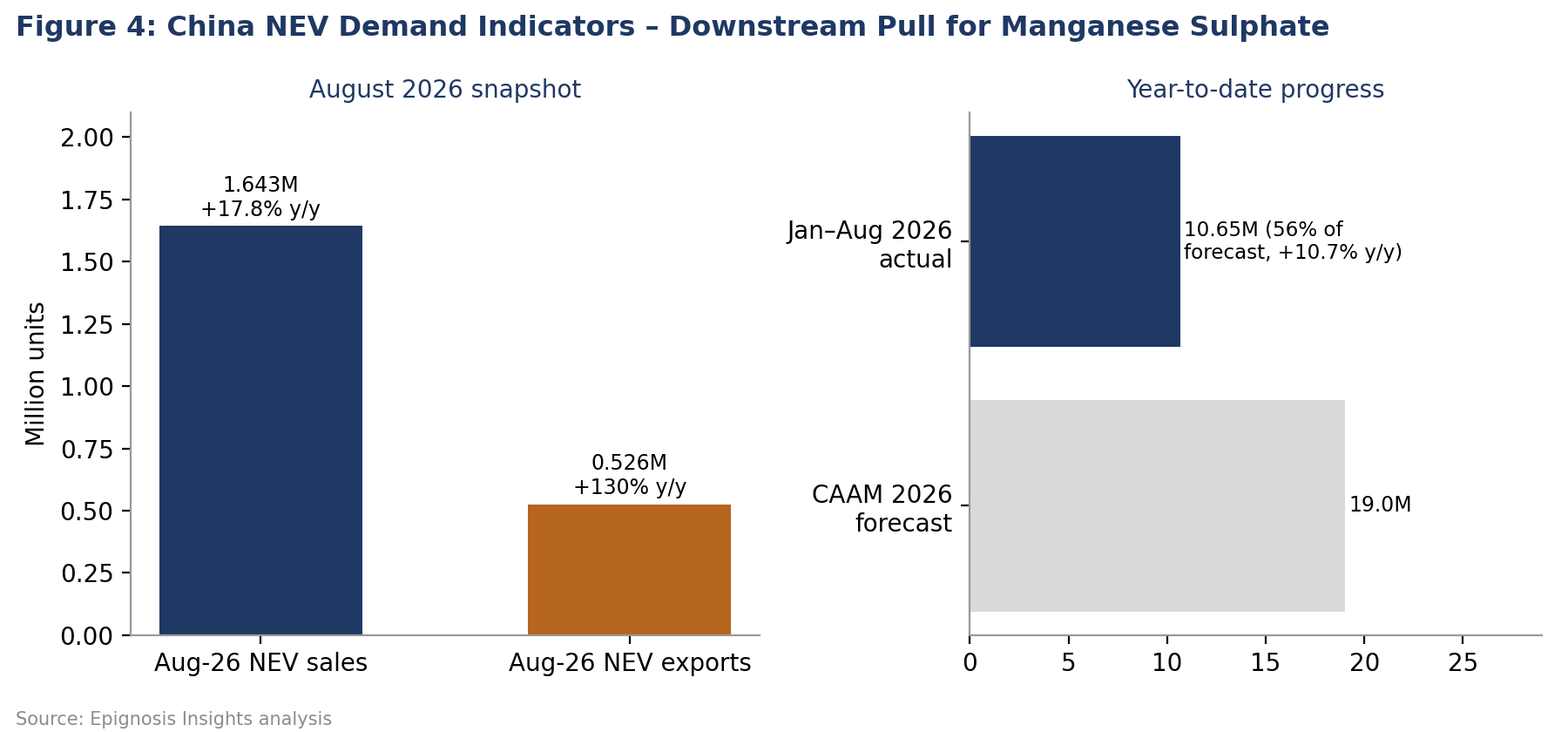
Battery demand remains the growth engine for manganese sulphate, particularly through nickel-cobalt-manganese (NCM) and lithium-manganese-iron-phosphate (LMFP) cathodes. The China Association of Automobile Manufacturers [9] reported that NEV sales reached 1.643 million units in August 2026, up 17.8% year-on-year, bringing January–August sales to 10.65 million units, up 10.7% and equal to about 56% of the association's full-year forecast of 19 million units. NEV exports were particularly strong at 526,000 units in August, more than double the prior-year level. The China Passenger Car Association [10] separately estimated August wholesale passenger NEV sales at 1.51 million units, up 16% year-on-year.
However, the domestic picture is more mixed. CnEVPost [11] reported that total domestic vehicle sales fell 24.2% year-on-year in August, the fifth consecutive month of declines exceeding 20%, even as NEVs reached a record 60.6% share of total vehicle sales. For manganese sulphate, this means demand growth is increasingly reliant on exports and on the chemistry mix within batteries. Precursor producers are sourcing primarily through long-term contracts, which limits spot liquidity and explains why spot prices react quickly to cost signals rather than to volume data.
Chemistry mix is an equally important variable. LMFP cathodes contain materially more manganese per kilowatt-hour than mid-nickel NCM chemistries, so every percentage point of market share that LMFP gains in passenger vehicles and energy storage systems adds disproportionately to sulphate demand. Epignosis Insights views the pace of LMFP adoption during 2026–2028 as the single largest swing factor for battery-grade consumption, outweighing headline EV growth. Energy storage is also emerging as a secondary demand channel, although lithium-iron-phosphate chemistries without manganese still dominate that segment.
Agricultural and feed-grade manganese sulphate, which accounts for a large share of total volume, remains stable. Epignosis Insights observes that the price differential between battery and industrial grades has been broadly constant during 2026, as both grades share the same ore and acid cost base.
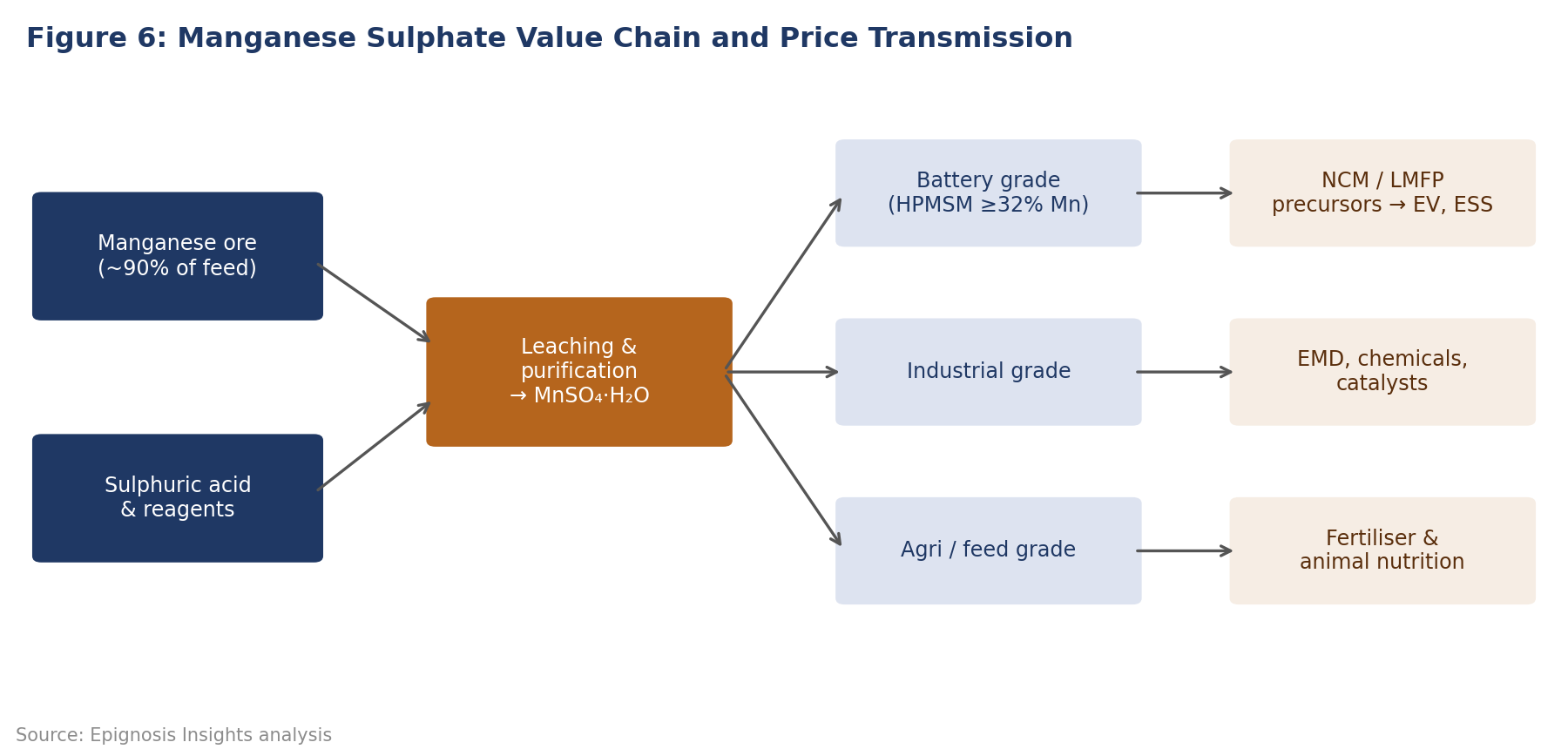
Figure 6 illustrates how costs move through the value chain. Changes in ore and sulphuric acid prices feed into refining costs within four to six weeks, while downstream pass-through to precursor and cathode producers occurs largely at quarterly or annual contract resets. This timing gap is why the fourth-quarter contract negotiation season, now beginning, is a critical period for price discovery.
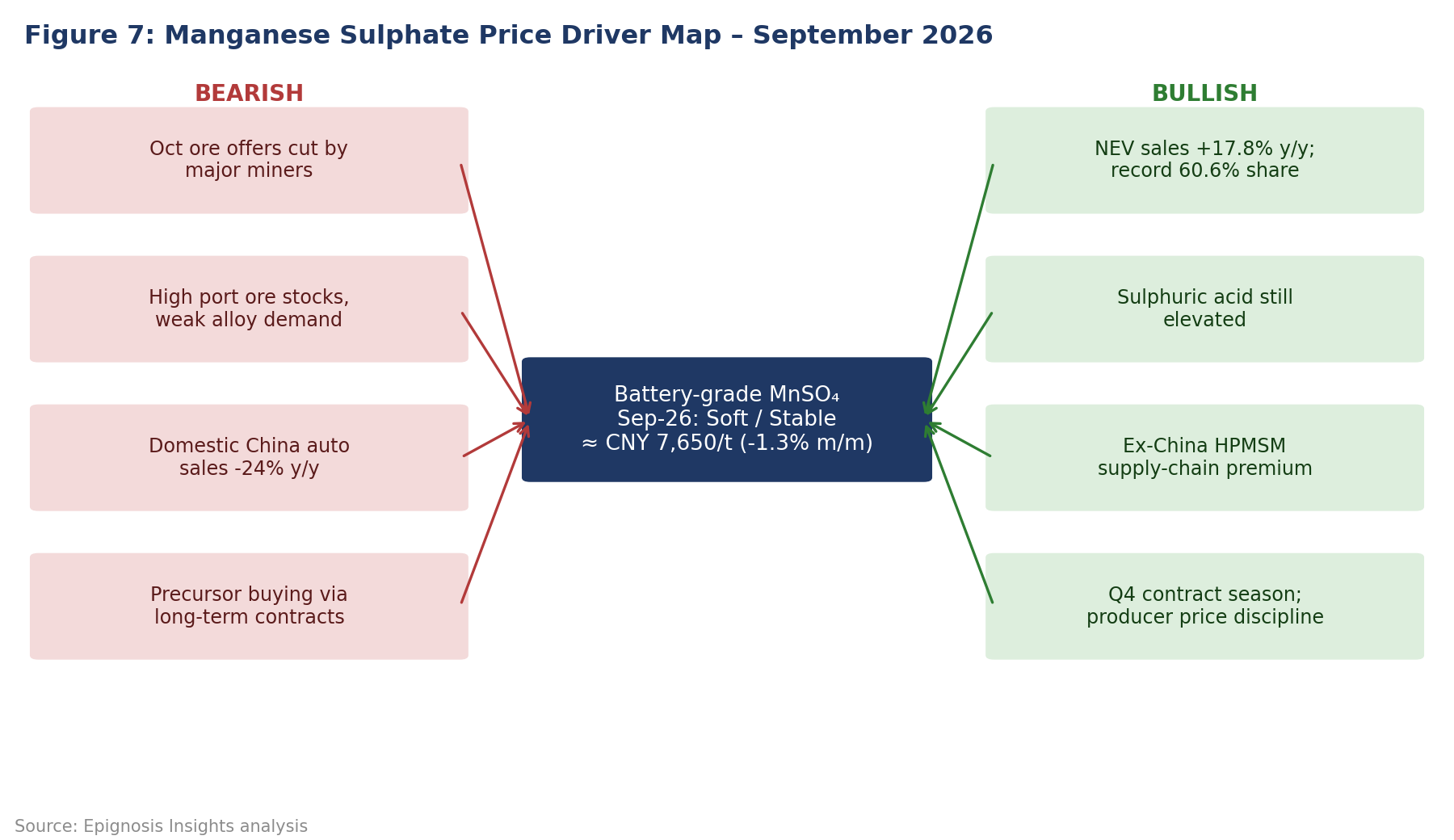
Epignosis Insights' driver map shows a finely balanced market. Bearish factors are concentrated on the cost side and in spot liquidity: lower ore offers, high port stocks and cautious contract-based buying. Bullish factors are linked to structural demand and policy: record NEV penetration, still-elevated acid prices, the emerging ex-China premium and producer price discipline during contract talks.
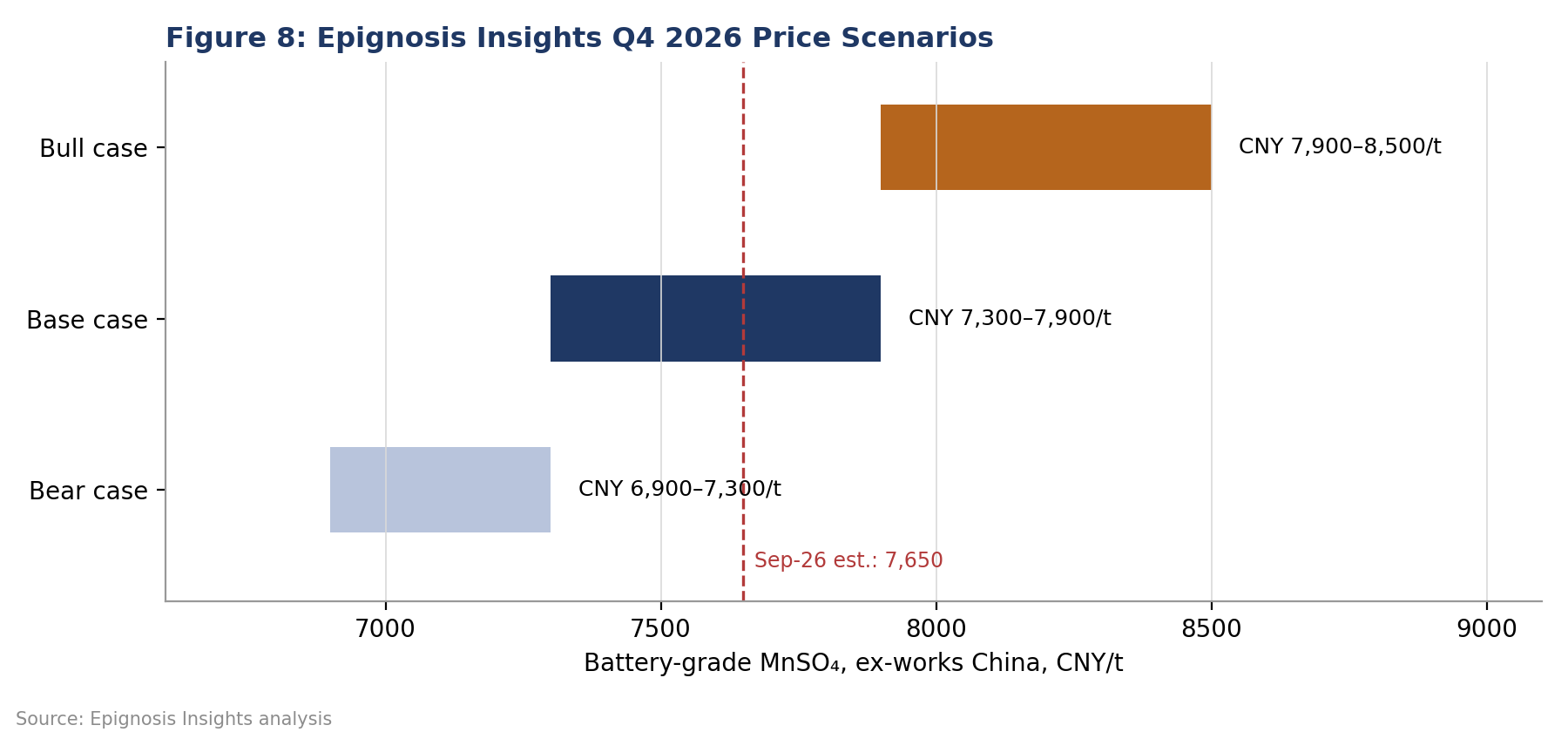
Epignosis Insights' base case for the fourth quarter of 2026 is a range of CNY 7,300–7,900 per tonne, assuming ore prices ease moderately, acid remains firm and contract volumes are signed close to current spot levels. The bear case (CNY 6,900–7,300) would require a further sharp drop in ore offers, a correction in sulphuric acid and weaker NEV exports. The bull case (CNY 7,900–8,500) would follow a renewed acid spike, supply disruptions in South Africa or Gabon, or stronger-than-expected precursor restocking ahead of the 2027 contract year. Key indicators to watch include October ore offers, Chinese sulphuric acid prices, CAAM's September NEV data and the outcome of year-end contract negotiations.
For cathode precursor producers and battery manufacturers, Epignosis Insights recommends locking a portion of 2027 requirements during the current softer spot window, while retaining flexibility through index-linked contract structures. Buyers outside China should begin evaluating the cost of regional-content premiums against the policy benefits of diversified supply.