Global Rare Earth Elements
Monthly Pricing Tracker Report


Monthly Pricing Tracker Report
The Global Rare Earth Elements (REE) Market entered September 2026 in a state of cautious equilibrium after a volatile first eight months of the year. Shanghai Metals Market (SMM) benchmark data places the neodymium-praseodymium (NdPr) oxide price — the sector's most closely watched indicator — at approximately $96.69 per kilogram as of 5 September 2026, down a modest 0.73% from August and now running below the $110/kg price-floor benchmark associated with the U.S. Department of Defense's offtake arrangement with MP Materials for a second consecutive month. Independent tracking from Rare Earth Mining's September 2026 market outlook describes the broader tracked basket as "near-flat," with an average change of +0.31% and a median of +0.22%, a marked contrast to the unanimous rally seen in July and the broad pullback recorded in August.
Beneath this surface calm, however, the market remains structurally divided along two fault lines. First, light rare earths (lanthanum, cerium, neodymium, praseodymium) continue to track a materially different trajectory from heavy rare earths (dysprosium, terbium, yttrium), the latter still carrying the scarcity premium created by China's Announcement 18 licensing regime of April 2025. Second, and closely related, a persistent price bifurcation separates China-domestic quotes from ex-China spot prices for the four elements under direct export licensing control — dysprosium, terbium, samarium and yttrium — with ex-China buyers in some cases paying three to five times the domestic Chinese reference price. This report, compiled by Epignosis Insights, sets out the September 2026 pricing snapshot, the month-on-month and year-to-date trend context, the supply- and demand-side forces at work, and the near-term outlook heading into China's 10 November 2026 export-control review date.
The table below summarizes China-domestic benchmark pricing for the seven most actively traded rare earth products, compiled primarily from Shanghai Metals Market (SMM) assessments and cross-checked against the U.S. Geological Survey's 2026 Mineral Commodity Summaries for long-run reference values.
| Element / Product | China Domestic (USD/kg) | M-o-M Change | YTD Change (2026) | Primary Driver |
| Neodymium oxide (Nd2O3) | $94.50 | ▲ 0.9% | ▲ ~64% | Magnet feedstock demand |
| Praseodymium metal | $133.58 | ▲ 0.07% | ▲ ~7% (since Apr) | NdFeB alloy production |
| Neodymium metal | $125.68 | ▲ 0.07% | ▲ ~136% (YTD open) | EV traction motor demand |
| NdPr oxide (benchmark) | $96.69 | ▼ 0.7% | ▲ ~67% | Below DoD $110/kg floor |
| Dysprosium metal | $235.57 | ▲ 0.07% | ▲ ~64% | Heavy-magnet, defense use |
| Terbium metal | $1,090.98 | ▲ 0.07% | ▲ ~105% | Export-licensing scarcity |
| Yttrium metal | $34.87 | ▲ 0.06% | n/a | Phosphors, ceramics |
Table 1: China domestic rare earth price snapshot, week of 14 September 2026. Compiled by Epignosis Insights from Shanghai Metals Market (SMM) benchmark data.
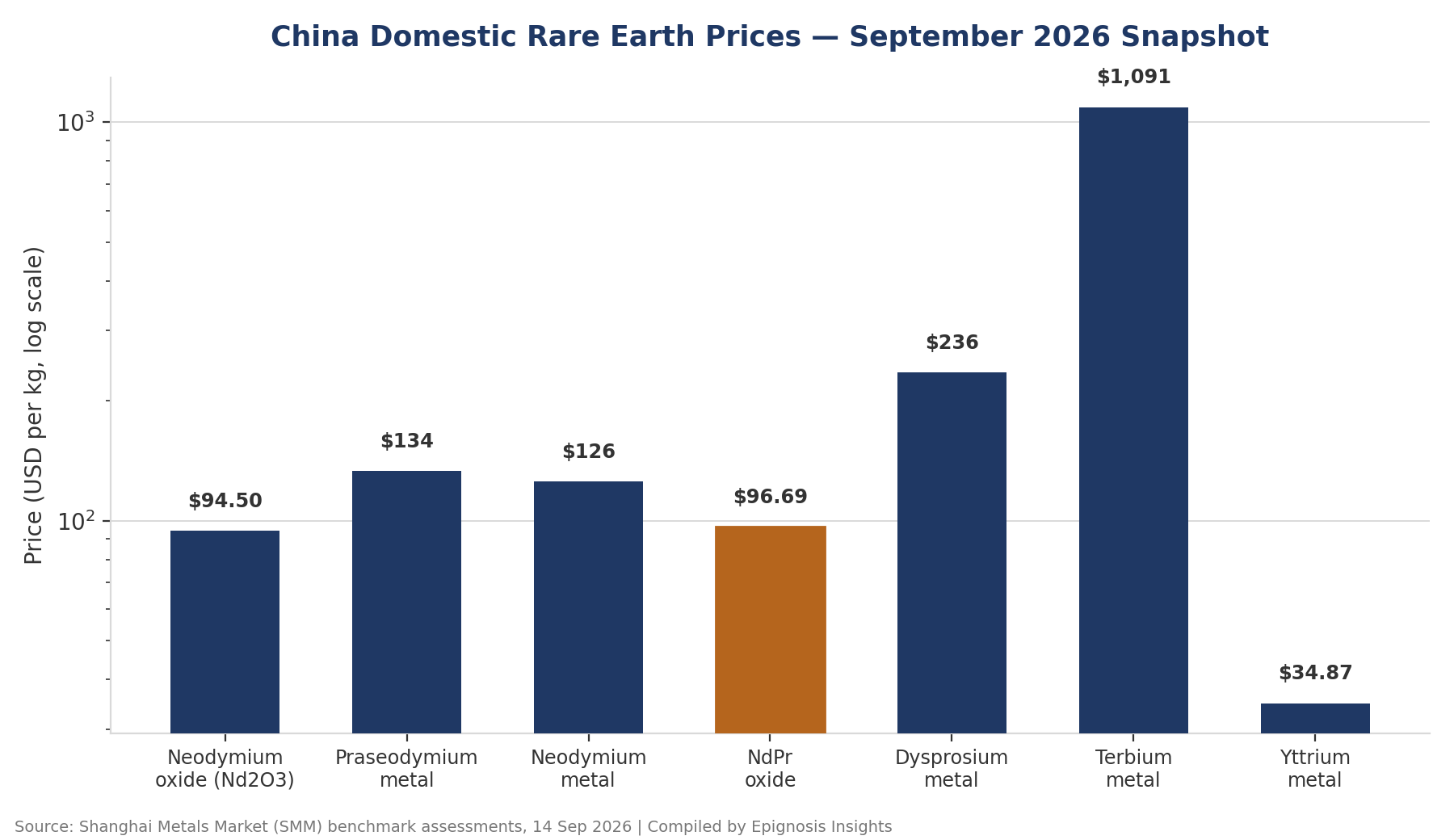
Figure 1: China domestic rare earth prices, September 2026 snapshot (log scale). Source: Shanghai Metals Market (SMM), compiled by Epignosis Insights.
Terbium metal remains the standout outlier on an absolute-price basis at just over $1,090/kg, more than eleven times the price of dysprosium metal and over thirty times that of praseodymium metal, reflecting its extremely constrained annual global production of only 700-800 tonnes, almost entirely sourced from Chinese ion-adsorption clay deposits. NdPr oxide, by contrast, functions as the market's benchmark pricing product precisely because it trades in far higher volumes and is used as the primary feedstock for NdFeB permanent magnets, the dominant magnet technology in EV traction motors and wind turbine generators.
NdPr oxide's 2026 trajectory illustrates the volatility that has characterized the sector this year. According to Critical Minerals News reporting on SMM benchmark data, the price opened the year at an estimated $53/kg in early January before climbing steadily through the first half of the year on the back of stronger EV magnet demand, Chinese supply-side production quotas, and the market's reaction to the April 2025 export-licensing restrictions on rare earth processing technology. The price crossed the $110/kg DoD floor in May, peaked above $120/kg in July, and then reversed sharply in August, settling into the current $96-97/kg range through early September. This pattern — a sharp rally through the first seven months followed by a two-month correction — has left neodymium metal up approximately 136% from its January opening level even after the recent pullback, according to SMM data referenced by Critical Minerals News.
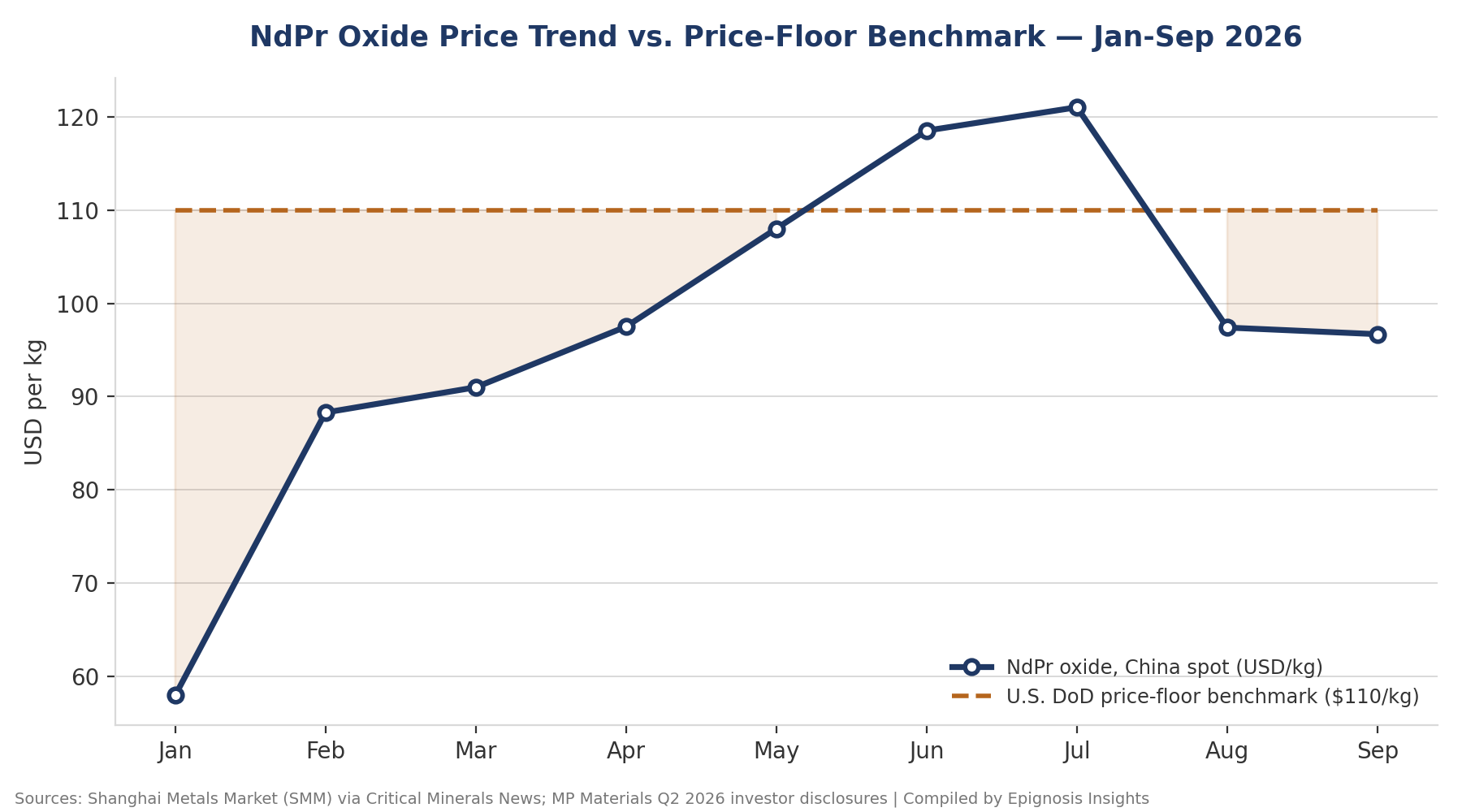
Figure 2: NdPr oxide price trend versus the U.S. DoD $110/kg price-floor benchmark, January-September 2026. Sources: Shanghai Metals Market via Critical Minerals News; MP Materials investor disclosures.
A complementary read on the trend comes from the China Rare Earth Industry Association's own Rare Earth Price Index, which tracks a weighted basket of 21 rare earth products and combination goods. Data distributed via SunSirs shows the index rising from a cyclical low of 153.3 in July 2024 to 217.00 at the end of December 2025, then surging a further 11.84% to 242.70 by 26 January 2026 — its highest level since March 2023 — before easing slightly to the mid-230s in February as heavy rare earth oxides corrected on relatively ample supply. As of early September 2026 the index sits close to its January peak, near 244, underscoring that the underlying structural tightness in the market has not materially eased even as individual product prices such as NdPr oxide have pulled back.
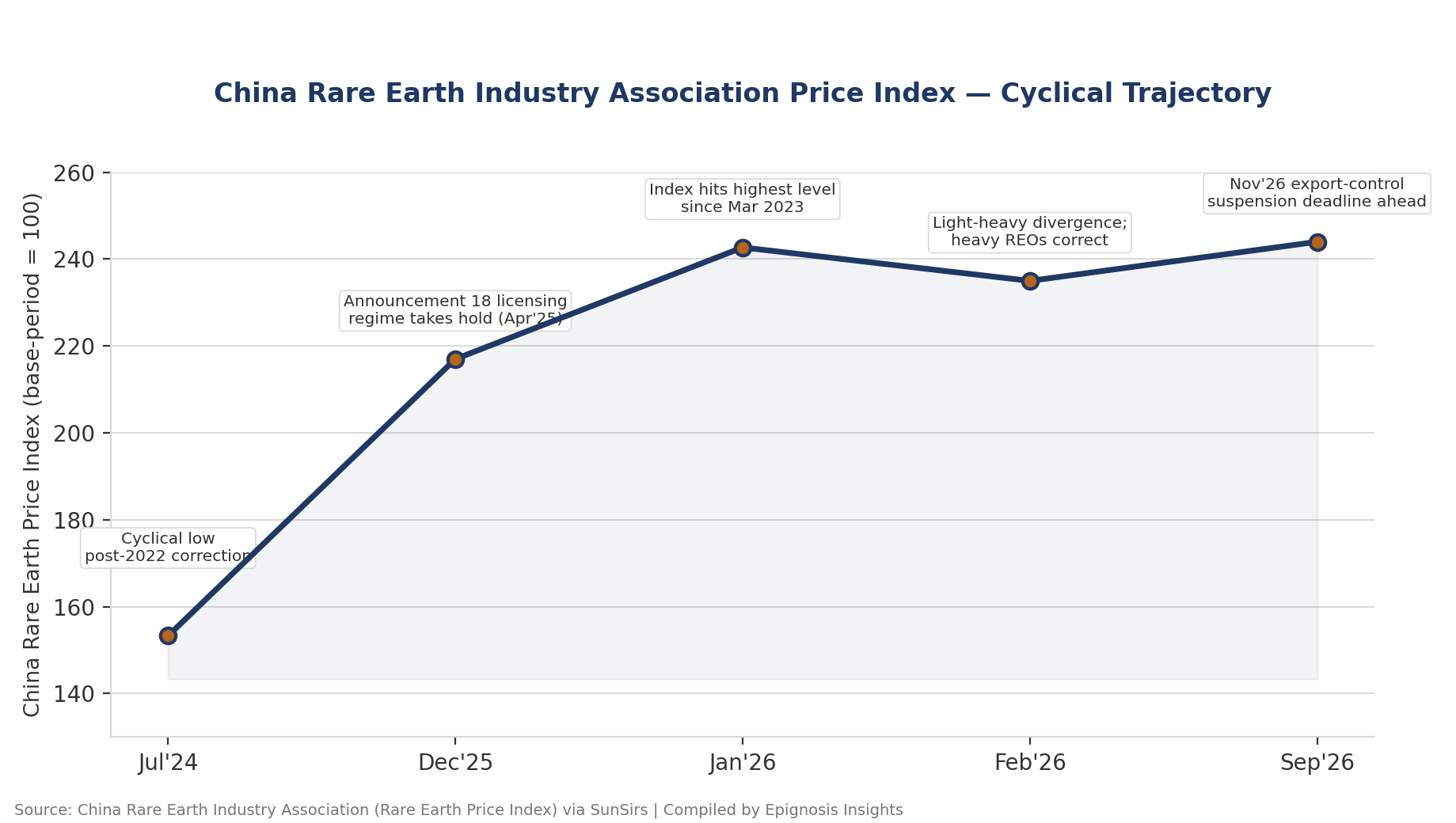
Figure 3: China Rare Earth Industry Association Price Index trajectory and key policy milestones, July 2024-September 2026. Source: China Rare Earth Industry Association via SunSirs. Compiled by Epignosis Insights.
The single most consequential structural development in the 2026 rare earth market has been the widening gap between China-domestic and ex-China prices for the four elements under direct export licensing control. China's Ministry of Commerce first imposed licensing requirements on dysprosium, terbium, samarium and yttrium in April 2025 under what industry trackers refer to as Announcement 18, explicitly targeting the elements considered most critical for defense, EV motor and clean-energy applications. Reuters reporting cited by The Oregon Group's critical-minerals analysis shows the resulting divergence starkly: yttrium oxide prices outside China rose roughly 140-fold since the controls took effect, while dysprosium and terbium oxide prices climbed four- to five-fold, with terbium oxide reaching approximately $4,500/kg ex-China by May 2026 against a much lower China-domestic reference. Benchmark Mineral Intelligence's coverage of the same phenomenon in July 2025 noted that light rare earth prices in China moved largely in step with North American prices — the delta explained mainly by shipping and handling costs — while Europe lagged, trading roughly 5% below Chinese PrNd levels, illustrating that the bifurcation is concentrated almost entirely in the licensed heavy rare earth category rather than across the market as a whole.
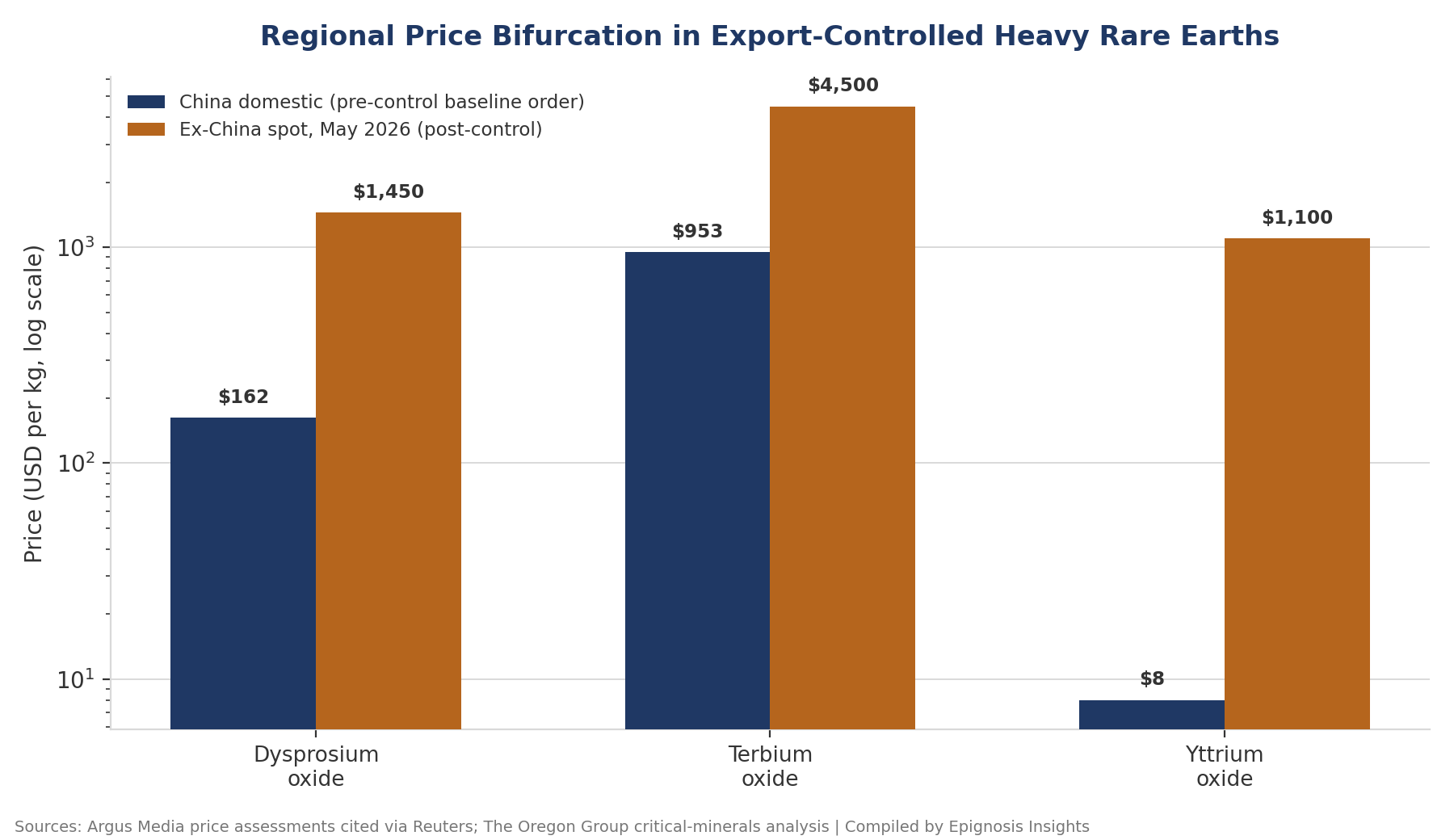
Figure 4: Regional price bifurcation in export-controlled heavy rare earth oxides. Sources: Argus Media price assessments cited via Reuters; The Oregon Group critical-minerals analysis. Compiled by Epignosis Insights.
China's broader export-control posture has continued to evolve through 2026. Beijing eased some restrictions in July 2025 following U.S. pushback, then introduced tougher new controls on dual-use rare earth items destined for Japan in early 2026, and separately delayed the implementation of a broader round of controls on medium and heavy rare earths, lithium batteries, and artificial graphite anode materials from 8 November 2025 to 10 November 2026. S&P Global Market Intelligence reporting notes that while China's aggregate rare earth export volumes have continued to grow — global exports of rare earth magnets rebounded to 5,952 metric tons in December 2025 — exports of the specific heavy rare earth compounds and metals subject to licensing have slowed disproportionately, with December 2025 volumes of less-processed rare earths running 15.8% below the 2025 monthly average. This selective tightening is the primary mechanism sustaining the regional price gap documented above, and the 10 November 2026 review date is the clearest near-term catalyst flagged across multiple trackers for renewed volatility.
On the supply side, the U.S. Geological Survey's Mineral Commodity Summaries 2026 reports that domestic U.S. production of rare-earth-oxide-equivalent mineral concentrates reached an estimated 51,000 tons in 2025, valued at $240 million, with bastnaesite mined as a primary product at Mountain Pass, California and monazite recovered from heavy-mineral-sand concentrates in the southeastern United States. The USGS data also shows a notable structural shift: U.S. imports of rare-earth compounds and metals rose 169% in 2025 even as their aggregate value declined to $165 million from $168 million in 2024, reflecting a pivot toward lower-value imported product categories as domestic processing capacity has expanded.
At the corporate level, MP Materials' second-quarter 2026 results, released 6 August 2026, provide the clearest publicly disclosed window into how the price-floor mechanism is functioning in practice. The company reported NdPr production of 840 metric tons for the quarter, up 41% year over year, and NdPr sales volume of 1,006 metric tons, up 127% year over year, alongside $17.6 million in Price Protection Agreement (PPA) income generated under its arrangement with the U.S. Department of Defense — income that exists specifically because market NdPr prices have traded below the $110/kg contractual floor. Materials segment revenue rose 155% year over year to $95.6 million, and CEO James Litinsky noted that "customer demand continued to outpace production growth," with Chief Operating Officer Michael Rosenthal guiding to Q3 2026 NdPr production above 1,000 metric tons. The company also disclosed a new long-term gadolinium supply agreement with a U.S. aerospace and defense customer, expanding its heavy rare earth product portfolio beyond the NdPr complex.
Consulting-firm analysis from Epignosis Insights frames these individual developments within a longer structural narrative. Its Rare Earth Magnet Market Outlook to 2040 projects that the value of global magnet-rare-earth-oxide consumption will grow roughly five-fold by 2040, from under $8 billion in 2024 to an estimated $44-57 billion, with total oxide consumption forecast to grow at a compound annual rate of around 5.2-5.4% and prices at 3.3-5.2% CAGR through the period. The firm's 2026 predictions specifically flag the emergence of additional vertically integrated U.S. producers beyond MP Materials — including USA Rare Earth and Vulcan Elements — as a defining feature of the year, each benefiting from landmark U.S. government investment aimed at reducing reliance on Chinese-refined material, which Kazuto Suzuki's analysis cited by S&P Global notes remains five to six times cheaper than Western-produced equivalents.
Heading into the fourth quarter of 2026, the rare earth market faces a relatively well-defined set of near-term catalysts layered onto a longer structural growth story. In the immediate term, China's export-control suspension is due for review on 10 November 2026, and market trackers including Rare Earth Mining's September 2026 outlook identify this as the single clearest event risk on the calendar, with the potential to either extend the current relative calm or reintroduce the sharp swings seen through June, July and August. Industry forecasts compiled via SunSirs suggest institutions broadly expect the light rare earth market to maintain a "tight balance leaning toward scarcity" through the remainder of 2026, with prices potentially running 15-30% above 2025 levels, while heavy rare earths such as terbium and dysprosium may see further downward correction from currently elevated levels as supply conditions ease modestly. Over the medium to long term, the combination of accelerating EV and wind-power magnet demand, an emerging robotics demand vector flagged by Epignosis Insights, and continued Western investment in vertically integrated supply chains points toward sustained upward price pressure and continued regional bifurcation until non-Chinese separation and metal-making capacity scales meaningfully — a process consulting-firm forecasts generally place on a multi-year, not multi-month, timeline.