Europe Sulphuric Acid Price Tracker – September 2026
Monthly assessment of smelter acid, Mediterranean import and contract prices, sulphur feedstock costs, supply–demand fundamentals and the outlook for Q4 2026


Monthly assessment of smelter acid, Mediterranean import and contract prices, sulphur feedstock costs, supply–demand fundamentals and the outlook for Q4 2026
European Sulphuric Acid Prices Corrected in September 2026 for the second consecutive month, as buyers resisted the record levels reached in mid-summer and sulphur feedstock costs began to ease from their peak. The Epignosis Insights assessment for NW Europe smelter acid averaged US$295 per tonne FOB in September, down 10.6% from August and 21% below the July high of US$375 per tonne. Mediterranean import prices fell 11.1% month on month to US$360 per tonne CFR, while delivered contract prices in NW Europe edged up 1.6% to US$315 per tonne, reflecting the lag with which quarterly contracts follow the spot market.
Despite the correction, prices remain far above pre-crisis levels. Smelter acid in September was still 84% higher than in February 2026, before the disruption to shipping through the Strait of Hormuz removed a large share of Middle Eastern sulphur from seaborne trade. Epignosis Insights expects European acid prices to continue easing in Q4 2026 under its base case, but sees a wide range of outcomes because the sulphur market remains exposed to further geopolitical shocks.
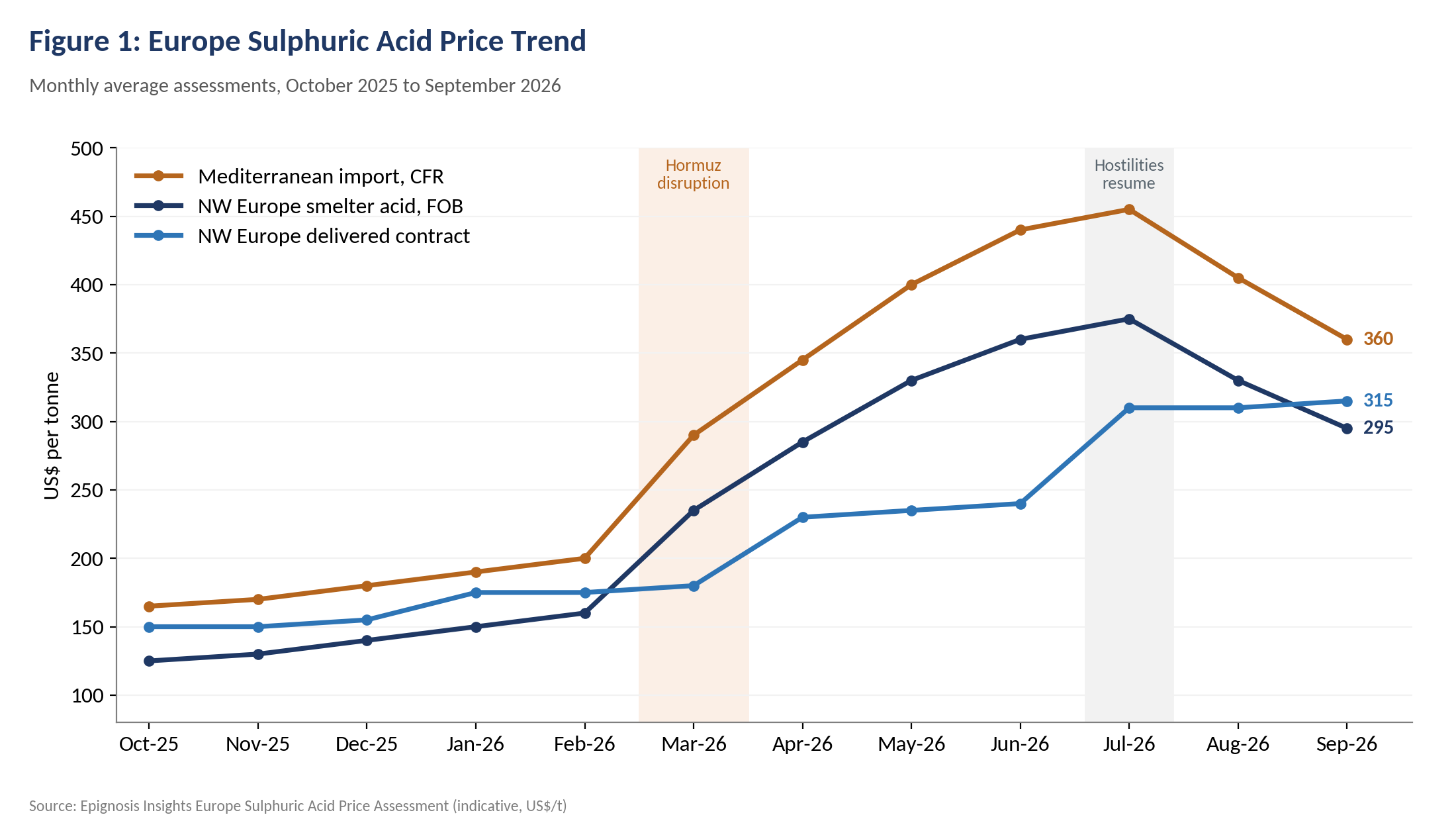
Smelter acid from copper, zinc and lead producers in Germany, the Nordics, Belgium, Spain and Poland forms the largest share of Europe's merchant supply. Epignosis Insights places September spot business for prompt loading mainly in the US$280–310 per tonne FOB range, down from US$320–345 per tonne in August. Overseas demand softened as phosphate producers and metals leaching operations that had built inventories during the summer price spike deferred new purchases, and producers with limited storage became more willing to discount, which accelerated the decline in the second half of the month.
Delivered prices into Mediterranean import hubs, including Morocco, Turkey and southern Europe, fell faster than NW European FOB values as freight rates for chemical tankers moderated and buyers drew on stock. The Epignosis Insights CFR Mediterranean assessment averaged US$360 per tonne in September, giving a freight and premium spread of about US$65 per tonne over NW Europe FOB, narrower than the US$80 per tonne spread recorded at the July peak.
Contract prices for industrial consumers in Germany, Benelux and France are typically reset quarterly and therefore lag the spot market. Epignosis Insights estimates that Q3 settlements agreed in late June and early July reflected the record spot prices of that period, so the September delivered contract assessment of US$315 per tonne sat above the spot FOB price for the first time since February. Epignosis Insights expects Q4 contract negotiations to deliver reductions of US$40–60 per tonne, as buyers point to the spot correction.
| Benchmark | Basis | Aug 2026 | Sep 2026 | MoM change | vs Feb 2026 |
| NW Europe smelter acid | FOB, spot | 330 | 295 | -10.6% | +84.4% |
| Mediterranean import | CFR, spot | 405 | 360 | -11.1% | +80.0% |
| NW Europe delivered | Contract | 310 | 315 | +1.6% | +80.0% |
| Granular sulphur | CFR Europe | 930 | 860 | -7.5% | +55.0% |
Source: Epignosis Insights Europe Sulphuric Acid Price Assessment (indicative, US$ per tonne)
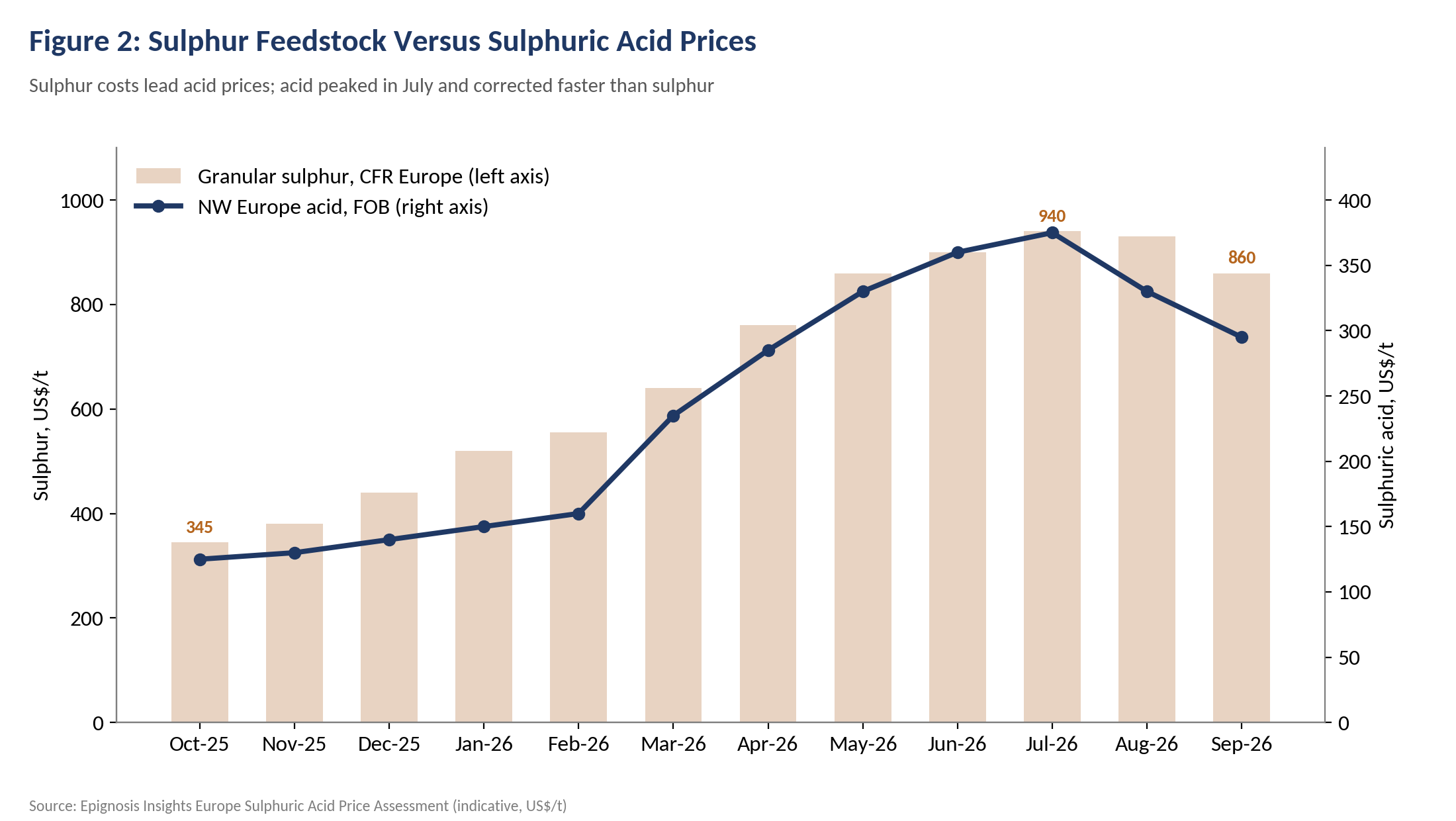
Sulphur is the main cost driver for acid produced in sulphur-burning plants, and its price sets the ceiling against which smelter acid competes. The sulphur market was transformed in 2026 by the Hormuz disruption. According to the International Food Policy Research Institute (IFPRI), world exports of elemental sulphur fell by a third in the first half of 2026, from 13.5 million tonnes to 9 million tonnes, with Gulf suppliers accounting for almost three quarters of the decline, and shipments through the strait fell back to near zero after hostilities resumed in mid-July.
Gulf producers' official prices reached record levels during the summer. QatarEnergy held its Qatar Sulphur Price at US$890 per tonne FOB in both July and August, a level far above any previous benchmark. In Europe's nearest large regional market, Turkish refiner Tüpraş awarded its August domestic sulphur tender at US$849–912 per tonne FCA, an average increase of around US$153 per tonne compared with its June tender.
September brought the first clear signs of demand resistance. Global Agriculture, citing price reporting agency Shanghai Metals Market, reported that ex-works sulphur in China's Shandong province fell 7.2% in the week to September 18 as phosphate fertilizer producers pushed back against negative margins. ICIS has described a shift in pricing power from sellers to buyers, noting that import prices in India, China and Indonesia have fallen by US$90–200 per tonne since their July peak, with declines of US$225–270 per tonne in Egypt, Africa and Brazil. The Epignosis Insights CFR Europe granular sulphur assessment eased 7.5% to US$860 per tonne in September, but remains 55% above its February level.
European acid supply in 2026 has been supported by strong copper smelter operations. Aurubis reported sulfuric acid output of 635,000 tonnes in the April–June 2026 quarter, up from 353,000 tonnes a year earlier, and 1.8 million tonnes in the first nine months of its fiscal year, up 23%, alongside significantly higher revenues from sulfuric acid sales. High copper and precious metal prices have encouraged smelters to maximize throughput, which has increased the volume of by-product acid available to the merchant market just as sulphur-based production became more expensive.
Sulphur-burning acid plants, by contrast, have faced severe margin pressure. With sulphur above US$850 per tonne, many burners have reduced operating rates or limited production to captive needs, shifting more of Europe's merchant demand toward smelter acid. Spent acid regeneration remains a stable but small part of supply. Outside Europe, CRU has noted that China's halt to acid exports intensified global tightness earlier in the year, removing a key source of supply to import markets in South America and Africa and increasing demand for European export cargoes.
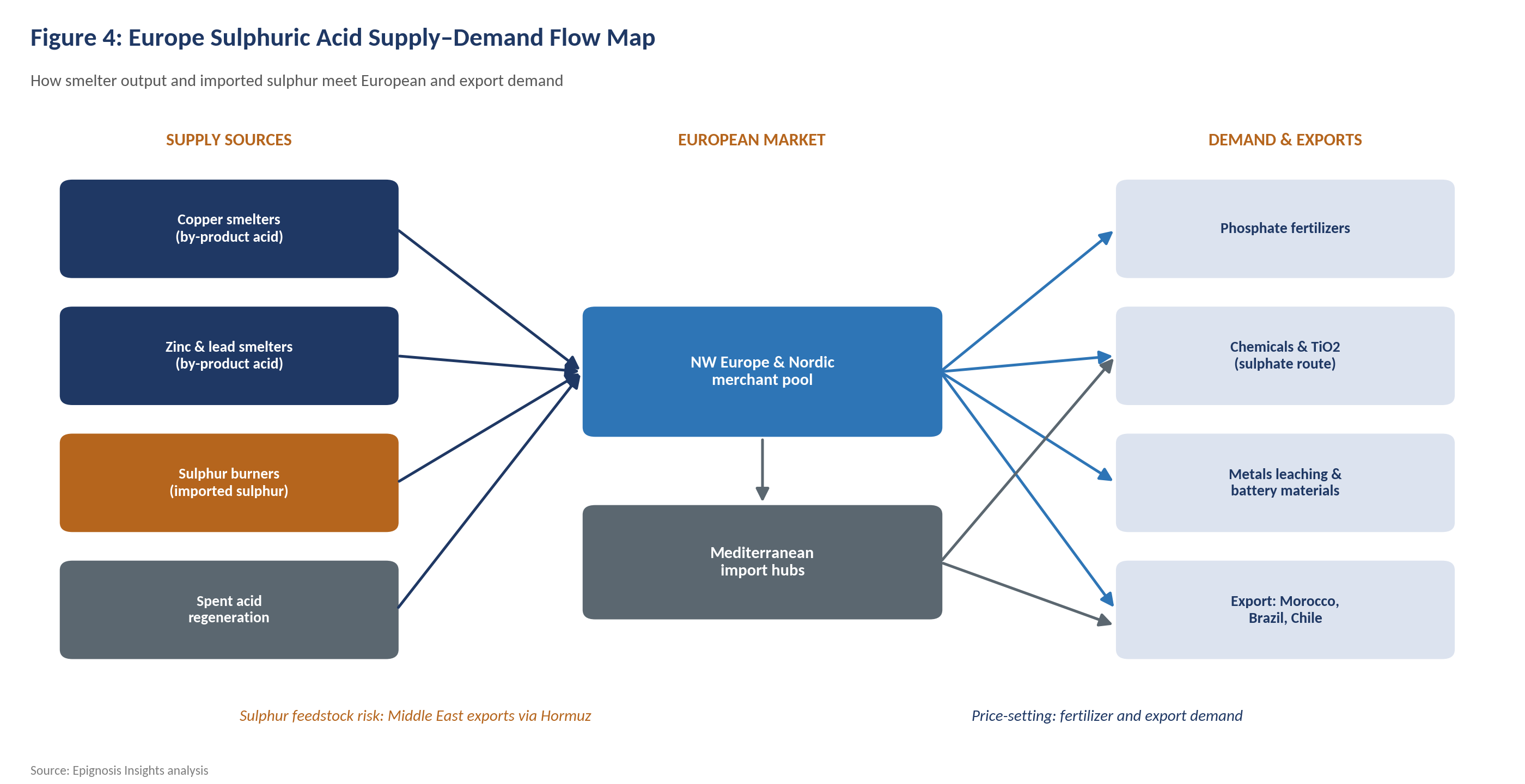
Phosphate fertilizer production remains the largest single use of sulphuric acid in Europe and in its main export markets, and fertilizer affordability is under severe strain. The European Commission reported that nitrogen fertilizer prices in April 2026 were 71% above their 2024 average, proposed a €540 million relief package for farmers, and noted that the EU imports 40–45% of the fertilizers it uses. The Council of the EU separately agreed a one-year suspension of customs duties on key nitrogen fertilizers such as urea and ammonia. Industry body Fertilizers Europe described the Commission's Fertiliser Action Plan as a starting point rather than a solution, arguing that it does not address high energy costs, carbon leakage risks and regulatory burdens. For acid consumers, weak fertilizer margins mean that phosphate producers are prioritizing inventory drawdowns over new purchases, reinforcing the September correction.
Industrial demand from chemicals, titanium dioxide pigments produced by the sulphate route, metal treatment and battery materials was broadly stable in September, though some consumers continued to cut usage at the margin. PricePedia has estimated that once sulphuric acid prices rise above roughly €180–200 per tonne, hydrochloric acid becomes a competitive substitute in several industrial applications, which limits how far acid prices can rise before demand begins to fall. Export demand from Morocco, Brazil and Chile remained the key swing factor, but was weaker in September as importers drew on inventories bought at higher summer prices.
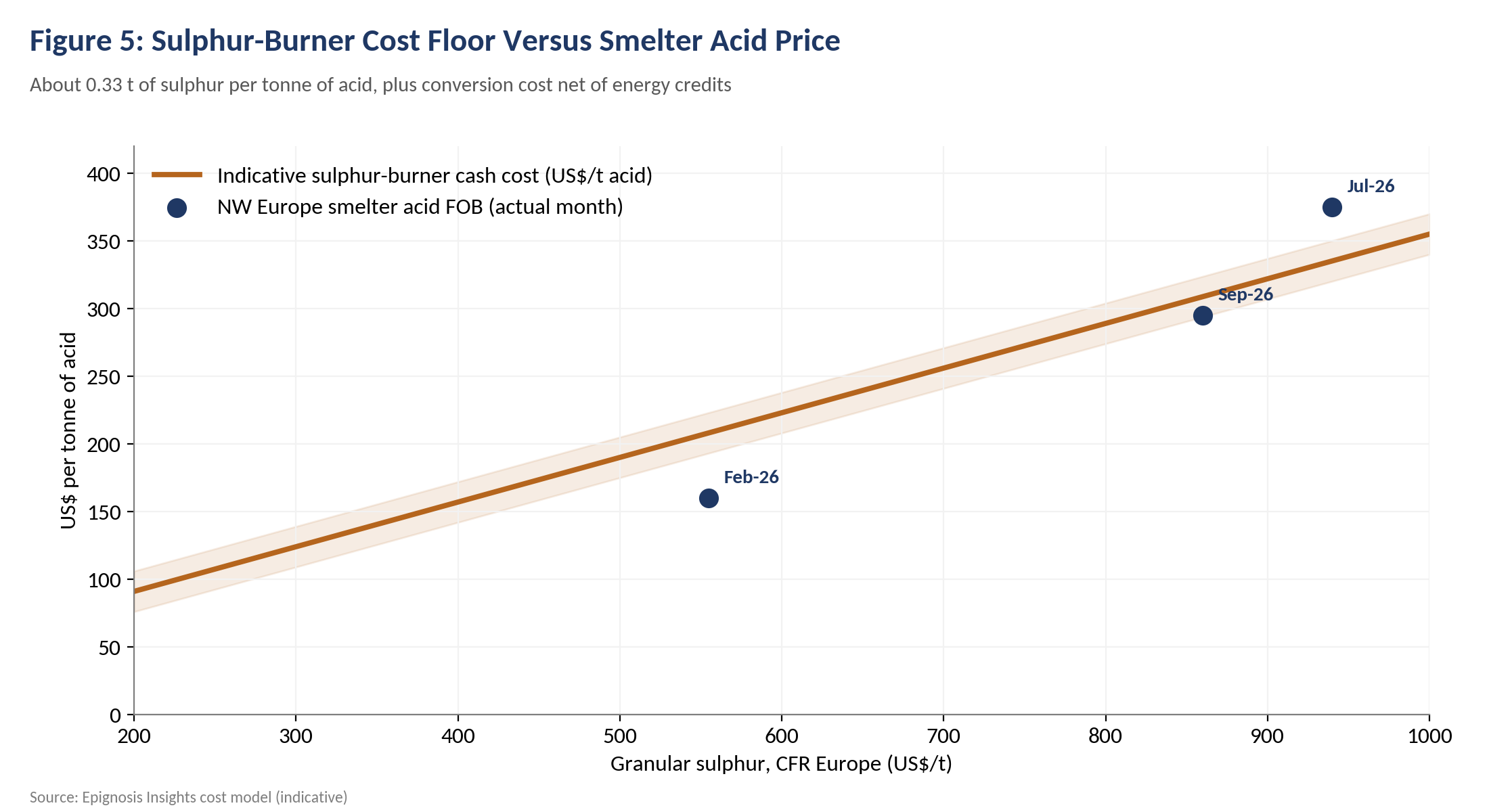
Epignosis Insights' cost model estimates that a sulphur-burning plant consumes about 0.33 tonnes of sulphur per tonne of acid, plus around US$25 per tonne in conversion costs net of steam and power credits. At September's sulphur price of US$860 per tonne, this implies a cash cost of roughly US$310 per tonne of acid, slightly above the US$295 per tonne smelter FOB price. This means smelter acid is now trading close to the marginal cost of sulphur-based production, which should limit further declines unless sulphur prices fall. In February, by contrast, smelter acid traded well below burner cost, while in July it traded at a premium as buyers paid for prompt availability.
Germany and Benelux. The industrial core of the European market is dominated by contract business with chemical, pigment and metal-processing consumers. Spot exposure is limited, so delivered prices in this region have been the most stable, and the main risk for buyers is the Q4 contract reset rather than day-to-day volatility.
Nordics and Poland. Large smelter complexes in Scandinavia and Poland are structurally long in acid and depend on exports by sea and rail. These producers felt the September slowdown in overseas demand most directly, and Epignosis Insights estimates that FOB values from Nordic ports fell slightly more than the NW Europe average.
Iberia and the Mediterranean. Spanish and southern European supply serves both domestic fertilizer producers and North African buyers, linking regional prices closely to Moroccan phosphate demand. Mediterranean CFR values therefore tend to move further than NW Europe FOB prices in both directions, as seen in the sharper decline in September.
Central and Eastern Europe. Inland markets rely more heavily on rail and road logistics, and delivered prices carry higher transport premiums. Buyers in these markets have fewer alternative supply options, which has kept delivered prices firmer than coastal benchmarks during the correction.
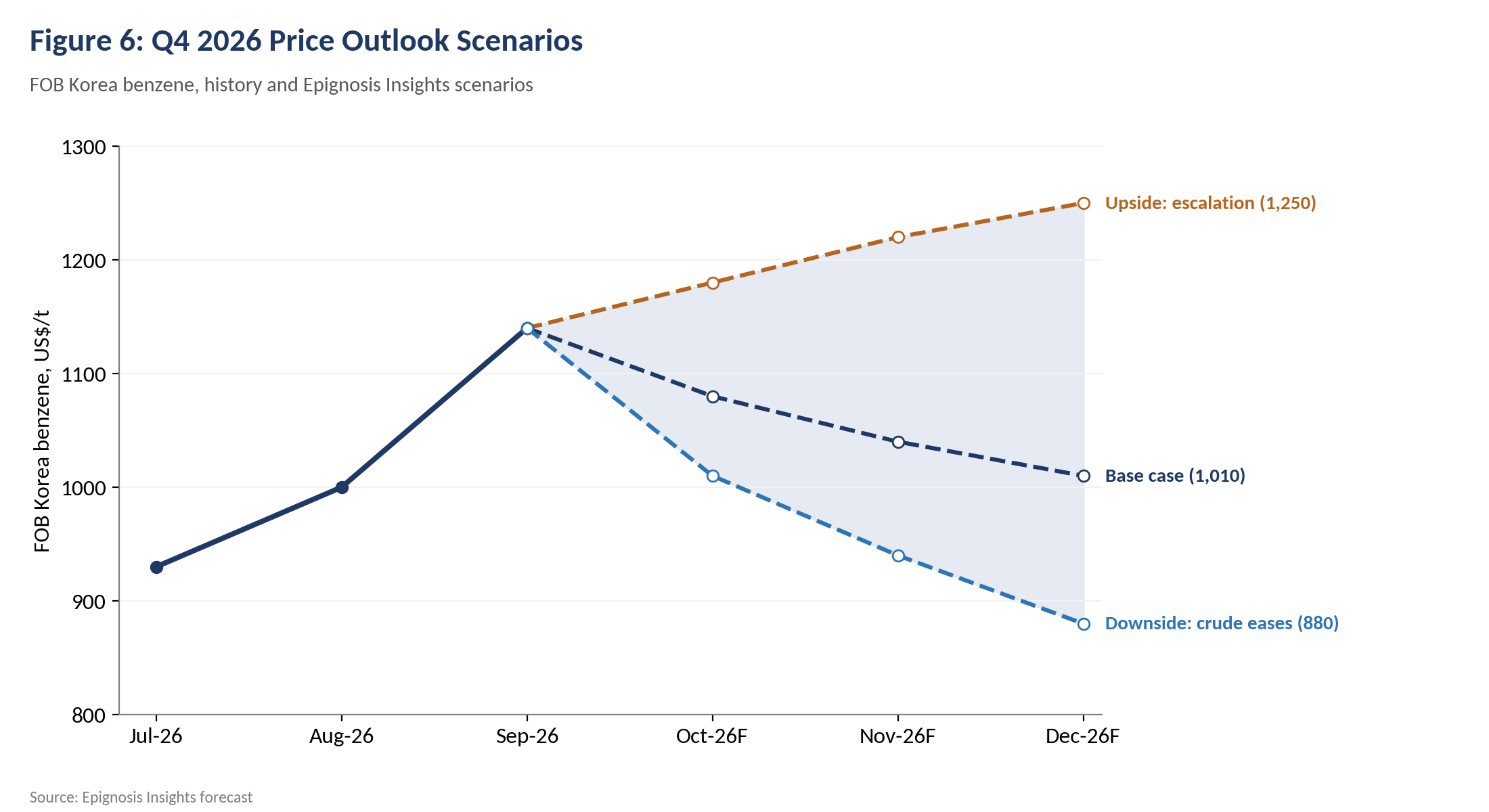
Epignosis Insights' base case assumes a gradual easing in sulphur prices and continued buyer caution, with NW Europe smelter acid falling to around US$270 per tonne FOB in October and US$245 per tonne by December. This assumes stable smelter operations, no major unplanned outages and only a limited recovery in Middle Eastern sulphur exports. Even if traffic through the Strait of Hormuz is restored, S&P Global has reported market participants' view that spot sulphur cargo movements could take three to four months to recover, as contract volumes stuck behind the strait would be cleared first.
Two alternative scenarios frame the risks. In an upside scenario, renewed escalation in the Gulf or major smelter outages in Europe would push acid back above US$350 per tonne FOB by December. In a downside scenario, a durable reopening of Hormuz and faster sulphur normalization would push prices down to around US$190 per tonne. Seasonal demand from phosphate producers ahead of the spring application season is likely to provide some support from late November.
For buyers, Epignosis Insights recommends using the current correction to negotiate Q4 and Q1 contract reductions, while avoiding excessive reliance on spot purchases given the high volatility of the sulphur market. Sellers with storage capacity may benefit from holding volumes into the seasonal pickup in demand rather than discounting further in October.
Epignosis Insights will monitor four indicators most closely in the coming months: Gulf producers' monthly official sulphur prices and the volume of cargoes transiting Hormuz; maintenance schedules at major European copper and zinc smelters; Q4 and Q1 contract settlements with industrial consumers; and phosphate fertilizer margins in Morocco, Brazil and Europe, which will determine the timing and strength of seasonal restocking.
Epignosis Insights assessments are compiled from reported spot transactions, producer and buyer price indications, contract settlements, company disclosures and published third-party market data. Prices are monthly averages in US dollars per tonne, are indicative, and refer to 98% concentration acid unless otherwise stated. Forecasts represent Epignosis Insights scenarios rather than firm price predictions.