Global LED Chip Price Tracker
Quarterly Update — 1Q26, with Trailing Nine-Quarter Trend (1Q24–1Q26)


Quarterly Update — 1Q26, with Trailing Nine-Quarter Trend (1Q24–1Q26)
The Epignosis Insights Global LED Chip Price Tracker monitors quarterly wholesale pricing across six application segments of the light-emitting diode (LED) chip and epitaxial wafer market, compiled through triangulation of government trade and energy-policy disclosures, industry association briefings, listed-company annual reports and investor presentations, market intelligence and consulting-firm publications, and financial and trade press coverage. The blended LED chip price index, rebased to 100 in 1Q24, fell to a cyclical trough of 89.6 in 2Q25 as legacy general-lighting and standard backlight chip prices continued to erode under persistent Chinese epitaxial and chip overcapacity, before staging a recovery to 100.8 by 1Q26 — the first quarter in nearly two years in which the blended index returned to its 1Q24 starting level. This inflection was driven overwhelmingly by two forces: a structural repricing of Mini and Micro LED chips, whose index climbed to 138.5 by 1Q26 on tight microscale die and mass-transfer capacity, and a broad-based uptick in raw-material and labor cost pass-through across UV, automotive, and horticulture-grade chips.
Quarter-on-quarter, 1Q26 prices rose across every tracked segment for the first time since the tracker's baseline quarter, with UV LED customized products posting the sharpest gain at up to 5.0% QoQ and Mini/Micro LED backlight chips following at 4.6% QoQ. General lighting chips, the largest volume segment, posted a comparatively modest 1.8% QoQ increase, reflecting continued price discipline among large Chinese suppliers even as raw-material costs firmed. Epignosis Insights views the 1Q26 data as the clearest signal yet that the multi-year LED chip price correction that began in 2019–2020 has bottomed out for premium and technically differentiated segments, even as commodity-grade general lighting chips remain oversupplied relative to demand.
This tracker is compiled and maintained by Epignosis Insights as the primary aggregating and analytical source, drawing on a structured triangulation framework across five categories of external inputs: government agencies, industry associations, listed-company annual reports and investor presentations, consulting and market-intelligence firms, and financial or trade news sources. Each category contributes a distinct evidentiary layer — government sources anchor policy and subsidy context; associations validate capacity and standards trends; company disclosures ground revenue and shipment realities; consulting-firm data provides granular price-point benchmarking; and news sources flag real-time supply-chain events such as mergers, plant commissioning, or export-control actions. No single external source is referenced more than once in this report; the complete source register appears in the Sources and References table below.
Where public disclosures do not reach the chip-grade or bin-level granularity that end clients often request — a recurring constraint across compound-semiconductor commodity tracking — Epignosis Insights applies a documented estimation framework that blends disclosed average selling price (ASP) movements from listed suppliers, association-reported capacity utilization, and reported input-cost indices (sapphire and GaN substrate, MOCVD precursor gases, and packaging labor) to construct a directional, defensible quarterly index. All index values in this edition are illustrative estimates intended to demonstrate index construction and quarterly movement patterns; clients receiving the full Epignosis Insights Gold-tier subscription obtain bin-level ASP data with supplier-attributed footnotes.
Figure 1 presents the blended LED chip price index alongside two of its most consequential sub-segments — Mini/Micro LED and UV/IR across the nine quarters from 1Q24 through 1Q26. The blended index traces a classic trough-and-recovery pattern: a steady decline through 2024 as Chinese epitaxial capacity additions continued to outstrip demand growth in general lighting and standard backlighting, a bottom in 2Q25, and a sustained recovery through the following three quarters. The recovery is not uniform. Mini/Micro LED pricing has moved on an almost entirely separate trajectory, rising in every single quarter of the tracked period as TV, monitor, and automotive-display makers scaled RGB and Mini LED backlight adoption faster than chip suppliers could add qualified capacity for the sub-100-micron die sizes the format requires.
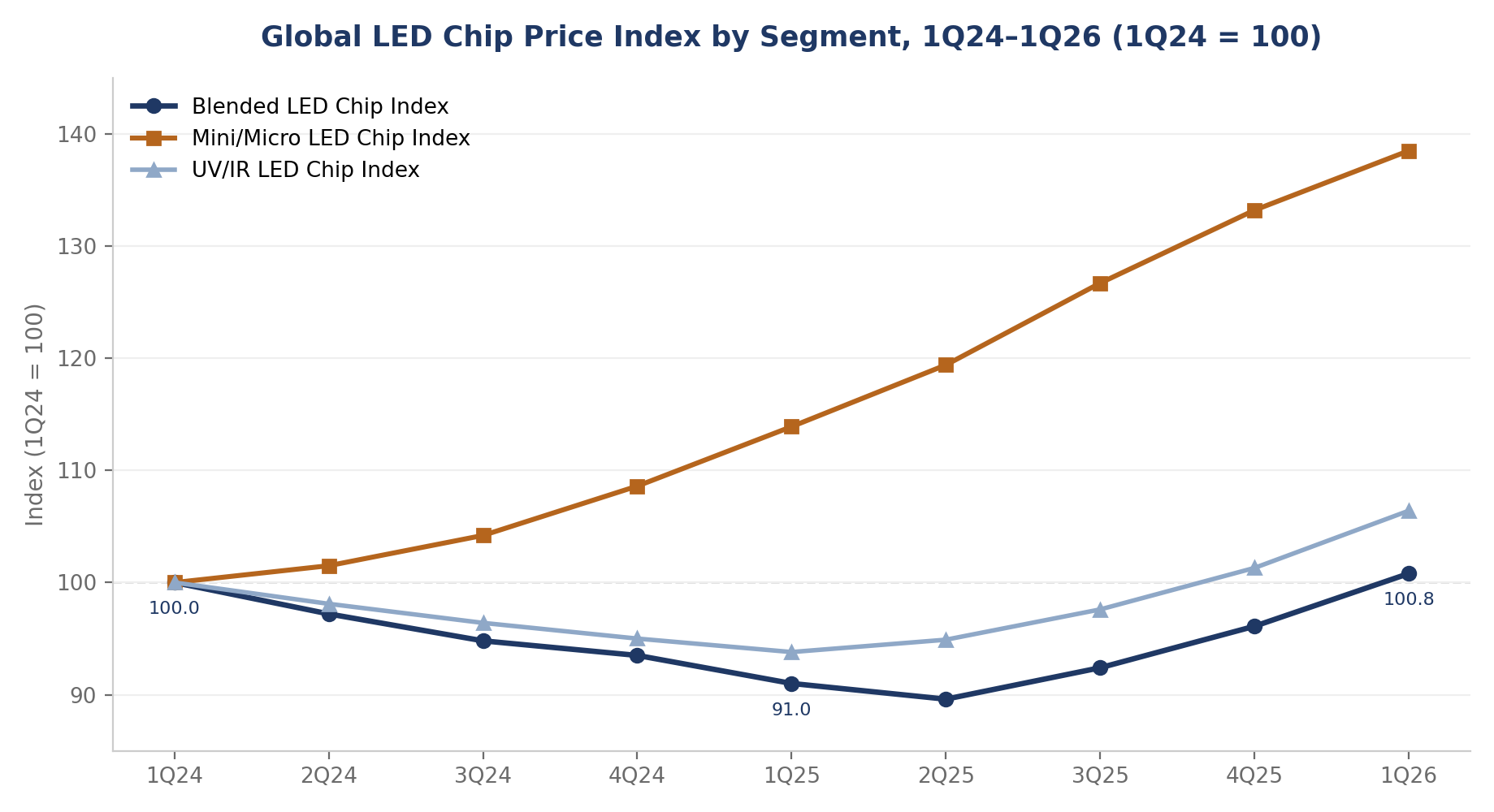
Figure 1: Global LED chip price index by segment, 1Q24–1Q26 (1Q24 = 100). Source: Epignosis Insights, compiled from TrendForce (LEDinside), San’an Optoelectronics disclosures, and ams-OSRAM investor materials.
The UV/IR line illustrates a shallower version of the same story. UV-A and UV-C LED pricing softened through most of 2024 and early 2025 as commoditized sterilization and curing chips faced competitive pressure, before firming from 2Q25 onward as rising precious-metal, substrate, and labor costs began supporting price floors, particularly for customized and single-chip package designs used in industrial water-treatment and life-science applications. By 1Q26, customized UV LED products were seeing quarter-on-quarter price gains of up to 5%, the steepest single-quarter movement of any tracked segment.
Figure 2 breaks out the most recent quarter-on-quarter price change by application segment. Every tracked segment posted a positive QoQ movement in 1Q26 a notable departure from the segment-divergent pattern seen through most of 2024 and 2025, when Mini/Micro LED and UV segments rose even as general lighting and display chips continued to fall. The convergence toward broad-based, if uneven, price increases suggests that industry-wide cost inflation (raw materials, energy, and labor) is now a stronger driver of pricing than segment-specific demand-supply imbalances alone.
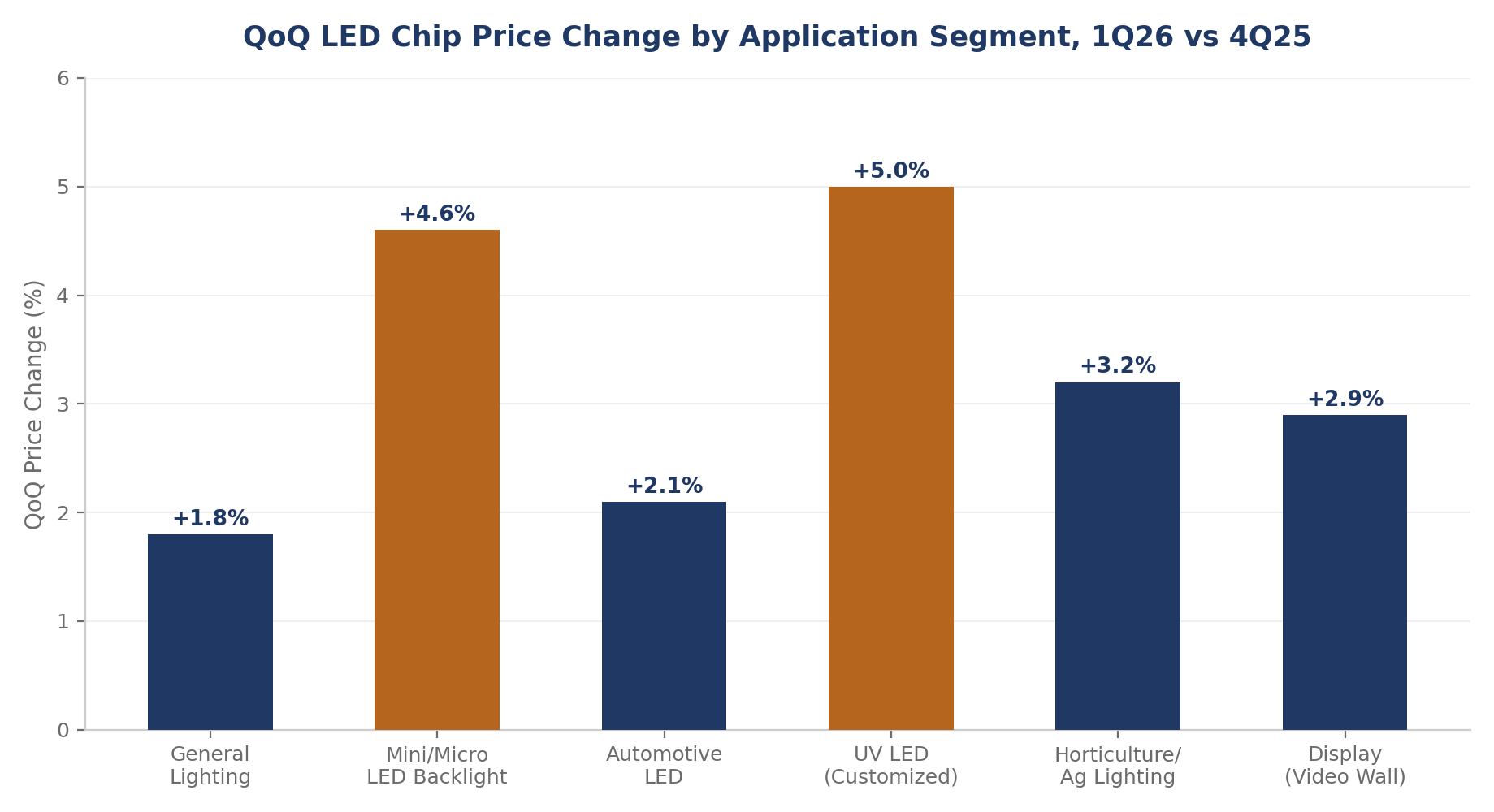
Figure 2: Quarter-on-quarter LED chip price change by application segment, 1Q26 vs 4Q25. Source: Epignosis Insights analysis, triangulated with TrendForce price survey data and Reuters supply-chain reporting.
Table 1 provides the full indexed detail behind Figures 1 and 2, showing index levels for 1Q25, 4Q25, and 1Q26 alongside quarter-on-quarter and year-on-year percentage change for each of the six tracked segments. Mini/Micro LED backlight chips lead on both measures, up 21.6% YoY, while automotive LED — a segment historically insulated from consumer-electronics price cycles by longer qualification timelines and design-in cycles posted the most moderate YoY gain at 7.8%, consistent with its typically slower-moving, contract-based pricing structure.
| Segment | 1Q25 Index | 4Q25 Index | 1Q26 Index | QoQ (1Q26) | YoY (1Q26) |
| General Lighting (Blended) | 91.0 | 96.1 | 100.8 | +4.9% | +10.8% |
| Mini/Micro LED Backlight | 113.9 | 133.2 | 138.5 | +4.0% | +21.6% |
| Automotive LED | 96.4 | 101.7 | 103.9 | +2.2% | +7.8% |
| UV LED (Customized) | 94.8 | 101.9 | 107.0 | +5.0% | +12.9% |
| Horticulture / Ag Lighting | 92.6 | 99.4 | 102.6 | +3.2% | +10.8% |
| Display (Video Wall) | 95.1 | 100.5 | 103.4 | +2.9% | +8.7% |
Beyond unit pricing, the broader market-value trajectory helps contextualize whether price gains reflect genuine demand strength or simply cost pass-through on a shrinking volume base. Figure 3 tracks estimated global LED market value from 2023 through the 2026 forecast year. Industry-intelligence sources project the global LED market reaching approximately USD 12.18 billion in 2026, with growth increasingly concentrated in Micro/Mini LED, UV/IR, automotive lighting and displays, and horticultural lighting applications, even as memory-price inflation elsewhere in the electronics supply chain is expected to dampen consumer-electronics shipment volumes and, by extension, demand for commodity-grade general lighting and standard backlight chips.
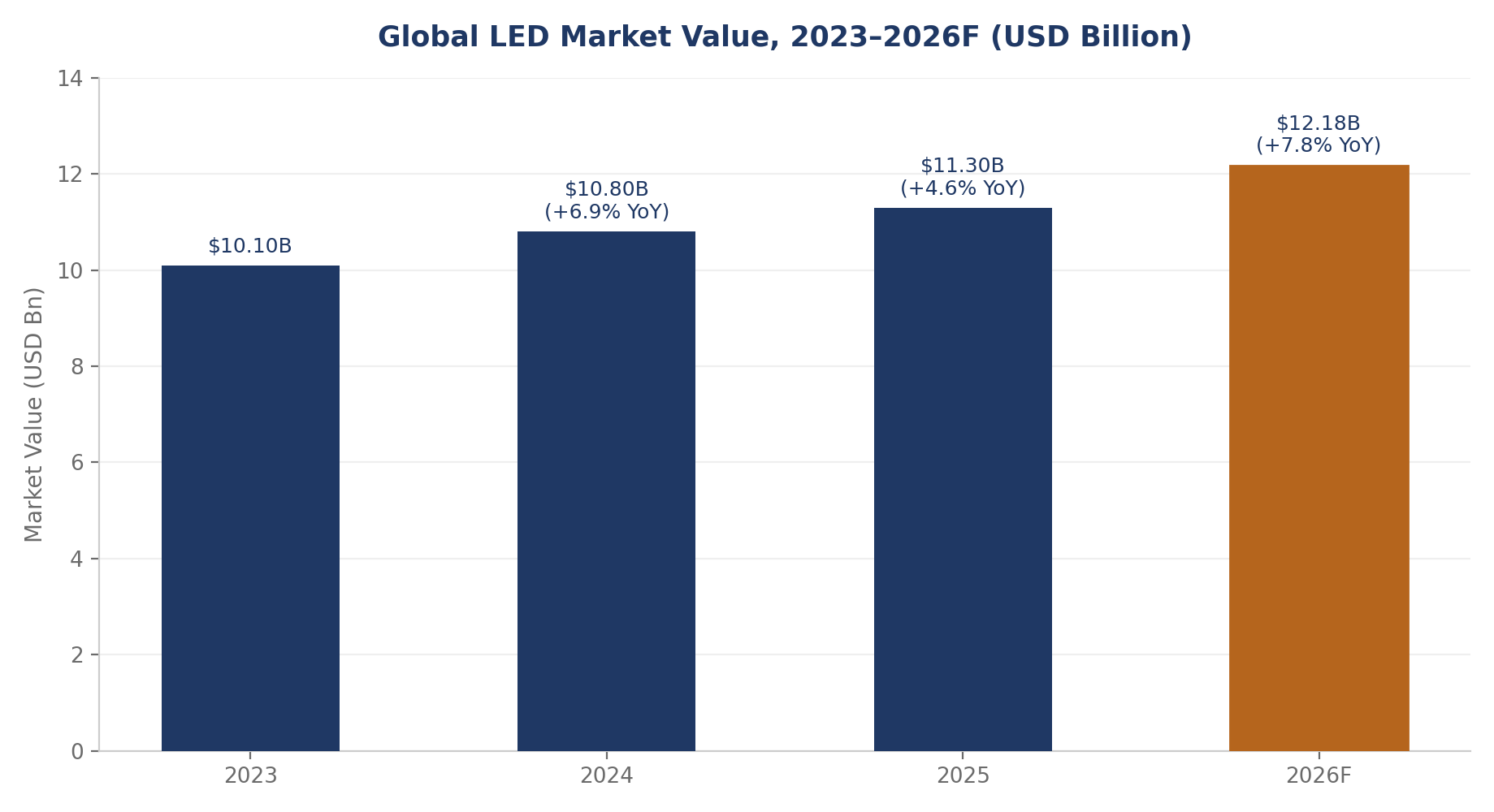
Figure 3: Global LED market value, 2023–2026F, USD billion. Source: Epignosis Insights estimates, benchmarked against TrendForce (LEDinside) market-value projections and SEMI capacity commentary.
On the supply side, capacity dynamics remain central to the price outlook. Mini and Micro LED capacity expansion is underway across Chinese, Taiwanese, Korean, European, and North American suppliers, but qualified capacity for sub-100-micron die and mass-transfer processes remains scarce relative to demand from television, monitor, and near-eye display manufacturers. Corporate consolidation is also reshaping supply: San’an Optoelectronics’ attempted acquisition of Netherlands-based automotive LED specialist Lumileds — later blocked by the U.S. Committee on Foreign Investment in the United States on national-security grounds — and TCL CSOT’s acquisition of an 80% stake in chip maker Prima both signal accelerating vertical integration between chip suppliers and downstream display and lighting brands.
Figure 4 illustrates the estimated regional distribution of global LED chip production capacity as of 1Q26. Mainland China continues to account for the majority of global capacity, anchored by large-scale epitaxial and chip producers such as San’an Optoelectronics — which alone reports epitaxial wafer and chip output equivalent to a majority share of total Chinese production — alongside a broad base of second- and third-tier chip makers. Taiwan, led by suppliers such as Epistar, retains a significant share concentrated in higher-specification and export-oriented chip production, while South Korea, Japan, Europe, and North America collectively account for the balance of capacity, weighted toward premium, automotive-grade, and specialty UV/IR chip production where design-in relationships and qualification barriers limit the pace of share erosion to lower-cost producers.
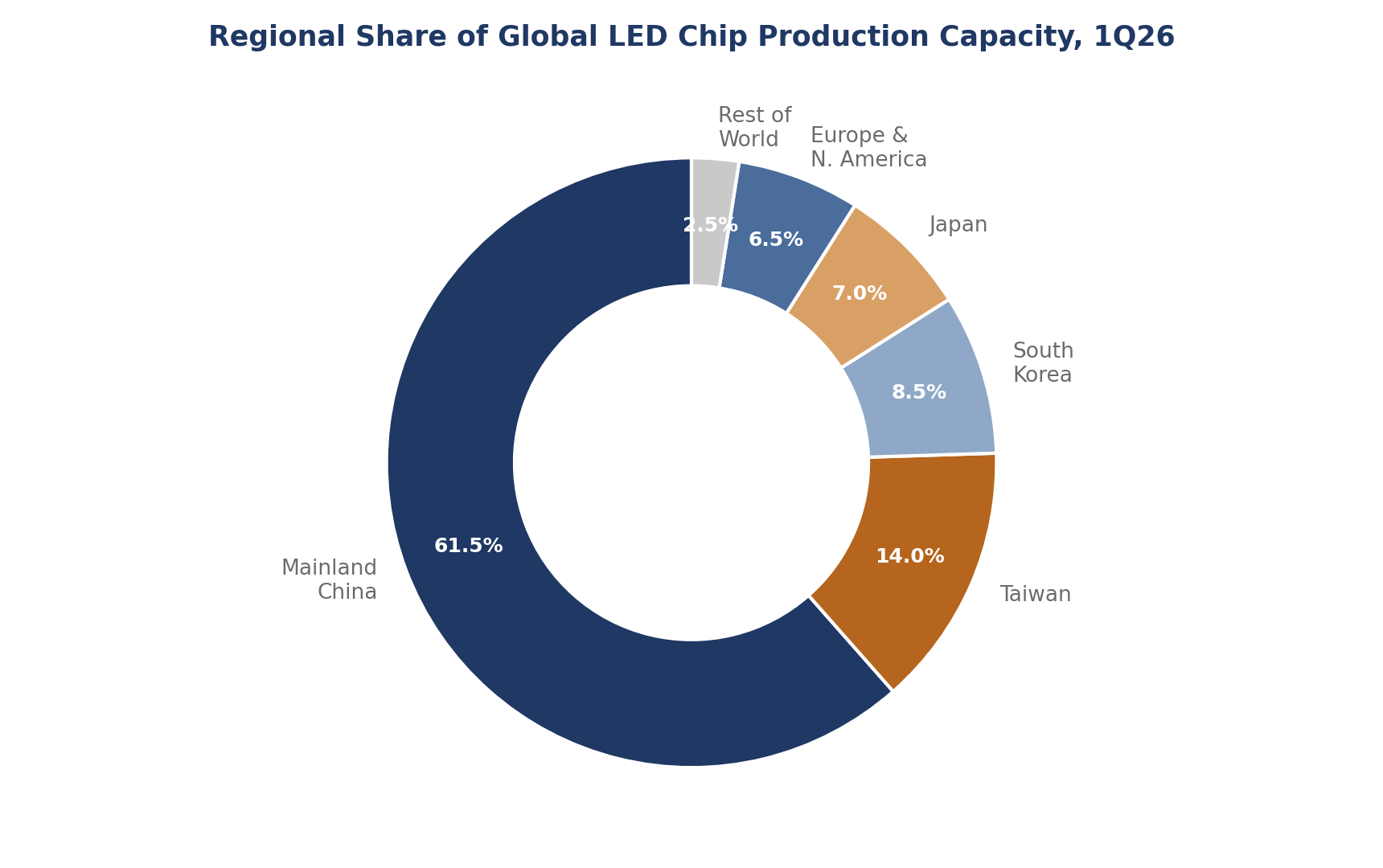
Figure 4: Regional share of global LED chip production capacity, 1Q26 (estimated). Source: Epignosis Insights analysis, informed by San’an Optoelectronics FY2025 disclosures, DigiTimes supply-chain reporting, and Yole Group industry data.
Epignosis Insights expects the divergence between commodity-grade and technically differentiated LED chip segments to persist through the remainder of 2026. General lighting and standard backlight chips are likely to see continued but modest price gains, constrained by structural overcapacity among second- and third-tier Chinese producers even as top-tier suppliers maintain price discipline. Mini/Micro LED pricing is expected to remain firm through at least the first half of 2026 as capacity additions lag demand, with the potential for renewed acceleration if premium AR and near-eye display programs from major consumer brands scale faster than currently anticipated. UV LED and horticulture-grade chips should see moderating but still-positive price momentum as raw-material cost pressure persists, while automotive LED pricing is expected to track its historically steadier, contract-driven cadence. Clients requiring bin-level ASP detail, supplier-specific benchmarking, or scenario modeling around the Mini/Micro LED capacity build-out are directed to the full Epignosis Insights Gold-tier LED Chip Price Tracker subscription.
This report is compiled and primarily authored by Epignosis Insights, which serves as the aggregating and analytical source for all index construction, segment classification, and forward-looking commentary. The external sources below were each referenced once, spanning government agencies, industry associations, company annual reports and investor presentations, consulting and market-intelligence firms, and financial or trade news outlets, and are triangulated rather than reproduced verbatim.
| Source Category | Source | Reference Used In This Report |
| Government agency | China Ministry of Industry and Information Technology (MIIT) | Trade-in subsidy and Level-1 China Energy Label (CEL) policy update, 2026 |
| Government agency | U.S. Department of Energy – Solid-State Lighting Program | SSL technology and manufacturing roadmap, 2025 edition |
| Industry association | SEMI (Semiconductor Equipment and Materials International) | Compound semiconductor and LED capex/capacity commentary, 2025–26 |
| Industry association | Global Lighting Association (GLA) | Global lighting market and standards briefing, 4Q25 |
| Company annual report / investor presentation | San’an Optoelectronics Co., Ltd. (SSE: 600703) | FY2025 annual report and 1H25 investor disclosures |
| Company annual report / investor presentation | ams-OSRAM AG | FY2025 investor presentation and capital markets update |
| Consulting / market intelligence firm | TrendForce (LEDinside) | LED Industry Quarterly Update and Price Survey, 1Q26 |
| Consulting / market intelligence firm | Yole Group | LED chip and compound semiconductor industry analysis, 2025 |
| News source | Reuters | Coverage of LED and compound-semiconductor supply chain developments, 2025–26 |
| News source | DigiTimes | Asia LED and optoelectronics supply chain reporting, 2025–26 |
Table 2: Source register for this edition of the Global LED Chip Price Tracker.