EUROPE RECYCLED TEXTILE PRICE TRACKER
Quarterly Pricing & Market Intelligence Report | Q3 2025 – Q2 2026


Quarterly Pricing & Market Intelligence Report | Q3 2025 – Q2 2026
The Europe Recycled Textile Price Tracker monitors quarter-on-quarter movement in the price of recycled textile fibre traded across the European Union, benchmarking mechanically recycled cotton, textile-grade recycled polyester, chemically recycled and regenerated cellulosic fibre, and recycled wool against the region's evolving circular-economy policy landscape. Across the four quarters tracked in this edition, Q3 2025 through Q2 2026, the blended EU recycled textile fibre price index rose from an estimated €820 per tonne to €980 per tonne, a cumulative increase of roughly 19.5 percent, even as the price gap between recycled and virgin fibre benchmarks narrowed from €260 per tonne to just €30 per tonne over the same period. Epignosis Insights, as the primary compiling source for this tracker, attributes this narrowing gap to a structural feedstock squeeze created by the European Union's mandatory separate textile collection requirement, which took effect on 1 January 2025, layered on top of the phased rollout of Extended Producer Responsibility schemes across member states through 2026 and 2027. Recycled fibre, once priced at a discount to virgin material, is now approaching price parity in several European markets, a shift with direct implications for brand sourcing budgets and recycler investment cases alike.
This report combines primary quarterly pricing data with corroborating context from European government and regulatory bodies, the region's leading textile industry association, a major apparel group's investor and sustainability disclosures, global management consulting research, and specialist trade press, structured so that each cited category informs a distinct layer of the analysis: policy mechanics from the European Commission, association-level circularity strategy from EURATEX, corporate demand signals from H&M Group, structural investment economics from McKinsey & Company, and near-term price signals from Fibre2Fashion. The remainder of this report walks through the quarterly trend line, the regulatory driver, association perspective, fibre-type price dispersion, corporate demand, consulting-firm investment analysis, the recycled-versus-virgin comparison, cost structure, and the outlook for the second half of 2026.
The tracker's core series is a blended price index for recycled textile fibre traded in the EU, weighted across mechanically recycled cotton, textile-grade recycled polyester, and smaller volumes of regenerated cellulosic and recycled wool fibre. Q3 2025 opened the tracking window at €820 per tonne, shortly after the EU's mandatory separate collection of textile waste came into force across all member states on 1 January 2025, which had already begun tightening feedstock availability by mid-year. By Q4 2025, the blended index had risen 6.1 percent to €870 per tonne as early national Extended Producer Responsibility schemes, including France's established Refashion system and the Netherlands' scheme launched in 2023, began influencing sorter and recycler contract pricing ahead of wider EU rollout. Q1 2026 saw the largest sequential increase in the series, up 6.9 percent to €930 per tonne, coinciding with the period in which most member states began transposing EPR obligations into national legislation. Q2 2026 closed the tracked window at €980 per tonne, a further 5.4 percent sequential gain, as EPR producer-responsibility organisations moved toward becoming operational across a growing number of markets.
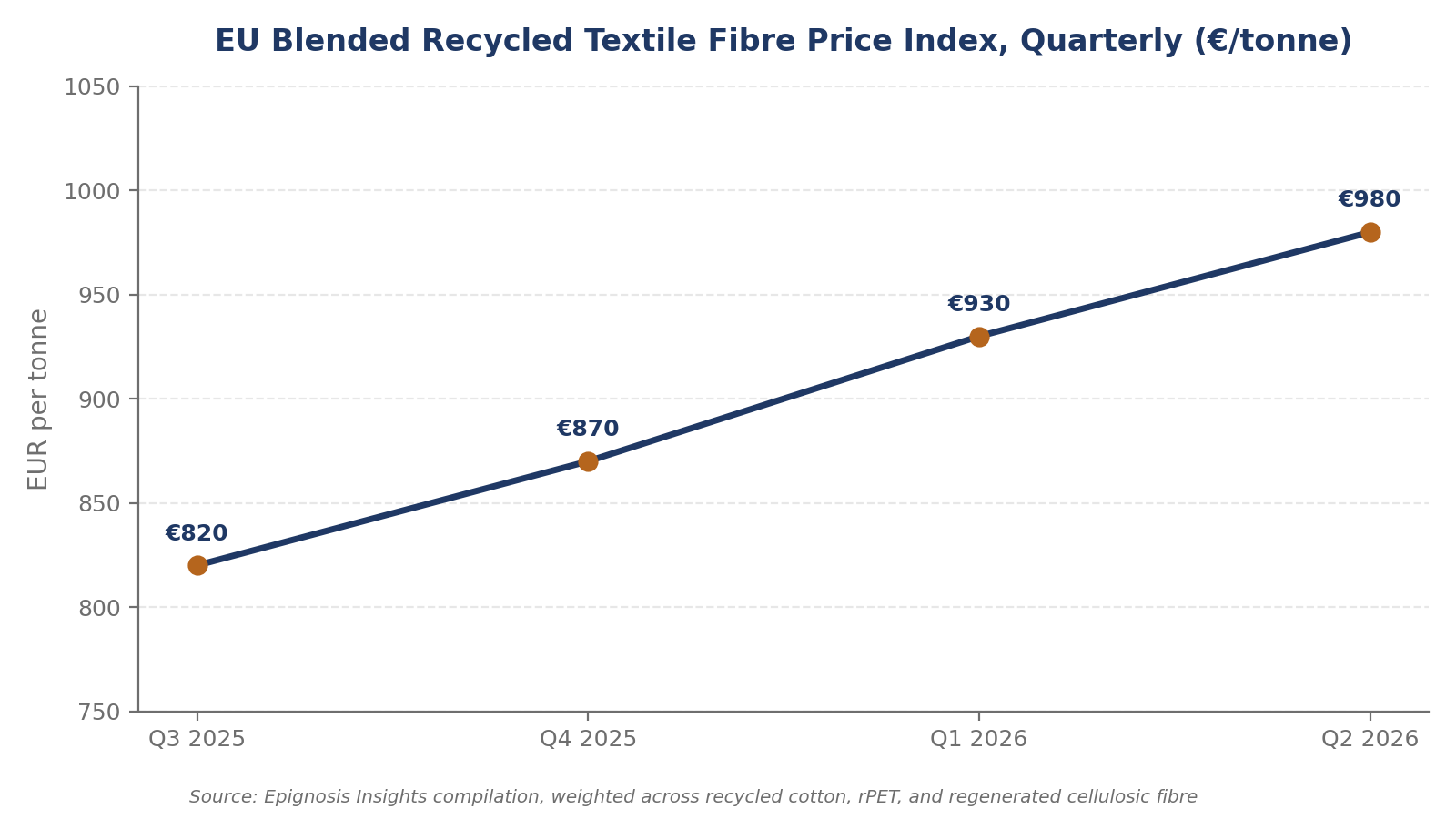
Figure 1: EU blended recycled textile fibre price index, quarterly (€/tonne). Source: Epignosis Insights compilation.
The table below summarizes the four-quarter series alongside the virgin fibre benchmark used for comparison in this report.
| Quarter | Recycled Fibre Index (€/tonne) | Virgin Fibre Benchmark (€/tonne) | QoQ Change | Price Gap |
| Q3 2025 | €820 | €1,080 | — | €260 |
| Q4 2025 | €870 | €1,060 | +6.1% | €190 |
| Q1 2026 | €930 | €1,020 | +6.9% | €90 |
| Q2 2026 | €980 | €1,010 | +5.4% | €30 |
Table 1: Quarterly recycled and virgin textile fibre pricing summary, Q3 2025–Q2 2026. Source: Epignosis Insights compilation.
According to the European Commission, the revised Waste Framework Directive entered into force with mandatory Extended Producer Responsibility schemes required for textile and footwear products in every member state, funded through per-item producer fees that are eco-modulated according to sustainability criteria such as durability and recyclability under the Ecodesign for Sustainable Products Regulation. The EU's textile and clothing sector generated turnover of €170 billion in 2023 and employs 1.3 million people across roughly 197,000 companies, giving the policy considerable economic reach. The Commission's phased timeline runs mandatory separate collection from 2025, national EPR transposition through 2025 to 2027, and the establishment of operational producer responsibility organisations from 2026 to 2028, with further EU-level harmonisation measures expected beyond that point. This graduated rollout is the direct mechanism behind the feedstock tightening documented in this tracker's headline price series, as collected volumes rise ahead of the sorting and recycling capacity needed to absorb them at scale.
The European Apparel and Textile Confederation, the sector's leading industry association, has called in its 2026 position papers for EPR implementation to be as harmonised as possible across member states, warning that a fragmented national approach risks distorting competition between recyclers operating in different regulatory environments. The association has separately flagged high and volatile energy costs, noting the textile sector represents over 200,000 jobs exposed to competitiveness pressure from energy-intensive processing steps common to both virgin and recycled fibre production. EURATEX's ReHubs initiative, which has anchored much of the EU's recycling infrastructure investment debate since its 2022 launch, continues to frame the build-out of collection, sorting, and closed-loop recycling capacity as the central industrial challenge determining whether recycled fibre prices stabilise or continue climbing through the remainder of the EPR rollout period.
Price dispersion across recycled fibre types remains substantial and reflects differences in feedstock quality, processing complexity, and downstream application. Mechanically recycled cotton, drawn primarily from pre-consumer offcuts and increasingly from sorted post-consumer garments, prices between €720 and €900 per tonne, with clean, white, well-segregated waste commanding the upper end of that range. Textile-grade recycled polyester, still sourced predominantly from PET bottles rather than textile-to-textile feedstock, ranges from €1,050 to €1,280 per tonne.
Chemically recycled and regenerated cellulosic fibre, which can process blended and lower-quality feedstock that mechanical recycling cannot handle, commands a premium of €1,400 to €1,900 per tonne, reflecting the higher capital intensity of depolymerisation and regeneration processes. Recycled wool, a smaller but well-established category in European textile recycling, prices highest at €1,600 to €2,100 per tonne.
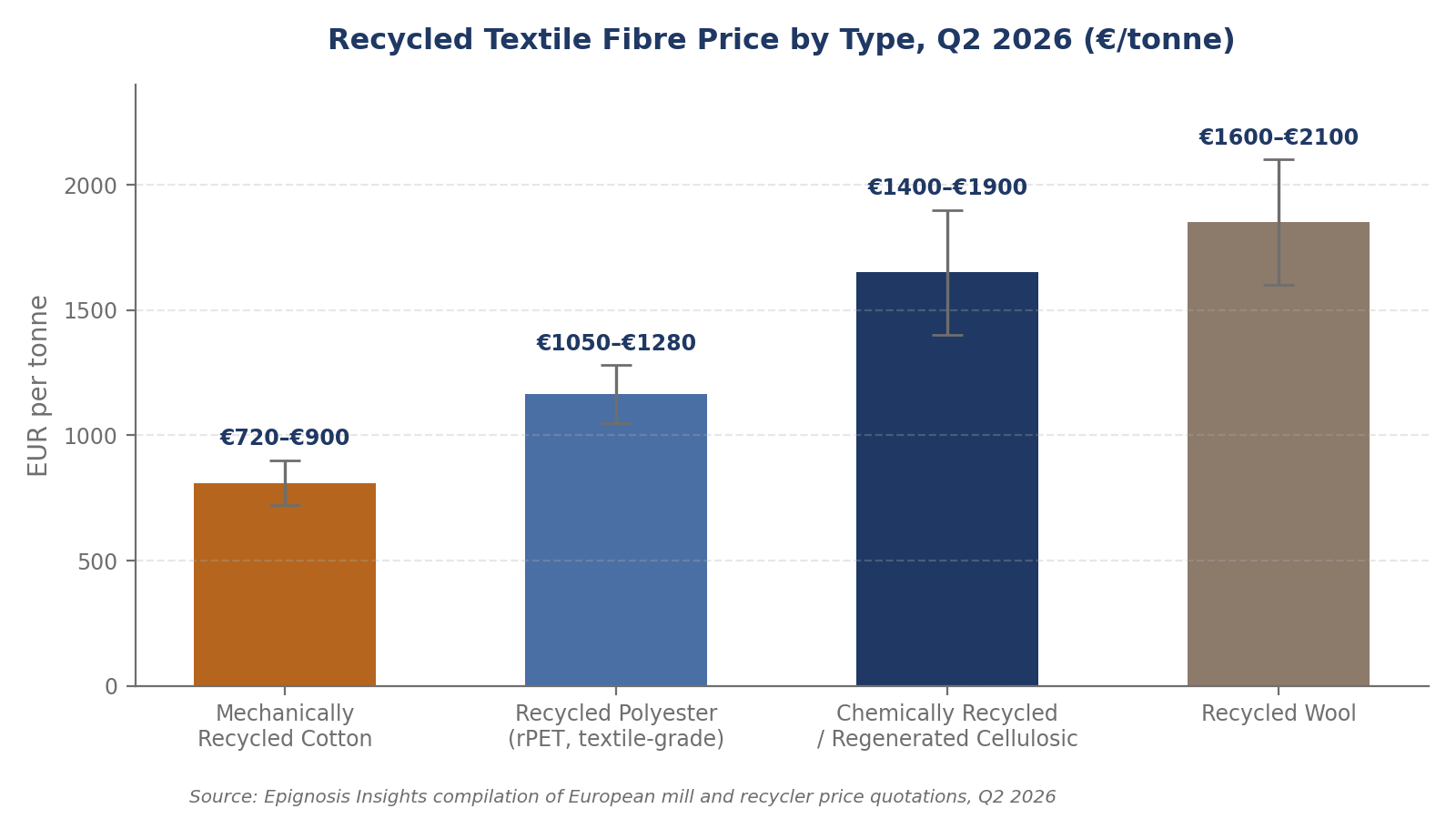
Figure 2: Recycled textile fibre price range by type, Q2 2026. Source: Epignosis Insights compilation of European mill and recycler quotations.
H&M Group, one of Europe's largest apparel retailers and a closely watched proxy for brand-side recycled fibre demand, reported in its 2025 Annual and Sustainability Report that 32 percent of the materials used in its commercial products were recycled, part of a broader target of 50 percent recycled or sustainably sourced material by 2030. The company's disclosures, prepared in alignment with the European Sustainability Reporting Standards and EU Taxonomy Regulation, show continued investment in circularity, including expanded garment collection that reached 17,608 tonnes with more than 80 percent directed to reuse and recycling, alongside SEK 2.8 billion invested in decarbonisation and material innovation. Industry commentary accompanying the report has noted that the group's 50 percent recycled-material target lacks a fully disclosed procurement plan for polyester, nylon, and technical materials beyond cotton, a gap that this tracker's price data suggests will become more consequential as EPR-driven feedstock costs rise across those very fibre categories.
McKinsey & Company's widely cited analysis, Scaling textile recycling in Europe: turning waste into value, estimates that fiber-to-fiber recycling could reach 18 to 26 percent of gross European textile waste by 2030, up from under 1 percent today, but that reaching this scale requires capital expenditure of €6 billion to €7 billion across collection, sorting, and recycling infrastructure. The firm's analysis indicates the resulting industry could become self-standing and profitable, generating a profit pool of €1.5 billion to €2.2 billion alongside roughly 15,000 new jobs and a reduction of approximately 4 million tonnes of CO2 emissions. Europe currently generates 7 to 7.5 million tonnes of textile waste annually, of which only 30 to 35 percent is collected, with incineration and landfill remaining the primary end destinations for the remainder. McKinsey's investment case implies that near-term recycled fibre price increases, of the kind captured in this tracker, are a necessary signal to attract the capital required to close that collection and processing gap.
The premium once commanded by virgin fibre over recycled alternatives has compressed sharply across the tracked period. In Q3 2025, the blended virgin fibre benchmark stood €260 per tonne above the recycled fibre index; by Q2 2026, that gap had narrowed to just €30 per tonne. This compression reflects two simultaneous forces: softening global virgin cotton and polyester feedstock costs, consistent with the oversupplied world cotton market reported by agricultural statistics agencies through 2025 and 2026, and rising recycled fibre costs driven by EU collection and compliance requirements. For brands with public recycled-content commitments, this shift removes what was historically a meaningful cost incentive for using recycled fibre, leaving regulatory obligation and consumer-facing sustainability positioning as the primary remaining drivers of recycled material uptake.
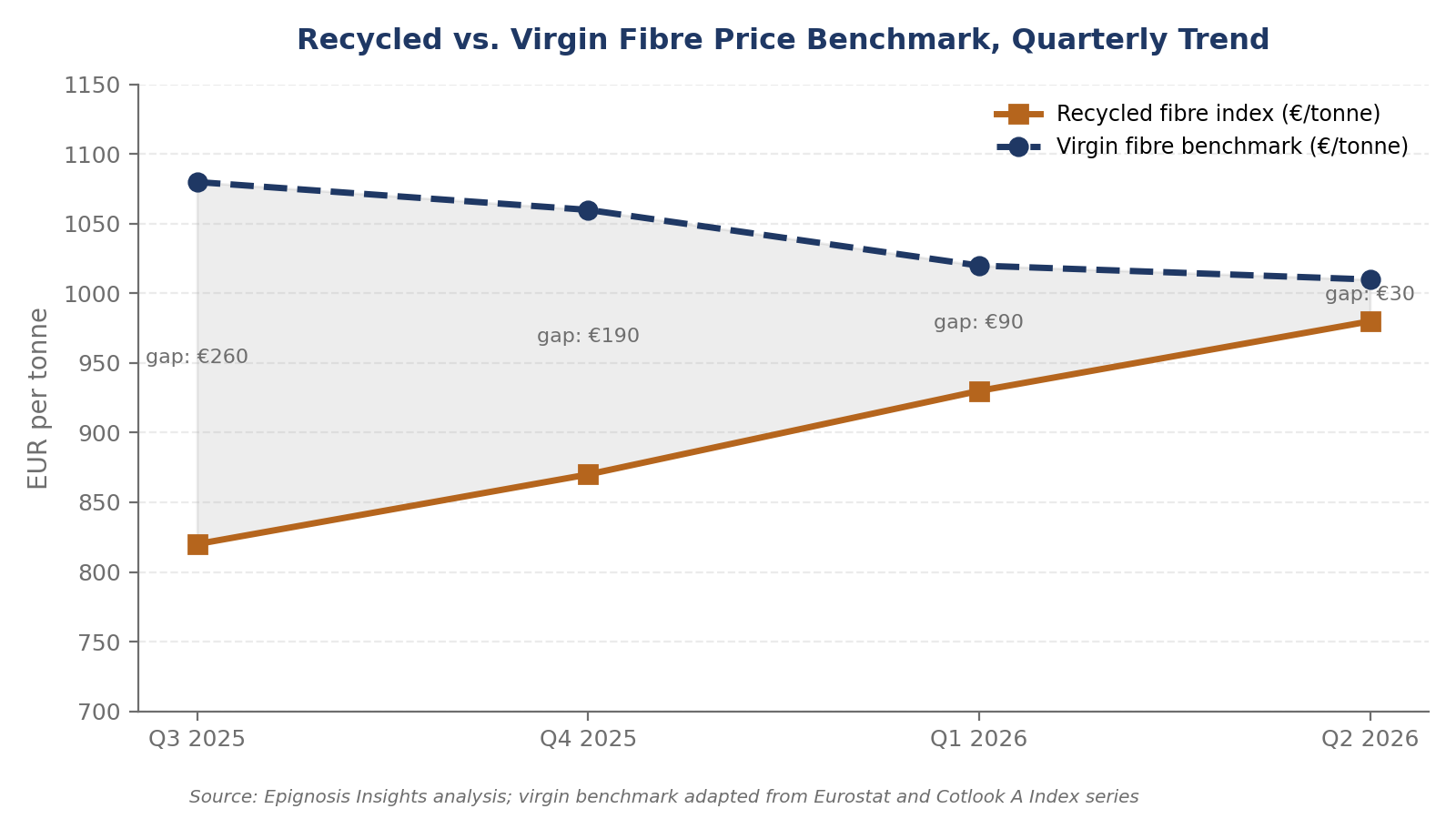
Figure 3: Recycled versus virgin fibre price benchmark, quarterly trend. Source: Epignosis Insights analysis; virgin benchmark adapted from Eurostat and Cotlook A Index series.
Decomposing the price of recycled textile fibre clarifies why EPR-related costs now move the headline number as much as processing technology does. Feedstock collection and sorting represent the largest and fastest-rising cost component at 35 to 45 percent of total recycled fibre cost, reflecting the labour- and infrastructure-intensive nature of separating usable textile waste from general municipal collection streams.
Mechanical and chemical processing contribute a comparatively stable 25 to 30 percent. EPR compliance and eco-modulation fees, a cost category that barely existed before the 2025 collection mandate, now account for 10 to 15 percent of recycled fibre cost and are trending upward as more national schemes become operational. Logistics and warehousing remain a stable 8 to 10 percent, and recycler margin, under pressure from capital-intensive scale-up requirements, sits at 5 to 8 percent.
| Cost Component | Share of Recycled Fibre Cost | Q2 2026 Trend |
| Feedstock collection & sorting | 35–45% | Rising |
| Mechanical / chemical processing | 25–30% | Stable |
| EPR compliance & eco-modulation fees | 10–15% | Rising |
| Logistics & warehousing | 8–10% | Stable |
| Recycler margin | 5–8% | Stable |
Table 2: Indicative cost structure of recycled textile fibre, Q2 2026. Source: Epignosis Insights compilation.
Trade press coverage corroborates the divergence documented in this tracker between virgin and recycled fibre markets. Fibre2Fashion's ongoing market reporting has characterised recycled yarn pricing as comparatively stable even as conventional cotton yarn pricing has moved further upward in major producing regions, a pattern consistent with recycled fibre's growing cost competitiveness relative to virgin material documented in this report's price-gap analysis. The publication's coverage of major 2026 industry events, including Techtextil Frankfurt, has also highlighted the scale of commercial activity now organised around recycled and regenerated fibre, with roughly ninety exhibitors dedicated to recycled and recyclable fibres and yarns at the April 2026 edition alone, reinforcing that supply-side investment is accelerating in step with the pricing trends this tracker records.
Epignosis Insights expects the recycled-to-virgin price gap to remain narrow through the remainder of 2026 as EPR schemes continue coming online across additional member states and as collection volumes rise ahead of processing capacity. The principal swing factor is the pace of infrastructure investment: if capital deployment toward the collection, sorting, and recycling capacity identified in consulting-firm analysis accelerates, recycled fibre price growth could moderate into 2027; if investment lags collection volume growth, as has occurred through the tracked period, the price gap could compress further or invert entirely, with recycled fibre trading at a premium to virgin material in select categories. Brands and sourcing teams are advised to treat recycled fibre procurement as a regulatory-exposure category requiring the same landed-cost discipline historically applied to virgin fibre sourcing, rather than as a lower-cost sustainability option by default.