EU ETS Carbon Credit (EU ETS) Price Tracker
Weekly Pricing & Market Intelligence Report


Weekly Pricing & Market Intelligence Report
The EU Emissions Trading System (EU ETS) carbon allowance market moved through an eventful eight-week stretch between the first week of July and the final week of August 2026, according to this week's Epignosis Insights tracker. The ICE EUA December-2026 benchmark contract climbed from roughly €75.80 per tonne of CO2 in early July to a six-month high near €86.60 per tonne around July 22, before correcting back toward €82.48 per tonne by August 28 — the most recent print available at the time of writing. Over the tracked period, that represents a net gain of close to 9 percent, even after giving back a meaningful share of the mid-July spike.
The rally was driven primarily by tightening allowance supply expectations tied to reduced auction volumes under the Market Stability Reserve (MSR), continued withdrawal of free allocation for industrial sectors, and market participants pricing in a structural deficit flagged by consulting-firm research for 2026 and 2027. The correction from the July peak reflected profit-taking and trader caution that a further push above €80 per tonne could invite political pushback from EU member states and CBAM-exposed industries, alongside a softening in the natural gas complex that carbon prices have tracked closely through the year.
The table below summarises the two principal EU ETS price references tracked each week: the ICE EUA December-2026 futures benchmark, the most liquid forward contract for EU allowances, and the EEX spot auction clearing price, which reflects the volume-weighted price at which member states sell allowances directly into the primary market.
| Week Ending | ICE EUA Dec-26 Futures (EUR/t) | EEX Spot Auction Clearing Price (EUR/t) | Week-on-Week Change (%) |
| Jul 04 | 75.80 | 75.45 | +0.00% |
| Jul 11 | 77.40 | 77.05 | +2.11% |
| Jul 18 | 81.20 | 80.85 | +4.91% |
| Jul 25 | 84.00 | 83.65 | +3.45% |
| Aug 01 | 84.20 | 83.85 | +0.24% |
| Aug 08 | 83.70 | 83.35 | -0.59% |
| Aug 15 | 83.30 | 82.95 | -0.48% |
| Aug 22 | 82.90 | 82.55 | -0.48% |
| Aug 29 | 82.48 | 82.13 | -0.51% |
Table 1: Weekly EU ETS allowance (EUA) price build-up, July 4 – August 29, 2026 (Source: Epignosis Insights)
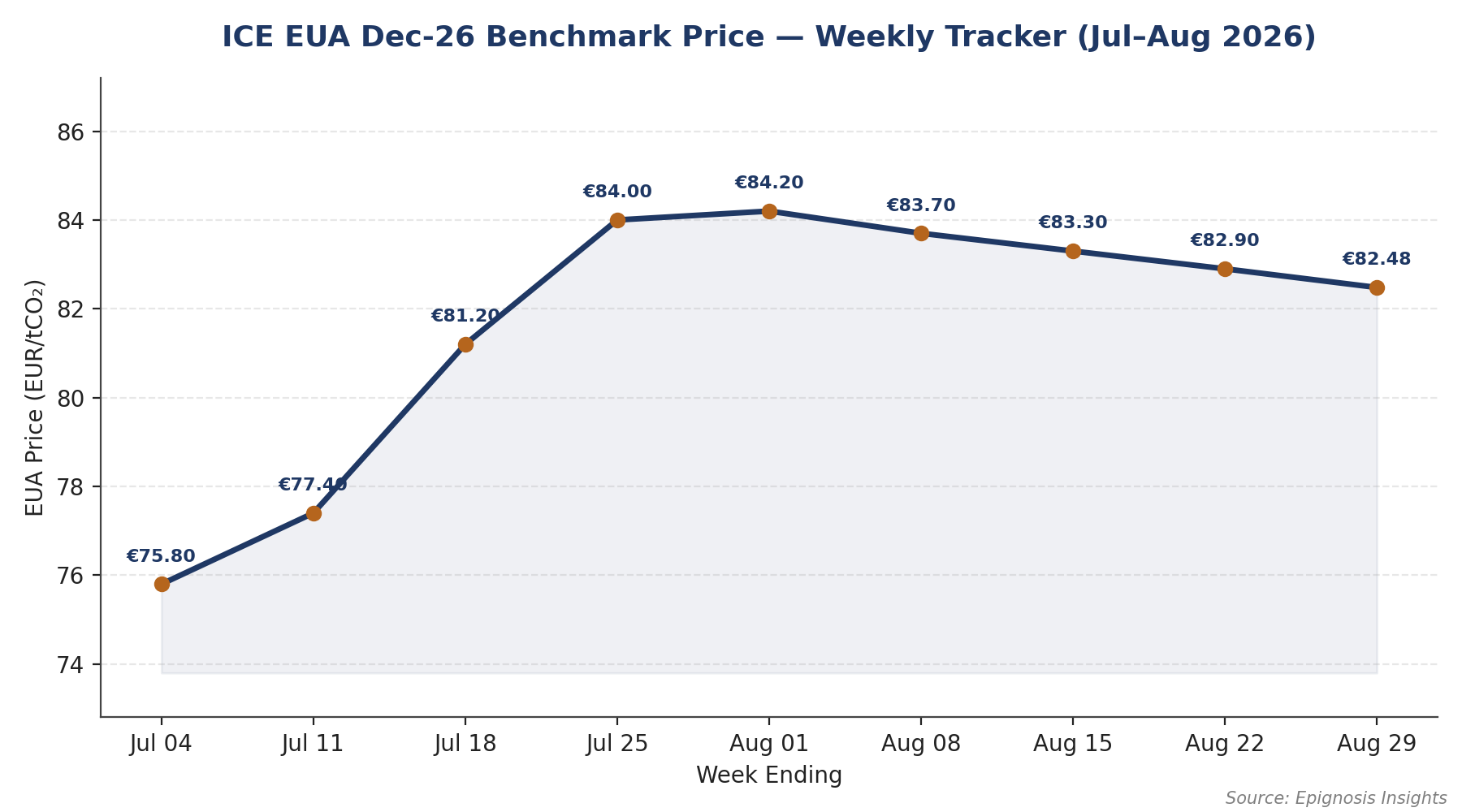
Figure 1: ICE EUA December-2026 benchmark price trend, weekly (EUR/tCO₂)
Two closely linked price references shaped EU carbon economics across the tracking window. On the futures side, the ICE EUA December-2026 contract rose steadily through the first three weeks of July, extending a rally that market coverage attributed to tightening supply expectations, before touching a six-month high of €86.60 per tonne on July 22 — the highest level since January 2026. That peak proved short-lived: within a day, the contract had corrected to €83.80 per tonne as the initial burst of speculative buying failed to attract broader follow-through demand, and traders grew wary that a decisive break above €80 per tonne could provoke renewed complaints from EU member states and energy-intensive industries already contending with the phase-in of carbon border costs. By the start of August, the benchmark had stabilised at approximately €84.20 per tonne, broadly in line with levels flagged in contemporaneous bank research, before drifting gradually lower across the rest of the month to close at €82.48 per tonne on August 28. On the auction side, the EEX spot clearing price tracked the futures benchmark closely throughout the period, typically settling a modest 30 to 40 cents below the forward contract — a pattern consistent with the auction mechanism's role as a primary-market outlet for the same underlying allowance pool that trades on the secondary futures market
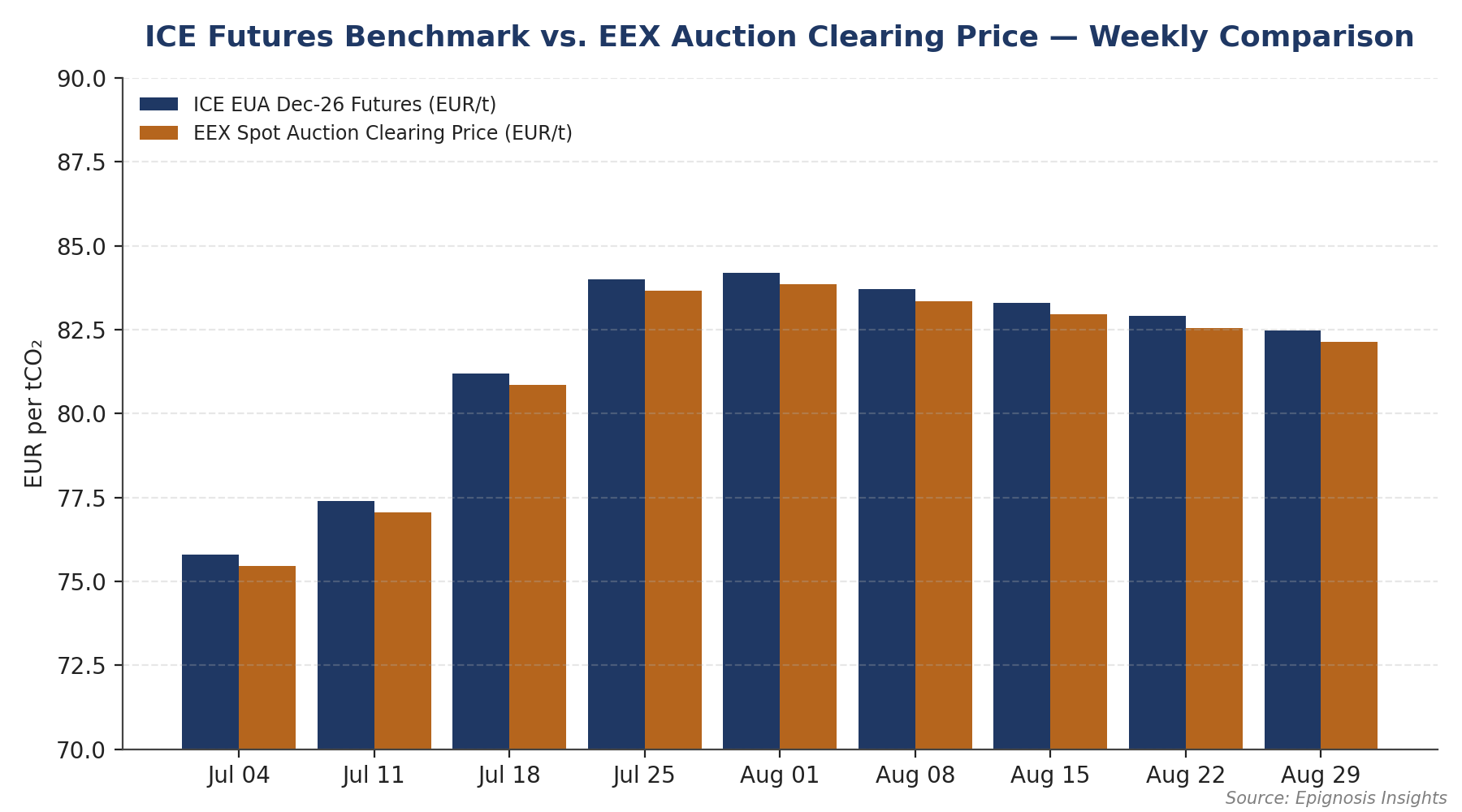
Figure 2: ICE EUA futures benchmark versus EEX spot auction clearing price, weekly comparison (EUR/tCO₂)
Regulatory developments remain the dominant medium-term driver of EU carbon pricing, and several strands of policy converged during the tracking window. The European Commission's July 2026 proposal to reform the EU ETS ahead of the bloc's 2040 climate target represents the most significant overhaul of the system since the Fit-for-55 package, and market participants have increasingly priced in its implications for allowance supply even before formal adoption. The proposal seeks to balance continued tightening of the overall emissions cap against industrial competitiveness concerns, including an extension of free allocation for sectors covered by the Carbon Border Adjustment Mechanism (CBAM) through 2037, with a revised “CBAM factor” used to phase out those free allowances more gradually than under the original Fit-for-55 timeline.
Running in parallel, CBAM itself entered its compliance phase on January 1, 2026, ending the three-year transitional reporting-only period; under the current phase-in schedule, importers of CBAM-covered goods face an obligation equivalent to 2.5 percent of embedded emissions in 2026, rising in stages to 100 percent by 2034, with an equivalent reduction each year in the free EU ETS allocations granted to the domestic producers of those same goods. The Market Stability Reserve continues to constrain auction supply through the second half of 2026, and EEX's published 2026 auction calendar confirms that MSR-related reductions apply to auction volumes through August, with the scale of reductions for the September 2026 to August 2027 intake period still subject to confirmation. Additional supply-side complexity comes from the auctioning of allowances for the EU's Social Climate Fund, with 50 million additional allowances scheduled for auction in 2026 to help finance the fund, a volume that market participants must weigh against the broader MSR-driven tightening.
Company-level disclosures offer a useful cross-check on how CBAM-exposed industries are responding to the carbon price and trade-policy backdrop. On its second-quarter 2026 earnings call, ArcelorMittal's investor relations team characterised the current EU ETS reform proposals as a sign that the European Commission is increasingly recognising the competitiveness challenges facing energy-intensive industry, highlighting in particular the extension of the free-allocation phase-out timeline and adjustments to the overall emissions cap as steps in the right direction for steelmakers. The company noted that CBAM, in effect since January 1, 2026, together with a new Tariff Rate Quota (TRQ) mechanism introduced on July 1, 2026, is expected to fundamentally reshape competitive dynamics in the European steel market by reducing total EU steel imports by an estimated 13 million tonnes compared with 2025 levels, with flat-rolled products facing the sharpest quota reductions.
Management indicated that the additional carbon cost imposed under CBAM is expected to be recovered progressively through European steel prices, with North European domestic hot-rolled coil spreads already reflecting the tighter import environment. For CBAM-covered sectors more broadly — cement, aluminium, iron and steel, fertilisers, hydrogen and electricity — the interaction between the EU ETS allowance price tracked in this report and the CBAM certificate price is direct and mechanical: CBAM certificate prices for the 2026 compliance year are set to reflect the quarterly average of 2026 EU ETS allowance prices, before CBAM certificate sales begin in February 2027 for embedded emissions from 2026-vintage imports, at which point pricing shifts to a weekly average of EU ETS auction closing prices.
Independent research from the banking and consulting community adds important context to the week-to-week price moves captured in this tracker. ABN AMRO's carbon market research has pointed to a looming EU ETS supply deficit driven by a tightening emissions cap and reduced free allocations, estimating a year-on-year reduction in allowance supply of roughly 180 million tonnes for 2026, with traders and funds reinforcing the bullish momentum through increased hedging activity and long futures positions. The research house's own base case at the time of its most recent update placed EUA prices around €84.2 per tonne — closely matching the levels observed in this tracker's early-August readings — with a year-end target of €100 per tonne predicated on continued tight supply-demand dynamics. The analysis flagged several sources of two-way risk that this tracker will continue to monitor: uncertainty around finalised free-allocation benchmarks, the timing of shipping-sector allowance surrender obligations, a risk that the European Commission could delay Innovation Fund auction volumes by as much as 21 million tonnes between June and August 2026, and the yet-to-be-confirmed scale of Market Stability Reserve injections beginning in September 2026. The research also cautioned that the Commission retains the option of smoothing the coming supply deficit by front-loading future allowance surpluses into the market, a policy lever that would materially change the bullish outlook if exercised. Separately, quarterly analyst polls compiled by financial newswires have shown forecasters trimming their 2026 and 2027 EUA price expectations somewhat in light of the Commission's July reform proposal, even as the underlying market continued to trade well above those averaged forecasts through most of the tracking window.
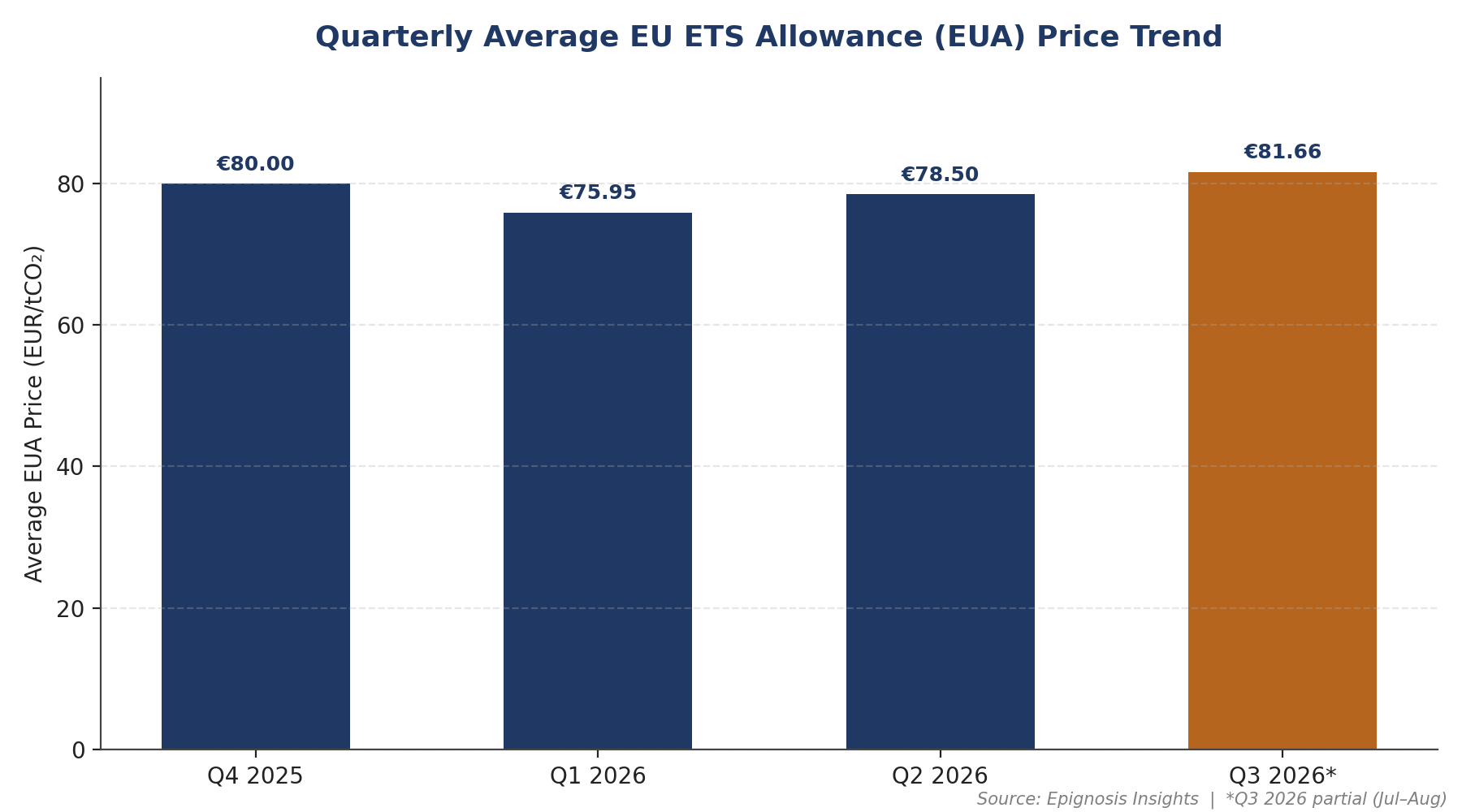
Figure 3: Quarterly average EU ETS allowance (EUA) price trend, Q4 2025 – Q3 2026 (partial)
The net effect of rising and volatile carbon prices is being felt across the full chain of EU ETS-covered and CBAM-exposed industries. For power generators and industrial emitters without free allocation, a EUA price sustained above €82 per tonne materially raises the marginal cost of fossil-fuel-based generation relative to renewables, reinforcing the price signal the scheme is designed to send, while for CBAM-covered importers of steel, aluminium, cement, fertiliser and hydrogen, the direct linkage between the EU ETS allowance price and the CBAM certificate price means that this tracker's weekly EUA readings now translate mechanically into future compliance costs for non-EU producers exporting into the bloc. Trade coverage of the early-August rally noted that the market increasingly priced in the structural deficit implied by the Commission's reform proposal even before its rules are finalised, while also flagging trader sensitivity to the psychologically significant €80 per tonne level, above which further gains have historically invited political scrutiny.
Looking into September, the trajectory of Market Stability Reserve injections beginning that month, alongside the pace of Innovation Fund and Social Climate Fund auctioning, are likely to be the dominant swing factors for the EUA price, with the natural gas complex remaining an important secondary driver given the historically close, though recently loosening, correlation between the two markets. Epignosis Insights will continue to track both the futures benchmark and the EEX auction clearing price on a weekly basis through the remainder of the third quarter, alongside the evolving CBAM compliance calendar.
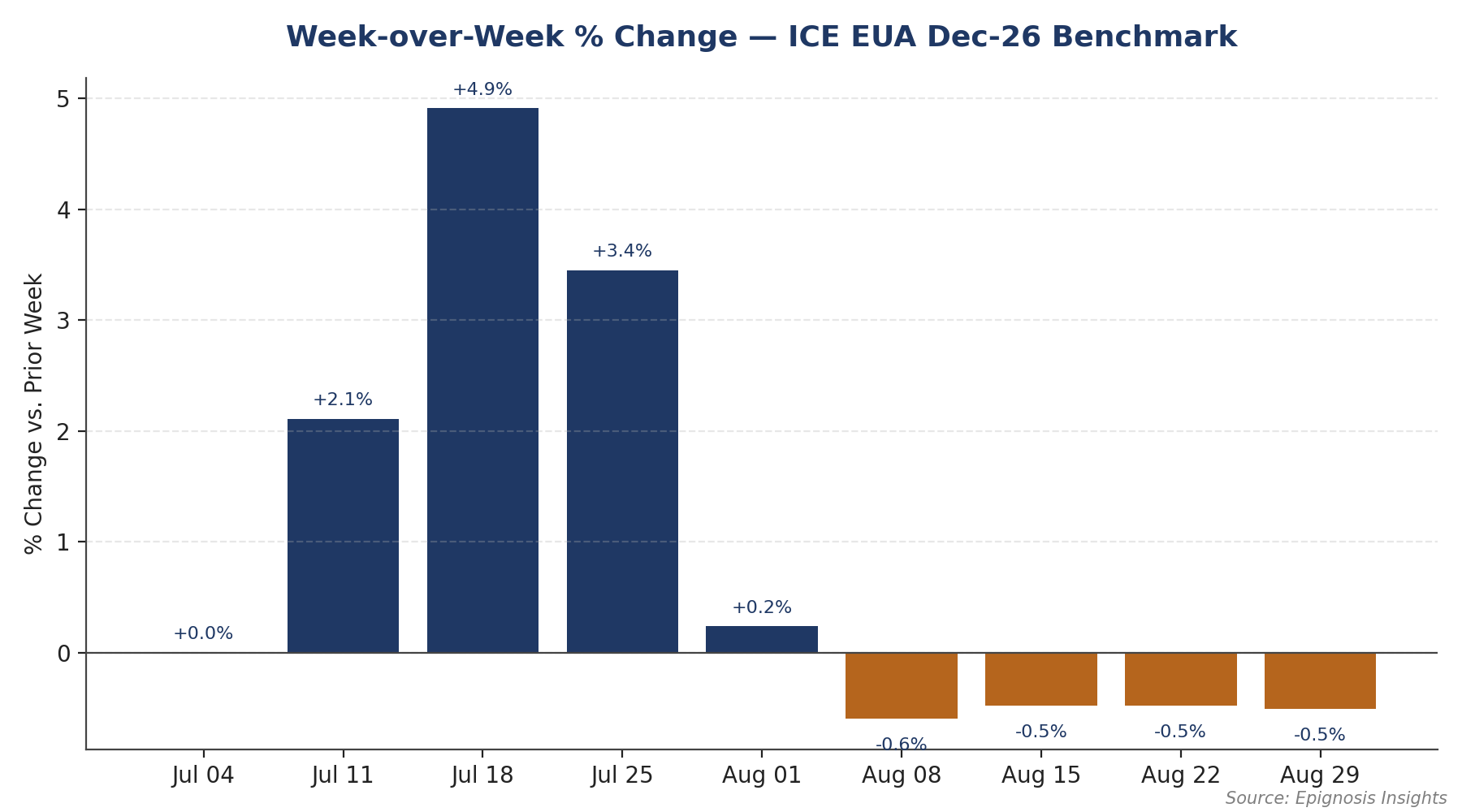
Figure 4: Week-over-week percentage change in the ICE EUA Dec-26 benchmark