Asia Semiconductor Wafer Price Tracker
Epignosis Insights Research Desk — Monthly Report, August 2026


Epignosis Insights Research Desk — Monthly Report, August 2026
Asia's Semiconductor Wafer Market is running two simultaneous price cycles in 2026, and this report, compiled by the Epignosis Insights Research Desk from industry-association shipment data, consulting-firm contract-price surveys, company investor disclosures, and government trade statistics, tracks both. On the foundry side, Taiwan Semiconductor Manufacturing Company is pushing through multi-year price increases across its most advanced logic nodes, with 3-nanometer wafers now priced around $20,000 and 2-nanometer wafers expected to exceed $30,000 once high-volume production ramps later this year. On the memory side, DRAM and NAND Flash contract prices have posted the steepest sequential increases in the industry's history, driven by AI data-center demand pulling capacity away from consumer electronics. According to SEMI's Silicon Manufacturers Group, worldwide silicon wafer shipments reached 3,573 million square inches in the second quarter of 2026, up 7.4% year-on-year and 9.1% quarter-on-quarter confirming that volume growth and price growth are both running hot at the same time, an unusual combination that reflects genuine capacity scarcity rather than speculative repricing.
TSMC has mapped out consecutive annual price increases across its advanced-node portfolio spanning 2026 through at least 2029, according to industry reporting citing the Economic Daily News and corroborated by multiple semiconductor trade publications. The 2026 increases took effect January 1 and range between 3% and 10% depending on process node, customer volume, and application, with smartphone and mobile chips seeing roughly 5% increases, CPUs approximately 7%, and high-performance computing and AI chips facing increases of up to 10%. In absolute terms, industry pricing data shows TSMC's 300mm wafers currently range from approximately $3,000 at the mature 28-nanometer node to roughly $18,500 at 5-nanometer and $20,000 at 3-nanometer, with the forthcoming 2-nanometer node expected to exceed $30,000 per wafera roughly 50% premium over current 3nm pricing that marks a notable inflection point where manufacturing complexity is now outweighing the traditional cost benefits of transistor shrinkage.
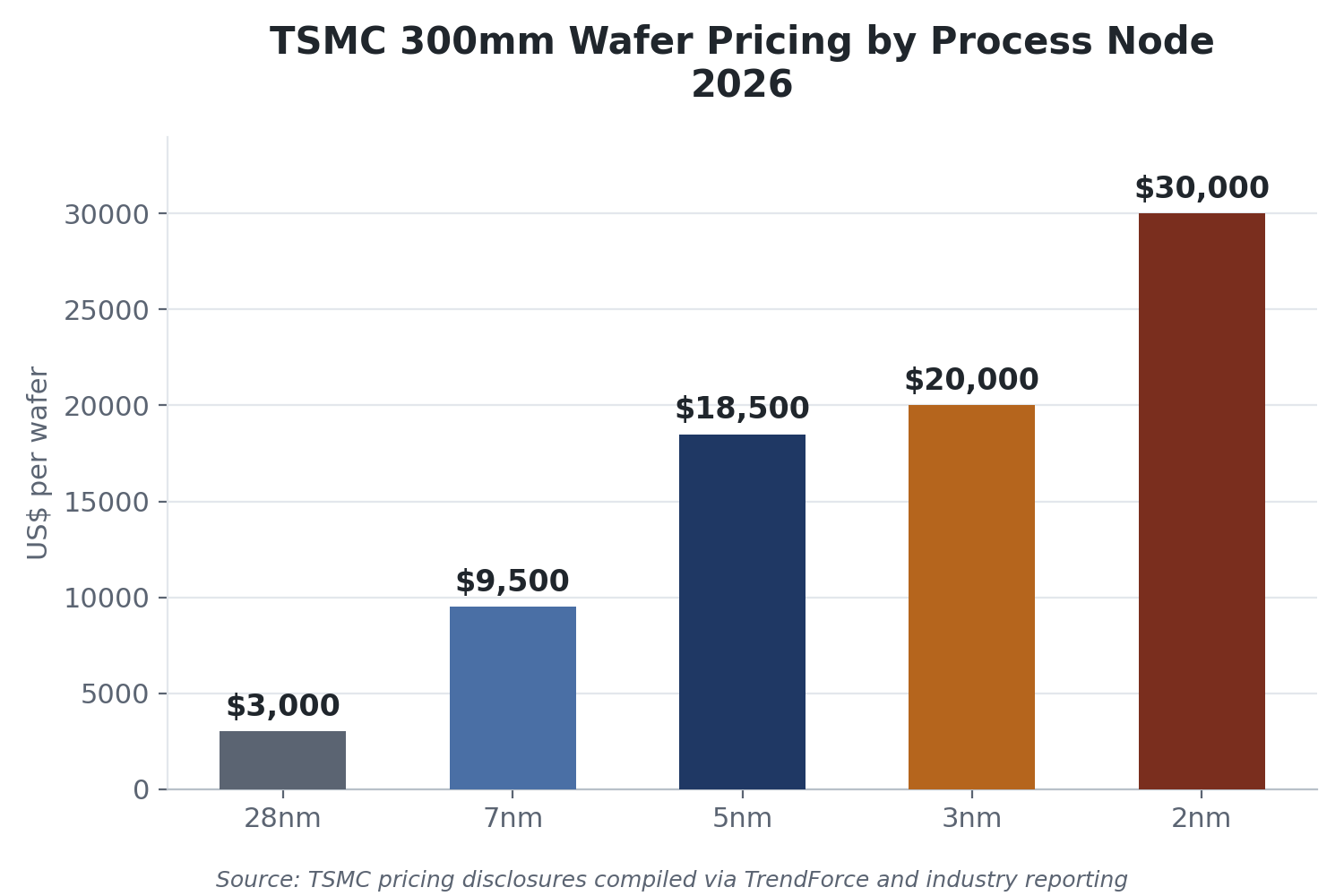
Figure 1: TSMC 300mm wafer pricing by process node, 2026. Source: TSMC pricing disclosures compiled via TrendForce and industry reporting, Epignosis Insights Research Desk.
The memory segment has seen even sharper price movement than logic foundry pricing. According to TrendForce's memory pricing survey, conventional DRAM contract prices rose approximately 90% to 95% quarter-on-quarter in the first quarter of 2026 a record for the industry before moderating to a still-extraordinary 58% to 63% increase in the second quarter. NAND Flash contract prices moved in the opposite sequence, rising roughly 55% to 60% in the first quarter before accelerating to 70% to 75% in the second quarter, outpacing DRAM growth for the first time in the current cycle. TrendForce attributes both trends to the same root cause: DRAM suppliers reallocating capacity toward high-bandwidth memory and server-grade RDIMMs for AI data centers, while NAND capacity increasingly shifts toward enterprise SSDs, leaving consumer-facing PC and smartphone memory buyers competing for a shrinking residual supply. Looking ahead, TrendForce's latest survey forecasts more moderate but still substantial increases of 13% to 18% for DRAM and 10% to 15% for NAND Flash in the third quarter of 2026, as consumer-market price tolerance approaches its limit even while server demand remains structurally undersupplied.
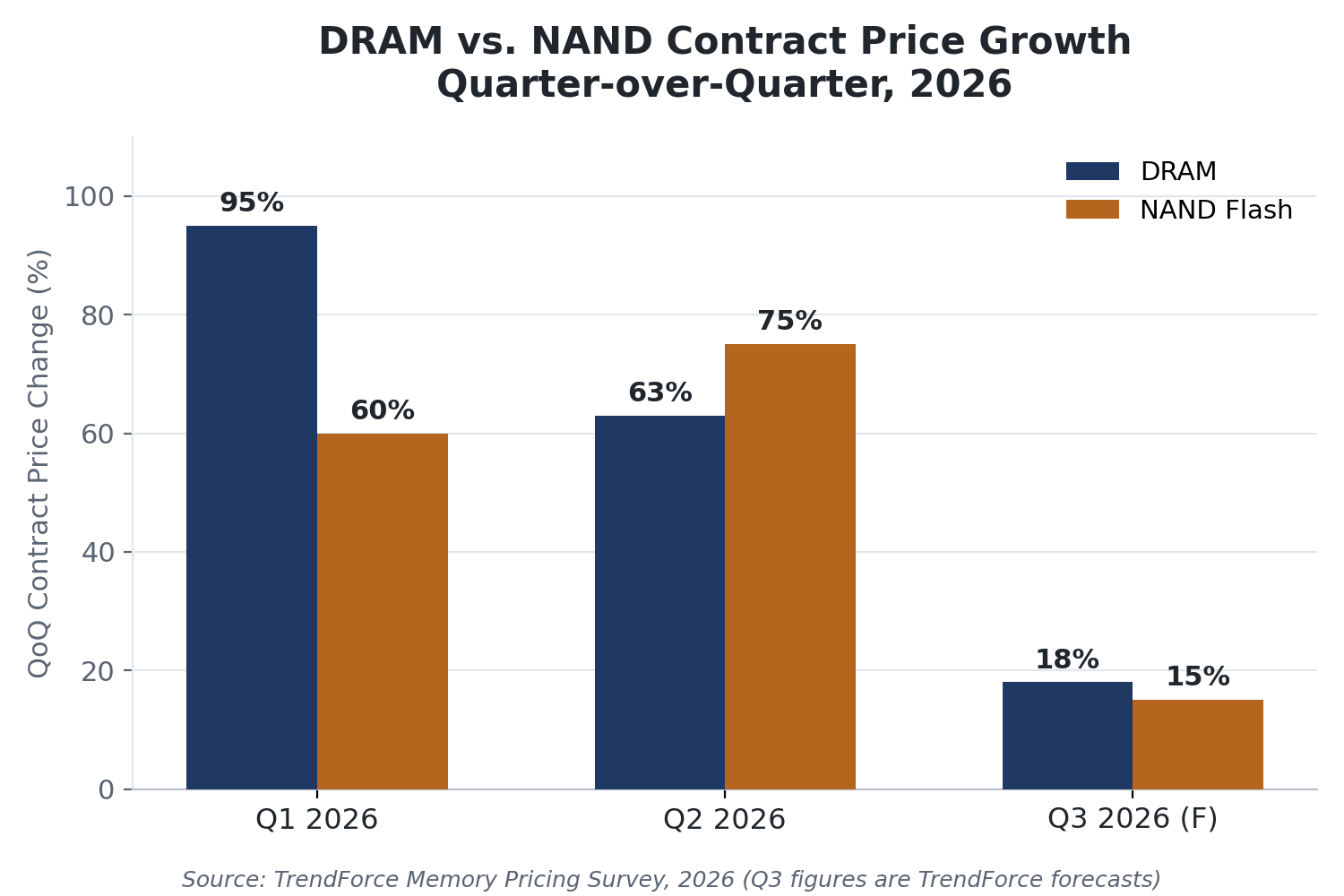
Figure 2: DRAM vs. NAND Flash contract price growth, quarter-over-quarter, 2026. Source: TrendForce Memory Pricing Survey, Epignosis Insights Research Desk.
Industry association SEMI's Silicon Manufacturers Group provides the clearest cross-industry volume benchmark, tracking raw wafer shipments independent of any single manufacturer's pricing strategy. The group's Q2 2026 report shows worldwide silicon wafer shipments of 3,573 million square inches, up from 3,327 MSI in the same quarter of 2025 and 3,275 MSI in the first quarter of 2026. SEMI SMG Chairman Ginji Yada, also General Manager of Sales and Marketing at SUMCO Corporation, noted that AI-related demand is broadening beyond advanced logic and memory into power devices and photonics, while industrial and automotive demand is recovering even as memory price pressures constrain PC and smartphone demand a dynamic directly consistent with the diverging consumer-versus-server pricing pattern documented in the memory section above.
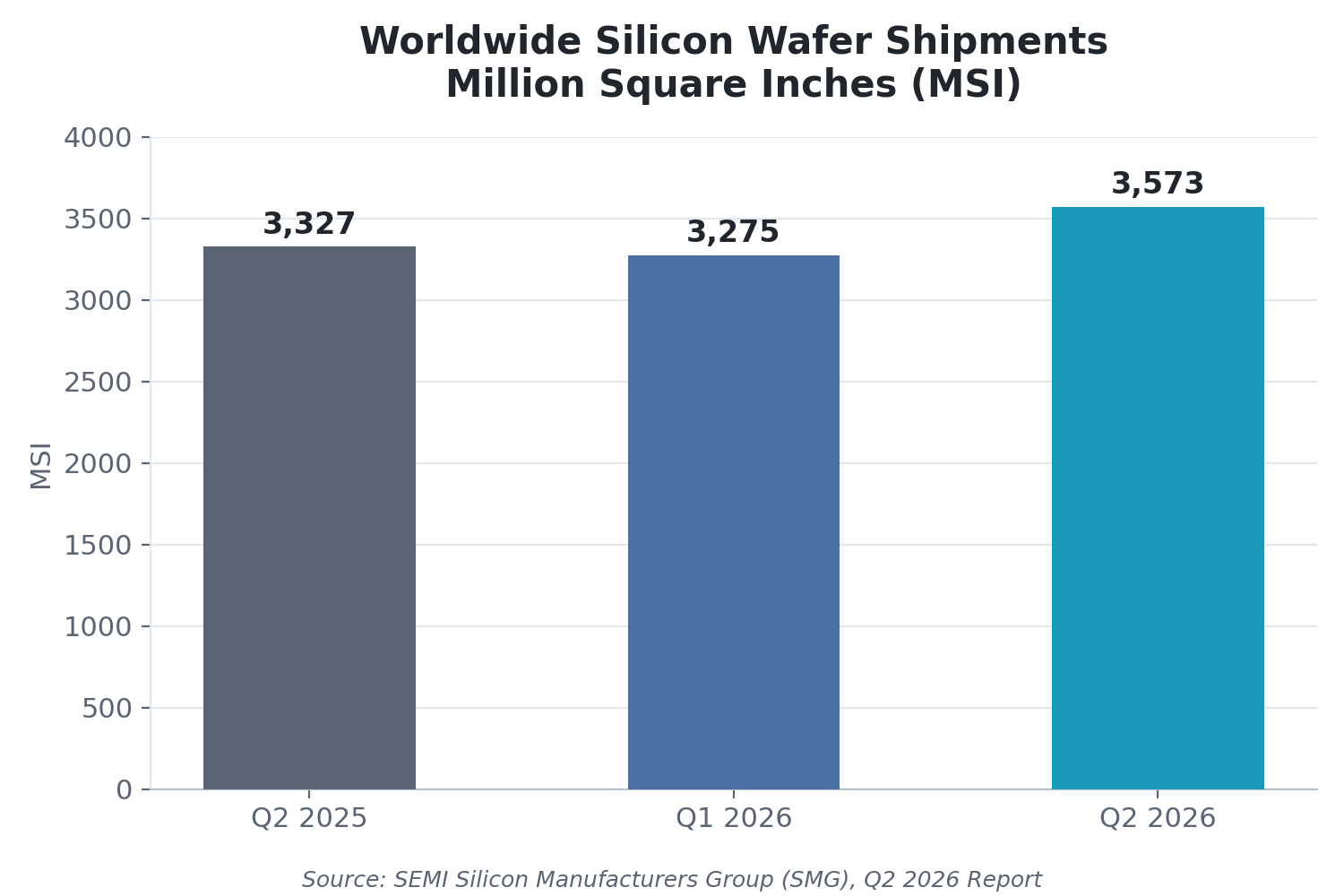
Figure 3: Worldwide silicon wafer shipments, million square inches (MSI). Source: SEMI Silicon Manufacturers Group, Epignosis Insights Research Desk.
TSMC's own investor disclosures provide direct confirmation of the pricing power described above. The company reported second-quarter 2026 revenue of $40.2 billion, at the high end of its guidance range, with gross margin reaching 67.7% up 1.5 percentage points sequentially on cost improvements and higher capacity utilization. Management raised its full-year 2026 revenue growth outlook to slightly above 40% year-on-year and lifted 2026 capital expenditure guidance to a range of $60 billion to $64 billion, up from a prior $52–$56 billion range, alongside an additional $100 billion investment commitment in Arizona. CEO C.C. Wei told analysts on the earnings call that the company's conviction in the multi-year AI megatrend remains very strong and that capital spending in the coming three years will be even more significantly higher than the past three years. TSMC guided third-quarter 2026 revenue to a range of $44.6 billion to $45.8 billion, which would represent another sequential record, while flagging that gross margin is expected to moderate slightly in the third quarter as 2-nanometer production ramps.
Government trade data corroborates the scale of capacity expansion underway. Taiwan's Ministry of Finance reported that semiconductor equipment imports reached $105.7 billion in 2025, an increase of $35.7 billion, or 51.0%, over the prior year a figure that reflects the scale of fabrication capacity being built across Taiwan's foundry ecosystem to meet the AI-driven demand described throughout this tracker. Separate Ministry of Finance monthly trade releases show Taiwan's overall exports expanding by more than 50% year-on-year in several months of 2026, with information, communication, and electronic component shipments consistently cited as the primary growth driver. This import-led capital equipment buildout is the direct upstream counterpart to the wafer capacity increases SEMI is now recording in shipment volumes, and it signals that the current pricing cycle is being met with genuine capacity investment rather than pure price gouging on a fixed supply base.
Pricing pressure is not confined to the leading edge. Trade publication Digitimes reports that mature-node foundries led by China's SMIC have initiated a fresh wave of price increases on legacy process nodes, a trend TSMC is reportedly now following even at its more mature 5-nanometer and 4-nanometer nodes rather than restricting hikes to its newest technology. This matters for Asia's broader wafer market because mature nodes typically 28-nanometer and above still account for the majority of wafer volume used in automotive, industrial, and power-management applications, meaning the price increases documented in Figure 1 for advanced nodes are now being mirrored, to a lesser degree, across a much larger base of legacy production capacity. Taiwan's UMC, historically a mature-node specialist, has flagged continued pricing challenges heading into 2026 even as SMIC's own increases suggest Chinese foundries are gaining enough negotiating leverage in legacy segments to raise prices in step with, rather than below, their Taiwanese counterparts.
A parallel cost layer sits downstream of wafer fabrication itself: advanced packaging. Industry cost-modeling firm Silicon Analysts reports that outsourced semiconductor assembly and test (OSAT) providers, led by Taiwan's ASE Technology, are raising packaging and test service prices by 5% to 20% in 2026, with memory-focused packaging and test specialists such as Powertech Technology pushing increases as high as 30%. The constraint is structural rather than cyclical: CoWoS advanced packaging, which integrates logic dies with high-bandwidth memory stacks for AI accelerators, requires specialized 2.5D interposer and 3D stacking equipment that cannot be rapidly scaled, and CoWoS capacity has functioned as the binding constraint on Nvidia GPU shipment volumes for more than a year despite ongoing expansion by TSMC and its packaging partners.
For buyers assembling finished AI accelerators, this means the wafer price increases tracked in this report represent only part of the total landed cost increase the packaging step layered on top is, in percentage terms, rising even faster for memory-intensive products.
The wafer capacity buildout tracked in this report is concentrated in three geographies with distinct specializations. Taiwan, anchored by TSMC, continues to dominate advanced logic manufacturing, accounting for the majority of global sub-5-nanometer capacity and commanding the pricing power documented in Figure 1. South Korea's Samsung and SK Hynix remain the primary counterweight in memory, with SK Hynix reporting first-quarter 2026 revenue of $27.98 billion, up 62.5% quarter-on-quarter, on the strength of its high-bandwidth memory bit-shipment mix — the highest among the top three DRAM suppliers according to TrendForce's supplier rankings. China's foundry ecosystem, led by SMIC, has concentrated its expansion in mature and legacy nodes rather than competing directly at the leading edge, a segmentation that has allowed Chinese and Taiwanese mature-node pricing to move in tandem, as described above, without direct competition at the 3-nanometer and below tier where TSMC remains effectively unchallenged. This three-way regional split Taiwan in advanced logic, Korea in advanced memory, China in mature-node volume is the structural backdrop against which every price movement in this tracker should be read.
| Metric | Value | Period |
| Worldwide silicon wafer shipments | 3,573 MSI | Q2 2026 |
| Wafer shipment growth, YoY | +7.4% | Q2 2026 |
| Wafer shipment growth, QoQ | +9.1% | Q1→Q2 2026 |
| TSMC 3nm wafer price | ~$20,000/wafer | 2026 |
| TSMC 2nm wafer price (projected) | ~$30,000/wafer | 2026 |
| Conventional DRAM contract price, QoQ | +58% to +63% | Q2 2026 |
| NAND Flash contract price, QoQ | +70% to +75% | Q2 2026 |
| DRAM contract price forecast, QoQ | +13% to +18% | Q3 2026 (F) |
| TSMC Q2 2026 revenue | $40.2 billion | Q2 2026 |
| TSMC Q2 2026 gross margin | 67.7% | Q2 2026 |
| TSMC 2026 capital expenditure | $60–$64 billion | FY2026 |
| Taiwan semiconductor equipment imports, annual | $105.7 billion (+51.0% YoY) | 2025 |
The data compiled in this tracker points toward continued, if moderating, price pressure across both the foundry and memory segments of Asia's semiconductor wafer market through the remainder of 2026. On the foundry side, TSMC's mapped multi-year price increases through 2029, combined with a sold-out 3-nanometer node through 2027, suggest advanced-node wafer pricing has further room to climb even as the pace of annual increases stays in the single-digit percentage range. On the memory side, TrendForce's own forecast trajectory from roughly 95% DRAM contract growth in the first quarter down to a projected 13–18% in the third quarter shows the steepest phase of the current memory supercycle has likely already passed, though absolute price levels remain at record highs with no meaningful new fab capacity expected before late 2027 or 2028. For procurement teams and device makers sourcing wafers and memory across Asia, the practical takeaway is that server- and AI-linked demand will continue to command priority allocation and pricing, while consumer-facing PC and smartphone buyers should expect continued supply constraints and cost pass-through pressure at least through the end of 2026.