U.S. Lumber Price Tracker
Weekly Edition | Week 41: October 5–9, 2026 | Data as of October 8, 2026


Weekly Edition | Week 41: October 5–9, 2026 | Data as of October 8, 2026
| Indicator | Latest | Prior | Change |
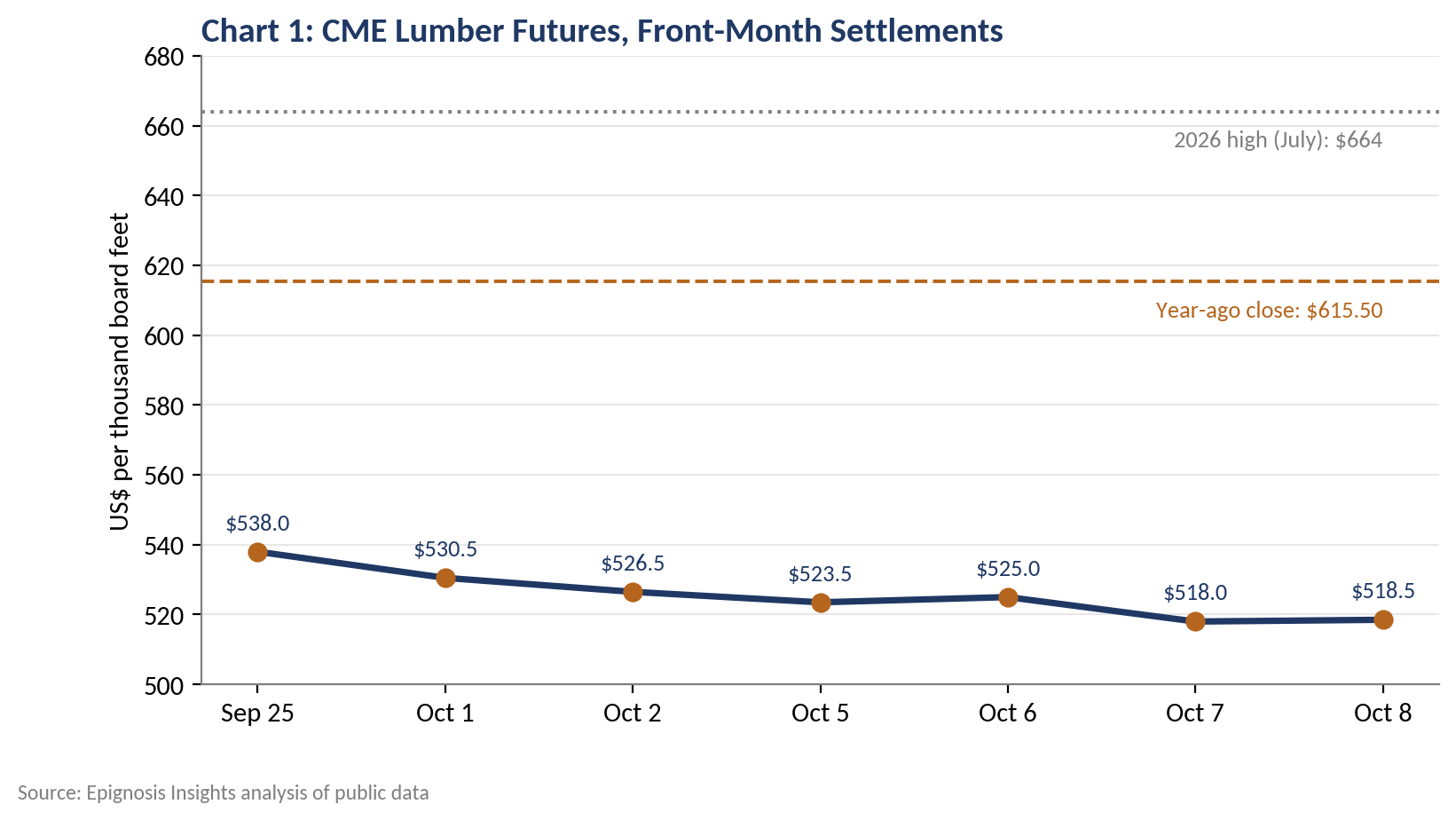
| CME lumber futures (front month) | $518.50/mbf (Oct 8) | $526.50 (Oct 2) | -1.5% w/w; -15.0% y/y |
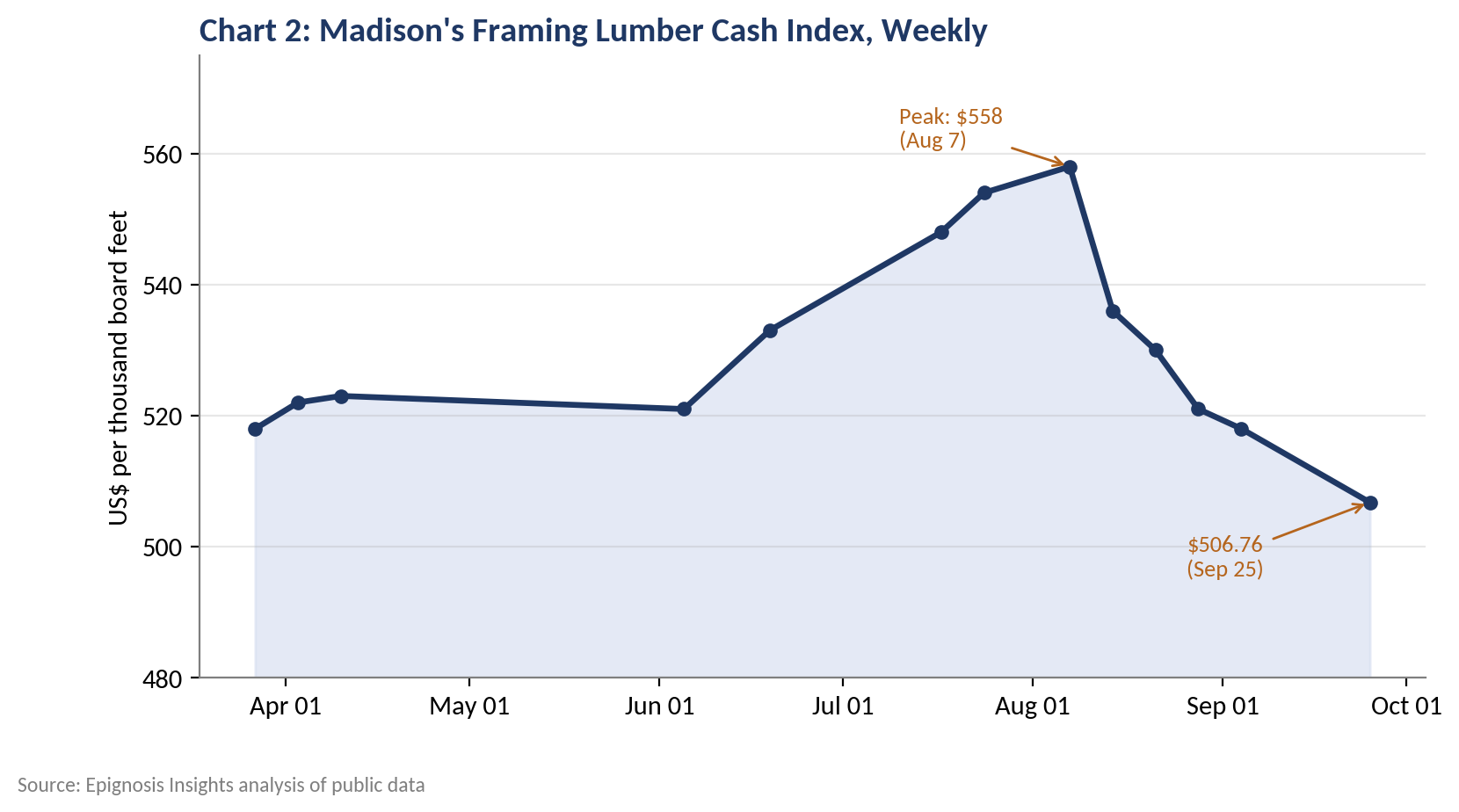
| Framing lumber cash index | $506.76/mbf (Sep 25) | Prior week | -1.8% w/w; +4.5% y/y |
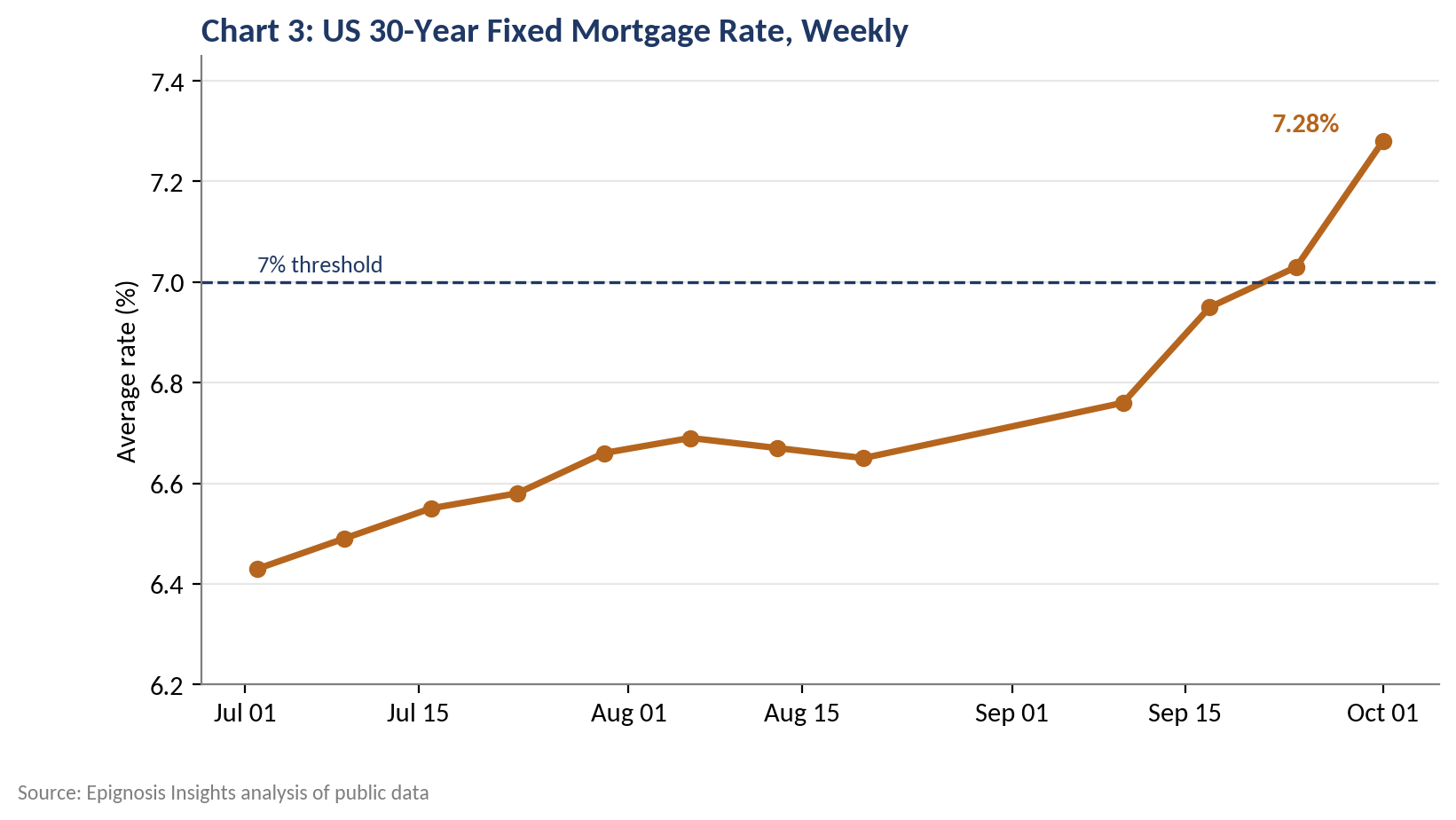
| 30-year fixed mortgage rate | 7.28% (Oct 1) | 7.03% (Sep 24) | +25 bp w/w; +94 bp y/y |
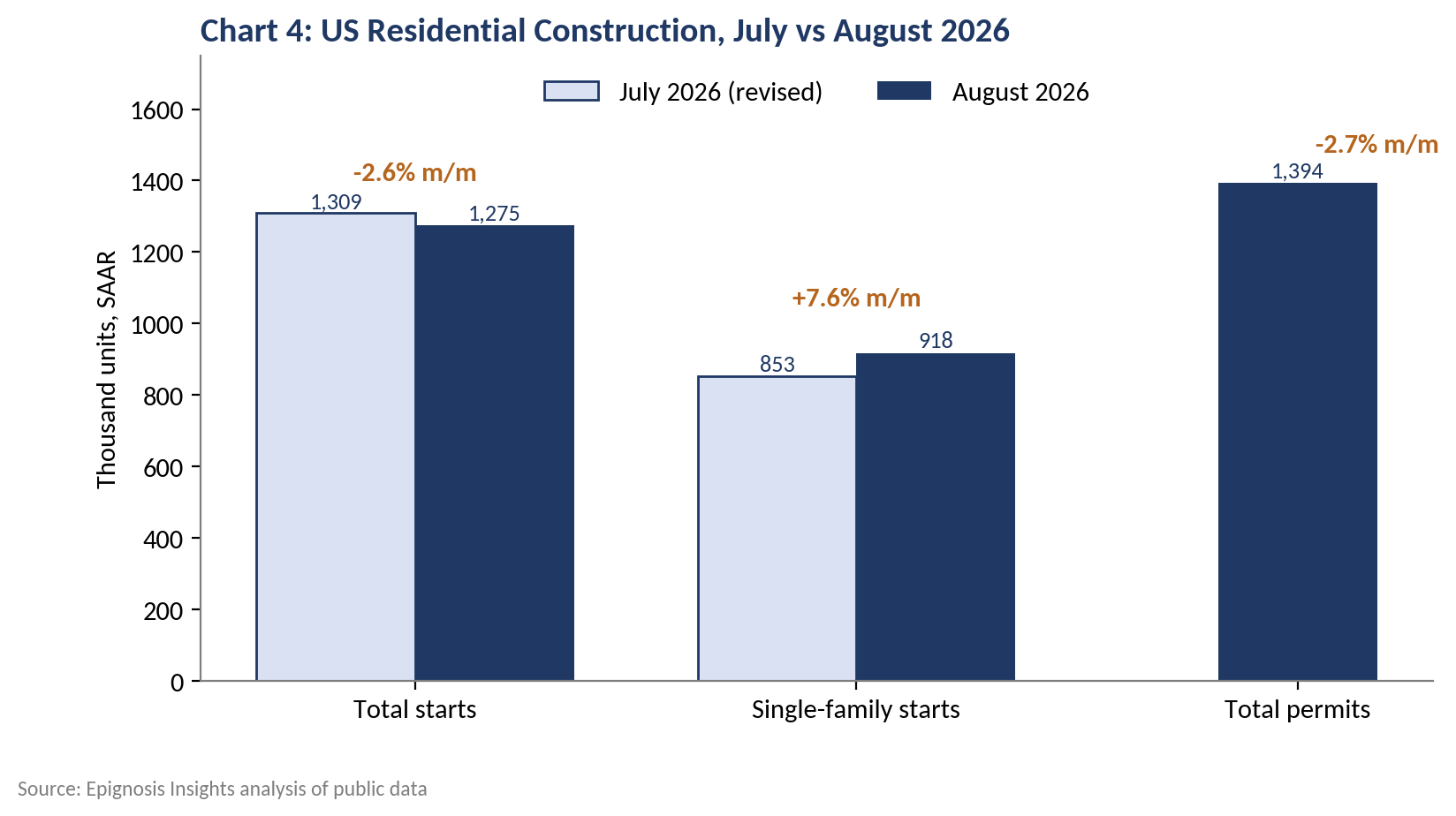
| Total housing starts (SAAR) | 1.275M (Aug) | 1.309M (Jul) | -2.6% m/m |
| Single-family starts (SAAR) | 918k (Aug) | 853k (Jul) | +7.6% m/m |
| NAHB/Wells Fargo HMI | 32 (Sep) | 35 (Aug) | -3 points |
| Duty on most Canadian softwood | ~45.2% | AR7 final pending | Could fall ~10 pts |
U.S. Softwood Lumber Prices extended their autumn slide in the week ending October 9, 2026. The CME front-month contract settled at $518.50 per thousand board feet (mbf) on October 8, roughly 1.5% below the prior Friday's close and about 15% below year-ago levels, according to Epignosis Insights' compilation of exchange settlement data. Prices have now given back close to 22% from the July 2026 peak of $664/mbf, and the market has printed successive lows over the past fortnight: a ten-month low on October 2, followed by a fresh twelve-month low early this week.
The driver is demand, not supply. The 30-year fixed mortgage rate climbed to 7.28% on October 1, its highest reading since early 2025; mortgage applications have fallen for five consecutive weeks; and homebuilder sentiment dropped to a one-year low of 32 in September. Against this backdrop, the supply side remains comparatively firm. Combined duties of roughly 45% on most Canadian softwood lumber continue to anchor the cost floor for the largest import source, while North American producers are operating lean after a wave of 2025 mill closures.
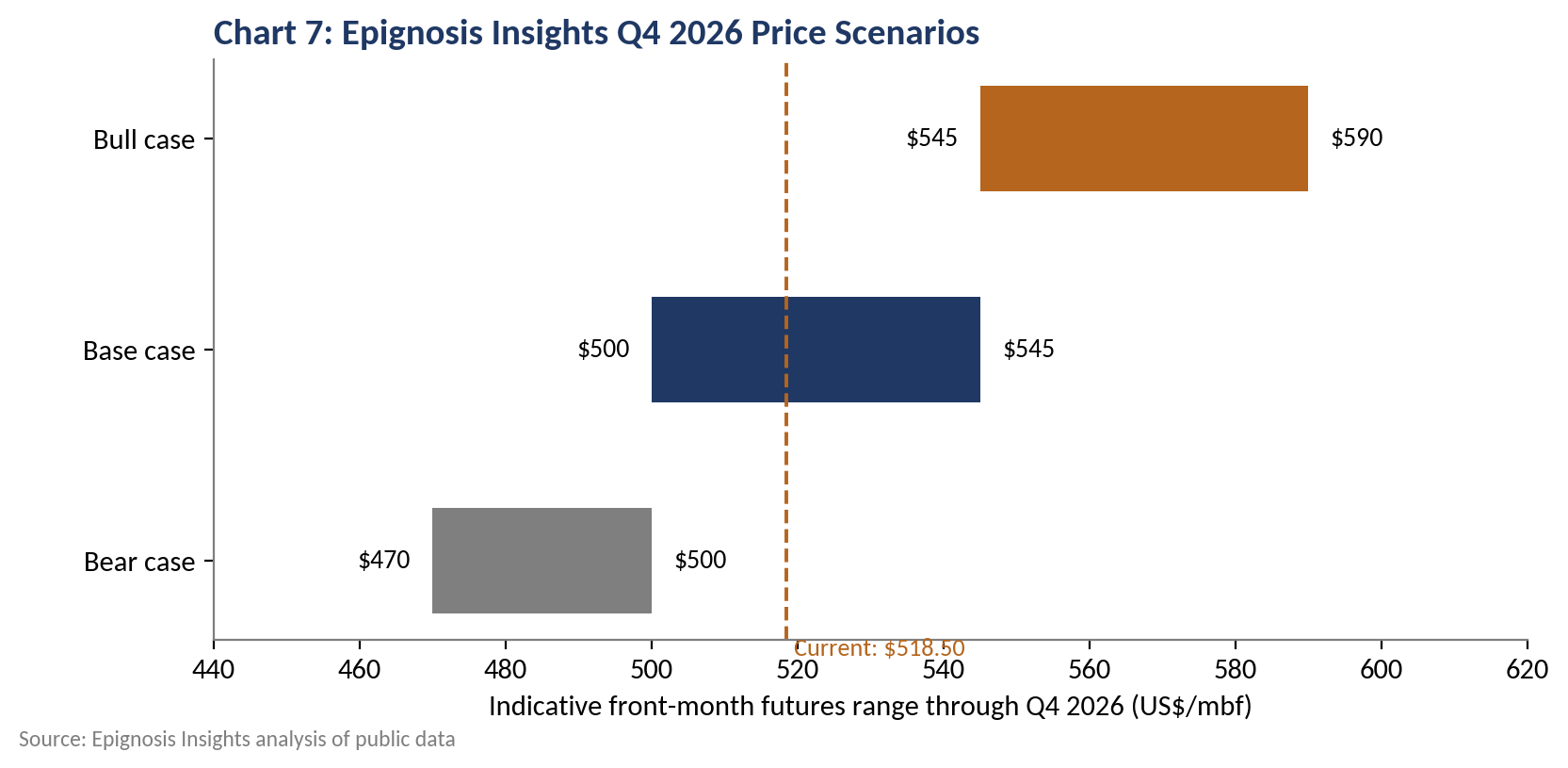
Epignosis Insights' base case places front-month futures in a $500–545/mbf range through the remainder of Q4 2026, with a sustained recovery unlikely before the 2027 spring building season. The two pivotal catalysts over the coming weeks are the US Department of Commerce's final seventh administrative review (AR7) duty rates, expected this month, and the September housing starts release scheduled for October 20.
Exchange data confirm that the decline has been gradual and persistent rather than disorderly. The contract closed the prior week at $526.50/mbf on Friday, October 2, its lowest close since November 14, 2025, after losing $11.50, or 2.1%, over five sessions. Activity was notably thin, with average daily turnover of 536 contracts sitting well below the 12-week baseline of 757 (Lesprom). In Epignosis Insights' reading, this pattern signals buyers standing aside rather than sellers capitulating.
This week opened with modest two-way trading. The contract slipped to $523.50 on Monday, recovered to $525.00 on Tuesday, then fell 1.33% to $518.00 on Wednesday (Investing.com), before edging up 0.19% to $518.50 on Thursday. Over the past month, the benchmark has fallen about 10.5%, and it now sits 15% below the same point in 2025 (Trading Economics).
In a longer context, 2026 has followed a mid-year rally and steep correction. Futures peaked at $664/mbf in July, then fell 18.5% to $541 by September 18 as seasonal weakness and elevated borrowing costs took hold (Barchart). The October lows extend that drawdown to roughly 22%. Chart 1 tracks front-month settlements across the last two weeks against the year-ago and 2026 peak reference levels.
Seasonality explains only part of the move. The September-to-December window is ordinarily the softest stretch of the framing calendar, but the current correction is deeper than a routine seasonal fade because it coincides with a sharp rise in financing costs. From a technical standpoint, Epignosis Insights treats $500/mbf as the next psychological support, while the September 18 low of $541 now acts as first resistance. A weekly close back above that level would be the earliest signal that the correction has run its course; until then, rallies are likely to be sold into by mills seeking to clear Q4 inventory.
The physical market has softened far less sharply than futures. Framing lumber was assessed at $506.76/mbf on September 25, down 1.8% week-over-week and 2.8% month-over-month but still 4.5% higher year-over-year; on the same date, futures were 10.2% lower than a year earlier (NAHB). The weekly cash index peaked at $558/mbf in the week ending August 7 before declining through most of the following seven weeks (Madison's Lumber Reporter).
Epignosis Insights attributes this divergence to two factors. Futures typically discount the Q4 demand slowdown earlier than the physical market, and mills constrained by duty costs and recent closures have been reluctant to cut quotes aggressively. On September 25, the front month carried a premium of roughly $31 over the cash index. With futures down a further $20 since then, that premium has compressed materially, a configuration that historically precedes either a cash catch-down or a stabilisation in futures.
Mortgage financing costs are the dominant headwind. The 30-year fixed rate averaged 7.28% as of October 1, up from 7.03% a week earlier and 6.34% a year ago (Freddie Mac). Rates have risen roughly 85 basis points since early July, when they averaged 6.43%. The transmission to buyers has been immediate: mortgage applications fell 4.2% in the week ending October 2, a fifth straight weekly decline and the lowest level since January 2025 (All Ag News).
Construction data show a market softening unevenly. Privately owned housing starts ran at a seasonally adjusted annual rate of 1,275,000 in August, 2.6% below July's revised 1,309,000 and 1.2% below August 2025. Single-family starts, the most lumber-intensive segment, rose 7.6% to 918,000, but building permits slipped 2.7% to 1,394,000 (US Census Bureau). The August decline was driven entirely by a 21.7% drop in multi-family starts, and with permits falling in both segments, further moderation in starts is likely in the months ahead (TD Economics).
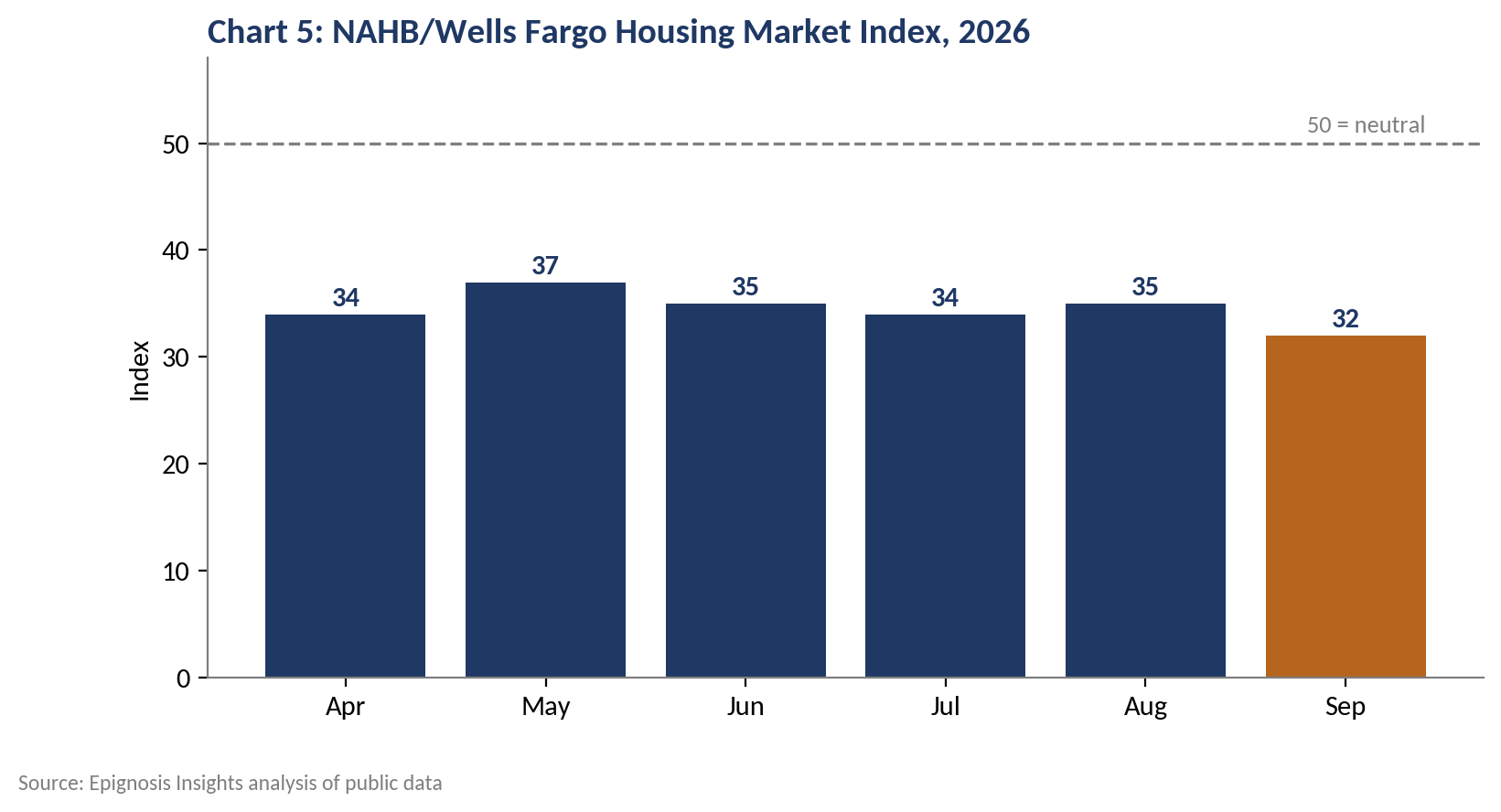
Builder sentiment confirms the forward signal. The NAHB/Wells Fargo Housing Market Index fell three points to 32 in September, below the consensus estimate of 34, with the current sales conditions component dropping to 35 from 39 (investingLive). For lumber, this matters because builders discounting homes to clear inventory are unlikely to accelerate new starts in Q4, already the seasonally weakest quarter for framing demand. Epignosis Insights' reading is that single-family starts near 900,000 units can absorb current mill output without generating price upside, but cannot sustain a rally while mortgage rates hold above 7%.
Supply-side signals are more balanced. West Fraser, one of North America's largest lumber producers, reported Q2 2026 sales of $1.434 billion and adjusted EBITDA of $59 million, with its lumber segment contributing $41 million, including a $13 million favourable in-year duties adjustment. Management expects lumber demand to remain stable in 2026 amid ongoing affordability challenges and reiterated SPF and SYP shipment targets of 2.4 to 2.7 billion board feet, supported by the ramp-up of its modernised Henderson, Texas sawmill (West Fraser).
Two implications stand out for price formation. First, margins at major producers remain thin even after the mid-year price gains, which limits appetite for volume-driven price cutting and reinforces the cost floor.
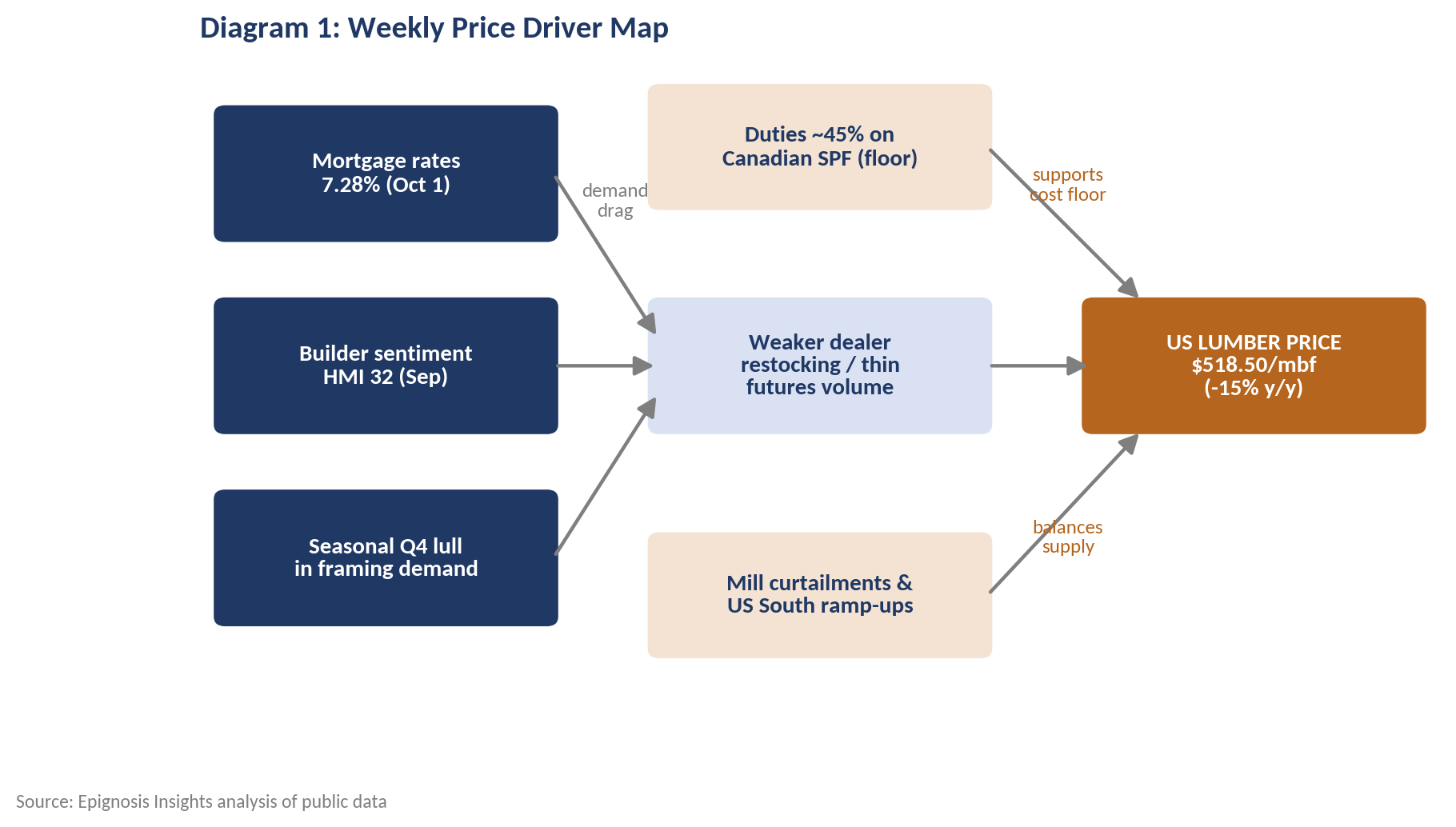
Second, capacity is migrating south, as US South mills ramp up while Canadian interior capacity was rationalised through 2025. Looking further out, the US is projected to become a net exporter of softwood lumber by 2027, with offshore exports rising from 1.11 billion board feet toward 2.7 billion as Southern Yellow Pine mills target North Africa, the Middle East and the Caribbean (Fastmarkets). Epignosis Insights views this export valve as a medium-term stabiliser that gives US mills an outlet when domestic demand softens, reducing the depth of seasonal troughs. Diagram 1 above maps how these demand and supply forces are interacting this week.
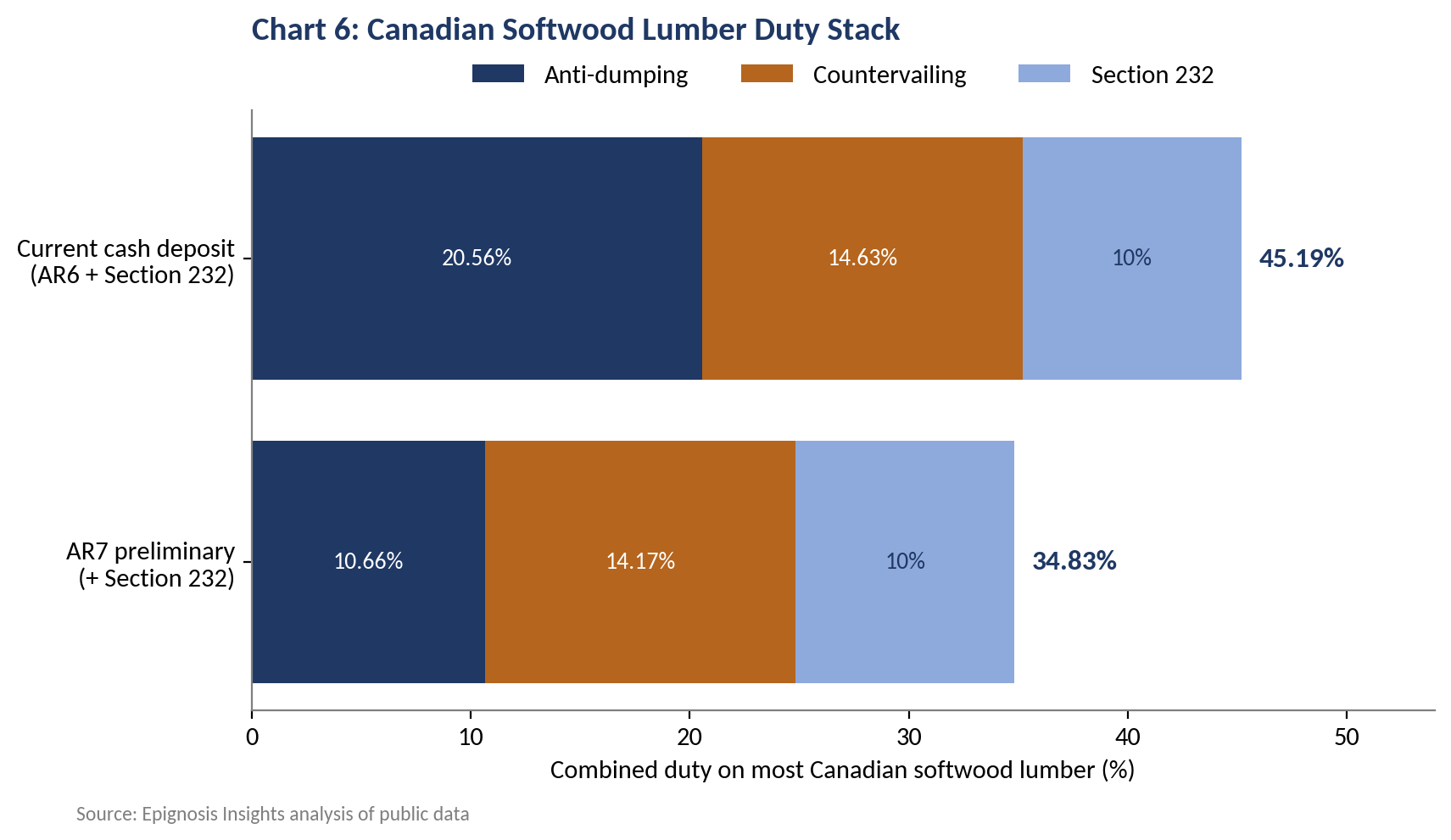
Trade policy remains the largest source of uncertainty. Most Canadian softwood lumber currently enters at sixth administrative review (AR6) cash deposit rates, comprising a 20.56% anti-dumping rate and a 14.63% countervailing rate for non-selected companies (US Department of Commerce). On top of this sits the 10% Section 232 tariff on softwood timber and lumber in force since October 2025, bringing the combined burden to roughly 45%.
That stack is set to change. Commerce's preliminary AR7 results in April set a combined anti-subsidy and anti-dumping rate of 24.83% for lumber imported in 2024 (US Lumber Coalition), roughly ten points below the current deposit rate. The final AR7 results are expected in October 2026, and AR6 deposit rates remain in effect until then (Global Affairs Canada). Chart 6 compares the two duty stacks.
The broader US–Canada dispute has also escalated. The United States applied additional 50% tariffs to approximately CA$27.6 billion of Canadian goods from August 22 under Section 338, and Canada's counter-tariffs, including a 25% surtax on US-origin lumber, came into force on September 8 (Dentons). Plywood, veneered panels and laminated veneer lumber face a higher 50% Canadian rate (Panels & Furniture Asia). Separately, the Commerce Secretary was due to deliver an update on hardwood timber and lumber imports by October 1, which could lead to further duties (The Architect's Newspaper).
Epignosis Insights' assessment is that a lower final AR7 rate would reduce the landed cost of Canadian SPF by close to ten percentage points. In a demand-constrained market this is mildly bearish for US prices near term because it lowers part of the cost floor. Canadian retaliation on US lumber has limited direct price impact given modest US export volumes to Canada, but the 50% panel tariff is a margin risk for US plywood and LVL producers selling north.
Forecasters broadly agree that the trough extends into winter. Log and lumber prices are expected to remain relatively flat for the rest of 2026 before potentially moving upward in 2027 (Washington State Department of Natural Resources). One forest products outlook projects North American lumber consumption rising 0.7% to 59.9 billion board feet in 2026 and 2.7% to 61.5 billion in 2027, with prices up 3.1% and 7.7% respectively (Farm Credit East), a trajectory that depends on rate relief that has yet to materialise.
Epignosis Insights' base case ($500–545/mbf) assumes mortgage rates holding between 7.0% and 7.3%, AR7 finalising near preliminary levels, and a normal seasonal lull. The bear case ($470–500/mbf) reflects rates pushing toward 7.5%, September starts falling below 1.25 million, and a lower AR7 rate easing Canadian supply costs. The bull case ($545–590/mbf) requires rates retreating below 7%, earlier-than-usual Q1 restocking, or a supply or policy shock such as new hardwood or panel tariffs spilling into softwood.
Epignosis Insights will adjust these ranges against three signposts. First, financing costs: each sustained 25 basis point move in the 30-year mortgage rate has historically shifted builder purchasing intentions within weeks, so the Thursday rate prints are the most frequent read on direction. Second, the October 20 housing starts release: a single-family reading holding near or above 900,000 units would validate the base case, while a slide toward 850,000 would tilt risk to the bear case. Third, the AR7 final determination: a rate close to the preliminary 24.83% is largely priced in, whereas any upward surprise would restore part of the duty-driven cost floor and support prices into year-end.
For builders, dealers and truss manufacturers, the current window favours disciplined, needs-based purchasing with two to three weeks of coverage, using the compressed futures premium to negotiate firmer price protection on Q1 2027 programmes. Any downward revision in Canadian duties should be treated as a negotiating lever rather than a signal to build inventory. For producers, the priority is protecting margins by aligning production with order files and evaluating hedges for spring 2027 volumes while futures sit near cycle lows. The near-term watch-list comprises the final AR7 determination, weekly Freddie Mac rate releases each Thursday, and the September housing starts report on October 20.