Europe Structural Steel Price Tracker
Weekly Report — Week Ending 11 September 2026 | Flat & Long Product Pricing, Policy Drivers and


Weekly Report — Week Ending 11 September 2026 | Flat & Long Product Pricing, Policy Drivers and
European Structural Steel Prices extended a seven-week rally into September 2026, with hot-rolled coil (HRC) in Northern Europe closing the week ending 11 September at an estimated €742 per tonne ex-works, up roughly 5% since late July. The Epignosis Insights Structural Steel Price Tracker, which benchmarks weekly EU-27 pricing across five product categories — hot-rolled coil, cold-rolled coil, rebar, structural sections and plate — finds the move driven less by demand recovery than by a tightening supply picture: a new tariff-rate-quota (TRQ) safeguard regime cutting duty-free import volumes roughly in half, low Rhine water constraining barge-based raw-material logistics into Ruhr-area mills, and mills returning from summer shutdown with order books already largely sold through September.
This report consolidates Epignosis Insights' proprietary weekly tracker with data drawn from the European Commission's ongoing safeguard and CBAM rulemaking, the European steel industry association EUROFER, ArcelorMittal's Q2 2026 investor disclosures, a global metals and mining consultancy's Carbon Border Adjustment Mechanism (CBAM) cost analysis, and European trade press coverage of late-summer mill order books. Flat products (HRC, CRC) have moved further and faster than long products (rebar, structural sections) over the tracking window, a divergence this report traces to how unevenly the new safeguard quotas bite across product categories.
The pricing move sits against a European steel industry that EUROFER describes as still working through 'unchanged negative conditions' at the structural level, even as weekly spot prices climb. The association's latest Economic and Steel Market Outlook confirmed a further contraction in apparent steel consumption and steel-using-sector output, with a meaningful recovery not expected before 2026 on EUROFER's own Steel Weighted Industrial Production index. That backdrop matters for reading this week's price strength correctly: it is a supply-side and policy-side rally sitting on top of a demand base that remains historically weak, not a demand-led recovery.
The policy shift underpinning current pricing has been building for nearly a year. The European Parliament approved the EU's new steel trade measure on 19 May 2026, replacing the prior tariff-only safeguard with a tighter tariff-rate-quota system intended to roughly halve the volume of steel that can enter the EU duty-free. The European Commission followed on 31 July 2026 with a public consultation on extending the safeguard's product scope further, while separately advancing a revision to the EU Emissions Trading System that EUROFER's Director General has been vocal about on cost-competitiveness grounds. The cumulative effect, as the tracker's weekly data show, has been a steady tightening of import availability precisely as mills reopen from the traditional August shutdown.
The Epignosis Insights tracker follows weekly EU-27 pricing (EUR per tonne) across five categories: hot-rolled coil and cold-rolled coil (Northern Europe, ex-works), rebar (Northern Europe, delivered), and structural sections and plate (EU domestic, ex-works), updated from a rolling panel of mill offers and distributor transaction data cross-checked against published index levels. HRC, CRC and rebar are tracked against published benchmark index movements; structural sections and plate are tracked as Epignosis Insights desk estimates benchmarked against fabricator and stockholder quotes, given thinner published index coverage for those categories.
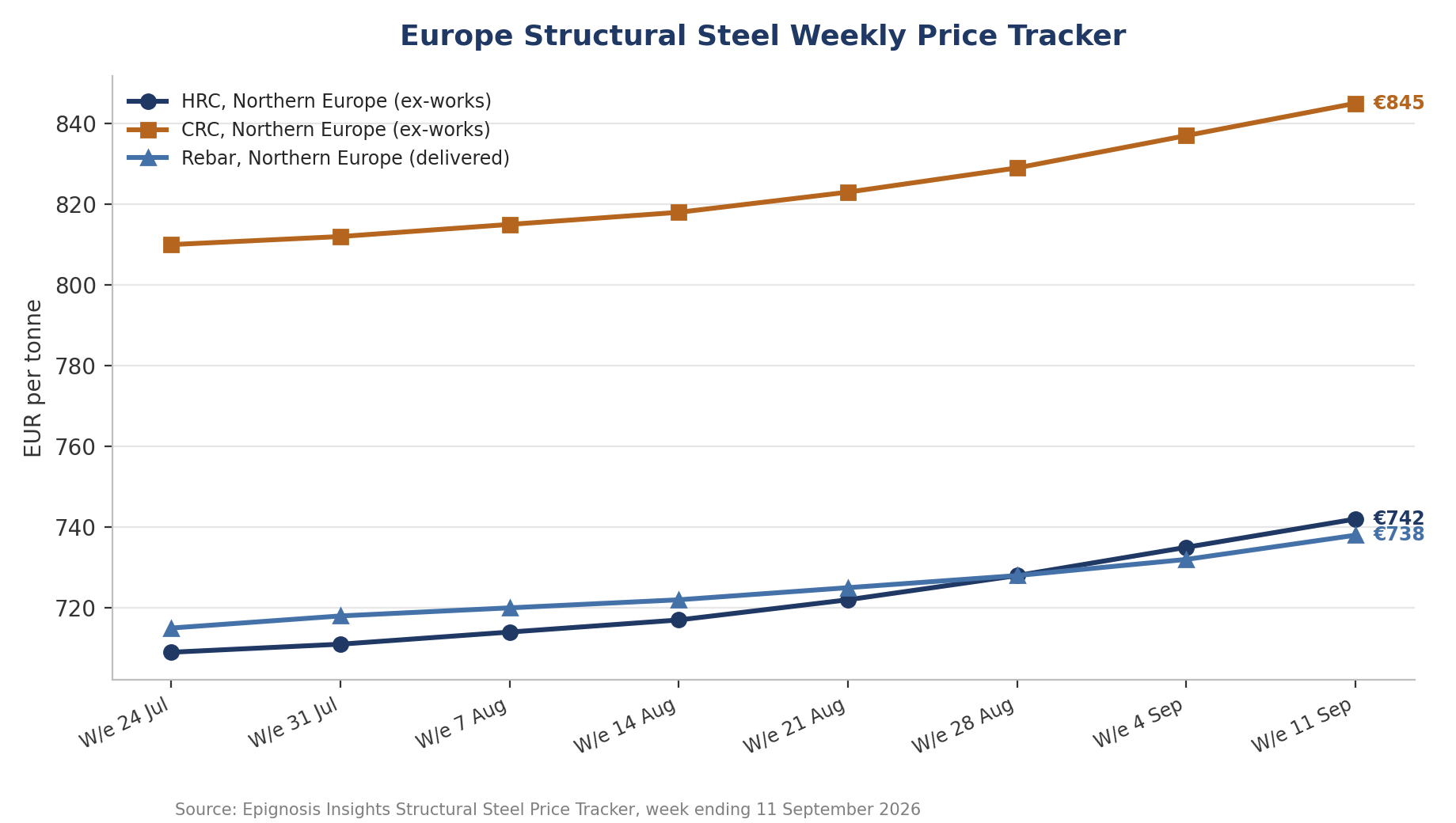
Figure 1. Europe Structural Steel Weekly Price Tracker. Source: Epignosis Insights Structural Steel Price Tracker.
Every category tracked posted a higher price in the week ending 11 September than in the week ending 24 July. HRC in Northern Europe rose from an estimated €709/tonne to €742/tonne over the eight-week window, a gain of roughly 4.7%, with the steepest single-week increase falling in the two weeks after the August shutdown as mills confirmed sold-out order books and pushed September offers higher. Cold-rolled coil, which has carried a persistent premium of roughly €100–115/tonne over HRC through the summer, moved from an estimated €810/tonne to €845/tonne over the same period.
Long products moved more moderately. Rebar, delivered Northern Europe, rose from roughly €715/tonne to €738/tonne, a gain of about 3.2%, while structural sections moved from an estimated €760/tonne to €791/tonne. Plate, which trades closer to the CRC price band, rose from an estimated €830/tonne to €870/tonne. The gap between flat and long product gains reflects a structural difference this report examines below: the new TRQ safeguard bites far harder on flat products, where import penetration reached an estimated 25% of EU consumption in 2024, than on long products, whose markets are driven mainly by intra-EU competition.
Table 1. Weekly price tracker by product (EUR per tonne, EU-27)
| Week ending | HRC | CRC | Rebar | Sections | Plate |
| W/e 24 Jul | €709 | €810 | €715 | €760 | €830 |
| W/e 31 Jul | €711 | €812 | €718 | €764 | €833 |
| W/e 7 Aug | €714 | €815 | €720 | €767 | €837 |
| W/e 14 Aug | €717 | €818 | €722 | €770 | €841 |
| W/e 21 Aug | €722 | €823 | €725 | €774 | €847 |
| W/e 28 Aug | €728 | €829 | €728 | €779 | €854 |
| W/e 4 Sep | €735 | €837 | €732 | €784 | €862 |
| W/e 11 Sep | €742 | €845 | €738 | €791 | €870 |
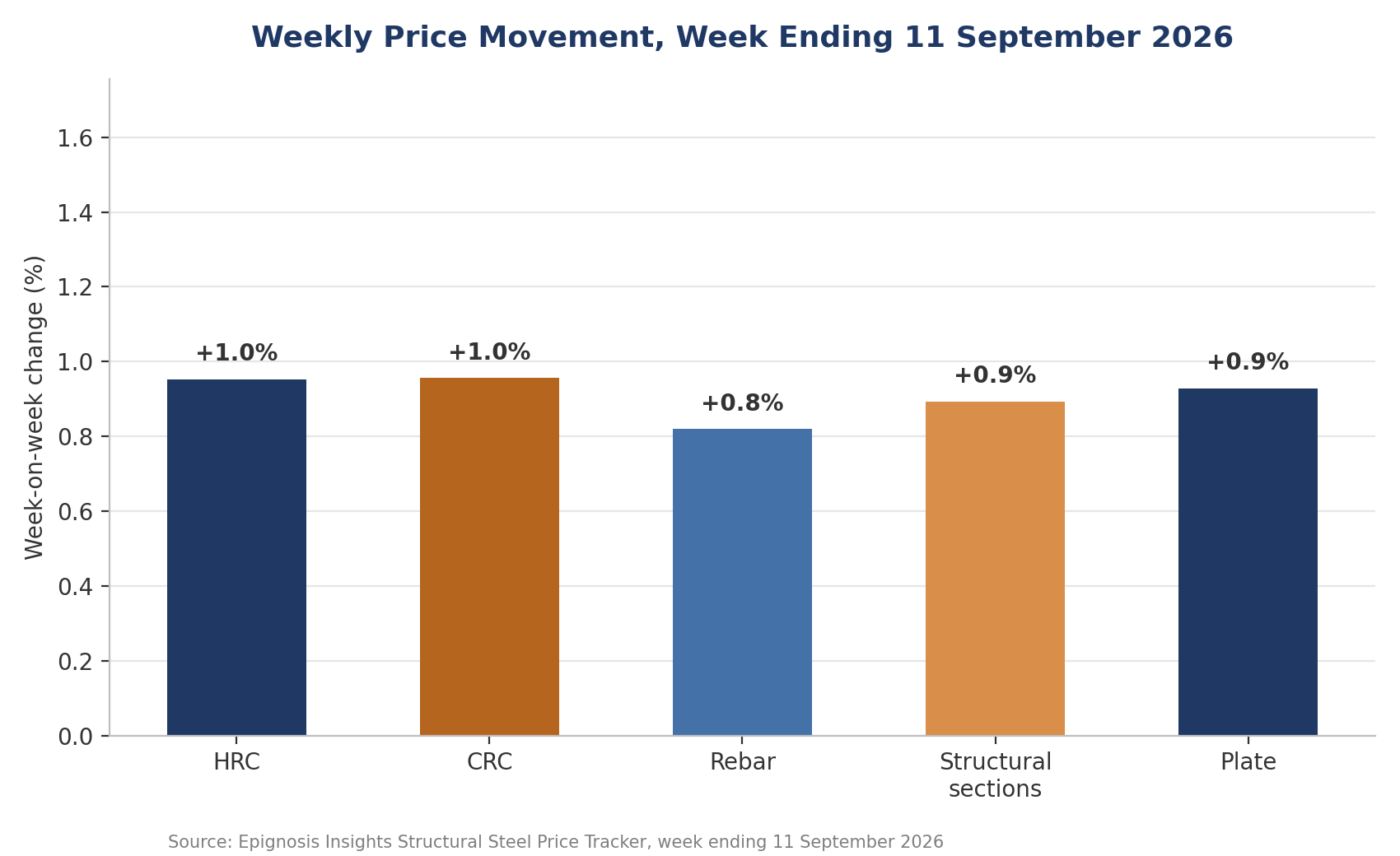 Figure 2. Weekly price movement, week ending 11 September 2026. Source: Epignosis Insights Structural Steel Price Tracker.
Three forces explain the shape of the past eight weeks. First, the TRQ safeguard's flat-product quotas were the first tranche to tighten meaningfully, and with roughly a quarter of EU flat-steel consumption historically import-supplied, the quota cut removes a supply source mills cannot easily replace domestically in the near term. Second, low water levels on the Rhine — a recurring late-summer constraint — throttled barge-based logistics into Ruhr-area integrated mills through July and August, reportedly limiting hot-metal output at at least one major German producer and adding a real, if temporary, supply-side squeeze on top of the policy-driven one. Third, ordinary seasonal restocking compounded both effects: distributors and fabricators, aware that August capacity would be tight and September order books already filling, front-loaded purchases before the summer shutdown, pulling forward demand into a market that was simultaneously losing import supply.
The result, visible in this week's tracker data, is a market where mills are in a stronger negotiating position than at any point in several years — not because underlying steel demand has recovered, but because the combination of policy-driven import scarcity and a temporary logistics constraint has tightened the domestic supply-demand balance faster than consumption has grown.
The Carbon Border Adjustment Mechanism adds a second, longer-running layer of structural support beneath the weekly price moves. Analysis from a leading global metals and mining consultancy estimates that CBAM currently adds an average cost burden of roughly US$100 per tonne to imported steel when benchmarked against EU domestic mills, a figure set to rise as an increasing share of embedded carbon in imports becomes chargeable each year through the mechanism's phase-in. By full implementation in 2034, the same analysis estimates the CBAM-driven cost increase on imported steel could reach approximately US$300 per tonne — equivalent to roughly a quarter of the delivered import price today. For buyers weighing import versus domestic sourcing decisions now, the direction of travel on CBAM cost is unambiguous even before this week's TRQ-driven price move is factored in.
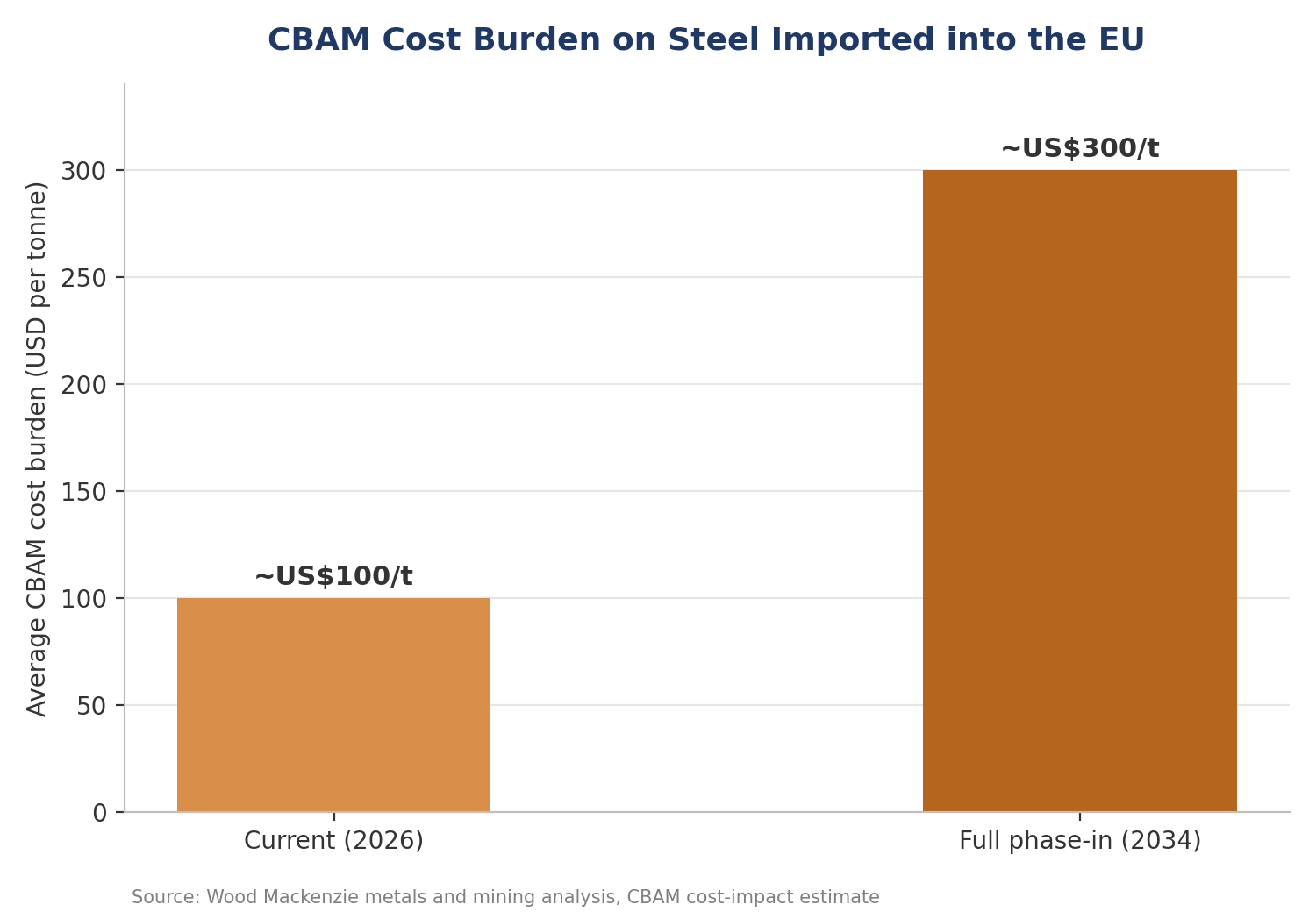
Figure 4. CBAM cost burden on steel imported into the EU. Source: Wood Mackenzie metals and mining analysis.
ArcelorMittal's second-quarter 2026 results, published 30 July 2026, offer a direct read on how the tightening European market is showing up in producer economics. The company's European segment reported EBITDA per tonne of $98 in Q2 2026, a three-year high for the segment, up $28 per tonne sequentially from Q1, with management attributing the improvement explicitly to the new TRQ trade tool and an improved policy backdrop rather than to demand recovery. At the group level, ArcelorMittal's overall EBITDA margin reached $155 per tonne in Q2 2026, well above the company's 2012–2019 through-cycle average of $89 per tonne, with first-half 2026 group EBITDA per tonne of $143 also representing a substantial premium to history. Management guided to stable-to-higher European shipments in the third quarter, describing this as a counter-seasonal outcome that would not normally occur without the trade-policy tailwind.
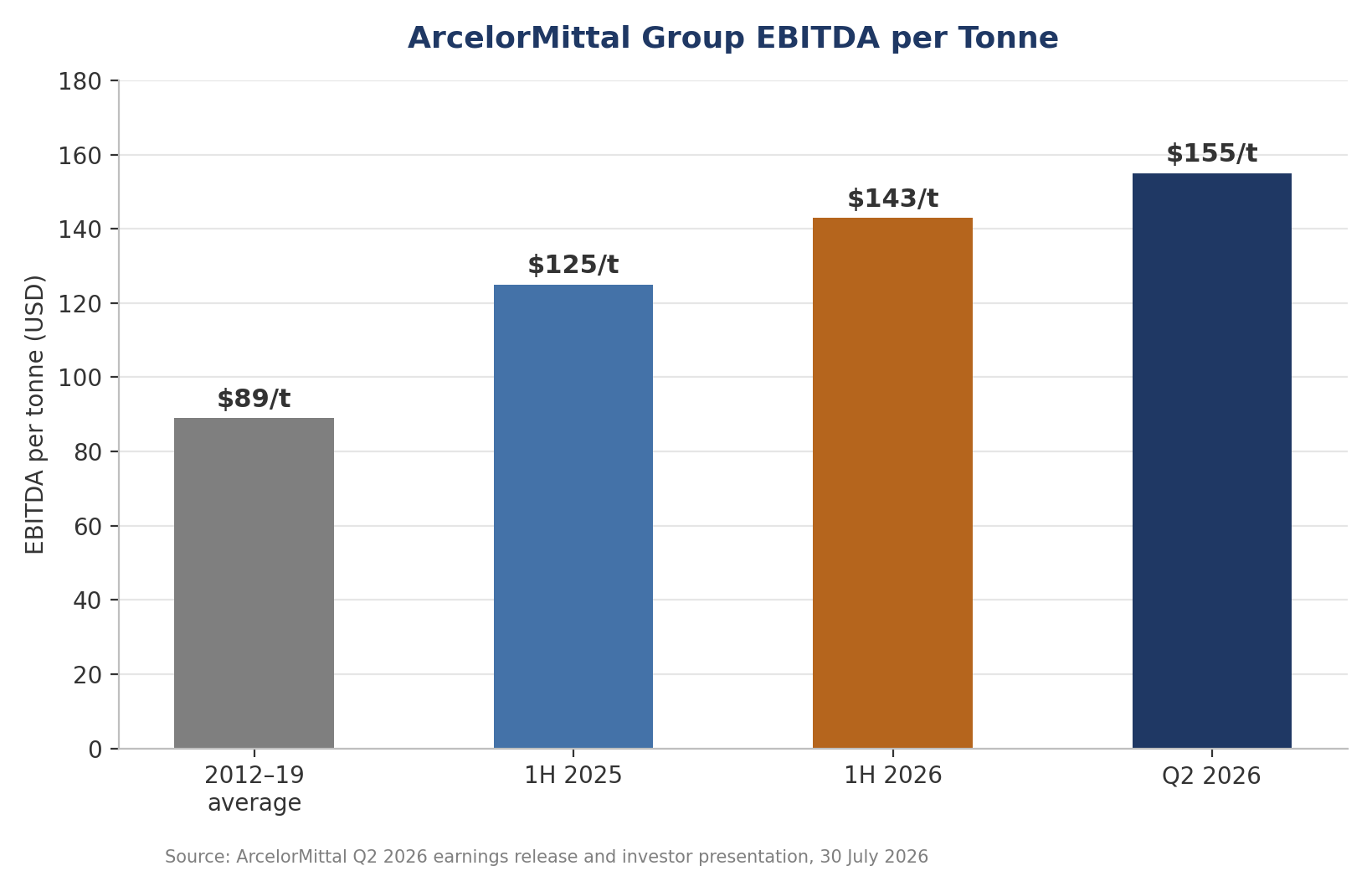
Figure 3. ArcelorMittal Group EBITDA per tonne. Source: ArcelorMittal Q2 2026 earnings release and investor presentation.
The flat-versus-long divergence this tracker records is expected to persist rather than close in the near term. Import penetration in flat products was running at an estimated 25% of EU consumption before the new TRQ took effect, meaning the quota reduction represents a severe constraint on available flat-product supply that EU mills will take time to backfill. Long product markets in Western Europe, by contrast, are driven mainly by intra-EU competition among domestic producers, so the direct supply impact of reduced external quotas is comparatively muted — though Turkey's position as a major long-products exporter introduces some upside risk specifically to wire rod and sections pricing if Turkish mills redirect volumes toward the EU ahead of further quota tightening.
The tracker's near-term outlook points to continued, moderate week-on-week increases across all five categories through the end of September, as September order books — already reported largely sold at most Northern European mills — leave limited room for buyers to negotiate lower prices before October allocations open. Rhine water levels remain the key swing factor for flat products specifically: a return to normal barge logistics would ease the temporary constraint layered on top of the TRQ effect, while continued low water would extend it. Buyers should treat the TRQ quota calendar and CBAM phase-in schedule, not weekly spot moves alone, as the more durable signal for 2026–2027 procurement planning, given how much of the current rally traces to policy mechanics that are still in their early stages of implementation.
Methodology: Pricing reflects Epignosis Insights' weekly desk-research tracker for the week ending 11 September 2026, compiled from a rolling panel of mill offers and distributor transaction data, cross-checked against published index levels and publicly disclosed cost and market data from EUROFER, the European Commission, ArcelorMittal's public disclosures, and European trade press coverage. Structural sections and plate figures are Epignosis Insights desk estimates given thinner published index coverage. Figures are benchmark estimates for sourcing and budgeting purposes; actual supplier quotations vary by origin, grade, order volume and delivery terms.