Key Findings
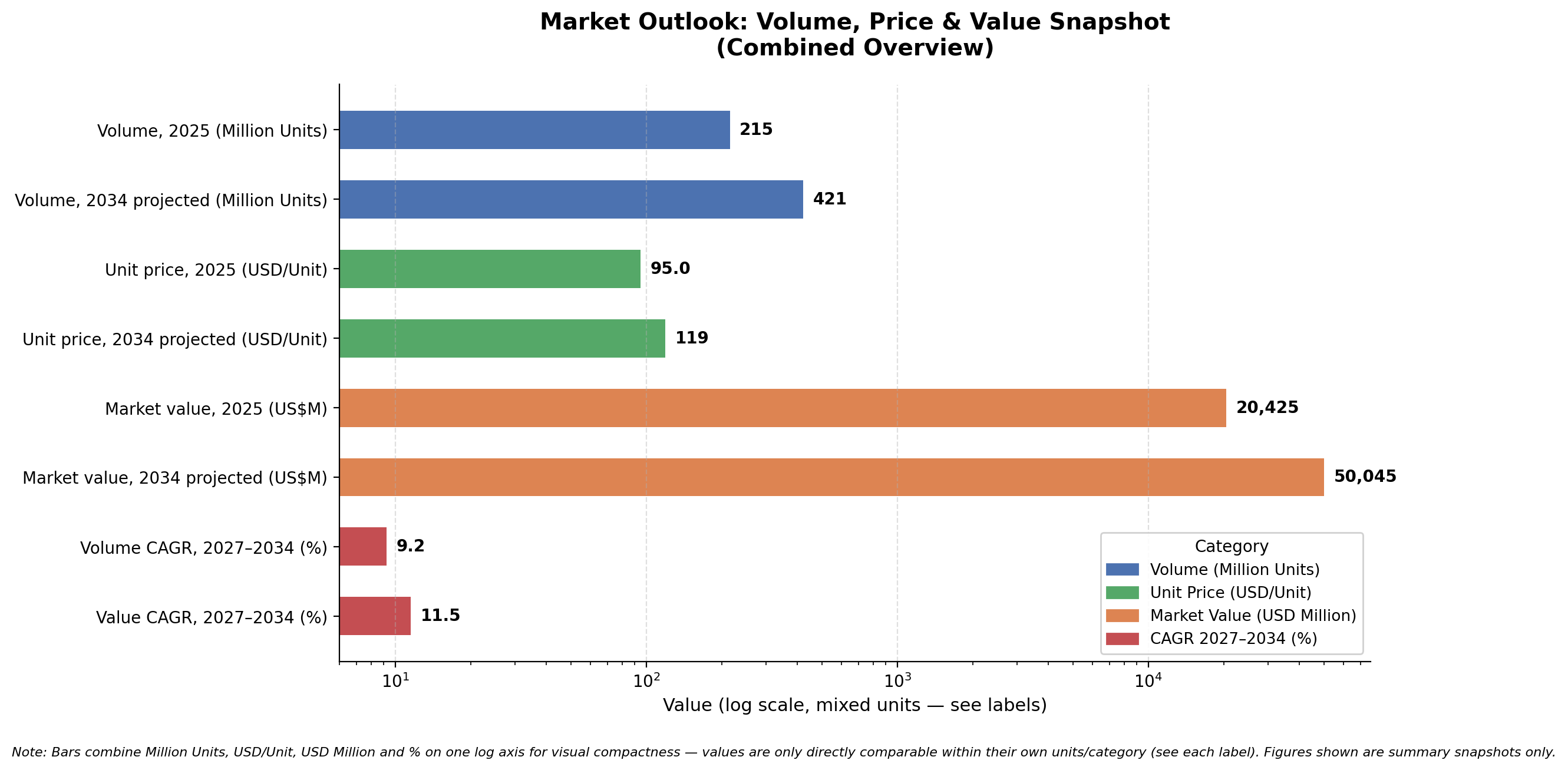
- Volume growth: Market volume is projected to increase from 210 million units in 2024 to 421 million units by 2034.
- Strong forecast growth: Unit demand is expected to grow at a 9.2% CAGR from 2027 to 2034, reflecting increasing replacement and new installation demand.
- Revenue expansion: Market revenue is projected to rise from US$16.8 billion in 2024 to US$50.05 billion in 2034.
- Revenue CAGR: The market is forecast to record an 11.5% CAGR during 2027 to 2034, exceeding unit volume growth due to pricing and product mix improvements.
- ASP increase: Average selling price is estimated to increase from US$80 per unit in 2024 to US$119 per unit by 2034.
- 2025 recovery: Unit volume increases from 210 million units in 2024 to 215 million units in 2025, representing 2.4% growth.
- Acceleration from 2026: Unit growth accelerates to 7.1% in 2026, followed by annual growth of approximately 7.5% to 8.1% through 2034.
- Premiumization: Rising average selling prices indicate increasing contribution from advanced filtration technologies, high efficiency products and specialized industrial filtration systems.
- Revenue opportunity: The market adds approximately US$33.25 billion in annual revenue between 2024 and 2034, creating opportunities across equipment, replacement filters, media and aftermarket services.
U.S. Industrial Filtration Market Outlook
U.S. industrial filtration market recorded a sales volume of 215 million units in 2025 and is estimated to reach a volume of 421 million units by 2034 with a CAGR of 9.2% during the forecast period.
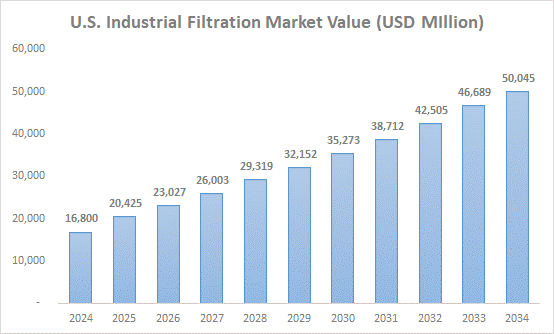
U.S. Industrial Filtration Market Dynamics
Semiconductor Manufacturing Expansion
The U.S. industrial filtration market is gaining an important demand opportunity from the expansion of domestic semiconductor manufacturing, particularly because semiconductor fabrication requires highly controlled cleanroom environments, ultra pure process water, specialty gases, chemicals, and contamination control. The scale of U.S. fab investment has increased substantially under the CHIPS and Science Act. In August 2024, the U.S. Department of Commerce reported more than US$30 billion in proposed CHIPS private sector investments across 23 projects in 15 states, including 16 new semiconductor manufacturing facilities, with more than 115,000 expected manufacturing and construction jobs.
The expansion directly creates demand across several filtration categories within the U.S. industrial filtration market. Semiconductor fabs require high efficiency air filtration for cleanrooms, ultra pure water filtration for wafer processing, chemical filtration for process chemicals, and gas filtration for contamination sensitive manufacturing processes. The scale of individual projects illustrates the potential equipment intensity. TSMC announced plans for more than US$65 billion of investment across 3 leading edge fabs in Arizona, while Micron's planned U.S. memory manufacturing program involves approximately US$125 billion of private capital over 2 decades, including US$50 billion of capital expenditure during the first 6 years.
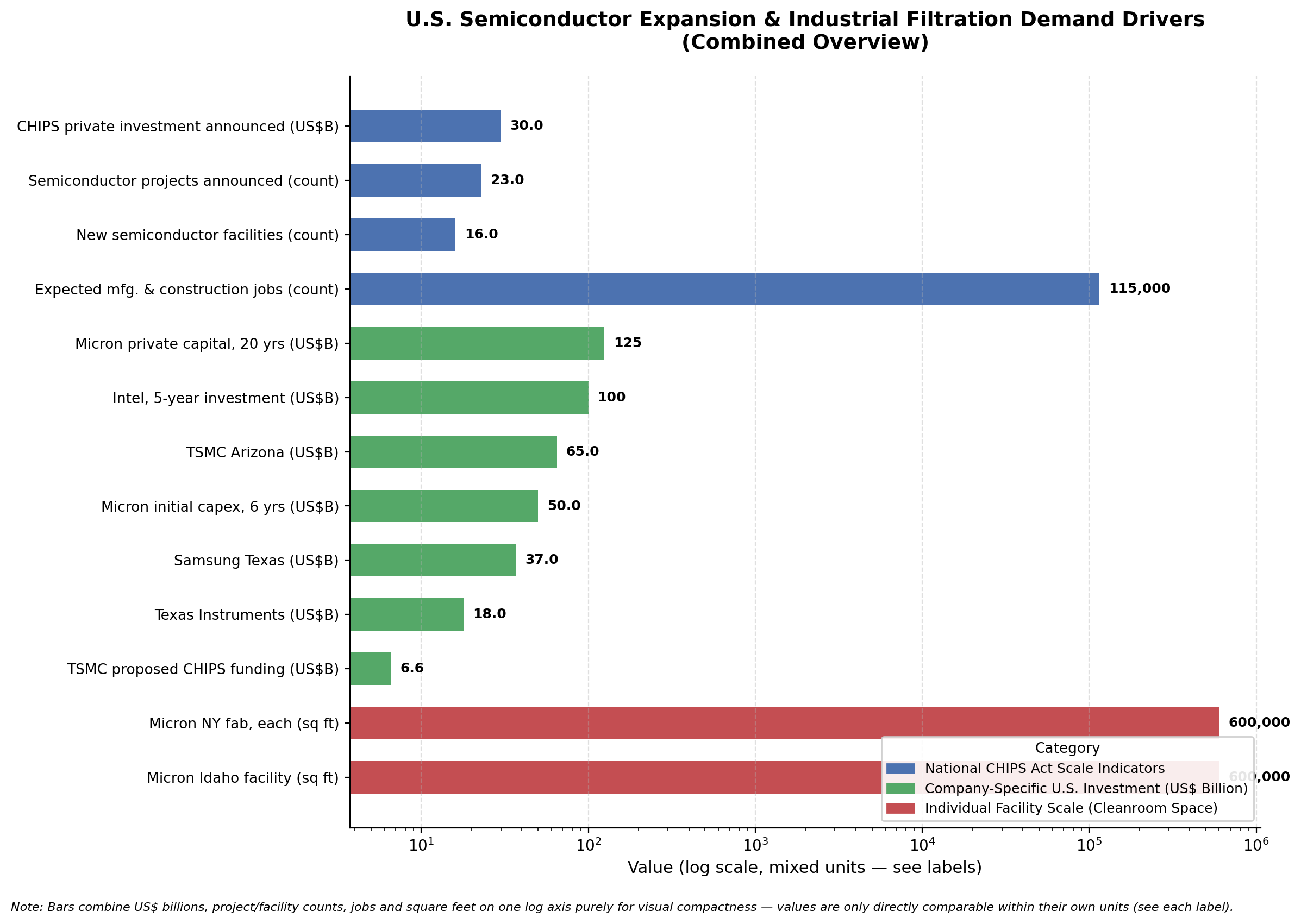
The U.S. industrial filtration market also benefits from the increasing scale and technical complexity of individual fabs. Micron's planned New York project includes 2 leading edge DRAM fabs, with each planned fab containing approximately 600,000 square feet of cleanroom space. Its planned Idaho high volume manufacturing facility also includes approximately 600,000 square feet of cleanroom space. Such facilities require continuous contamination control rather than one time filtration equipment purchases, creating opportunities for replacement filters, high purity media, monitoring systems, and maintenance services throughout the operating life of the facility.
These investments strengthen the U.S. industrial filtration market opportunity beyond conventional industrial dust and liquid filtration because semiconductor manufacturing places greater emphasis on ultra high efficiency filtration, extremely low contamination levels, process water purification, chemical filtration, and gas purification. Samsung's Texas expansion, for example, includes 2 new leading edge logic fabs, an R&D fab, an advanced packaging facility, and expansion of its existing Austin operations. Texas Instruments is also investing more than US$18 billion through the end of the decade to construct 3 new facilities in Texas and Utah.
The resulting opportunity for the U.S. industrial filtration market is therefore concentrated not only in initial filtration equipment installation but also in recurring replacement and consumables. As fabs move from construction into commercial production, filtration suppliers can generate recurring demand from cleanroom filters, ultra pure water systems, chemical filters, gas filters, monitoring equipment, and replacement media. The semiconductor industry's expansion consequently creates a higher value filtration opportunity than standard industrial applications because contamination control requirements can require specialized products, stringent qualification, and continuous filtration performance.
High Initial Investment Requirements
The U.S. industrial filtration market faces a significant challenge from the high upfront capital required for engineered filtration systems, particularly where filtration must be integrated with pumps, pressure vessels, ductwork, automation, sensors, containment systems, and monitoring equipment. The investment requirement varies considerably by application. Standard industrial filtration systems can require tens of thousands of dollars per installation, while specialized systems serving semiconductor and electronics manufacturing can reach substantially higher values. Recent U.S. market analysis places standard central filtration systems at approximately US$12,000 to US$45,000 per unit, while premium systems designed for semiconductor and electronics cleanroom environments can reach US$80,000 to US$250,000 per unit.
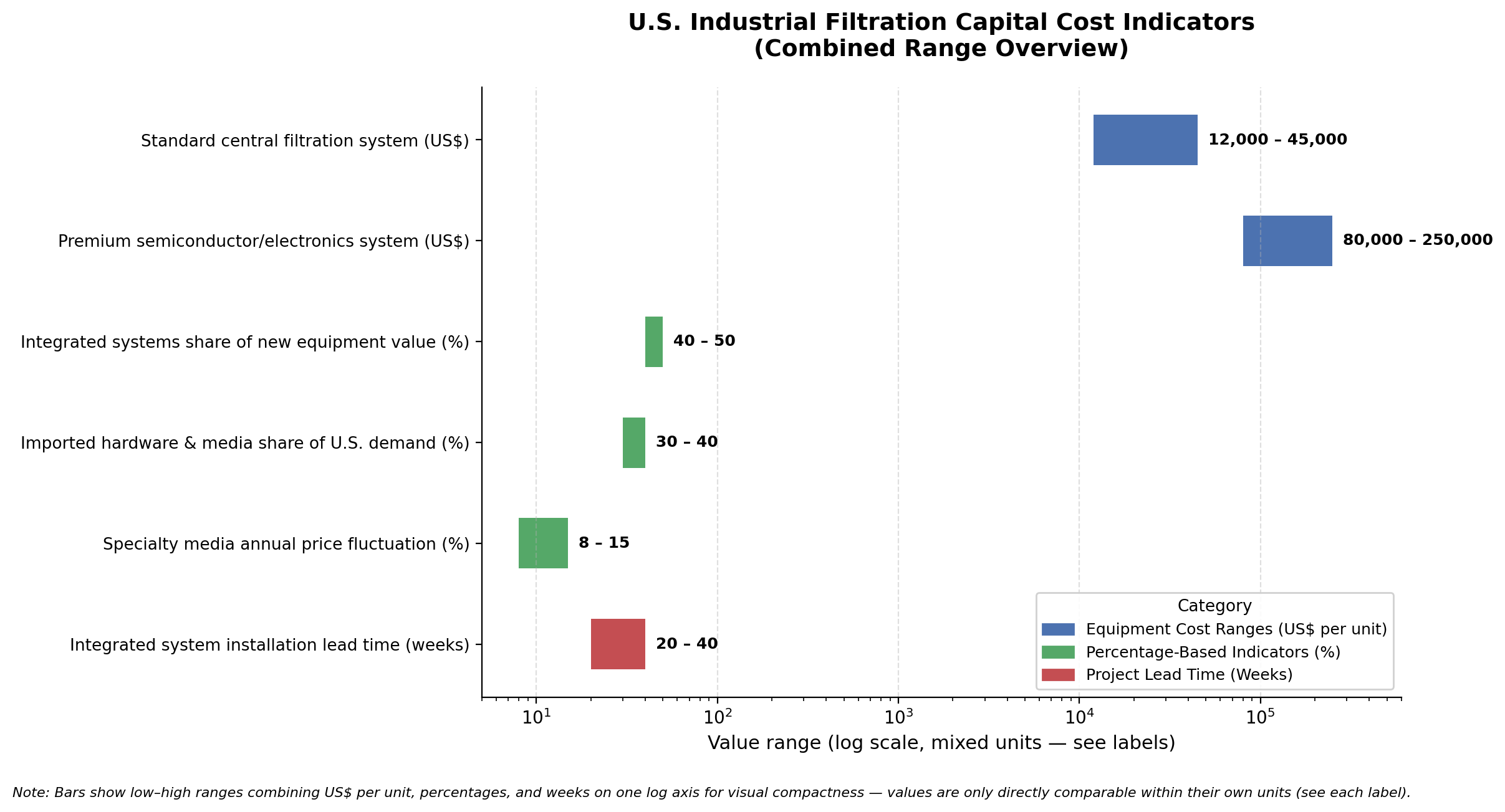
The capital burden becomes more significant when filtration is purchased as part of an integrated industrial project rather than as an individual filter component. Integrated systems can include filtration equipment, housings, pumps, valves, instrumentation, controls, installation, engineering, commissioning, and validation. Recent analysis indicates that integrated filtration systems account for approximately 40% to 50% of new equipment value in the U.S. industrial filtration equipment and systems market. This increases the initial procurement value for industrial customers but also creates a financing barrier for small and medium sized manufacturers with limited capital expenditure budgets.
The U.S. industrial filtration market also faces a secondary financial challenge because customers must evaluate lifecycle expenditure rather than simply the purchase price. Industrial filtration systems can generate continuing expenses from electricity consumption, filter replacement, cleaning, labor, monitoring, maintenance, and disposal. High pressure and high flow applications can be particularly expensive to operate because pumps and fans consume significant energy. Consequently, a lower priced filtration system may not necessarily represent the lowest cost option over its operating life. Recent industry analysis indicates that U.S. buyers are increasingly evaluating total cost of ownership, energy efficiency, and filter service life when selecting filtration systems.
For smaller manufacturers, the challenge is particularly pronounced because the same compliance requirement may require engineering modifications beyond the filtration unit itself. Industrial air filtration installations can involve ductwork, fans, controls, containment, and site modifications in addition to the filtration equipment. This means the total project expenditure can be considerably higher than the quoted price of the filter or filtration unit. Industry analysis identifies high initial investment as a material adoption barrier, particularly for smaller manufacturers in sectors such as food processing, woodworking, and metal fabrication.
The U.S. industrial filtration market therefore has an important commercial opportunity in financing and service based business models. Leasing, equipment as a service, long term maintenance agreements, vendor managed inventory, and performance based contracts can reduce the initial capital burden for customers. This approach can also help manufacturers generate recurring revenue from replacement filters, maintenance, monitoring, and technical services instead of relying exclusively on one time equipment sales. Recent market analysis indicates that aftermarket services, remote monitoring, and predictive maintenance subscriptions are expanding as filtration suppliers shift toward lifecycle based customer relationships.
The challenge is consequently not simply that industrial filtration equipment is expensive. It is that customers must commit capital before realizing benefits such as lower emissions, improved process reliability, reduced contamination, lower water consumption, or reduced maintenance. Suppliers that can demonstrate measurable payback periods, energy savings, longer filter life, reduced downtime, and lower total cost of ownership can address this investment barrier more effectively than suppliers competing primarily on initial equipment price. For the U.S. industrial filtration market, this creates a growing distinction between commodity filtration products and engineered filtration solutions where lifecycle economics become a central purchasing consideration.
U.S. Industrial Filtration Market: New Installation vs Replacement Analysis
The U.S. industrial filtration market is structurally driven by 2 distinct demand pools: new filtration systems installed alongside greenfield facilities, capacity expansions, and process upgrades, and replacement demand generated by the large installed base of operating filtration equipment. The distinction is commercially important because new installations are generally project based and have longer procurement cycles, whereas replacement filters generate recurring purchases throughout the operating life of equipment. Recent U.S. industrial filtration analysis estimates that replacement and aftermarket filters contribute roughly 60% to 70% of market revenue, highlighting the importance of the installed base to suppliers.
The U.S. industrial filtration market replacement segment has a different demand structure because filtration performance gradually deteriorates as filter media loads with particles, contaminants, or process residues. Replacement demand therefore depends on operating hours, contamination levels, filter specifications, process conditions, and regulatory requirements. IndexBox estimates that replacement cycles for industrial settings typically occur every 12 to 24 months, although high intensity applications can require considerably more frequent changeouts. This recurring requirement makes replacement demand less dependent on new factory construction than new equipment demand.
For suppliers, the U.S. industrial filtration market replacement opportunity can be more commercially attractive because consumables create customer relationships that extend beyond the initial equipment sale. Cartridges, filter bags, membranes, seals, media, and related components must be purchased repeatedly. IndexBox estimates consumables and replacement parts account for approximately 55% to 65% of installed base spending, while filter spares analysis places replacement elements, cartridges, and media at roughly 60% to 70% of total spares demand.
New installations nevertheless remain strategically important because every newly installed filtration system creates a future replacement revenue stream. A supplier that wins an original equipment project can potentially establish its filter specifications, media configuration, monitoring technology, and maintenance relationship before competitors enter the replacement cycle. This creates an important equipment to aftermarket conversion opportunity within the U.S. industrial filtration market, particularly for suppliers offering proprietary filter media, validated products, monitoring systems, and service contracts.
The difference is particularly visible in specialized industries. Semiconductor fabs, pharmaceutical plants, food processing facilities, and chemical plants require filtration systems that operate continuously and often under stringent contamination or quality requirements. New facilities therefore generate an initial equipment opportunity, followed by recurring replacement and consumables demand once production begins. Advanced filtration technologies are also growing faster than standard filtration, with recent U.S. market analysis estimating membrane and advanced filtration technologies at approximately 7% to 9% annual growth, compared with roughly 4% to 6% for the broader market.
U.S. Industrial Filtration Market: Product Type Analysis
The U.S. industrial filtration market is characterized by a broad product mix spanning particulate removal, liquid solid separation, high purity processing, air pollution control, and contamination control. The product structure is increasingly influenced by replacement demand, with replacement elements, cartridges and media accounting for approximately 60% to 70% of U.S. filter spares demand, while cartridges alone represent about 35% to 45% of segment value. This creates a recurring revenue opportunity for manufacturers and distributors because industrial filtration systems require periodic replacement even when plants are not undertaking major capital projects.
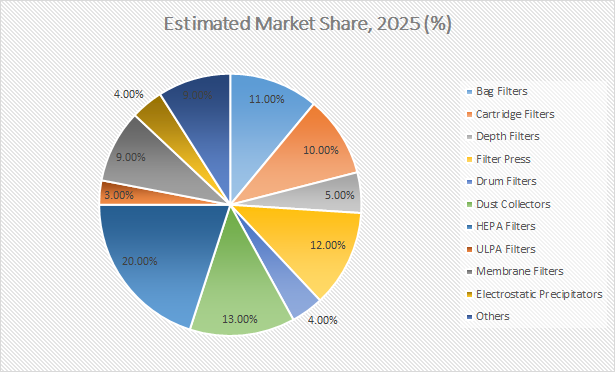
The U.S. industrial filtration market shows particularly strong commercial differentiation between consumable products and capital equipment. Cartridge filters, bag filters and membrane products generate recurring replacement purchases, whereas filter presses, drum filters, dust collectors and electrostatic precipitators generally involve larger project or equipment decisions. IndexBox estimates that consumables and replacement parts including filter media, cartridges, bags, membranes and seals represent approximately 55% to 65% of installed base spending. Integrated filtration systems account for approximately 40% to 50% of new equipment value, indicating that suppliers can generate revenue through both initial system installation and subsequent replacement programs.
The U.S. industrial filtration market is also shifting toward higher performance products. Membrane and advanced filtration technologies are estimated to be expanding at approximately 7% to 9% annually, compared with overall industrial filter demand growth of approximately 4% to 6%. The faster growth reflects increasing requirements for finer particle removal, higher process purity, water reuse and contamination control. This trend is particularly relevant for membrane filters, HEPA filters and ULPA filters, where customers are more willing to pay for filtration performance when contamination can affect production yield or regulatory compliance.
Within the U.S. industrial filtration market, cartridge filters represent an important recurring revenue pool because of their broad applicability and ease of replacement. Current industry research identifies cartridge filters as the largest product segment globally in 2025, supported by applications across pharmaceuticals, food and beverage and chemicals. U.S. demand is further supported by the country's large installed industrial base and recurring maintenance requirements. OEM and aftermarket suppliers compete not only on filtration efficiency but also on service life, pressure drop, compatibility, availability and replacement lead time.
The U.S. industrial filtration market also provides substantial opportunity in filter presses and related solid liquid separation equipment. Filter presses are identified as the fastest growing product segment in the broader industrial filtration market because they can process large slurry volumes and produce relatively dry filter cakes. Their relevance is particularly strong in mining, chemicals, pharmaceuticals and wastewater treatment. For U.S. suppliers, the opportunity extends beyond the initial press installation to replacement filter cloths, plates, seals, maintenance and process optimization services.
For air filtration, the U.S. industrial filtration market is seeing demand across dust collectors, HEPA filters, ULPA filters and electrostatic precipitators as industrial facilities place greater emphasis on particulate control and controlled production environments. HEPA and ULPA systems command higher value per filtration unit because customers typically require validated performance and reliable particle removal. ULPA demand is especially relevant to semiconductor and precision manufacturing facilities, where contamination control can directly affect production quality. Meanwhile, dust collectors provide a broader industrial opportunity across metalworking, manufacturing and material processing.
Overall, the U.S. industrial filtration market can be divided into three commercial opportunity groups. High volume recurring products include cartridge filters, bag filters, depth filters and membrane replacement elements. Higher value capital equipment includes filter presses, drum filters, dust collectors and electrostatic precipitators. Premium specialized products include HEPA and ULPA filtration systems. This segmentation creates different competitive strategies, with commodity products competing heavily on availability and replacement pricing, while advanced filtration products compete through efficiency, validation, technical support and lifecycle performance. The overall U.S. industrial filters market is projected to expand at approximately 4% to 6% annually through 2035, supporting continued expansion across both replacement products and new filtration installations.
Competitive Analysis
Key companies analyzed within the U.S. industrial filtration market are:Donaldson Company, Parker Hannifin Corporation, 3M, Camfil, AAF International, Filtration Group, Eaton, Graver Technologies, Pentair, Pall Corporation, Alfa Laval, MANN+HUMMEL, Veolia, ITT, Koch Separation Solutions, Freudenberg Filtration Technologies, W. L. Gore & Associates, CECO Environmental, HYDAC.