Top 10 Key Findings – Global Energy Storage Market
- China accounts for 43.8% of the global energy storage market, making it the largest deployment and manufacturing hub.
- China and the United States together contribute 68.4% of global energy storage installations.
- Lithium-ion batteries represent 85–90% of newly deployed battery energy storage capacity worldwide.
10–100 MWh systems hold the largest market penetration (32.7%), driven by utility-scale renewable integration projects.
- More than 1,650 GW of renewable energy projects worldwide remain awaiting grid connection, accelerating battery storage investments.
- Battery cells account for 50–65% of total utility-scale energy storage system costs, making cell pricing a critical profitability factor.
- China controls nearly 80% of global lithium-ion battery cell manufacturing capacity, creating supply chain concentration risks.
- Utility-scale battery projects can be commissioned within 12–24 months, significantly faster than the 5–10 years typically required for new transmission infrastructure.
Global Energy Storage Market Outlook
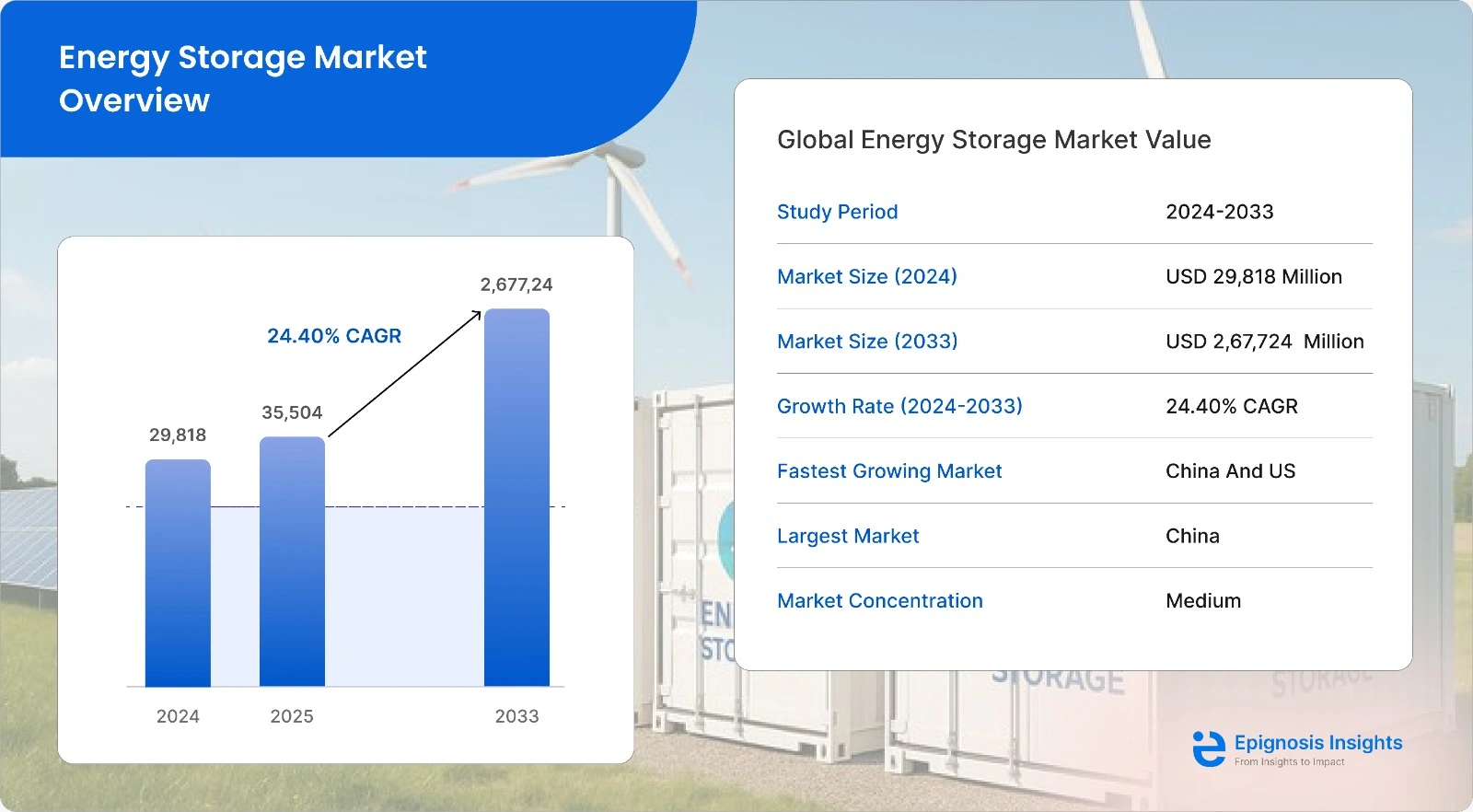
Global Energy Storage Market recorded a deployment of 221.9 GWh in 2025 and is estimated to reach a volume of 1,216 GWh by 2033 with a CAGR of 24.4% during the forecast period.
Global Energy Storage Market Dynamics
Grid Congestion and Transmission Bottlenecks Accelerating Local Energy Storage Investments
Grid congestion has emerged as a significant structural driver influencing the global energy storage market. Electricity networks are facing challenges in accommodating the rapid growth of renewable generation, which has not been matched by corresponding investments in transmission infrastructure. The International Energy Agency reports that over 1,650 GW of solar and wind projects worldwide have been awaiting grid connection, revealing a substantial mismatch between the additions of renewable capacity and the capability of existing transmission networks.
In the United States, the interconnection queues have surpassed 2,000 GW of proposed generation and storage capacity, with battery energy storage systems (BESS) becoming one of the fastest-growing technologies seeking approval. Instead of enduring the lengthy process of waiting 5–10 years for new transmission lines to be permitted and constructed, utilities and independent power producers are increasingly opting to deploy BESS close to renewable energy sources. These projects can typically be commissioned within 12 to 24 months, allowing them to absorb excess electricity during times of transmission congestion and release stored power during peak demand periods. This strategy helps reduce the annual renewable energy curtailment rates that can exceed 5–10% in various high-renewable markets.
Europe faces similar challenges, particularly as the expansion of offshore wind in countries like Germany, the United Kingdom, and the Netherlands continues to progress faster than transmission upgrades. As a result, transmission system operators are turning to localized storage solutions for congestion management and grid stabilization. Australia’s experience illustrates that strategically positioned utility-scale batteries can delay expensive transmission expansions while improving grid reliability.
From an economic standpoint, localized storage offers multiple revenue opportunities through energy arbitrage, ancillary services, capacity markets, and deferred network investments. This significantly enhances project returns, especially compared to single-purpose storage assets. These financial incentives are prompting utilities to incorporate storage solutions directly into long-term transmission planning, rather than viewing batteries merely as backup options.
As the deployment of renewable energy accelerates beyond the pace of grid modernization globally, transmission bottlenecks are anticipated to remain an ongoing issue. This reinforces the role of localized storage as a cost-effective alternative to traditional network expansion. Consequently, grid congestion management is becoming a critical long-term investment theme that supports sustained growth in the global energy storage market, positioning battery energy storage as an essential element of future electricity infrastructure, rather than just a facilitator of renewable energy.
High Dependence on Chinese Battery Cell Manufacturing
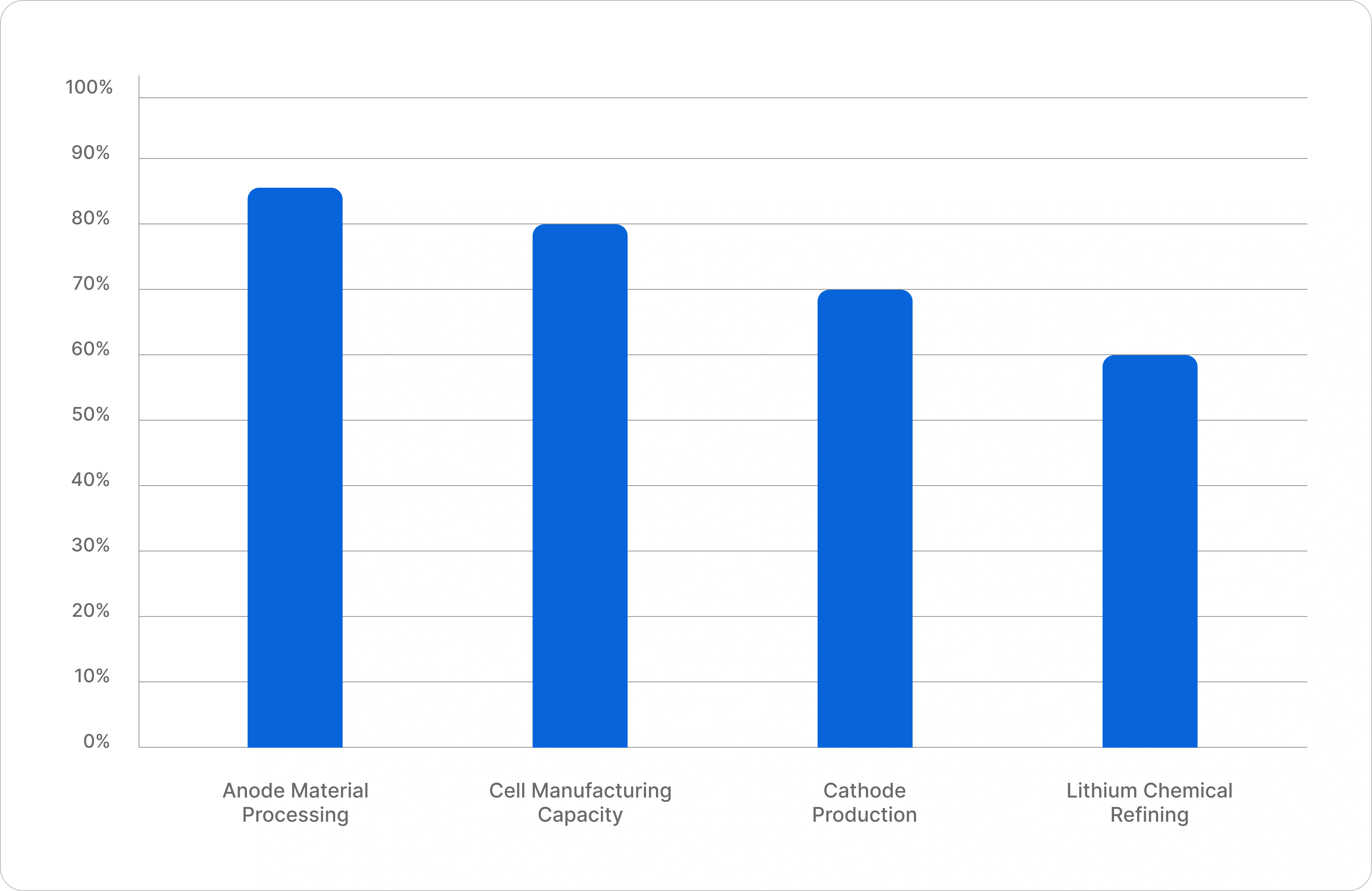
China's dominance in battery cell manufacturing presents a significant structural risk to the global energy storage market. The country currently holds a substantial share of the battery supply chain, managing everything from raw material processing to cell production. The International Energy Agency reports that China accounts for about 80% of the global lithium-ion battery cell manufacturing capacity, more than 70% of cathode production, roughly 85% of anode material processing, and over 60% of global lithium chemical refining. This heavy concentration leaves battery energy storage system (BESS) developers in North America, Europe, Australia, and emerging markets reliant on Chinese suppliers for lithium iron phosphate (LFP) and nickel manganese cobalt (NMC) cells.
Given that battery cells typically constitute 50–65% of the total capital cost of a utility-scale energy storage system, any supply disruptions or price fluctuations can greatly impact project economics and commissioning timelines. Rising geopolitical tensions, export restrictions on strategic minerals, shifting trade policies, and logistics challenges have led various governments to expedite investments in domestic battery manufacturing. In the United States, several gigafactory projects have been announced, supported by the Inflation Reduction Act (IRA), while the European Union is boosting regional battery production through the European Battery Alliance to lessen import dependence.
Architected visual representation of China's battery supply chain dominance
However, despite these efforts, most new facilities are projected to take several years to achieve commercial-scale production, maintaining the reliance on Chinese manufacturers in the short term. Moreover, China enjoys considerable cost advantages thanks to vertically integrated supply chains, economies of scale, and established raw material processing infrastructures, enabling its domestic producers to manufacture battery cells at lower costs than many international competitors.
As the deployment of utility-scale storage accelerates globally, securing a diversified battery supply has become a strategic priority for governments, utilities, and project developers. Therefore, reducing supply chain concentration is emerging as a crucial competitive objective within the global energy storage market, with increasing investments now directed toward localized manufacturing, alternative battery chemistries like sodium-ion technology, and long-term supply agreements to bolster resilience against future geopolitical and commercial uncertainties.
Global Energy Storage Market Technology Life Cycle Analysis
The global energy storage market is currently experiencing a notable transformation as the focus of commercial deployment shifts from relying on a single battery chemistry to a more diverse array of storage technologies tailored for various applications and discharge durations. Lithium-ion batteries continue to dominate, representing approximately 85–90% of newly installed battery energy storage capacity worldwide. This dominance is attributed to decreasing production costs, established manufacturing infrastructure, and impressive round-trip efficiencies exceeding 90%. However, this technology has reached a mature phase, with innovation now concentrating on cost optimization, safety improvements, and enhanced energy density rather than groundbreaking performance enhancements.
In contrast, sodium-ion batteries have begun to enter the early commercialization phase, drawing significant investment due to the abundance of sodium compared to lithium, which facilitates a more cost-effective supply chain for stationary storage. Flow batteries are moving through their growth stage as utilities increasingly look for storage options that can provide 6–12 hours of discharge while minimizing capacity degradation over prolonged operational lifetimes.
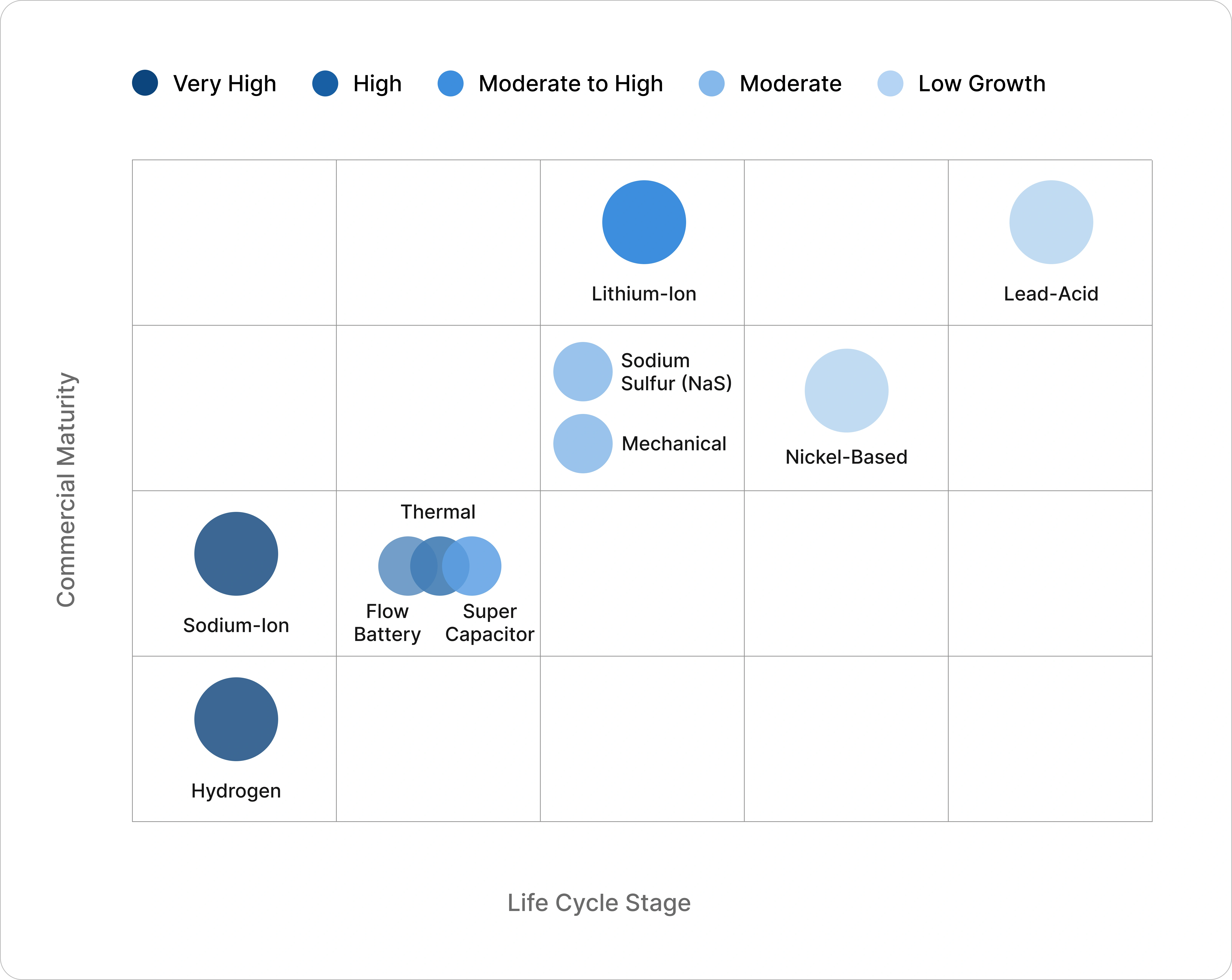
Additionally, thermal and hydrogen energy storage technologies are making progress as governments emphasize the importance of long-duration energy storage (LDES) to support energy systems heavily reliant on renewables. However, commercialization of these technologies is still constrained by higher capital costs and evolving project economics. Mechanical storage, particularly pumped hydro systems, remains vital for large-scale grid balancing, although their expansion is limited by geographical factors.
On the other hand, lead-acid and nickel-based battery systems are gradually losing market share, primarily due to their shorter operational lifespans and lower energy density when compared to more advanced battery chemistries. This shifting landscape suggests that future competition in the global energy storage market will increasingly hinge on application-specific optimizations rather than dependence on a single dominant solution. As a result, long-duration, low-cost, and resource-diversified technologies are projected to garner a larger portion of new investments through 2033.
Segment and Regional Analysis
Global Energy Storage Market Capacity Analysis: Why 1–100 MWh Installations Lead New Investments
The capacity profile of the global energy storage market illustrates that medium- and large-scale battery systems are at the forefront of new deployments. As electricity grids increasingly seek flexible resources for renewable integration and network stability, installations ranging from 10 to 100 MWh have emerged as the most prevalent, making up approximately 32.7% of the market. This capacity range strikes an optimal balance between economic feasibility, deployment speed, and operational flexibility, and these systems are commonly used alongside utility-scale solar and wind farms. They provide essential services such as frequency regulation, peak shaving, energy arbitrage, and renewable firming, all while requiring significantly lower capital investments compared to larger storage installations.
The 1 to 10 MWh sector represents 28.6% of total deployments and is expanding rapidly, driven by growing adoption in industrial settings, commercial campuses, manufacturing plants, mining operations, and distribution utilities. These systems offer notable advantages, including reduced demand charges, improved power quality, and enhanced localized grid resilience, without the need for extensive transmission upgrades. Together, the 1 to 100 MWh categories account for over 61% of total installations, reflecting the market's preference for scalable assets capable of engaging in multiple electricity market services.
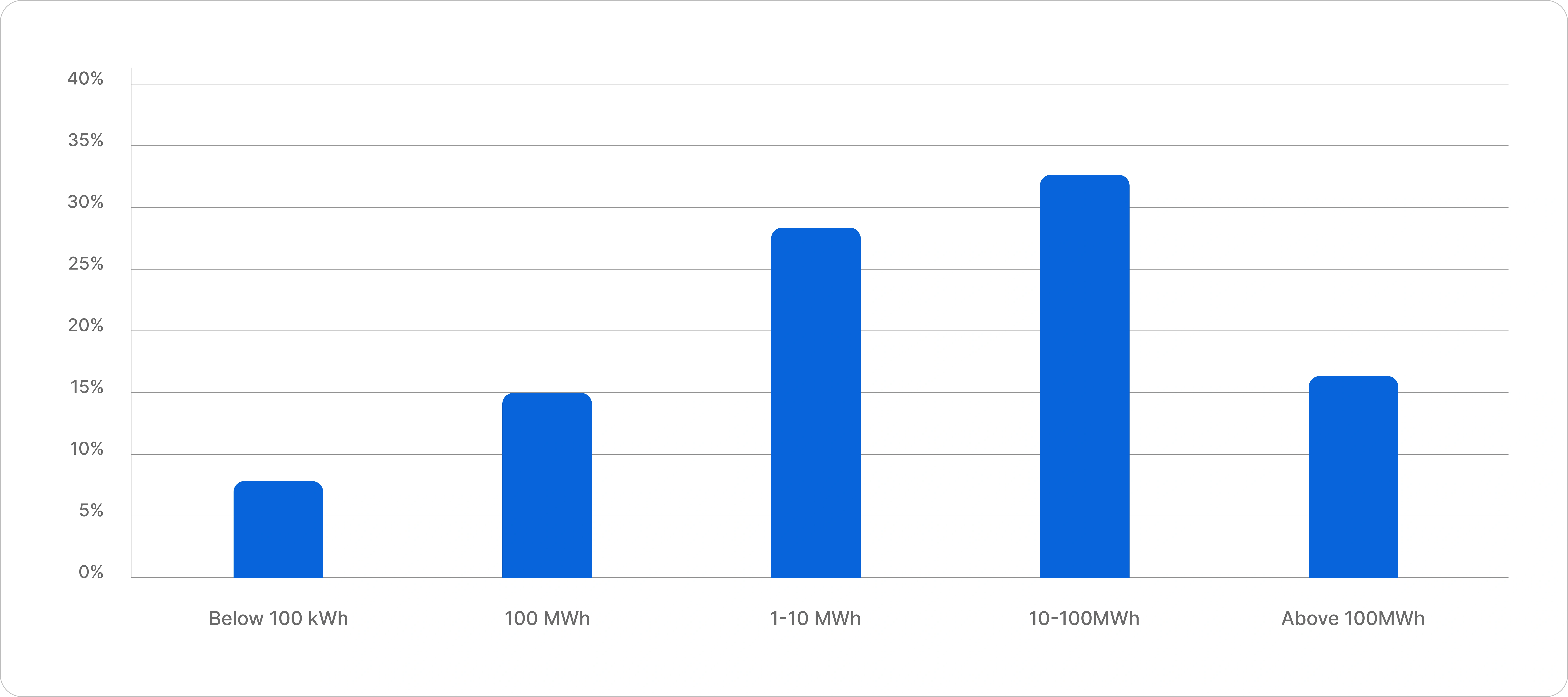
Projects that exceed 100 MWh constitute 15.5% of installations but contribute a disproportionately larger share of installed energy capacity due to many projects surpassing the 200 to 500 MWh range, with several recent projects exceeding 1 GWh. These large-scale assets are increasingly vital in stabilizing electricity systems heavily reliant on renewable energy, deferring transmission investments, and enhancing system reliability. In contrast, systems below 100 kWh comprise only 7.8% of market penetration, despite a rise in residential battery adoption, as their overall impact on installed capacity remains relatively modest. The 100 kWh to 1 MWh category, accounting for 15.4%, is benefiting from increased investments in commercial facilities, EV charging stations, and community microgrids. As utilities move to replace traditional peaking assets with flexible storage solutions, medium- and utility-scale projects are expected to attract the majority of investment, solidifying these capacity ranges as key drivers of growth in the global energy storage market during the forecast period.
Why China and the United States Continue to Lead the Global Energy Storage Market
China and the United States together represent about 68.4% of the global energy storage market, showcasing their significant investments in battery manufacturing, renewable energy integration, and grid modernization. China leads the market with an estimated 43.8% share, bolstered by the largest battery manufacturing ecosystem in the world. The country has aggressively deployed utility-scale battery energy storage systems (BESS) and has seen renewable installations exceed 350 GW with new solar and wind capacity additions in 2024. Furthermore, China holds the majority of global lithium-ion cell manufacturing capability, allowing developers to implement storage projects at highly competitive prices.
The United States, holding a 24.6% market share, is experiencing accelerated investments thanks to the Inflation Reduction Act (IRA), increasing data center electricity demand, and rapidly expanding utility-scale solar projects that are increasingly incorporating co-located battery storage. States like California and Texas are leading the commissioning of multi-hundred-megawatt battery projects aimed at enhancing grid reliability and minimizing renewable curtailment, which establishes the U.S. as the second-largest contributor to the global energy storage market.
In Europe, key players such as Germany, the United Kingdom, Italy, and Spain collectively make up around 12.5% of the market. This growth can be attributed to ambitious renewable energy targets, increasing electricity price volatility, and investments in grid flexibility. Germany is at the forefront within the region with a 5.4% market share, driven by widespread adoption of residential batteries integrated with rooftop solar systems, alongside rising deployment of commercial energy storage solutions. The United Kingdom is expanding its utility-scale battery installations through frequency response and capacity market mechanisms, while Italy and Spain are moving quickly to deploy storage solutions that stabilize their rapidly growing solar generation.
Australia, with a 3.5% market share, stands out as one of the highest battery storage markets globally on a per-capita basis, utilizing large-scale batteries to replace traditional peaking power plants and to support renewable-rich electricity networks. Meanwhile, Japan and South Korea maintain strong technological leadership through advanced battery manufacturing and energy management systems, although their domestic deployment growth is relatively moderate due to mature electricity markets.
India currently holds 2.2% of the global energy storage market, with expectations of experiencing one of the fastest long-term growth rates as the government aims for 500 GW of non-fossil fuel power capacity by 2030 and enhances battery storage procurement to fortify grid reliability. Collectively, countries outside of the top ten contribute only 8.1% to the market, illustrating that energy storage deployment is heavily concentrated in regions with robust policy support, advanced transmission infrastructure, and significant renewable energy investments. However, this geographic concentration is anticipated to gradually diversify over the next decade, as emerging economies ramp up their renewable integration and grid modernization efforts.
Competitive Analysis
Key companies analyzed within the global energy storage market are: Contemporary Amperex Technology Co., Limited (CATL), BYD Company Limited, LG Energy Solution, Samsung SDI, Panasonic Energy Co., Ltd., SK On Co., Ltd., EVE Energy Co., Ltd., CALB Co., Ltd., Gotion High-Tech Co., Ltd., SVOLT Energy Technology Co., Ltd., Farasis Energy, AESC Group, Tesla, Inc., Fluence Energy, Inc., FlexGen Power Systems, LLC, Wärtsilä Corporation, Sungrow Power Supply Co., Ltd., Huawei Digital Power Technologies Co., Ltd., Hitachi Energy Ltd., GE Vernova, ABB Ltd., Siemens Energy AG, Schneider Electric SE, Delta Electronics, Inc., Invinity Energy Systems plc, ESS Tech, Inc., VRB Energy Inc., Sumitomo Electric Industries, Ltd., HiNa Battery Technology Co., Ltd., Altris AB, Form Energy, Inc., Energy Vault Holdings, Inc., Highview Power, Hydrostor Inc., RheEnergise Limited, Nel ASA, Plug Power Inc., ITM Power plc, Bloom Energy Corporation, Brenmiller Energy Ltd., Rondo Energy, Antora Energy, Eaton Corporation plc, Mitsubishi Electric Corporation, Toshiba Energy Systems & Solutions Corporation, Johnson Controls International plc and others.
Epignosis Insights Competitive Assessment Framework (EICAF)
The Epignosis Insights Competitive Assessment Framework (EICAF) evaluates participants in the global energy storage market with a focus on long-term competitive positioning rather than short-term revenue outcomes. Technology innovation is given the highest weighting of 20%, as manufacturers who can successfully commercialize advanced solutions like lithium-ion, sodium-ion, flow batteries, and long-duration energy storage are better equipped to meet the evolving needs of utilities and industries.
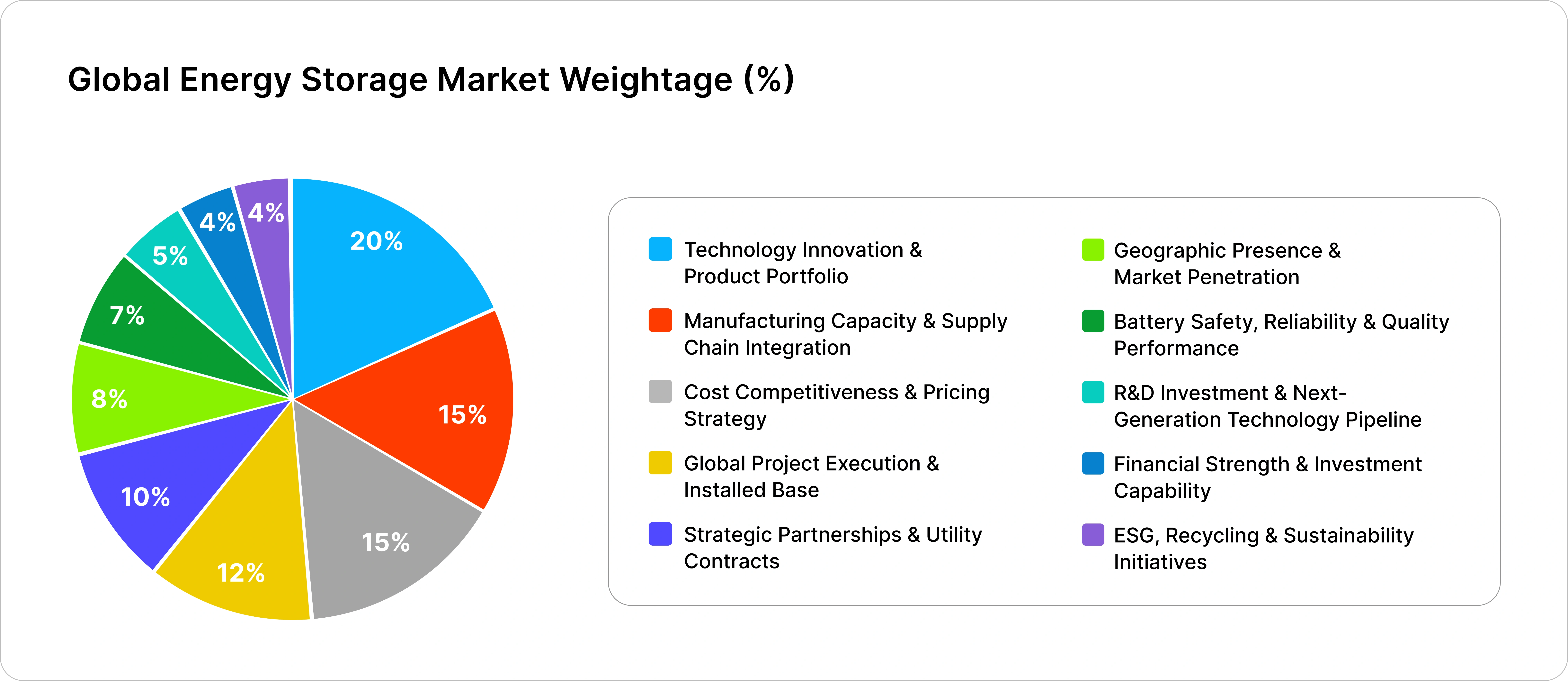
Manufacturing capacity and vertically integrated supply chains are crucial, accounting for 15% of the assessment, highlighting the industry's reliance on large-scale battery production, secure sourcing of raw materials, and localized manufacturing to minimize procurement risks and project lead times. Cost competitiveness is another significant factor, also at 15%, as falling battery system costs have a major impact on project economics and procurement choices for utility-scale storage.
The framework further assesses project execution capability and installed base at 12%, which reflects a company's ability to deliver large grid-scale projects while maintaining operational reliability across various grid conditions. The importance of strategic partnershipsparticularly with utilities, renewable developers, EPC contractors, and grid operatorshas risen, comprising 10% of the assessment, as long-term agreements offer stable order pipelines and recurring revenue opportunities.
Geographic diversification is evaluated at 8%, assessing a company’s exposure to both mature and emerging markets, which helps reduce dependence on a single region or regulatory environment. Battery safety, lifecycle performance, and product reliability hold a weight of 7%, gaining importance due to increasing regulatory scrutiny surrounding utility-scale battery installations.
The framework also takes into account sustained investment in next-generation technologies, financial resilience, and ESG initiatives, all of which are vital for organizations to maintain technological leadership and adapt to evolving regulatory and sustainability demands. By balancing operational capabilities, innovation strength, commercialization success, and strategic execution, the EICAF provides a holistic benchmark to assess competitive leadership within the global energy storage sector.