Global Diesel Generator Market
Analysis by Power Rating (Below 75 kVA, 75–375 kVA, 375–750 kVA, 750–2,000 kVA, Above 2,000 kVA), Application (Standby, Prime and Continuous, Peak Shaving), Mobility (Stationary, Mobile), End Use and Region


Analysis by Power Rating (Below 75 kVA, 75–375 kVA, 375–750 kVA, 750–2,000 kVA, Above 2,000 kVA), Application (Standby, Prime and Continuous, Peak Shaving), Mobility (Stationary, Mobile), End Use and Region
Global diesel generator market recorded a sales volume of 1.46 million units in 2024 and is estimated to reach 1.87 million units by 2034, growing at a CAGR of 2.3% between 2027 and 2034. In value terms, the market is estimated at US$20.9 billion in 2025 and is forecast to reach US$33.2 billion by 2034. The gap between value and volume growth is the defining feature of the forecast: each additional unit sold over the next decade carries a higher average rating, more control and aftertreatment content and, increasingly, a longer service contract. Epignosis Insights estimates that more than half of incremental market value between 2025 and 2034 will come from units rated above 750 kVA, even though these units represent less than 4% of shipments.
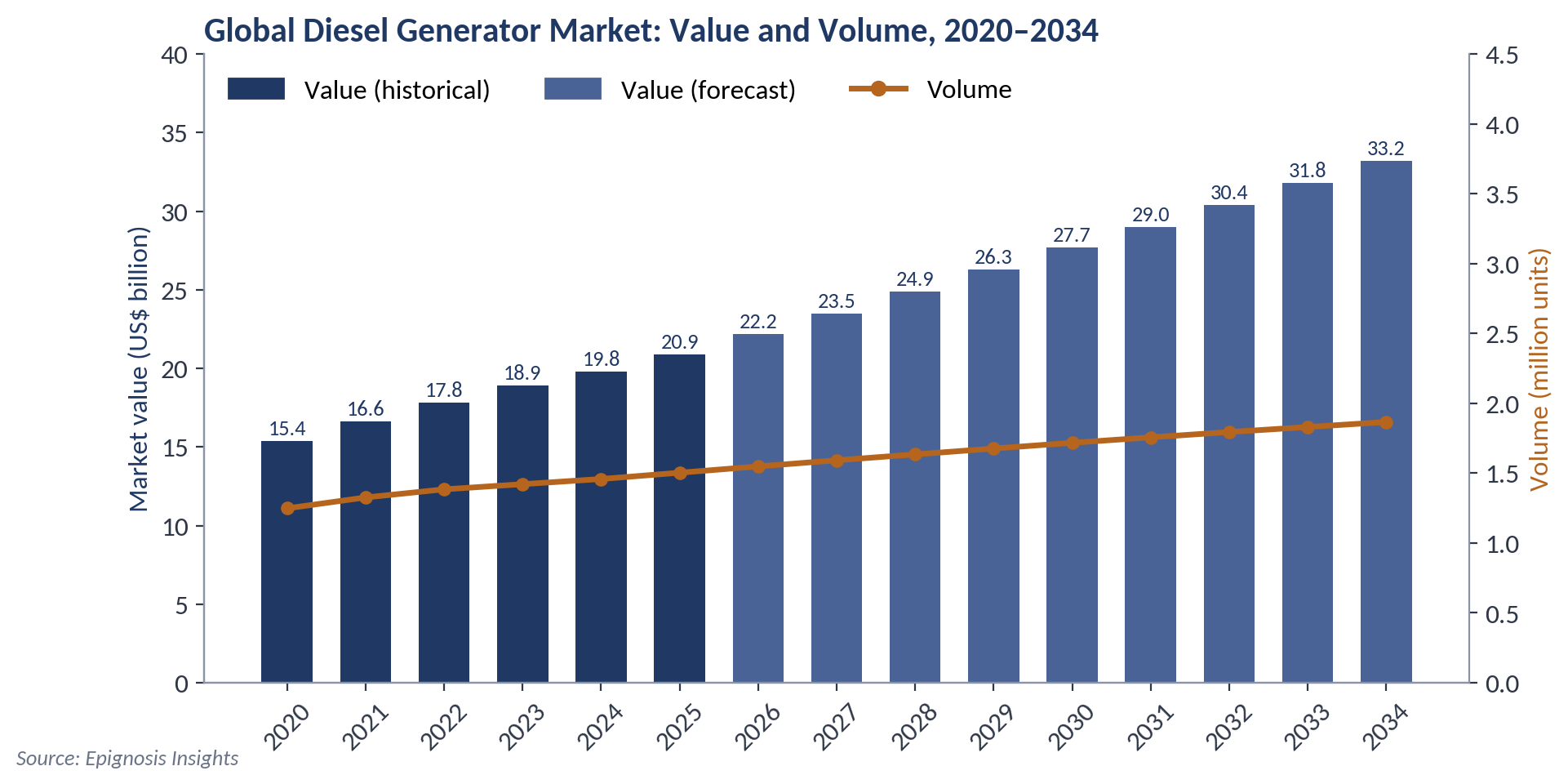
Global Diesel Generator Market: Value and Volume, 2020–2034
The fastest change in the diesel generator market is happening at the top of the power range. Hyperscale, colocation and AI training facilities typically require multi-megawatt standby capacity sized to the full critical IT load plus cooling, with redundancy architectures such as N+1, N+2 or 2N adding further units on top of the base requirement. A single 100 MW campus can therefore require between 40 and 80 units rated at 2,500 to 3,250 kVA, depending on the redundancy design. Electricity consumption by data centres reached about 415 TWh in 2024 and is projected to roughly double to around 945 TWh by 2030, according to the International Energy Agency. Every additional megawatt of data centre load that connects to the grid typically arrives with a matching block of on-site backup capacity, which is why standby generation demand has tracked the data centre build-out more closely than any other end-use indicator.
Epignosis Insights estimates that demand for diesel generators rated above 2,000 kVA rose from 8,600 units in 2023 to 12,000 units in 2025 and will reach 19,500 units by 2030. Over the same period, manufacturing capacity for this class is expected to grow from 10,800 units to 21,800 units. The result is a sustained period of tight supply in which utilisation exceeds 90% through 2028, compared with roughly 77% for the market as a whole. Order backlogs illustrate how far demand has moved ahead of output. Generac reported in its third-quarter 2026 results that its backlog for products sold into the data centre market had grown to approximately US$4.5 billion, following a long-term supply agreement for backup generators at Amazon data centres. For a company that historically derived most of its revenue from residential standby units, this represents a material change in revenue composition.
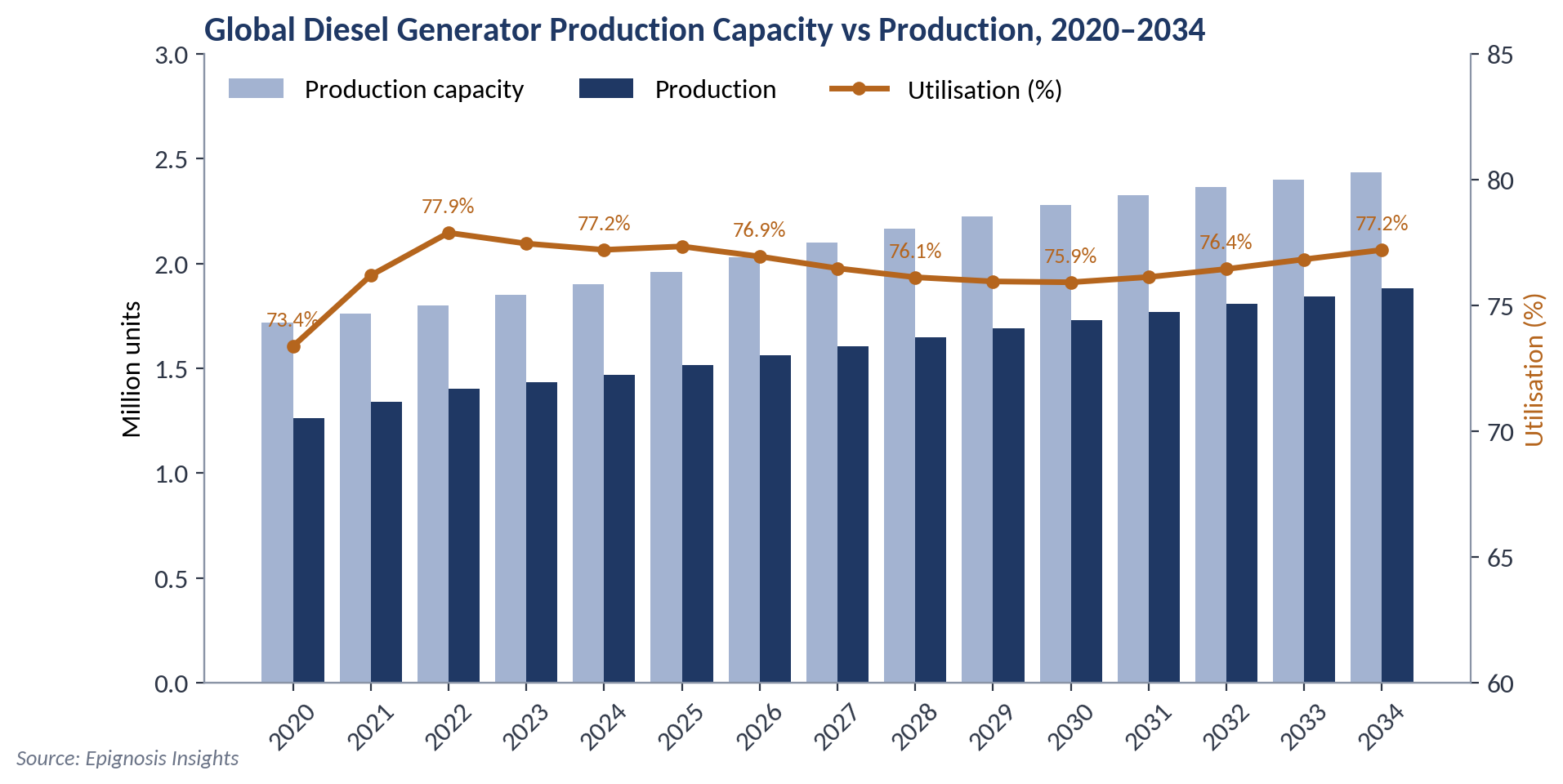
Above 2,000 kVA Diesel Generators: Demand vs Manufacturing Capacity, 2023–2030
The large-format segment also changes how generators are bought. Data centre operators increasingly reserve manufacturing slots through framework agreements covering multiple sites and several years, rather than tendering unit by unit. This shifts negotiating leverage toward manufacturers with proven high-horsepower engine platforms and gives early movers better access to delivery windows. It also creates a secondary opportunity for mid-sized manufacturers able to supply 1,500 to 2,000 kVA units in parallel configurations where top-end units are unavailable within project timelines. Epignosis Insights expects the above 2,000 kVA class to expand its share of global market value from 21% in 2025 to approximately 28% by 2034.
The principal risk to this driver is a shift in data centre power architecture. Operators are testing natural gas generation, fuel cells and large battery systems as alternatives or supplements to diesel standby. However, diesel retains three practical advantages that limit near-term substitution: on-site fuel storage that does not depend on a pipeline, fast start and load acceptance, and established permitting pathways for emergency-only operation. Epignosis Insights therefore expects diesel to remain the default standby technology for most new data centre capacity through 2030, with alternatives gaining share mainly in prime-power and grid-support roles.
Emission regulation is the second structural force in the diesel generator market, and its effect is felt primarily through product cost and design rather than demand volume. The regulatory picture differs substantially across major markets. In India, the Central Pollution Control Board's CPCB IV+ norms took effect in July 2023 for gensets up to 800 kW, requiring significantly lower nitrogen oxide and particulate emissions than the previous CPCB II stage. In the European Union, Stage V limits under Regulation (EU) 2016/1628 apply to non-road engines, including mobile gensets, and effectively require diesel particulate filters on most units above 19 kW. In the United States, stationary engines used for non-emergency purposes must meet Tier 4 Final limits, while emergency standby units may operate under less stringent Tier 2 or Tier 3 limits provided their non-emergency running hours remain within regulatory caps.
These regulatory differences translate directly into pricing. Epignosis Insights' cost analysis indicates that a 500 kVA genset built for an unregulated market carries a price index of 100, compared with 127 for a CPCB IV+ compliant unit, 135 for an EU Stage V unit and 142 for a US Tier 4 Final non-emergency unit. Most of the uplift comes from aftertreatment hardware, including selective catalytic reduction systems, diesel particulate filters and diesel exhaust fluid dosing, together with higher-specification fuel injection and electronic engine controls. Enclosure redesign, additional cooling capacity and certification testing account for most of the remaining difference.
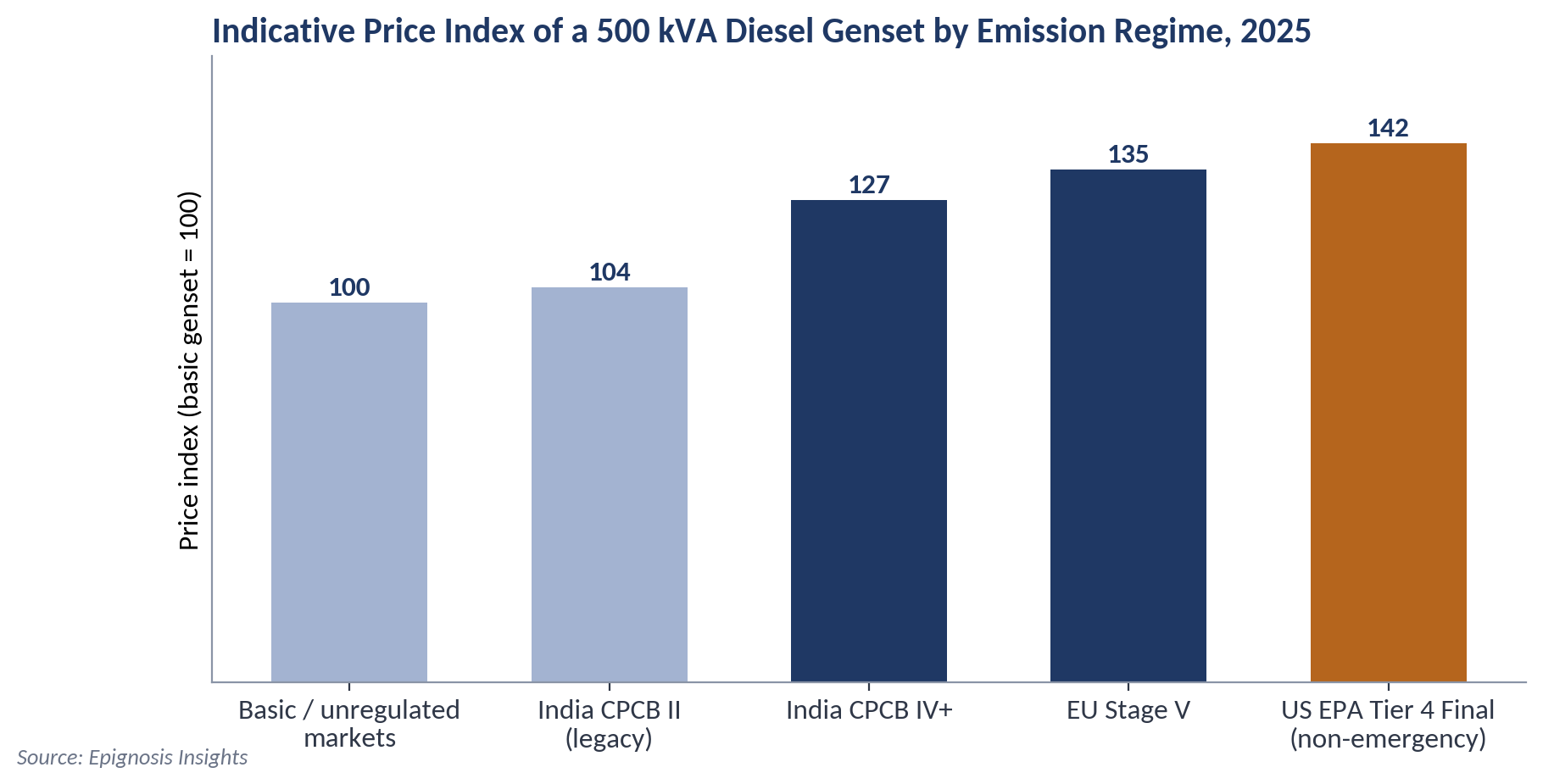
Indicative Price Index of a 500 kVA Diesel Genset by Emission Regime, 2025
The commercial impact has been uneven. In India, the transition to CPCB IV+ caused a temporary demand dip as buyers pre-purchased CPCB II stock before the deadline, followed by a recovery as compliant products became available across power ratings. The new regime also favoured manufacturers with in-house engine development capability, because compliant engines required extensive recalibration and validation. In the United States, the emergency standby exemption has kept data centre and healthcare backup units largely on Tier 2 platforms, which explains why US market growth has been driven by volume and rating rather than aftertreatment content. Epignosis Insights estimates that emission-related content added approximately 4 percentage points to global average selling price growth between 2020 and 2025, and expects a further 3 percentage points by 2034 as more countries align with tighter limits.
Global diesel generator production capacity is estimated at 1.96 million units in 2025, against production of 1.52 million units, giving an industry-wide utilisation rate of 77.3%. Epignosis Insights projects capacity to grow at a 2.1% CAGR between 2027 and 2034 to reach 2.44 million units, broadly in line with volume demand. The headline utilisation figure, however, conceals two very different supply environments. Below 375 kVA, the market has structural overcapacity, particularly in China and India, where hundreds of genset assemblers compete on price using locally produced or licensed engines. Above 2,000 kVA, the market is capacity constrained, with only a handful of manufacturers able to produce high-horsepower engines at scale.
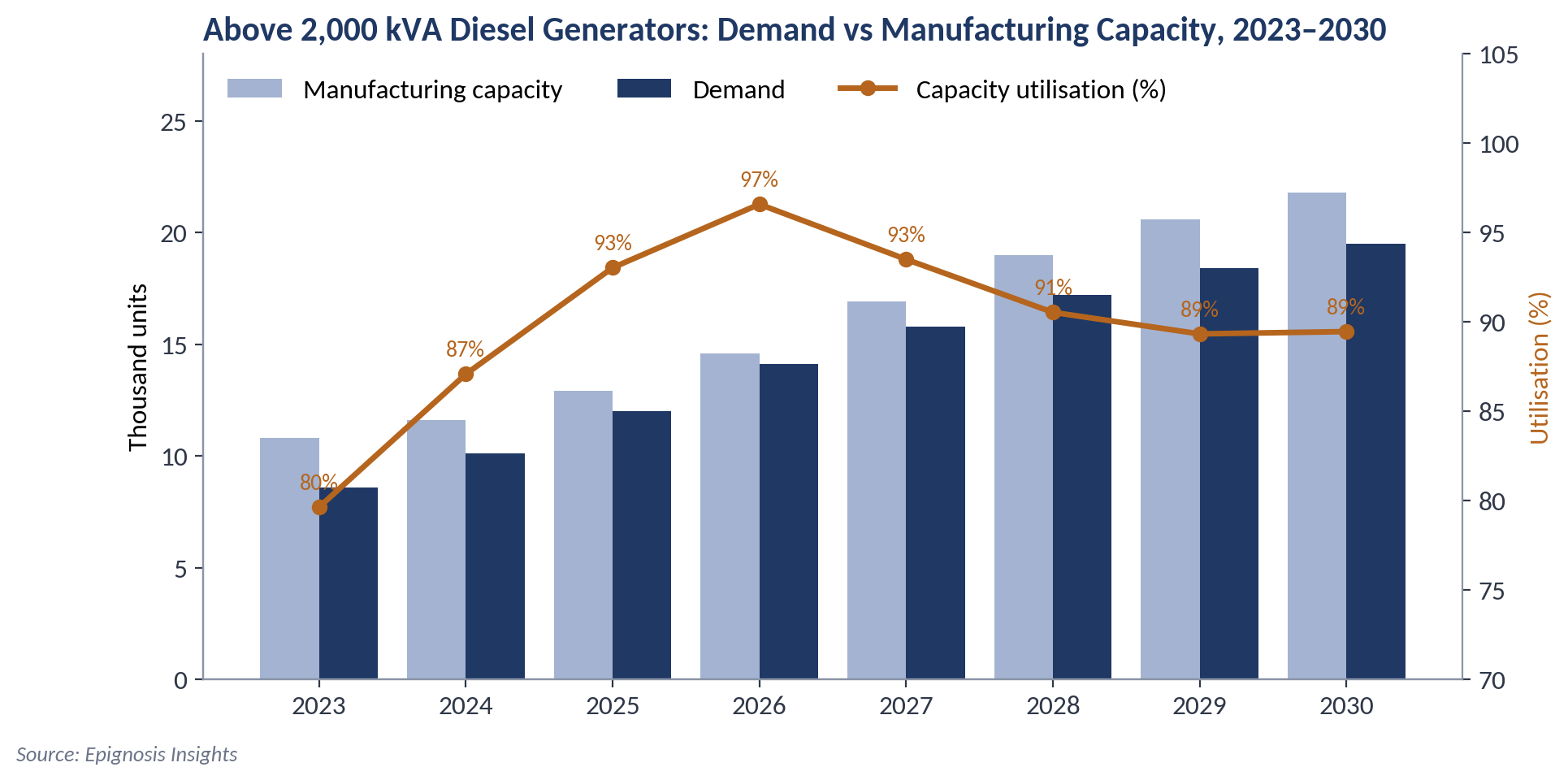
Global Diesel Generator Production Capacity vs Production, 2020–2034
China accounts for 860,000 units, or 43.9%, of global production capacity, followed by India with 410,000 units. Europe and North America hold 230,000 and 210,000 units respectively, while Japan, South Korea and Southeast Asia together account for 160,000 units. The remaining 90,000 units are distributed across the Middle East, Africa and Latin America, typically in assembly plants serving regional markets. The geographic split reflects product mix: Chinese and Indian capacity is concentrated in small and mid-range units for domestic use and export to Africa, the Middle East and Southeast Asia, while European and North American capacity is weighted toward large, high-specification units for mission-critical applications.
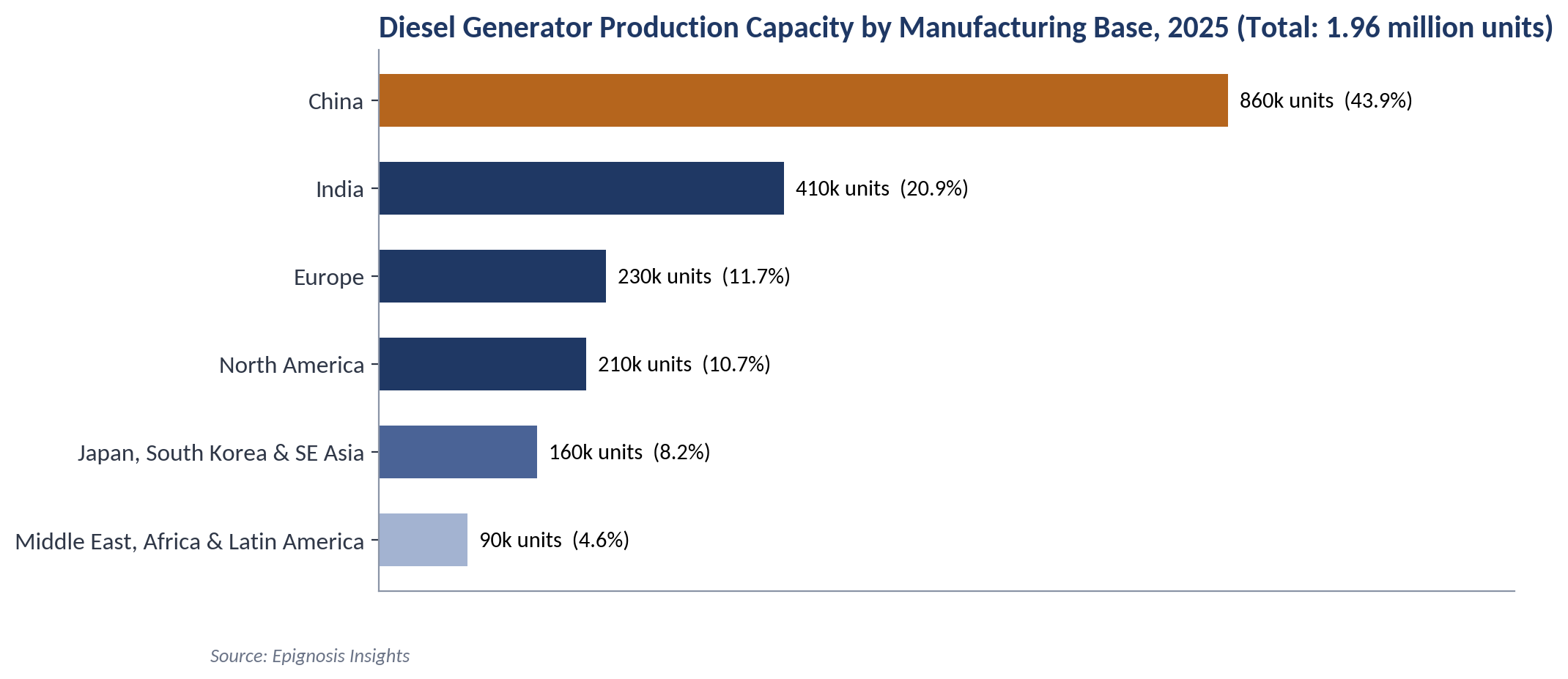
Diesel Generator Production Capacity by Manufacturing Base, 2025
The binding constraint on large-format supply is engine capacity rather than genset assembly. Packaging, alternator integration and enclosure fabrication can be scaled relatively quickly, but high-horsepower engine blocks, crankshafts and turbochargers require long-lead castings, forgings and machining capacity.
Manufacturers have responded with significant investment. Cummins announced a US$150 million expansion of its Fridley, Minnesota facility in February 2026 to raise QSK95 high-horsepower engine output by 30%. Rolls-Royce Power Systems is executing a plan to double its global power generation capacity between 2022 and 2028, with investment concentrated in Germany and the United States. Epignosis Insights expects these expansions to bring large-format utilisation below 90% by 2029, easing lead times without returning the segment to oversupply.
Alternators, switchgear and control systems form the second tier of supply risk. Large alternators share supply chains with industrial motors and grid equipment, both of which are experiencing elevated demand. Manufacturers with vertically integrated alternator production or long-term supply agreements are better placed to commit to multi-year delivery schedules. Epignosis Insights' supplier interviews indicate that customers increasingly evaluate genset suppliers on delivery certainty and the ability to provide fully packaged, factory-tested systems, rather than on price alone.
The diesel generator market is highly skewed when viewed across power ratings. Units below 75 kVA represent 72.0% of global shipments but only 22% of market value. At the other end of the range, units above 2,000 kVA account for just 0.8% of shipments but 21% of value. This inversion means that small changes in large-format demand have a disproportionate effect on overall market revenue, while unit-based indicators can understate the market's real momentum.
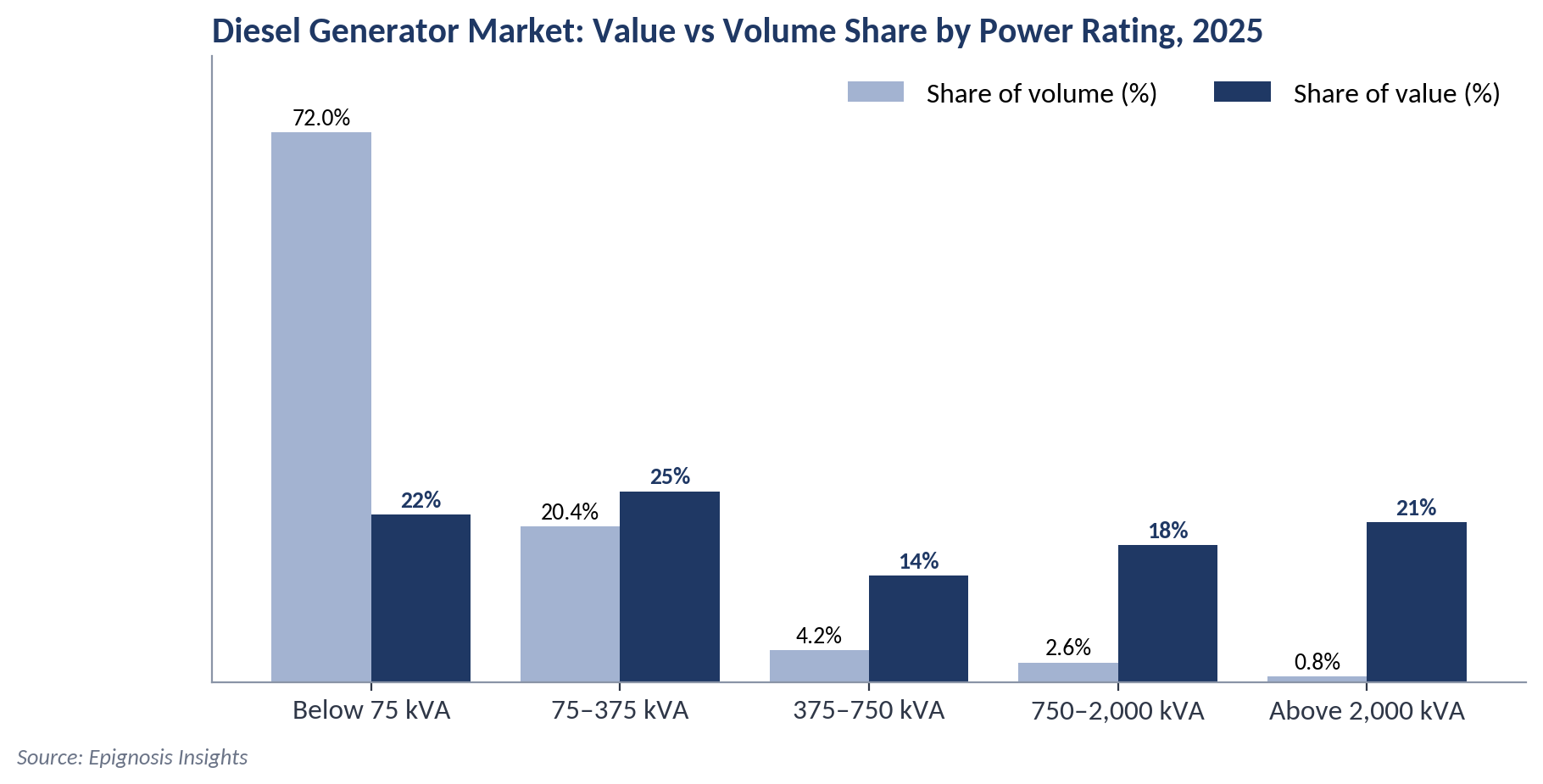
Diesel Generator Market: Value vs Volume Share by Power Rating, 2025
The below 75 kVA segment serves residential backup, small commercial premises, telecom towers and portable applications. Demand is closely tied to grid reliability, particularly in South Asia, Sub-Saharan Africa and parts of the Middle East, where frequent outages make small gensets an essential household and business asset. Price competition is intense, and Epignosis Insights expects average selling prices in this segment to rise only modestly through 2034. The 75 to 375 kVA segment, accounting for 25% of value, serves commercial buildings, small industrial sites and construction, and is where emission compliance has had the most visible effect on pricing in India and Europe.
The 375 to 2,000 kVA range, representing 32% of combined value, covers hospitals, airports, manufacturing plants and enterprise data centres. This band is increasingly the overflow market for hyperscale projects that cannot secure delivery slots for the largest units. The above 2,000 kVA segment is forecast to grow fastest, at an estimated 8.9% CAGR from 2027 to 2034, supported by hyperscale and AI data centre construction, LNG and mining projects, and utility peak-capacity requirements.
Industrial users remained the largest end-use group in 2025 at 27% of market value, covering manufacturing, oil and gas, mining and process industries where diesel gensets provide either standby protection for critical processes or prime power in remote locations. Data centres followed at 18%, ahead of commercial buildings at 13% and utilities and infrastructure at 11%. Telecom, residential and construction and rental applications each represent 8%, while healthcare accounts for 7%.
By application, standby units represented 55% of 2025 market value, prime and continuous-duty units 33%, and peak-shaving units 12%. Standby demand is anchored in mission-critical facilities that run their generators only for testing and outages, so buyers prioritise start reliability, load acceptance and compliance with local fire and life-safety codes. Prime and continuous-duty demand comes mainly from mining camps, oil and gas sites, islands and off-grid industrial operations, where engine life, fuel efficiency and service intervals dominate purchasing decisions. Peak-shaving applications, used by industrial and commercial users to reduce demand charges or support grid operators during tight periods, are expected to gain share in markets with volatile electricity tariffs. By mobility, stationary units accounted for 79% of value and mobile units 21%, with the mobile segment closely tied to rental fleet replacement cycles and construction activity.
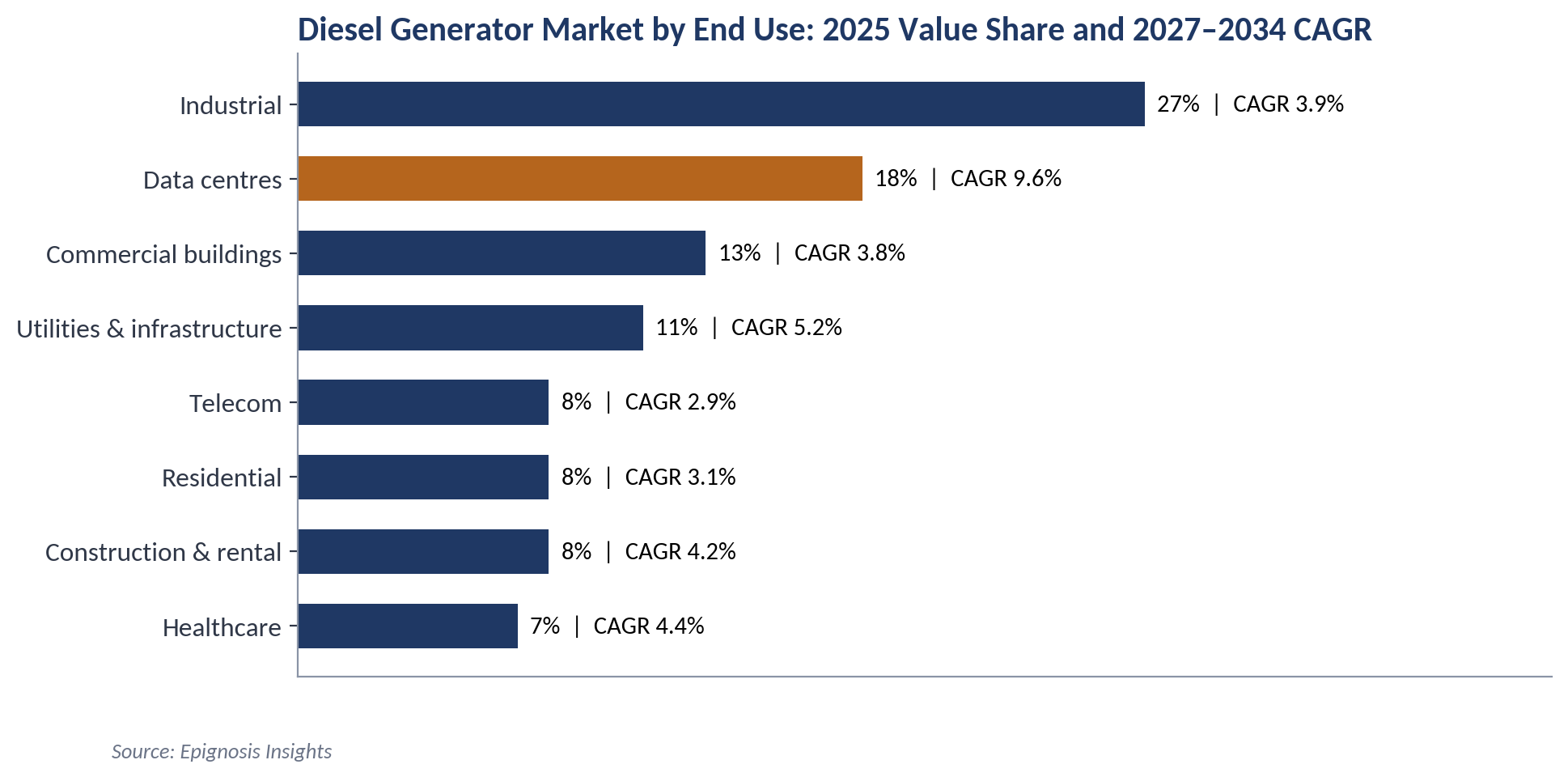
Diesel Generator Market by End Use: 2025 Value Share and 2027–2034 CAGR
Growth rates diverge more sharply than shares. Data centres are forecast to grow at 9.6% CAGR between 2027 and 2034, and Epignosis Insights expects them to overtake industrial applications as the largest single end use by value by 2033. Utilities and infrastructure follow at 5.2%, reflecting airports, metro rail systems, water treatment and grid-support installations. Telecom is the slowest-growing segment at 2.9% CAGR, as tower operators replace diesel runtime with lithium-ion batteries and solar hybrid systems, lowering both new unit demand and the average rating per site.
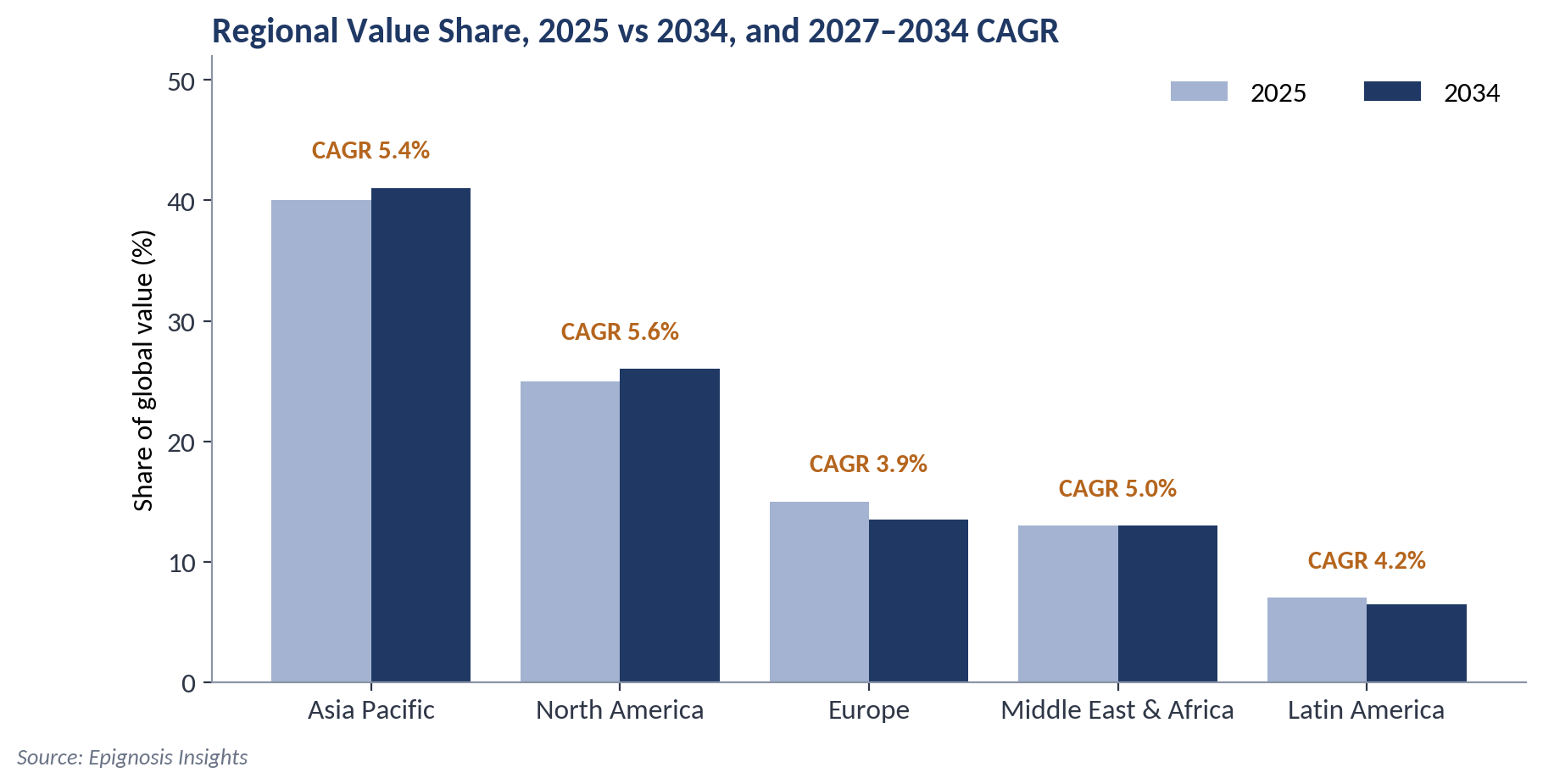
Regional Value Share, 2025 vs 2034, and 2027–2034 CAGR
Asia Pacific accounted for 40% of global value in 2025, supported by India, China, Southeast Asia and Australia. North America held 25% and is projected to post the highest regional CAGR of 5.6% between 2027 and 2034, raising its share to 26% by 2034 on the strength of US data centre investment. Europe, at 15% of 2025 value, grows more slowly at 3.9% CAGR, as stricter emission rules, higher grid reliability and earlier adoption of battery alternatives reduce new unit demand outside the data centre segment. The Middle East and Africa account for 13% of value with a 5.0% CAGR, driven by Gulf infrastructure programmes and grid reliability gaps across Africa, while Latin America represents 7% and grows at 4.2%.
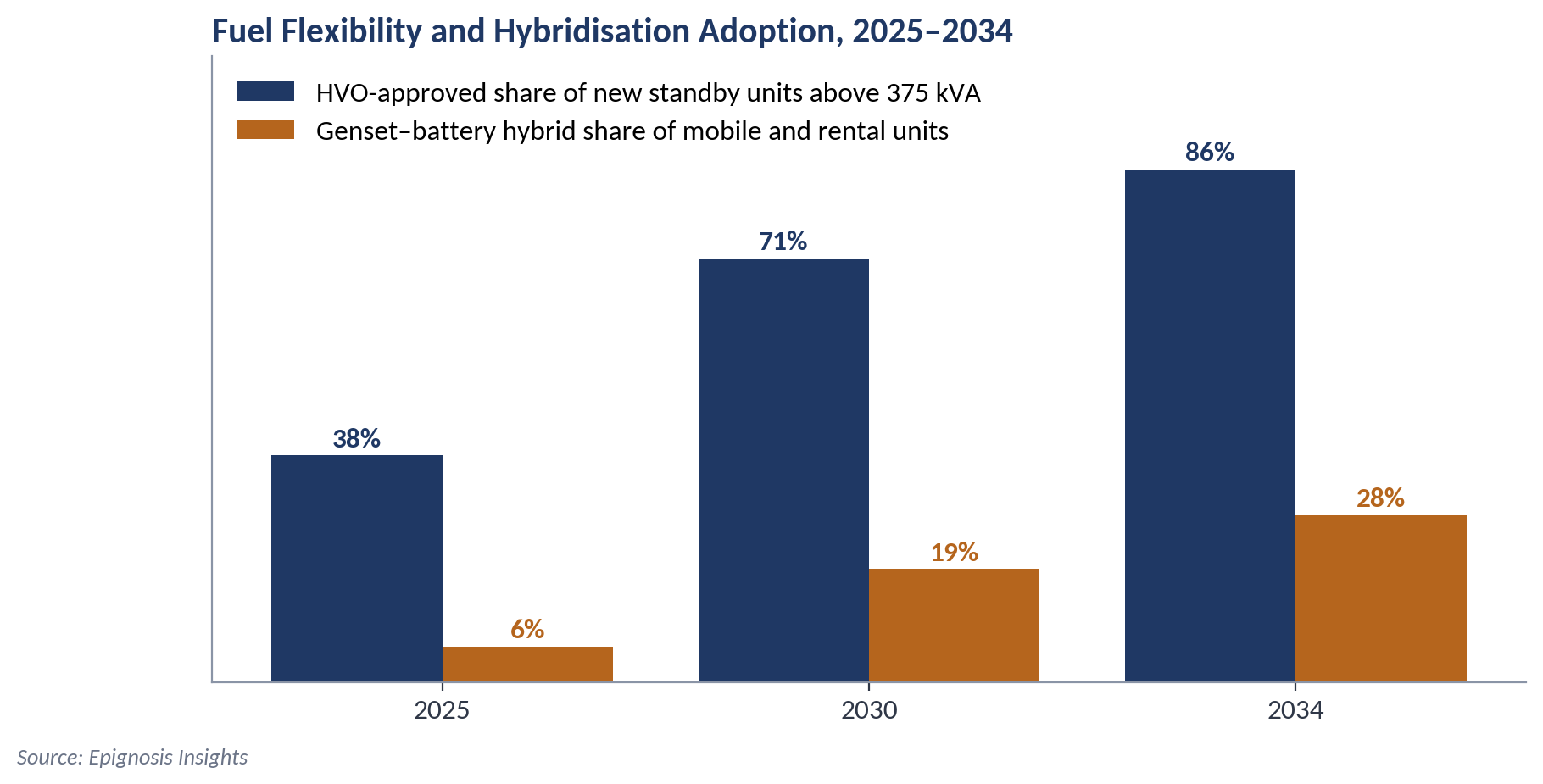
Fuel flexibility is becoming a standard specification requirement rather than a premium option. Hydrotreated vegetable oil, a renewable paraffinic diesel that can be used as a drop-in fuel in approved engines, allows operators to reduce lifecycle carbon emissions without changing generator hardware. Epignosis Insights estimates that 38% of new standby units above 375 kVA shipped in 2025 were approved by their manufacturers for HVO operation, and expects this share to reach 71% by 2030 and 86% by 2034. Approval is increasingly treated as a procurement prerequisite by hyperscale operators and public sector buyers with net-zero commitments, even where HVO is not used from day one.
Fuel Flexibility and Hybridisation Adoption, 2025–2034
Hybridisation is advancing fastest in mobile and rental applications. Genset and battery hybrid systems allow the engine to run at its most efficient load point while the battery covers low-load periods and short peaks, reducing fuel consumption and engine hours on construction sites and at events. Epignosis Insights estimates that hybrid configurations represented 6% of mobile and rental diesel units in 2025, rising to 19% by 2030 and 28% by 2034. For manufacturers, hybridisation lowers the number of engine hours sold per site but increases system value, control content and service revenue.
These trends point toward a diesel generator market that becomes more valuable per unit even as diesel fuel consumption per installed kilowatt declines. Manufacturers that combine HVO approval, factory-integrated battery options and remote monitoring are positioned to protect margins as customers evaluate generators on total cost of ownership and emissions profile, rather than on purchase price alone.
Key companies analysed in the global diesel generator market are: Caterpillar (including FG Wilson and Perkins), Cummins, Rolls-Royce Power Systems (mtu), Rehlko (formerly Kohler Energy), Generac (including Pramac), Mitsubishi Heavy Industries, Atlas Copco, Himoinsa (Yanmar group), DEUTZ (including Blue Star Power Systems), Aksa Power Generation, Kirloskar Oil Engines, Mahindra Powerol, Cooper Corporation, Ashok Leyland, Weichai Power, Guangxi Yuchai Machinery, Doosan Bobcat, Visa S.p.A., Teksan, Inmesol and others.
Ownership changes have reshaped the competitive set since 2024. Kohler Energy became a stand-alone business in May 2024 after Platinum Equity completed its transaction with Kohler Company, and rebranded as Rehlko in September 2024, with Kohler Power Systems transitioning to the new brand. DEUTZ has used acquisitions to move from engine supplier to genset system provider, completing its purchase of Germany's Frerk Aggregatebau in February 2026 and signing an agreement in May 2026 to acquire Brazilian manufacturer Maxi Trust Power, which produces up to 3,000 gas and diesel gensets annually in the 40 to 3,000 kVA range. Caterpillar reported a record order backlog of US$72.1 billion in the second quarter of 2026, with power generation for data centres among the key contributors alongside oil and gas customers.
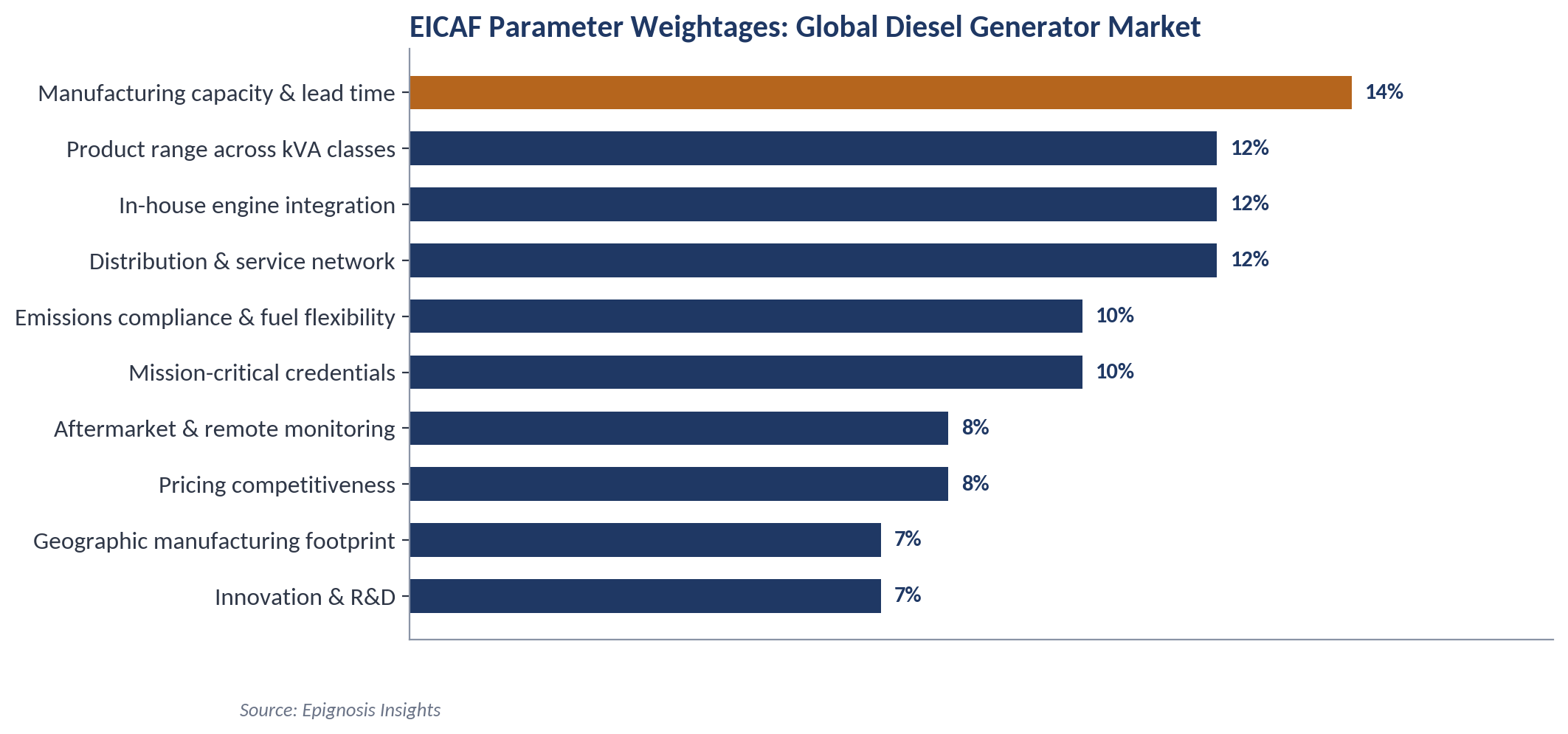
The Epignosis Insights Competitive Assessment Framework (EICAF) for the global diesel generator market evaluates companies across 10 weighted parameters reflecting the factors that most influence buyer selection in this industry. Manufacturing capacity and lead time receives the highest weighting at 14%, because delivery certainty has become a primary procurement criterion in the large-format segment. Product range across kVA classes, in-house engine integration, and distribution and service network each receive 12%, recognising the importance of full-range offerings, control of the engine supply chain and local service for uptime-critical customers. Emissions compliance and fuel flexibility, and mission-critical credentials each receive 10%. Aftermarket and remote monitoring capability and pricing competitiveness each receive 8%, while geographic manufacturing footprint and innovation and R&D each receive 7%. The total weighting equals 100%.
EICAF Parameter Weightages: Global Diesel Generator Market
Each company is assigned a score from 1 to 5 against every parameter, with the weighted score calculated as Company Score × Parameter Weightage. The resulting EICAF score provides a structured comparison of competitive capability that does not rely solely on revenue or installed base. This approach is particularly relevant to the diesel generator market because companies compete through distinct models, including vertically integrated engine and genset manufacturers, independent packagers using third-party engines, regional volume specialists focused on small units, and rental-oriented suppliers of mobile and hybrid equipment.