Key Findings
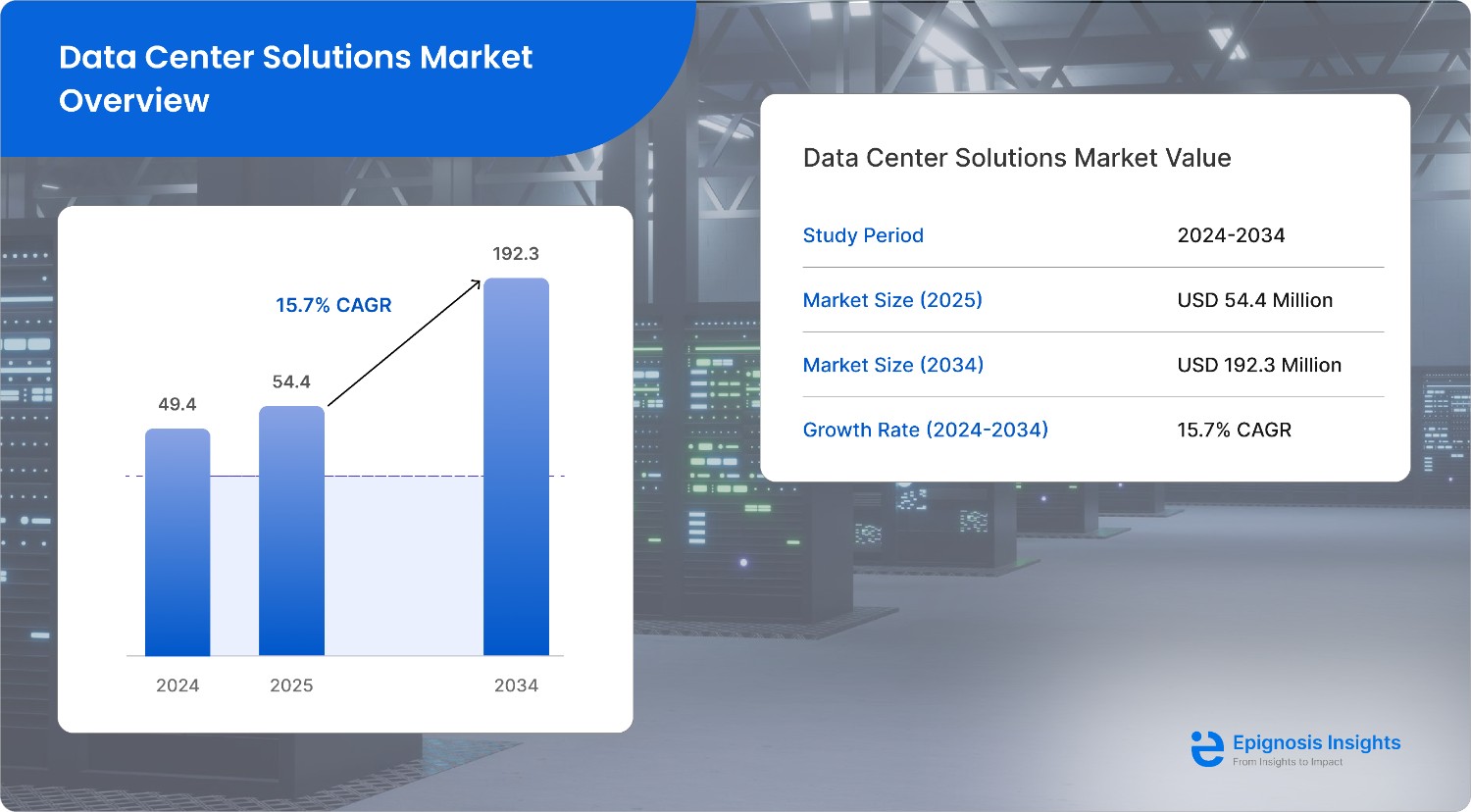
- Market value is projected to increase from USD 49.4 billion in 2024 to USD 192.3 billion by 2034.
- The market is expected to register a 15.7% CAGR during 2027–2034.
- AI workloads and high-density computing are accelerating demand for advanced data-center infrastructure.
- Rising rack densities are increasing requirements for high-capacity power distribution and advanced cooling.
- Liquid cooling is gaining importance as conventional air cooling faces limitations at higher rack densities.
- Growing power constraints are creating opportunities for UPS, energy storage, microgrids, and onsite power solutions.
- HVDC and hybrid AC/DC architectures are emerging as potential solutions for high-density AI facilities.
Data Center Solutions Market
Data Center Solutions Market recorded a market value of USD 54.4 billion in 2025 and is estimated to reach a value of USD 192 billion by 2034 with a CAGR of 15.7% during the forecast period.
Data Center Solutions Market:Power Availability vs Planned Capacity
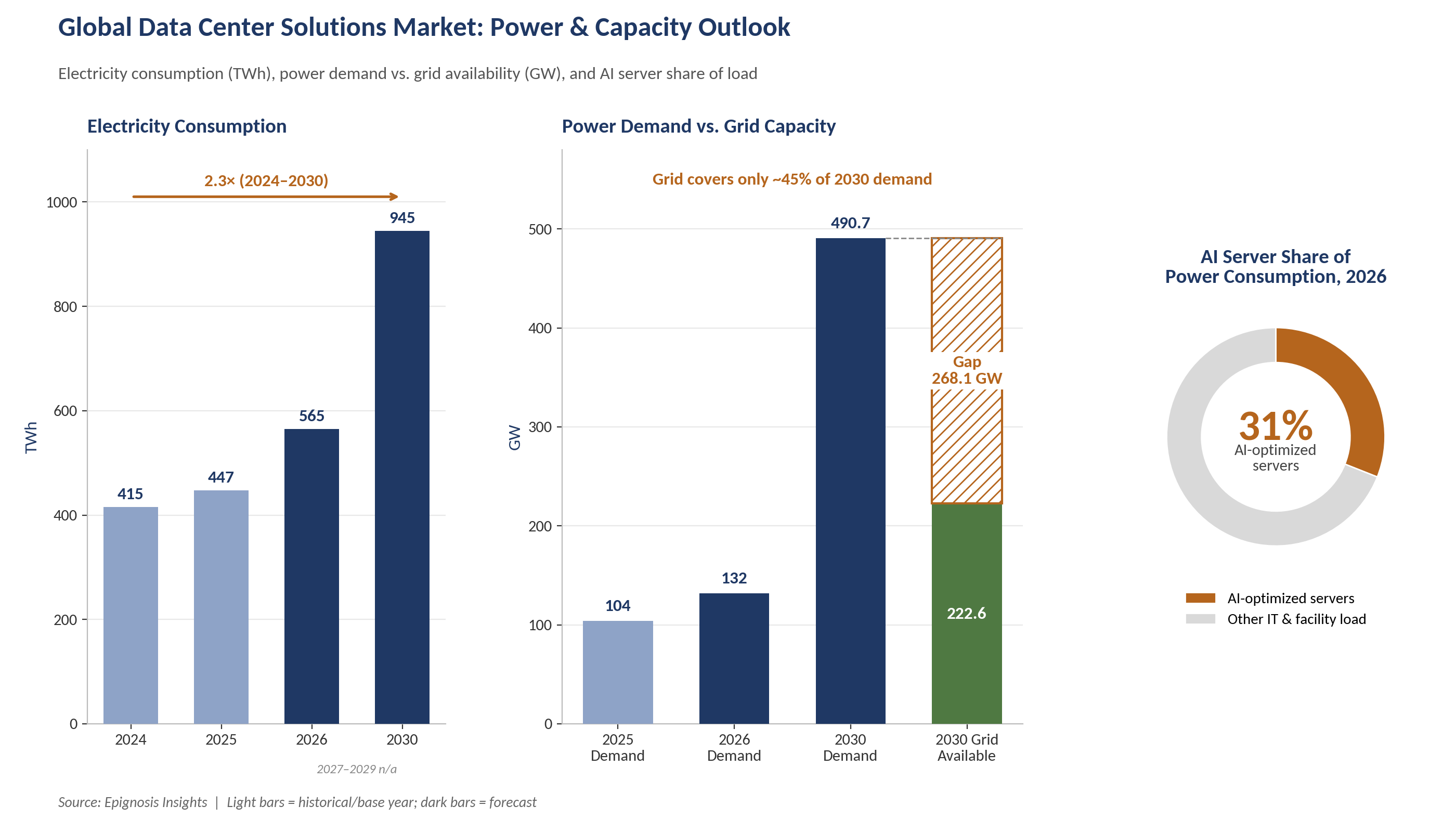
The Data Center Solutions Market is increasingly constrained by the mismatch between rapidly expanding AI-driven capacity requirements and slower grid development, creating demand for onsite generation, energy storage, advanced UPS systems, and resilient power-distribution infrastructure. The IEA estimates global data-center electricity consumption will rise from 415 TWh in 2024 to 945 TWh by 2030, while Gartner projects data-center power demand to reach 132 GW in 2026, up 27% year over year.
The capacity gap is particularly relevant for solution providers because planned data-center capacity does not automatically translate into immediately available grid power. TrendForce estimates that by 2030 global data-center power-demand capacity could reach 490.7 GW, compared with only 222.6 GW of grid capacity available to data centers, implying a potential 268.1 GW gap. This gap is a capacity comparison, not a forecast of actual unmet electricity consumption, because operators can supplement grid supply through behind-the-meter generation.
The resulting opportunity extends beyond electricity supply itself: power availability increasingly determines where data centers can be built, when projects become operational, and how quickly AI capacity can scale. In the U.S., for example, FERC recently highlighted a 6.8 GW power shortfall in PJM, illustrating how data-center growth is already affecting regional grid planning.
AI-Driven Data Center Transformation
The Data center solutions market is undergoing structural transformation as AI workloads shift infrastructure requirements from conventional compute toward high-density GPU systems, advanced networking, liquid cooling, and higher-capacity power systems. Global data-center electricity consumption reached approximately 415 TWh in 2024, representing around 1.5% of global electricity demand, while the IEA projects consumption to reach 945 TWh by 2030, nearly doubling within six years. Accelerated servers, primarily associated with AI workloads, are expected to grow their electricity consumption by approximately 30% annually through 2030, compared with 9% for conventional servers.
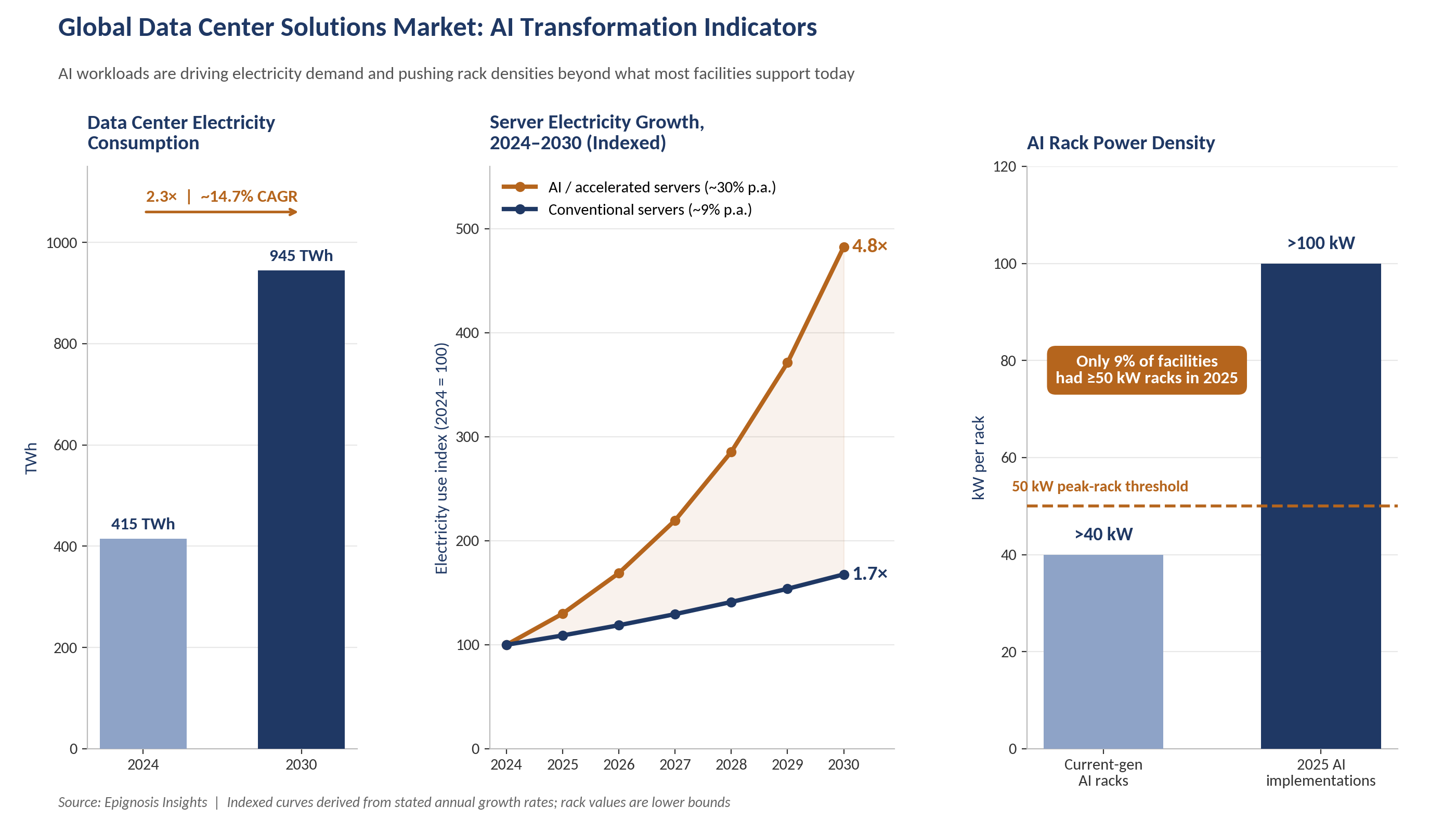
The transformation is particularly visible in rack density. Uptime Institute reports that the share of facilities with peak rack densities of at least 50 kW increased to 9% in 2025, compared with 6% in 2023, while 82% of facilities remained below 30 kW. AI infrastructure is pushing the upper end substantially higher: current AI systems can exceed 40 kW per rack, with some 2025-generation implementations exceeding 100 kW.
Consequently, the Data center solutions market is moving toward integrated AI-ready architectures rather than isolated equipment upgrades. Power distribution must accommodate higher sustained loads and rapid power fluctuations, while cooling increasingly requires direct-liquid or hybrid configurations for extreme-density deployments. Uptime Institute notes that liquid cooling is generally suited to rack powers above 50 kW, with near-total liquid cooling becoming necessary around 150 kW or more.
The commercial implication is a broader opportunity across UPS systems, power distribution, transformers, busways, high-speed networking, GPU infrastructure, liquid cooling, thermal-management systems, racks, monitoring, and DCIM. However, adoption will remain differentiated: hyperscale AI facilities are likely to deploy the highest-density architectures, while conventional enterprise environments will continue combining legacy air-cooled infrastructure with targeted AI upgrades. Thus, AI is not simply expanding data-center capacity it is changing the specification, capital intensity, and technology mix of the infrastructure itself.
Power Architecture & HVDC Analysis
The Data center solutions market is entering a significant power-architecture transition as AI workloads push rack densities beyond the practical limits of conventional low-voltage AC distribution. Traditional data centers commonly use multiple AC/DC conversion stages between the utility connection and IT equipment, creating conversion losses, additional equipment, and greater copper requirements. As AI clusters become more power-intensive, higher-voltage DC architectures particularly 800 VDCare emerging as a potential pathway for delivering large amounts of power more efficiently and with a smaller physical footprint. Vertiv notes that existing hybrid AC/DC architectures can involve three to four conversion stages, while higher-voltage DC can reduce conversion stages and current requirements.
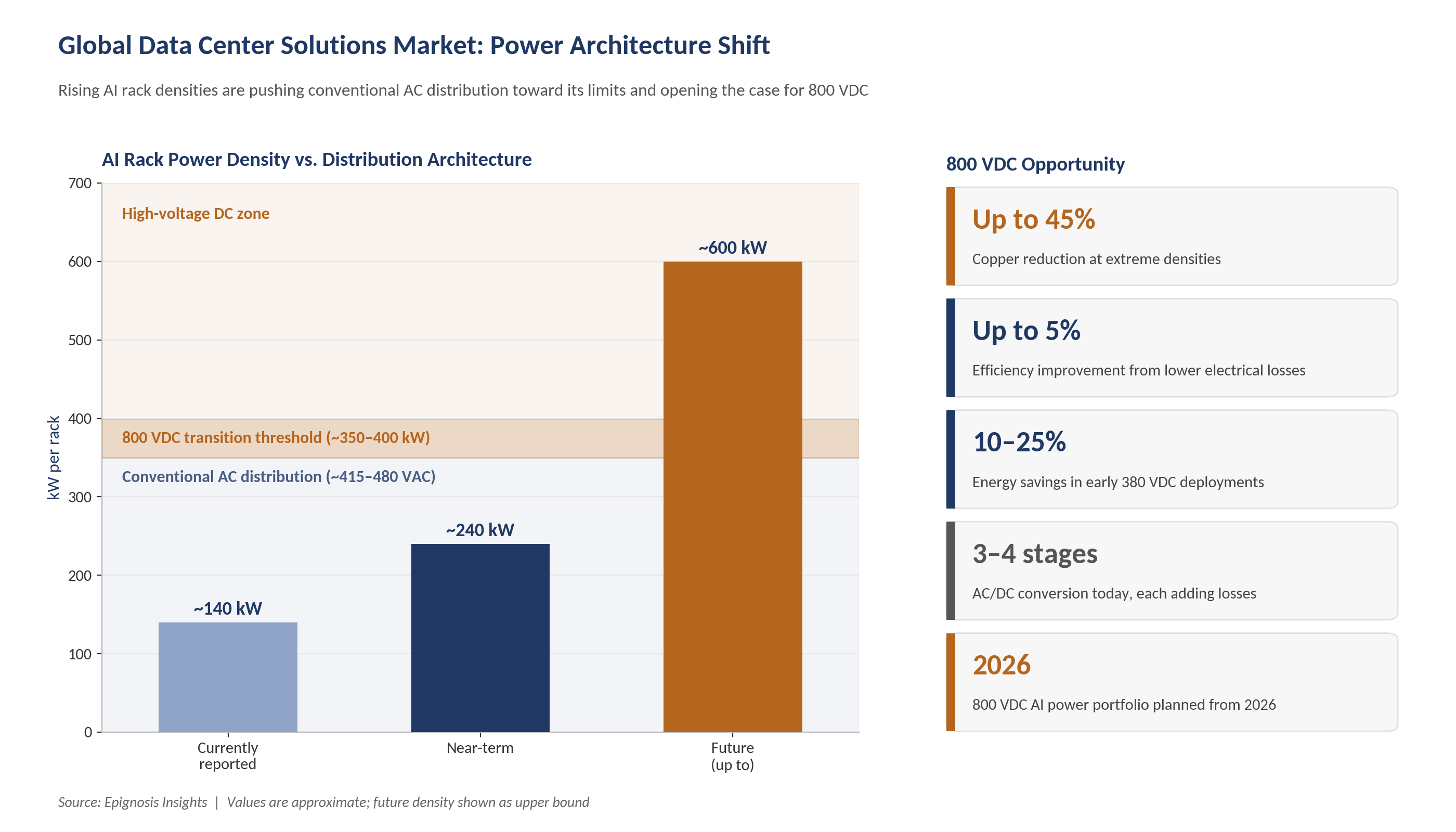
The Data center solutions market is therefore shifting from a simple question of supplying sufficient electricity toward optimizing how electricity is delivered inside the facility. At rack densities approaching several hundred kilowatts, conventional architectures require progressively larger conductors, busbars, connectors, and power-conversion equipment. Higher voltage allows the same power to be transmitted at lower current, reducing conductor requirements and associated resistive losses. Vertiv reports that 800 VDC architectures could deliver up to 45% lower copper requirements and up to 5% improvement in overall efficiency, although these figures represent vendor-reported potential rather than an industry-wide measured average.
The transition is not expected to mean an immediate replacement of AC infrastructure. Instead, the market is developing hybrid transition architectures. Rack-level sidecars can introduce 800 VDC while retaining much of the existing upstream AC infrastructure; pod-level systems can centralize conversion for groups of AI racks; and purpose-built AI facilities can eventually distribute higher-voltage DC across an entire data hall. This creates different adoption pathways for hyperscalers, colocation operators, and enterprises depending on rack density, facility age, workload profile, and retrofit economics.
The Data center solutions market is consequently creating new value pools for UPS manufacturers, electrical-equipment suppliers, power-conversion specialists, busway manufacturers, battery-storage providers, and data-center infrastructure integrators. NVIDIA has outlined an 800 VDC roadmap for next-generation AI factories, while Vertiv has stated that its planned 800 VDC portfolio is designed to support AI rack environments exceeding 300 kW.
However, adoption will remain selective. Conventional AC systems remain suitable for lower-density enterprise, cloud, and many colocation workloads, while 800 VDC becomes increasingly relevant as AI deployments approach extreme power densities. Consequently, the near-term market opportunity is likely to develop through hybrid AC/DC architectures, targeted AI halls, rack-level sidecars, and pod-level implementations, followed by broader DC distribution in purpose-built AI facilities. The strategic significance for the Data center solutions market is that power architecture is becoming an enabling technology for compute density rather than simply a supporting facility function.
AI Data Center Readiness Index
Facility readiness for artificial intelligence is now judged on more than compute access. It is a combined measure of power, cooling, efficiency, data foundations and capital discipline. For the data center solutions market, this matters because each readiness gap becomes a distinct demand pocket for equipment, software and services. Readiness benchmarks are also becoming more formal. The Red Tape Index's U.S. Data Center Readiness Index uses public federal and institutional datasets to score states on nine dimensions, among them energy supply, grid reliability, interconnection, permitting, workforce, water supply and public sentiment. Texas ranks first, with Oregon, Illinois and Florida completing the top four, and the index plans to expand into more than 30 countries by the end of 2026.
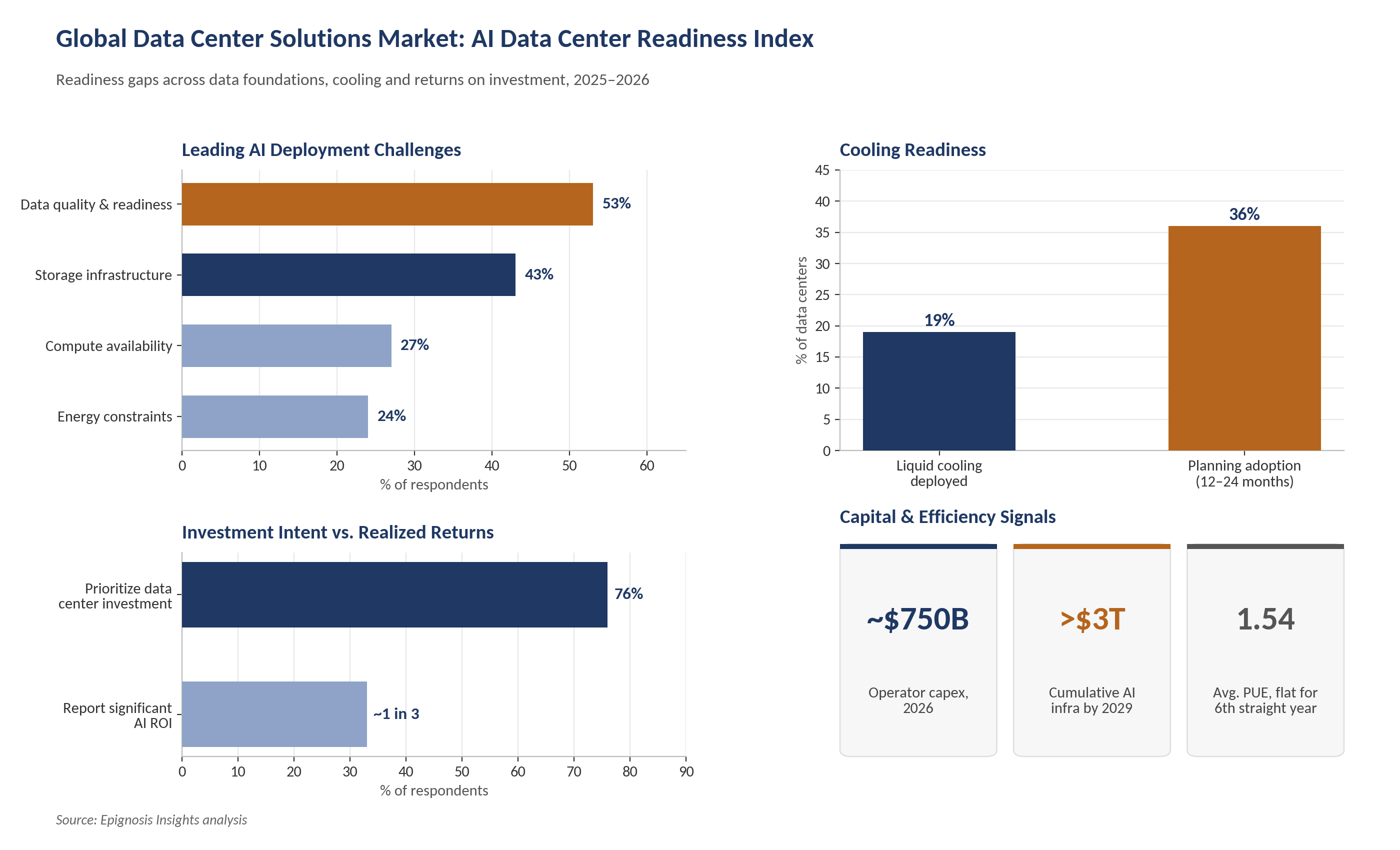
Cooling is one of the weakest readiness pillars. According to the Uptime Institute's 2025 Global Data Center Survey, 19% of data centers had deployed liquid cooling by early 2026, while a further 36% plan to adopt it within 12 to 24 months. The planned pipeline is therefore close to double the installed base, which points to a concentrated retrofit cycle over the next two years. Efficiency progress has also stalled: average PUE remained at 1.54 for a sixth consecutive year in 2025. For the data center solutions market, this favours vendors of retrofit-ready direct liquid cooling, coolant distribution units and rear-door heat exchangers that can be added without rebuilding existing halls.
The data foundation is the least visible gap. Seagate's 2026 Data Infrastructure Readiness Report found that respondents rank data quality and readiness (53%) and storage infrastructure (43%) as their main AI deployment challenges, ahead of compute availability (27%) and energy constraints (24%). Intent and outcomes also diverge: 76% of respondents prioritize data center investment, yet only one in three report significant AI ROI. This widens the data center solutions market beyond power and cooling into high-capacity storage tiers, data management platforms and infrastructure monitoring that can tie spending to measurable returns.
Capital is the strongest pillar. BloombergNEF projects that annual capital expenditure by major data center operators will approach $750 billion globally by 2026, with cumulative AI infrastructure investment expected to exceed $3 trillion by 2029. The gap between this spending and realized returns is likely to make buyers more selective. Modular, phased and pay-as-you-grow deployments are well placed to gain share in the data center solutions market, because they let operators add capacity in step with proven workload demand rather than in one large commitment.
Overall, readiness is uneven. Capital availability is high, while cooling maturity, efficiency gains and data foundations lag well behind. Epignosis Insights expects data center solutions market growth to concentrate where these gaps meet: retrofitting existing facilities for high-density workloads, integrated power and cooling packages, and storage modernization for AI pipelines. As readiness benchmarking moves from state to country level, site-selection decisions will rely more on comparable scores. Vendors that align their regional strategy with top-scoring jurisdictions, and with the specific gaps lagging markets need to close, will be best positioned in the next investment cycle.
Vendor Competitive Positioning Matrix
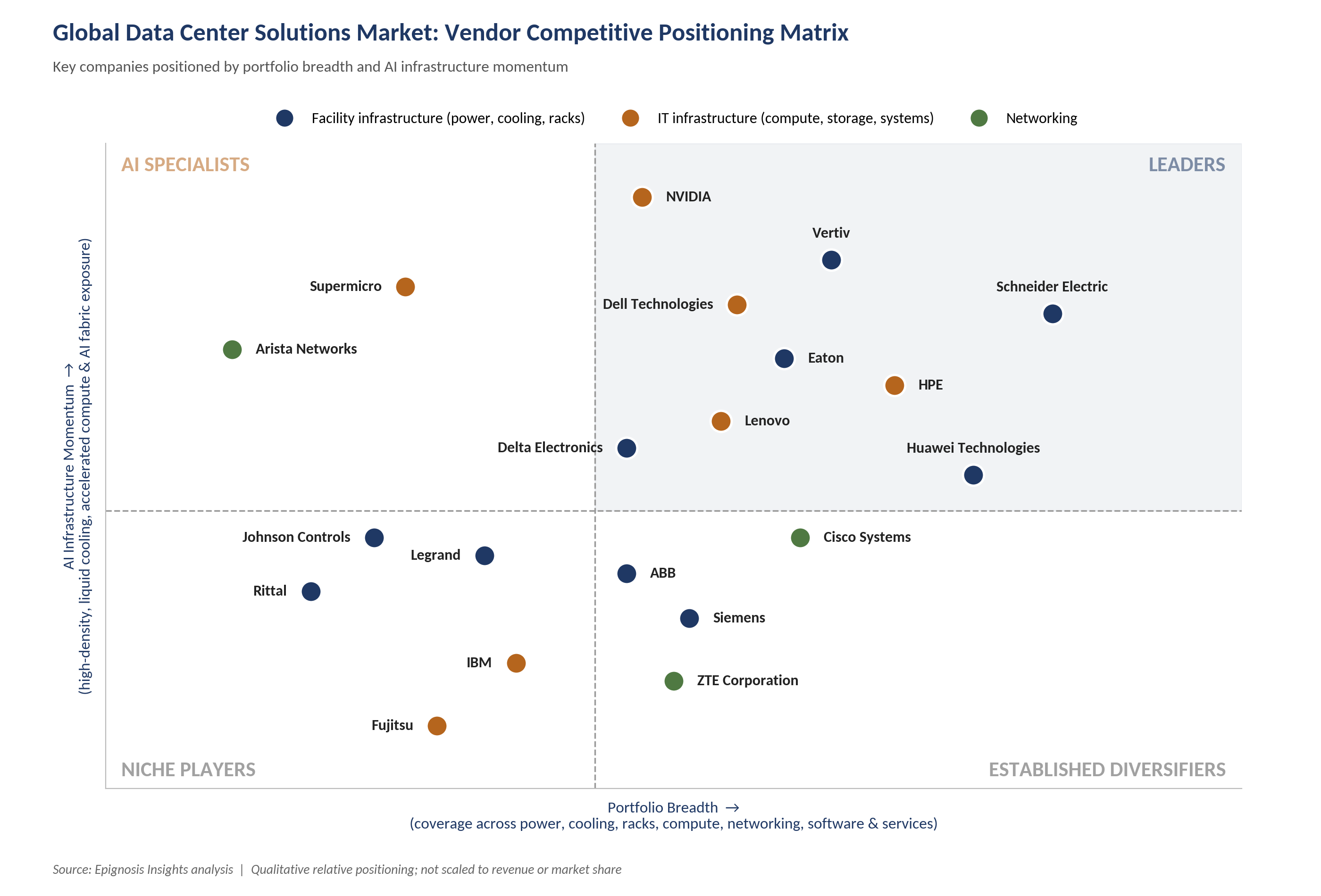
Key companies analyzed within the global data center solutions market are: Schneider Electric, Vertiv, Eaton, ABB, Siemens, Huawei Technologies, Dell Technologies, Hewlett Packard Enterprise (HPE), Cisco Systems, IBM, Lenovo, NVIDIA, Delta Electronics, Legrand, Johnson Controls, Rittal, Fujitsu, Supermicro, Arista Networks, ZTE Corporation and others.