Europe Bioplastics Price Tracker
Epignosis Insights Research Desk — Quarterly Report, Q2/Q3 2026


Epignosis Insights Research Desk — Quarterly Report, Q2/Q3 2026
Europe's Bioplastics Market enters the second half of 2026 with a widening gap between capacity ambition and near-term pricing reality, and this report, compiled by the Epignosis Insights Research Desk from industry-association, government, corporate, and price-analytics sources, tracks both sides of that gap. Global bioplastics production capacity stood at 2.31 million tonnes in 2025 and is forecast to more than double to 4.69 million tonnes by 2030, according to European Bioplastics e.V.'s market data compiled in cooperation with the nova-Institute, with the European biobased plastics industry currently running at an average of 73% of installed capacity. Yet polylactic acid (PLA), the region's flagship bioplastic, carried a European spot price of $3.59 per kilogram in May 2026 the highest of any tracked region globally and moving on a down trend even as regional demand from packaging and consumer goods softened. That combination aggressive capacity build-out against a European price premium under downward pressure is the defining tension this quarter's tracker sets out to explain.
Understanding where bioplastics prices are headed requires understanding the capacity wave arriving behind them. European Bioplastics' 2025 market data update shows packaging remains the largest application segment at 41.3% of total bioplastics demand, equivalent to 0.95 million tonnes, and the association's forecast trajectory implies the industry needs to more than double absorbed volume within five years to keep pace with planned capacity. In Europe specifically, growth is concentrated in additional polypropylene (bioPP), polyethylene (bioPE), and polyhydroxyalkanoate (PHA) capacity, according to the association, layered on top of the region's existing PLA and PBAT base concentrated in Germany, Italy, and Belgium. A 73% average capacity utilization rate signals the industry is not yet running capacity-constrained, which matters directly for pricing power: producers bringing new volume online in a market already running below full utilization face a structurally harder path to sustaining premium pricing than a supply-constrained market would allow.
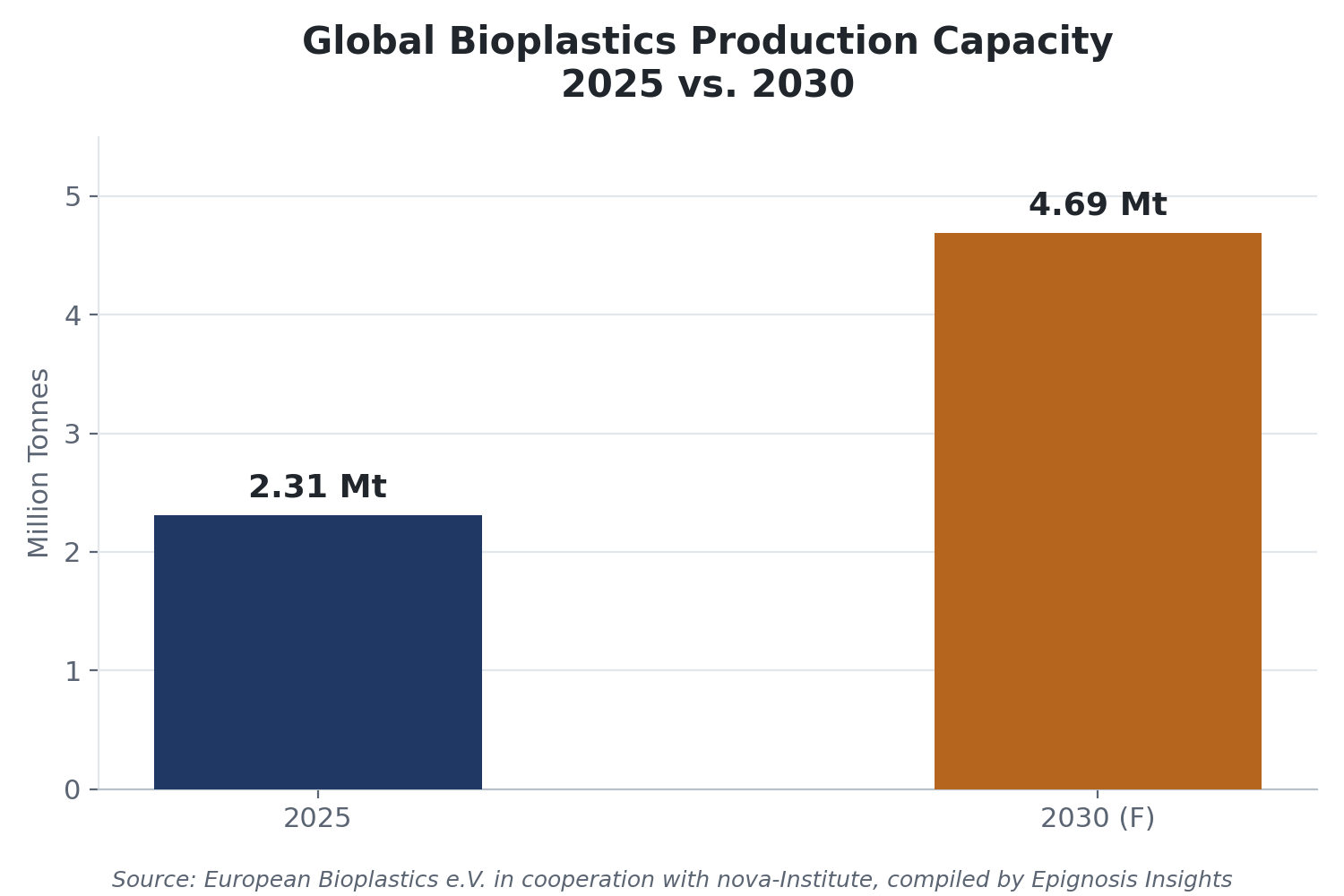
Figure 1: Global bioplastics production capacity, 2025 vs. 2030. Source: European Bioplastics e.V. in cooperation with nova-Institute, Epignosis Insights Research Desk.
Price-tracking data compiled by IMARC Group shows a pronounced regional pricing gap in the global PLA market as of May 2026: Northeast Asia priced at $2.56 per kilogram, Southeast Asia at $2.95 per kilogram, and Europe at $3.59 per kilogram a premium of roughly 40% over Northeast Asian pricing. According to the same tracking data, European PLA prices fell sharply during the reporting quarter, driven by muted consumption from packaging, consumer goods, and downstream converter demand, even as feedstock costs for lactic acid and lactide inputs added marginally to production costs and helped limit the scale of the price decline. Northeast Asian pricing softened even further on ample corn-based lactic acid feedstock supply and weaker export demand, reinforcing bearish sentiment across the region. The persistence of Europe's price premium despite a shared global down trend suggests the gap is structural rooted in higher regional energy and logistics costs, EU compliance and certification overhead, and thinner regional supplier competition rather than a temporary supply-demand imbalance likely to close quickly.
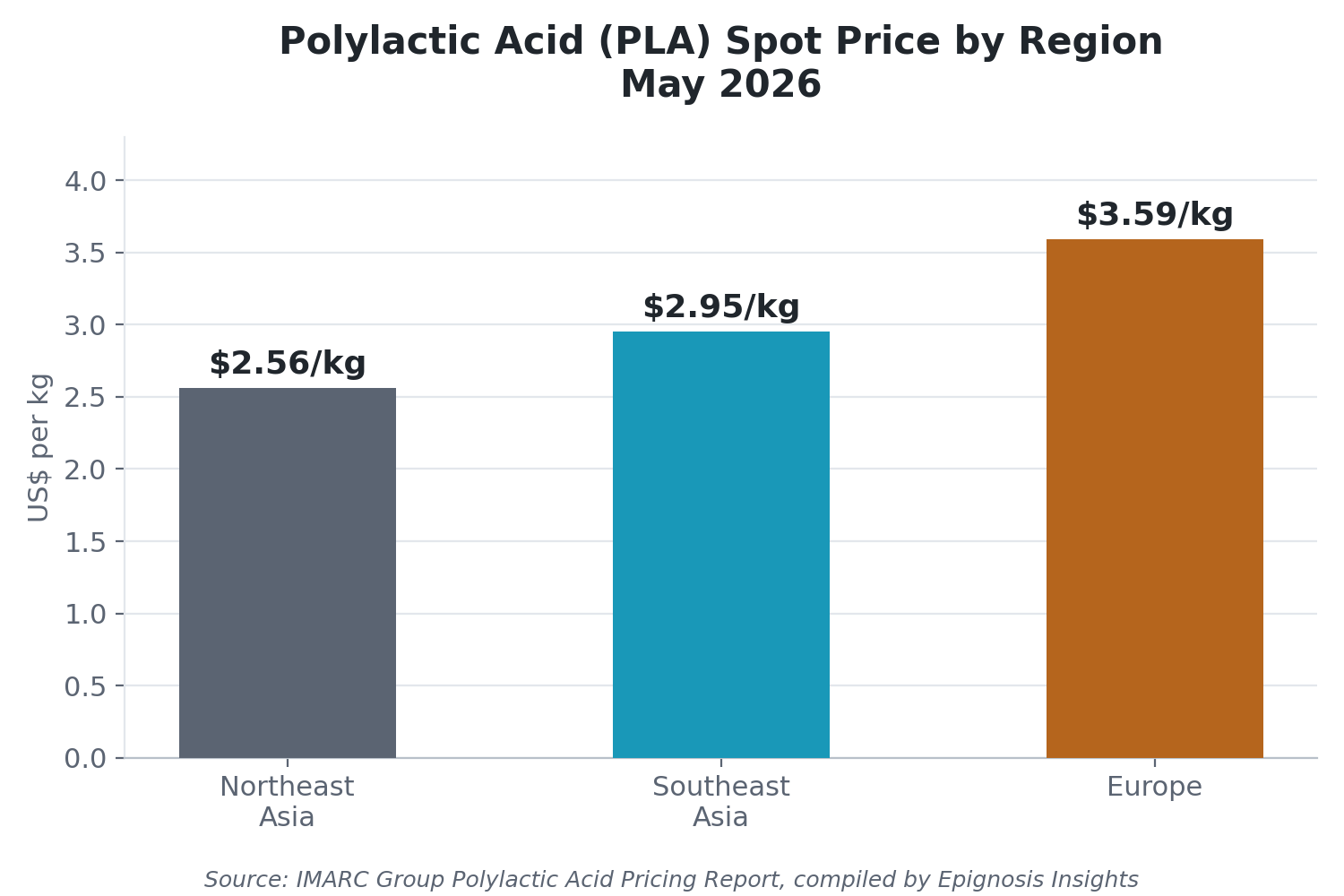
Figure 2: Polylactic acid (PLA) spot price by region, May 2026. Source: IMARC Group Polylactic Acid Pricing Report, Epignosis Insights Research Desk.
Bio-based polyethylene followed a different pricing pattern than PLA through the first quarter of 2026. According to price-tracking analysis from ProcurementResource, bio-PE pricing remained broadly firm through Q1 2026 even as ethanol feedstock costs softened in parts of Brazil and Asia, because producers continued to face elevated logistics costs alongside stronger conventional polyethylene benchmarks following crude oil volatility and Middle East supply disruptions. Because bio-PE is produced through bioethanol-derived ethylene, sugarcane ethanol pricing out of Brazil where Braskem remains the dominant global supplier under its I'm green bio-PE brand functions as the primary cost anchor, while European buyers additionally absorb transatlantic shipping costs that PLA, with more diversified regional production, is comparatively less exposed to. The report notes that bio-PE suppliers have been able to maintain their pricing premium over fossil-based polyethylene despite cautious downstream procurement activity, a sign that brand-owner sustainability commitments are still providing meaningful price support even as broader demand growth moderates.
Government policy is adding a separate, compounding layer of cost pressure across the UK portion of the European bioplastics market. HM Revenue & Customs confirmed the UK Plastic Packaging Tax rose to £228.82 per tonne from April 1, 2026, up from £223.69 the prior year and more than 14% above the tax's £200 starting rate when it was introduced in April 2022. Critically for bioplastics suppliers, the tax applies to any plastic packaging component containing less than 30% recycled content by weight a threshold defined by recycled content, not bio-based or compostable status, meaning virgin PLA, PBAT, or bio-PE packaging is not automatically exempt simply because it is renewably sourced or compostable. This is a common misconception the tax's own guidance materials specifically flag: compostable does not equal tax-free. For European bioplastics suppliers targeting the UK market, that nuance means the most direct way to reduce tax exposure is blending in mechanically or chemically recycled content a capability TotalEnergiesCorbion has specifically built into its Rayong PLA facility, which now offers recycled PLA (rPLA) in both 30% and 100% recycled grades using a proprietary low-energy hydrolysis process.
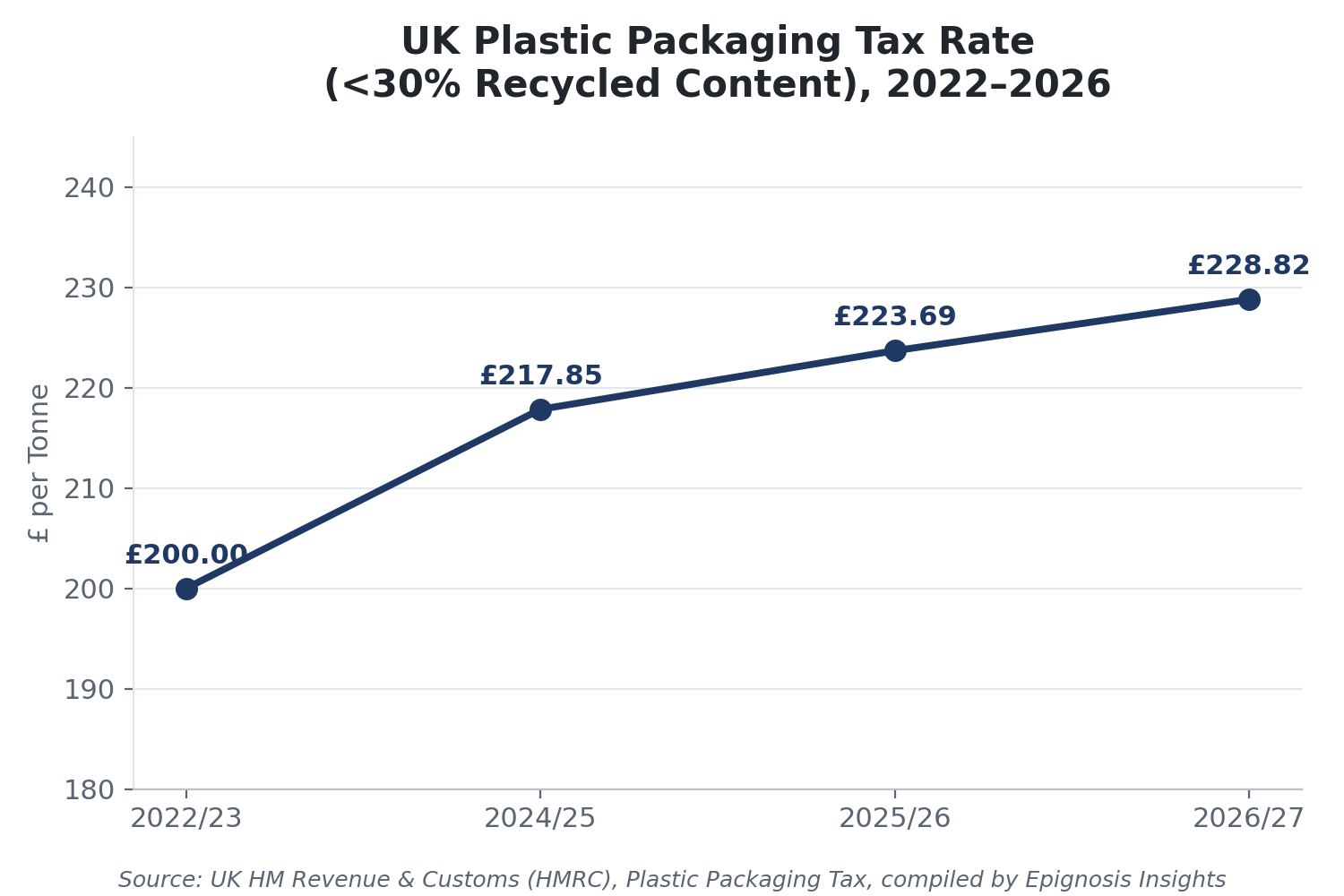
Figure 3: UK Plastic Packaging Tax rate on packaging with less than 30% recycled content, 2022–2026. Source: UK HM Revenue & Customs (HMRC), Epignosis Insights Research Desk.
Corporate investment decisions offer a direct read on how producers themselves assess near-term PLA economics. Trade publication Eco-Plastics in Packaging reported in late 2025 that TotalEnergiesCorbion pulled back from a planned expansion of PLA production, with the joint venture stating that the capital and operating cost required to produce PLA from biomass has increased significantly compared with its original investment case. The company emphasized the announcement would not affect its existing sales and marketing network or its current 75,000-tonne-per-year Rayong, Thailand facility, and reaffirmed its commitment to Luminy PLA as a category leader. Read alongside the regional pricing data above, the decision is a useful corroborating signal: if the world's most established dedicated PLA producer is finding new capacity economics harder to justify at current pricing, it lends credibility to the view that Europe's PLA price premium reflects genuine production cost pressure rather than an opportunistic markup that new entrants could easily undercut.
A separate structural constraint is shaping demand-side economics for biodegradable grades specifically. European Bioplastics' market data confirms PBAT and starch-blend copolymers remain concentrated in applications requiring industrial composting infrastructure, and the pace of that infrastructure's expansion is not keeping pace with production capacity growth a mismatch that, left unaddressed, risks capping realizable demand for compostable grades regardless of how favorably they are priced against conventional plastics. Because composting infrastructure investment is occurring unevenly across EU member states, with Western European markets like Germany and Italy considerably further along than Eastern European markets, suppliers of compostable bioplastic grades face a genuinely two-speed European market: strong end-of-life infrastructure support in some geographies and a comparatively weak business case in others, a dynamic that will likely keep PBAT and starch-blend pricing more regionally fragmented within Europe than PLA or bio-PE pricing over the coming several quarters.
Much of the regional pricing divergence documented above traces back to feedstock geography rather than polymer chemistry itself. PLA production depends on lactic acid derived predominantly from corn starch (in North America and parts of Asia) or sugarcane and sugar beet (in Europe and Southeast Asia), and IMARC Group's pricing analysis specifically attributes Northeast Asia's softer PLA pricing to ample corn-based lactic acid feedstock supply keeping local production costs low, a feedstock advantage European producers relying on sugar beet do not share to the same degree. Bio-PE tells a similar story in reverse: because bio-PE is produced from bioethanol-derived ethylene, and Brazil's sugarcane ethanol industry remains the dominant global cost-setter for that feedstock, European bio-PE buyers absorb both the underlying Brazilian ethanol price and the transatlantic freight cost of importing ethylene or finished resin, a structural cost layer Northeast Asian buyers sourcing from closer, better-established regional supply chains face to a lesser extent. This feedstock-driven cost structure is a meaningful part of why Europe's bioplastics price premium is unlikely to fully close even if global capacity utilization improves, since it reflects genuine input-cost geography rather than a temporary supply-demand mismatch that new capacity alone can resolve.
Within Europe, bioplastics production and demand remain heavily concentrated in three markets. European Bioplastics' data places Germany, Italy, and Belgium as the region's principal production hubs, reflecting a combination of established chemical-industry infrastructure, deep composting and organic-waste-collection networks, and, in Italy's case, a national regulatory framework that has mandated compostable bags for years ahead of equivalent EU-wide rules. That composting infrastructure advantage matters directly for pricing: markets with mature industrial composting capacity can realistically absorb PBAT and starch-blend compostable grades at commercial scale, supporting local demand and price stability, while markets without that end-of-life infrastructure are effectively limited to bio-based-but-non-biodegradable grades like bio-PE and bio-PET regardless of local willingness to pay a sustainability premium. For suppliers setting regional go-to-market pricing strategy, this means treating “Europe” as a single pricing zone risks understating just how differently Germany's, Italy's, and Belgium's mature bioplastics ecosystems price and absorb volume compared with markets earlier in their infrastructure build-out.
| Metric | Value | Period |
| Global bioplastics production capacity | 2.31 million tonnes | 2025 |
| Global capacity forecast | 4.69 million tonnes | 2030 |
| Average capacity utilization, EU biobased plastics | 73% | 2025 |
| Packaging share of bioplastics demand | 41.3% (0.95 Mt) | 2025 |
| PLA spot price, Europe | $3.59/kg (down trend) | May 2026 |
| PLA spot price, Northeast Asia | $2.56/kg | May 2026 |
| PLA spot price, Southeast Asia | $2.95/kg | May 2026 |
| Bio-PE pricing trend, Q1 2026 | Broadly firm / premium to fossil-PE maintained | Q1 2026 |
| UK Plastic Packaging Tax rate | £228.82/tonne | From April 2026 |
| UK PPT recycled-content exemption threshold | ≥ 30% recycled content | 2026 |
| TotalEnergiesCorbionRayong PLA capacity | 75,000 tonnes/year | 2026 |
The data compiled in this tracker points toward continued near-term softness in European PLA pricing, structural firmness in bio-PE pricing tied to feedstock and logistics costs, and a widening compliance-driven cost floor from policies like the UK's Plastic Packaging Tax that reward recycled content over renewable content alone. With global bioplastics capacity on track to roughly double by 2030 against a European industry currently running at only 73% utilization, near-term pricing power is likely to remain constrained for standard-grade PLA specifically, even as differentiated grades recycled-content PLA, high-barrier food-contact grades, and PHA retain more defensible premiums.
TotalEnergiesCorbion's capital discipline on new PLA capacity, set against European Bioplastics' still-bullish five-year capacity forecast, suggests the next twelve months will be a genuine test of whether announced capacity additions across the sector translate into actual investment or get quietly deferred as producers wait for pricing to catch up with the cost of building it.