
Strength Training Shift and Subscription Costs Reshape Connected Fitness Equipment Demand
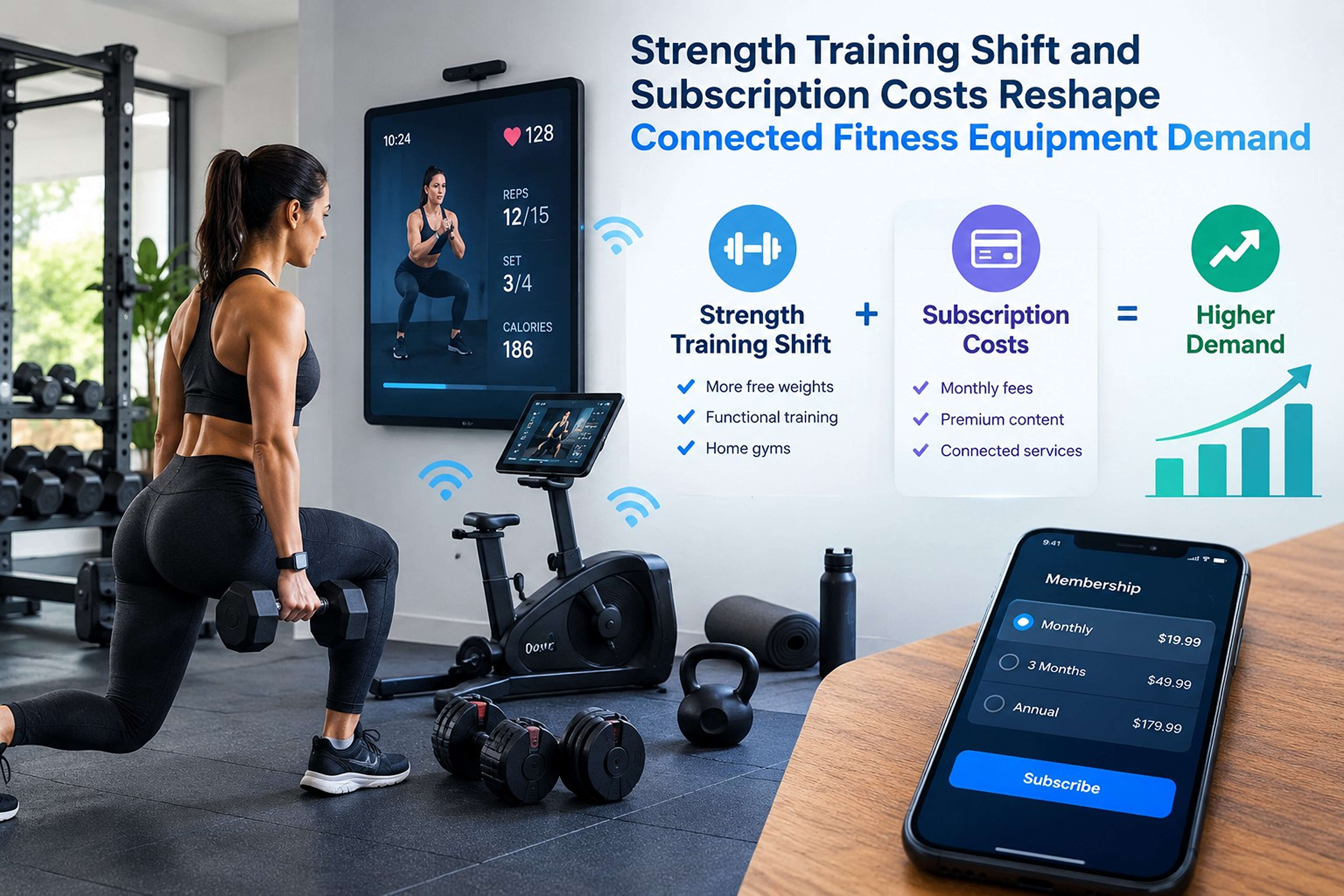
Consumer training preferences are shifting measurably toward strength and free-weight modalities. At the same time, the installed base of connected fitness equipment remains predominantly cardio-oriented, according to a new analysis from Epignosis Insights covering the global connected fitness equipment market.
Modality Data Shows Strength Gaining as Machine Cardio Declines
Health & Fitness Association tracking data cited in the analysis shows free weight and dumbbell usage among gym members rising from 28.4% in 2021 to 32.1% in 2024, while resistance machine usage declined from 31.4% to 26.6%, elliptical usage from 23.2% to 18.8%, and stationary bike usage from 21.6% to 19.4% over the same period. Treadmills remain the most-used modality at 43.4% but also declined. The association's 2026 report identifies free weights as the leading category of equipment usage growth, alongside expanding participation in pickleball, yoga and Pilates, while traditional high-intensity and stand-alone cardio formats continue to soften.
The analysis characterizes this shift as durable rather than cyclical, citing a peer-reviewed meta-analysis published in the American Journal of Preventive Medicine that linked resistance training to a 15% lower risk of all-cause mortality, 19% lower cardiovascular mortality, and 14% lower cancer mortality, with the largest benefit, a 27% reduction in mortality risk, observed at approximately 60 minutes of resistance training per week.
The analysis identifies this as a structural constraint on category recovery, noting that converting a cardio-equipment household to strength equipment requires an additional hardware purchase rather than a subscription renewal, a materially more difficult transaction at prevailing category price points.
Total Cost of Ownership Exceeds Hardware Price for Most Devices
The analysis finds five-year total cost of ownership ranging from approximately USD 2,500 for subscription-free equipment to nearly USD 7,000 for premium smart strength systems. Monthly subscription fees generally run between USD 30 and USD 60, and for budget-tier connected treadmills the five-year subscription cost can approach double the hardware purchase price. The analysis identifies the emergence of subscription-free hardware, where AI coaching and full workout libraries are included in the purchase price, as a competitive development that directly pressures the recurring revenue line incumbents have prioritized.
Capital Has Rotated From Hardware Toward Health Data
The analysis documents a marked rotation in category funding. Connected hardware specialists including Tonal and Hydrow, each of which raised hundreds of millions during peak funding years, have not secured new venture investment in more than three years, while 2026 capital has favored AI-driven health data companies including Whoop, Eight Sleep and Ultrahuman. Consolidation has followed, with Interactive Strength acquiring Ergatta in March 2026 at a valuation reported between USD 8.8 million and USD 19.5 million.
The analysis identifies subscriber churn against a saturated installed base as the category's most consequential risk, compounded by hardware replacement cycles long enough that natural upgrade demand cannot offset attrition, alongside competition from reopened facilities, price-increase churn sensitivity, and product safety liability across an aging installed base.
On product safety specifically, the analysis cites iFIT's recall of older NordicTrack RW900 rowing machines over reports of console overheating and ignition risk, affecting tens of thousands of units sold between 2018 and 2022, as among the largest connected fitness recalls in recent years and as illustrative of the long-tail liability attached to a substantial installed base of aging screen-equipped hardware.
Strategic Implications for Manufacturers and Investors
The analysis concludes that strength capability should be treated as a core product requirement rather than an optional extension, given the clinical evidence base underpinning consumer behavior. It further concludes that subscription value must be demonstrated continuously through content, coaching quality, and measurable outcomes rather than assumed, particularly as subscription-free competitors test whether the recurring fee itself represents the principal consumer objection. For investors, the analysis identifies the shift toward continuous health data collection and AI personalization as the strongest signal, noting that operators that can credibly reposition around that proposition retain a plausible path to renewed growth. In contrast, hardware-first, cardio-first operators remain most exposed to documented churn dynamics.
Full modality analysis, cost-of-ownership comparisons, competitive landscape data, and risk assessment are available in the complete connected fitness equipment market analysis from Epignosis Insights.
Manufacturers, retailers, and investors evaluating product strategy or capital allocation in this category can request additional data through the research desk listed below.