
Space Robotics Market Growth Outlook: How Lunar Exploration and On-Orbit Servicing Will Shape the Next Decade

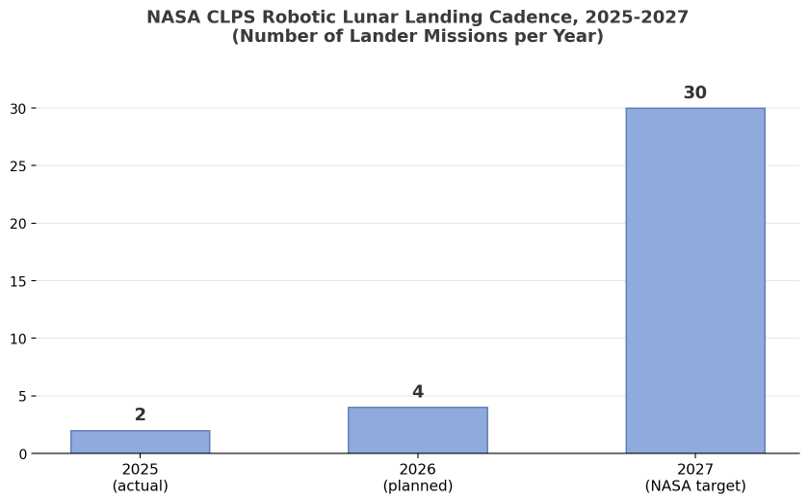
NASA's robotic lunar landing cadence under its Commercial Lunar Payload Services (CLPS) program is set to expand sharply, rising from two completed landings in 2025 to a targeted rate of up to 30 landings a year starting in 2027 under the agency's Ignition initiative, backed by a CLPS contract ceiling that was raised from $2.6 billion to $4.2 billion in 2026.
Government funding is expanding alongside that cadence. NASA's enacted FY2026 budget stands at approximately $24.4 billion, ESA member states committed a record €22.3 billion for 2026-2028 at their November 2025 Ministerial Council, and China's civil space program is estimated at close to $20 billion annually. Together, these commitments are pulling an expanding base of commercial robotics suppliers, from lunar lander integrators to on-orbit servicing specialists, into a market increasingly defined by repeatable, multi-mission contracts rather than one-off science payloads.
Key Highlights
- NASA's CLPS contract ceiling increased from $2.6 billion to $4.2 billion in 2026 to support a projected surge to up to four lander missions in 2026 and as many as 30 per year from 2027.
- Intuitive Machines is pursuing a Lunar Terrain Vehicle Services award worth up to $4.6 billion and reported roughly $920 million in contract backlog following its late-2025 acquisition of Lanteris Space Systems.
- DARPA's Robotic Servicing of Geosynchronous Satellites Mission Robotic Vehicle, carrying two dexterous robotic arms, is scheduled to launch in summer 2026 with Northrop Grumman's SpaceLogistics.
- Humanoid robotics is entering the space supply chain from the commercial sector: Apptronik raised more than $400 million in 2025, building on architecture descended from NASA's own Valkyrie robot.
- China's Chang'e-7 and Chang'e-8 missions, launching in 2026 and around 2028 respectively, are explicit precursors to a basic International Lunar Research Station targeted for 2035.
- A 2024 NASA Office of Inspector General audit found average cost growth of 26 percent and schedule slippage of 14 months across CLPS task orders, a benchmark now shaping how new awards are structured and priced.
Regional Momentum Is Broadening
Growth is no longer concentrated in a single program. The United States retains the largest funding base and the deepest commercial supplier ecosystem, anchored by NASA's CLPS cadence and DARPA's on-orbit servicing initiative. China ranks second on funding scale, with a consistent multi-year commitment to its Chang'e lunar program and International Lunar Research Station concept. At the same time, Europe's newly enlarged ESA envelope, agreed at a record €22.3 billion for 2026-2028, is reinforcing continued robotic Mars exploration through the ExoMars Rosalind Franklin rover. Japan and India, though smaller in absolute budget terms at roughly $2.3 billion and $1.6 billion annually, continue to offer some of the most capital-efficient mission designs in the sector, illustrated by JAXA's Hayabusa2 sample-return mission and ISRO's Chandrayaan lunar program.
Analyst View
Contract structure is becoming as important as contract size in this market," said a senior analyst at Epignosis Insights. "Fixed-price CLPS task orders have already shown average cost growth of 26 percent and schedule slippage of 14 months across the portfolio, per NASA's own Inspector General audit. Providers that can standardize lander and robotic arm designs across repeated missions, rather than building bespoke hardware each time, are the ones best placed to absorb NASA's accelerating flight cadence without repeating that cost growth on every award.
About the Research
This outlook is drawn from Epignosis Insights' ongoing coverage of government space budgets, commercial lunar and orbital robotics contracts, and program-level risk factors across NASA, ESA, CNSA, JAXA and ISRO. The analysis relies exclusively on primary sources, including agency budget documents, congressional appropriations records, SEC filings, DARPA program disclosures and reporting from established space-industry publications, rather than third-party market-sizing estimates. Coverage spans planetary landers and rovers, robotic arms and manipulators, on-orbit servicing vehicles, humanoid and astronaut-assist systems, and sample-return robotics, benchmarked across contract value, cost growth, schedule performance and regional program attractiveness.
The full underlying analysis, including the Epignosis Space Robotics Readiness Framework and Program Attractiveness Index referenced above, is available in Epignosis Insights' report, 'Space Robotics Market: Future Exploration Technologies.