Key Findings
- NASA's enacted fiscal year 2026 budget stands at approximately $24.4 billion, with the Exploration account rising to $8.31 billion to support Moon-to-Mars robotic and crewed development.
- European Space Agency member states committed a record €22.3 billion (about $25.9 billion) for 2026-2028 at the November 2025 Ministerial Council, including roughly €2.98 billion for human and robotic exploration.
- China's civil space program is estimated at close to $20 billion a year, the world's second largest, based on open-source analysis by the nonpartisan Center for Security and Emerging Technology.
- NASA raised the ceiling of its Commercial Lunar Payload Services (CLPS) contract from $2.6 billion to $4.2 billion in 2026, targeting up to 30 robotic lunar landings from 2027 onward.
- Intuitive Machines is pursuing a Lunar Terrain Vehicle Services award worth up to $4.6 billion, and reported an approximately $920 million contract backlog following its Lanteris Space Systems acquisition in late 2025.
- DARPA's Robotic Servicing of Geosynchronous Satellites (RSGS) Mission Robotic Vehicle, fitted with two dexterous robotic arms built by the Naval Research Laboratory, is scheduled to launch in summer 2026 with Northrop Grumman's SpaceLogistics.
- Commercial humanoid robotics is emerging as a crossover technology for space: Apptronik raised more than $400 million in 2025, building on architecture traced to NASA's Valkyrie and Robonaut programs.
- Task order costs on NASA's CLPS lunar delivery program have grown markedly, from about $93 million for Firefly's Blue Ghost Mission 1 to more than $320 million for Astrobotic's Peregrine Mission One after cost growth.
- Strategic opportunity: on-orbit servicing, lunar in-situ resource utilization robots and reusable robotic arms are shifting government-funded robotics away from single-use science payloads toward durable, revenue-generating orbital infrastructure.
- Major risk: budget volatility is structural rather than incidental. NASA's proposed FY2026 request of $18.8 billion was ultimately enacted at $24.4 billion, illustrating the planning uncertainty that robotics suppliers dependent on government contracts must absorb.
Space Robotics Market Outlook
Robotic systems have moved from a supporting role in space missions to the primary means by which government agencies and commercial operators now explore the Moon and Mars, service satellites, and prepare orbital infrastructure for humans. Government budgets remain the primary source of demand for space robotics, and those budgets have expanded substantially over the past three years, even as individual program lines have been reshuffled. NASA, the European Space Agency (ESA), the China National Space Administration (CNSA), Japan's JAXA and India's ISRO collectively directed more than $55 billion toward civil space activity in 2025-2026, a meaningful share of which funds robotic landers, rovers, manipulator arms and autonomous science platforms.
The distribution of that spending is uneven and reflects each program's strategic priorities. NASA's Exploration account, at $8.31 billion for FY2026, funds Moon-to-Mars transportation and lunar surface systems, including robotic precursor missions that reduce risk ahead of crewed landings. ESA's newly approved three-year envelope allocates almost €3 billion specifically to human and robotic exploration, alongside record commitments to space transportation and science. CNSA does not publish an itemized budget, but its overall civil space spending, estimated at near $20 billion annually, increasingly funds the multi-mission Chang'e lunar program and the International Lunar Research Station (ILRS) concept, which explicitly calls for robotic construction systems before any crewed presence.
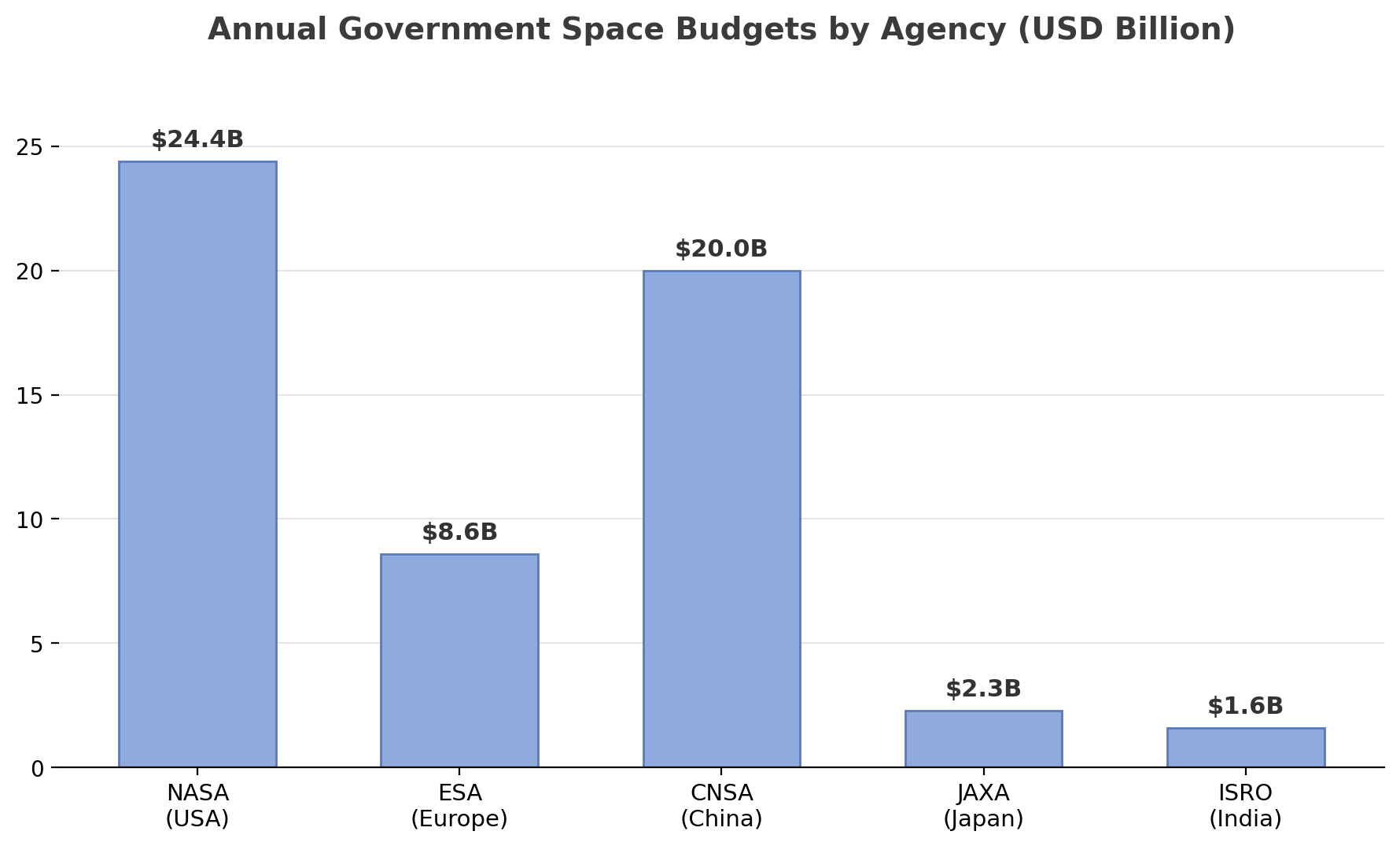
Figure 1: Annual government space budgets across NASA, ESA, CNSA, JAXA and ISRO. Sources: NASA FY2026 budget technical supplement; ESA CM25 Ministerial Council outcomes; CSET China space progress report; JAXA and Government of India budget disclosures.
Beyond agency budgets, a widening base of commercial contractors is capturing an increasing share of robotics-related spending through fixed-price task orders, dual-use technology contracts and, increasingly, private capital. Companies such as Intuitive Machines, Astrobotic, Firefly Aerospace, GITAI, Astroscale and Northrop Grumman's SpaceLogistics unit are building landers, robotic arms and servicing vehicles under structures that blend government funding with independent investment. This hybrid financing model is a defining feature of the current market: robotics programs that would once have been developed entirely inside a government agency are now competitively sourced, accelerating iteration cycles but also exposing suppliers to the same appropriations volatility that affects their government customers.
Space Robotics Market Dynamics
The Lunar Exploration Race Is Accelerating Demand for Autonomous Landers and Rovers
Renewed competition to establish a sustained lunar presence is the single largest driver of near-term demand for space robotics. NASA's Artemis campaign and CLPS initiative are designed to establish a steady cadence of robotic landers, rovers, and instruments on the Moon ahead of and alongside crewed Artemis missions. Under its 'Ignition' initiative, NASA is targeting as many as 30 robotic lunar landings beginning in 2027, a sharp acceleration from the two landings achieved in 2025. To support that pace, the agency raised the CLPS indefinite-delivery, indefinite-quantity contract ceiling from $2.6 billion to $4.2 billion in 2026 and has continued issuing new task orders, including an $180.4 million award to Intuitive Machines for the IM-5 mission.
China is pursuing a parallel but state-directed path. Chang'e-7, planned for launch in the second half of 2026, will deploy an orbiter, lander, rover, and a hopping probe to search the lunar south pole for water ice, while Chang'e-8, expected around 2028, will test in-situ resource utilization robotics, including 3D-printing of construction material from lunar regolith. Both missions are explicit precursors to the International Lunar Research Station, a robotically assembled outpost that CNSA and its partners intend to have operating in basic form by 2035. Independent estimates of Chang'e-7's development cost run to roughly $840 million to $1.1 billion, underscoring that lunar robotics has become a capital-intensive, multi-year national commitment rather than a series of standalone missions.
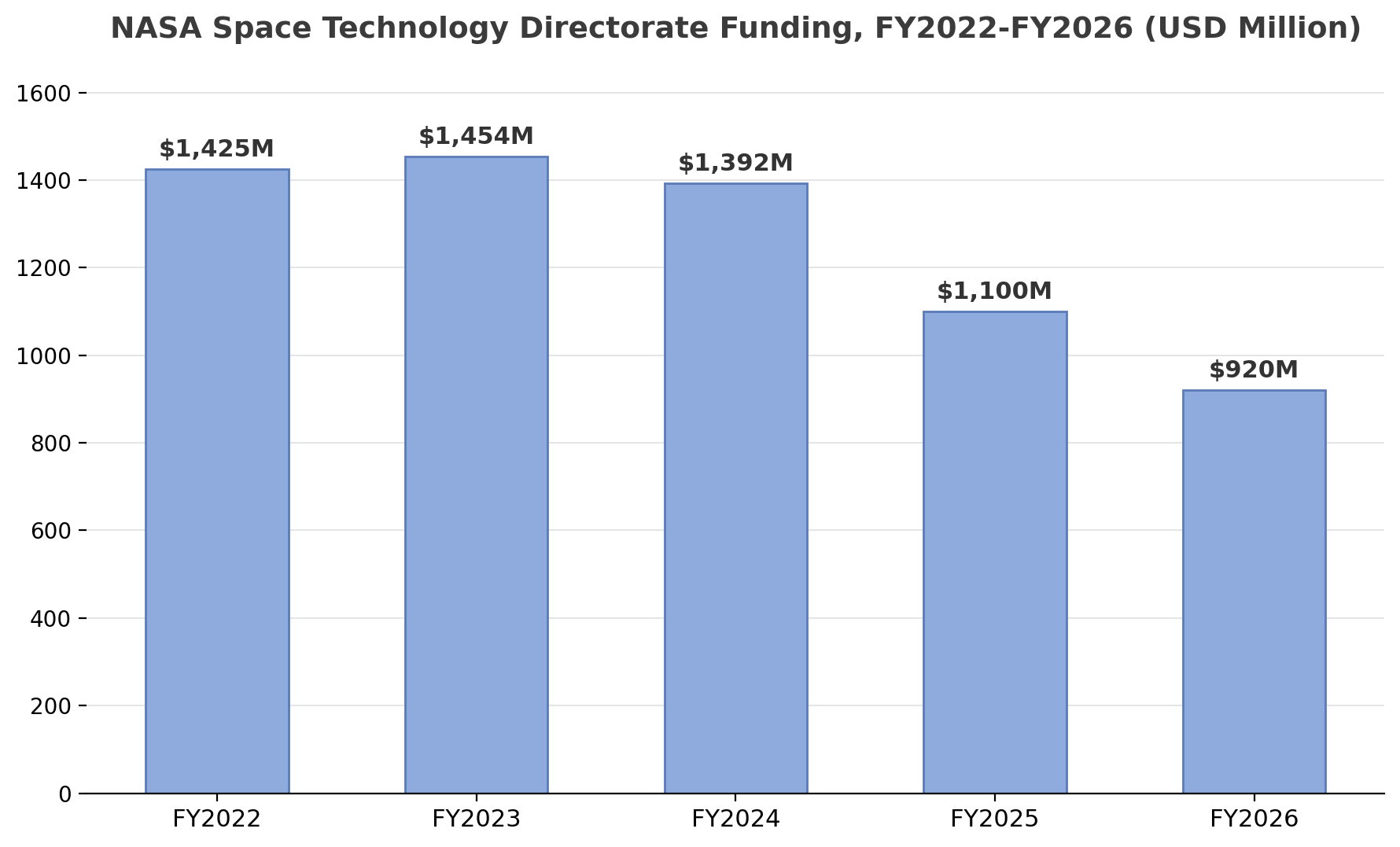
Figure 2: NASA Space Technology Directorate appropriated funding, FY2022-FY2026, the account that funds many exploration robotics demonstrations—source: NASA congressional budget justifications and enacted appropriations, FY2022-FY2026.
Notably, funding for NASA's dedicated Space Technology account, historically a key source for early-stage robotics demonstrations such as in-space assembly and cryogenic fluid management, has declined even as the higher-profile Exploration account has grown. This divergence signals a market shift: near-term robotics investment is concentrating on flight-proven, mission-specific hardware delivered through CLPS-style contracts. In contrast, speculative or foundational robotics research faces a tighter funding environment. Suppliers positioned to deliver flight-ready systems on commercial timelines are best placed to capture the growth in Exploration-account spending.
On-Orbit Servicing and Debris Removal Are Creating a New Robotic Arm Economy
A second major driver is the maturation of on-orbit servicing, a category built almost entirely around robotic manipulation. DARPA's Robotic Servicing of Geosynchronous Satellites (RSGS) program, developed with the Naval Research Laboratory and integrated by Northrop Grumman's SpaceLogistics subsidiary, is preparing to launch its Mission Robotic Vehicle (MRV) in summer 2026. The MRV carries two highly dexterous robotic arms capable of inspection, refueling, relocation, and anomaly resolution, for example, freeing a solar array that has only partially deployed.
The program builds on the flight heritage of Northrop Grumman's Mission Extension Vehicles, which have already demonstrated life-extension dockings with aging commercial satellites in geostationary orbit.
Smaller, more specialized entrants are broadening the addressable market for robotic arms in orbit. Tokyo-based GITAI has flown multiple robotic arm systems to the International Space Station, including its S1 single-arm and S2 dual-arm demonstrators, to support cable and switch operations, in-orbit assembly, and future construction tasks for a lunar base. Astroscale continues to advance debris-capture and satellite-servicing missions, while NASA's Johnson Space Center is exploring how commercially mature humanoid platforms, including Apptronik's Apollo, a direct descendant of NASA's own Valkyrie robot, could eventually perform maintenance work on the Moon or Mars without requiring a permanent human crew on site.
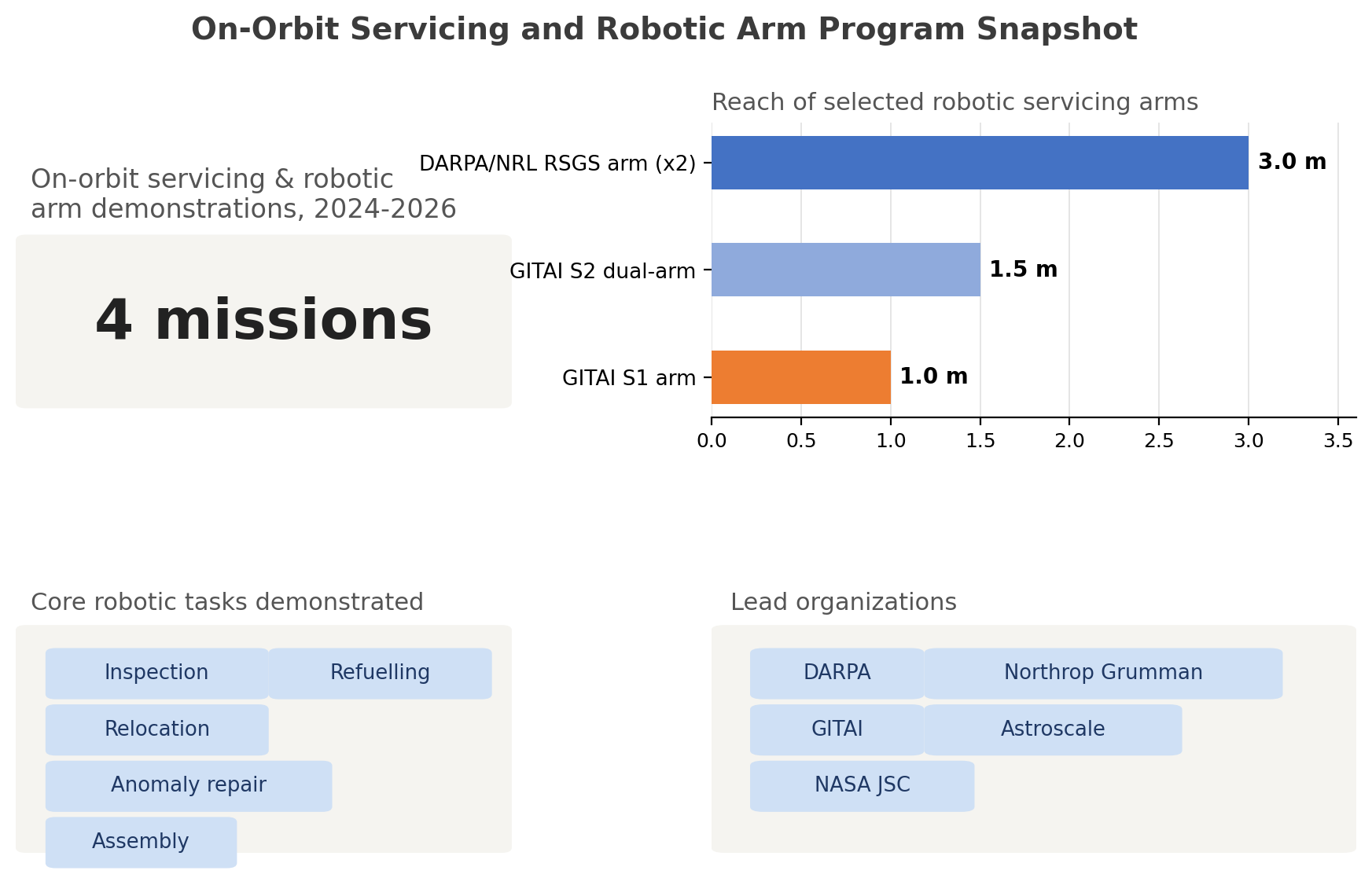
Figure 3: Snapshot of active on-orbit servicing and robotic arm demonstration programs, 2024-2026. Sources: DARPA RSGS program office; GITAI mission announcements; Northrop Grumman SpaceLogistics.
Collectively, these programs are converting on-orbit servicing from a one-off engineering demonstration into a repeatable commercial service line. The economic logic is straightforward: extending the operating life of a multi-hundred-million-dollar geostationary satellite by even a few years, or safely deorbiting derelict hardware before it fuels a collision, is commercially and strategically valuable enough to justify sustained investment in robotic arms, rendezvous sensors and autonomous grappling systems.
Space Robotics Technology Cost Comparison
Contract values for robotic lunar delivery missions vary widely depending on payload mass, landing-site difficulty, and the number of instruments carried. Still, a clear cost trend has emerged across NASA's CLPS program. Early task orders, such as Firefly Aerospace's Blue Ghost Mission 1 (awarded in 2021 for $93.3 million to support ten NASA payloads), were priced well below more recent awards. Intuitive Machines' IM-1 and IM-2 missions closed out at total contract revenues of $132.4 million and $131.2 million, respectively. In comparison, Astrobotic's Peregrine Mission One grew from an initial $226.5 million award to $320.4 million after additional testing requirements were added following early technical issues.
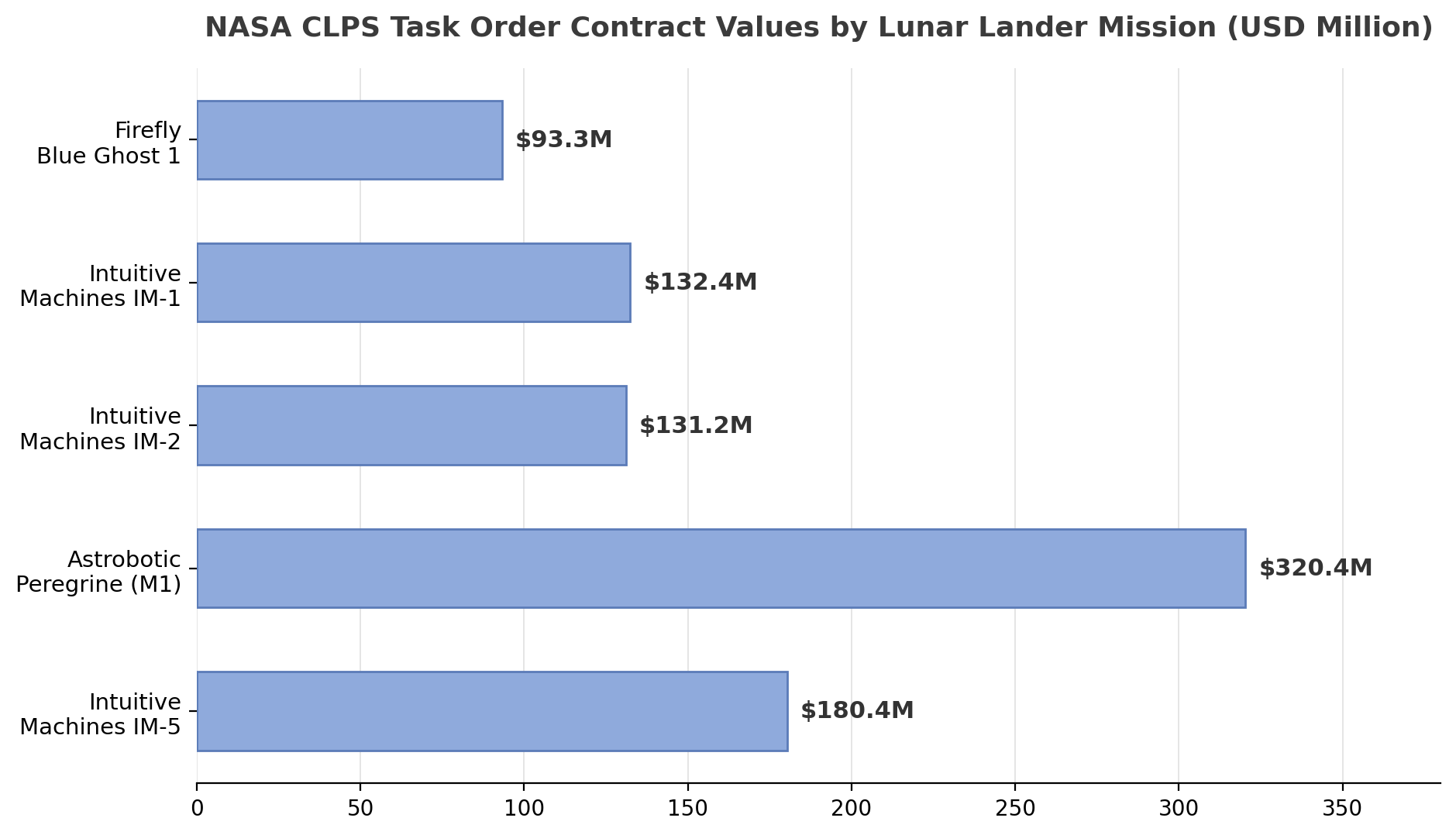
Figure 4: NASA CLPS task order contract values by lunar lander mission (USD million). Sources: NASA CLPS mission press kits; Intuitive Machines SEC filings (Forms 10-Q and 10-K); NASA award announcements.
A June 2024 NASA Office of Inspector General audit found that, across the CLPS portfolio, cost growth on awarded task orders averaged 26 percent and schedule slippage averaged 14 months, figures that highlight the technical difficulty of soft lunar landings even for experienced aerospace contractors. This cost inflation has direct implications for competitive strategy: providers able to standardize lander designs across missions, rather than building 'slightly bespoke' vehicles for each customer, are positioned to compress costs as flight cadence increases. Industry participants have acknowledged that early CLPS landers were customized to each payload manifest, but expect greater standardization as NASA pushes toward multiple landings per year.
Robotic arm and servicing hardware follows a different cost pattern, driven more by orbital regime and operational complexity than by payload count. GITAI's compact single-purpose S1 arm, with roughly a one-meter reach, represents a low-cost entry point for demonstrating specific tasks such as switch operation. At the same time, DARPA's RSGS dual-arm payload, designed for full satellite servicing across multiple GEO clients over several years, sits at the upper end of the cost-and-capability spectrum. The gap between these two approaches illustrates a bifurcating market: inexpensive, task-specific robotic modules for near-term commercial deployment, and heavily engineered, multi-mission servicing platforms intended to operate for years without direct human intervention.
Space Robotics Program Investment Analysis
Government robotics contracts are increasingly structured to reward delivered capability rather than simple cost reimbursement, a shift that changes how suppliers should evaluate program economics. NASA's CLPS task orders are fixed-price, meaning contractors absorb cost overruns from technical setbacks, but they are also awarded competitively and repeatedly, giving proven providers a growing revenue base. Intuitive Machines' pending Lunar Terrain Vehicle Services award, worth up to $4.6 billion over its life, illustrates the scale now available to contractors who can demonstrate reliable robotic and mobility performance; the company's broader backlog, reported at roughly $920 million following its November 2025 acquisition of Lanteris Space Systems, extends beyond lunar robotics into national security and communications infrastructure.
On-orbit servicing programs follow a similar logic but with a longer investment horizon. DARPA effectively concluded its direct RSGS funding in 2025, ahead of a 2026 launch, transferring near-term commercial risk to Northrop Grumman, which is financing the launch itself in anticipation of recurring servicing revenue from government and commercial GEO satellite operators. This 'invest now, monetize over years' structure is becoming a template across the sector: rather than funding a single mission outright, government agencies increasingly seed a technology demonstration and expect industry to carry it into a repeatable commercial service, spreading capital costs across multiple future customers.
For investors and suppliers assessing where to commit capital, the clearest opportunity lies in platforms that can be reused across multiple contracts rather than custom-built for a single mission. Lander and rover architectures that can be adapted across CLPS task orders, robotic arms that can be re-flown or upgraded in place, and humanoid or teleoperated systems that can transition between Earth-based commercial use and eventual space deployment (as Apptronik's Apollo is designed to do) all reduce the effective cost of capital per mission. Programs still built around one-off, fully bespoke hardware remain exposed to the cost growth and schedule slippage documented across the CLPS portfolio.
Space Robotics Program Attractiveness Analysis by Region
Program attractiveness for space robotics investment depends on four consistent factors: the scale and stability of government funding, the maturity of a domestic commercial launch and manufacturing base, the depth of the supplier ecosystem for precision robotics components, and the regulatory environment governing technology transfer and orbital operations. Epignosis Insights scored five major program regions against these criteria on a 100-point scale to produce a comparative attractiveness index.
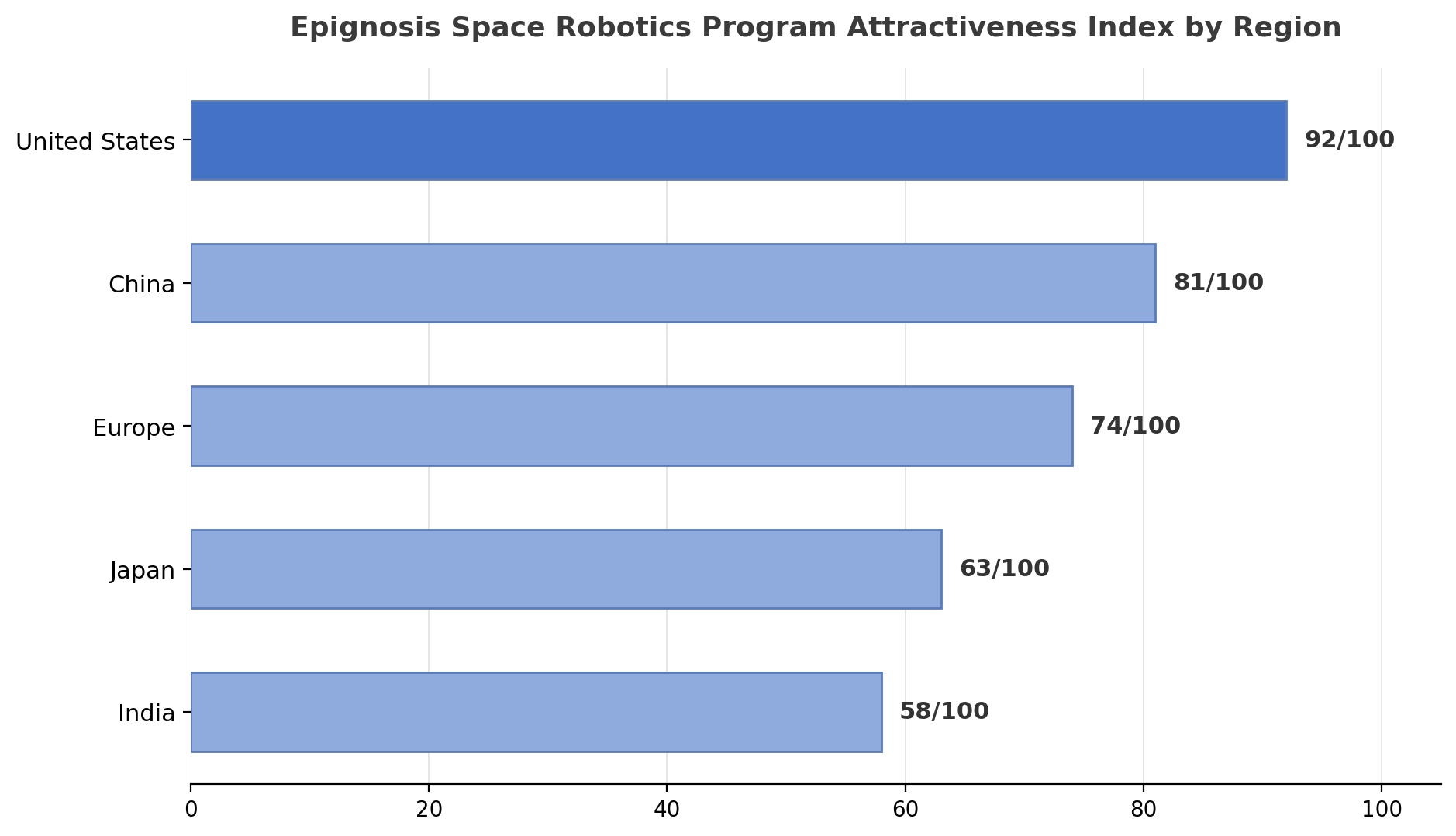
Figure 5: Epignosis Space Robotics Program Attractiveness Index by region (illustrative composite score, 100 = highest). Basis: government budget scale and stability, commercial ecosystem depth, launch cadence and regulatory environment, assessed against publicly available program data cited throughout this report.
The United States scores highest on the index, reflecting the combination of NASA's enacted $24.4 billion budget, the largest and most mature commercial launch and lander supplier base of any country, and an accelerating cadence of CLPS and DARPA-funded robotics missions. China ranks second, supported by consistent multi-year state funding for the Chang'e program and International Lunar Research Station, though the opacity of its civil-military budget allocation and tighter restrictions on international commercial participation constrain its score relative to funding scale alone.
Europe, newly strengthened by the record €22.3 billion ESA Ministerial Council outcome, ranks third; its robotic exploration ambitions, including continued backing for the ExoMars Rosalind Franklin rover, are constrained less by funding than by the multi-year, consensus-driven decision cycle inherent to a 23-member intergovernmental agency. Japan trails in absolute budget terms but retains a strong niche position in precision robotics and sample-return engineering, as demonstrated by the Hayabusa2 mission's asteroid sample return. India, while operating the smallest budget among the five, has built a reputation for capital-efficient mission design, evidenced by its Chandrayaan lunar program and planned Venus Orbiter Mission, making it an attractive partner for cost-sensitive robotic payload collaborations even without matching the funding scale of the other regions.
Space Robotics Market Risk Assessment Matrix
Space robotics programs carry a distinct risk profile shaped by their reliance on government appropriations, the technical difficulty of autonomous operation in extreme environments, and dependence on a narrow base of specialized suppliers. The matrix below plots the principal risks identified across current lunar, orbital-servicing, and humanoid robotics programs by likelihood and potential impact on program economics.
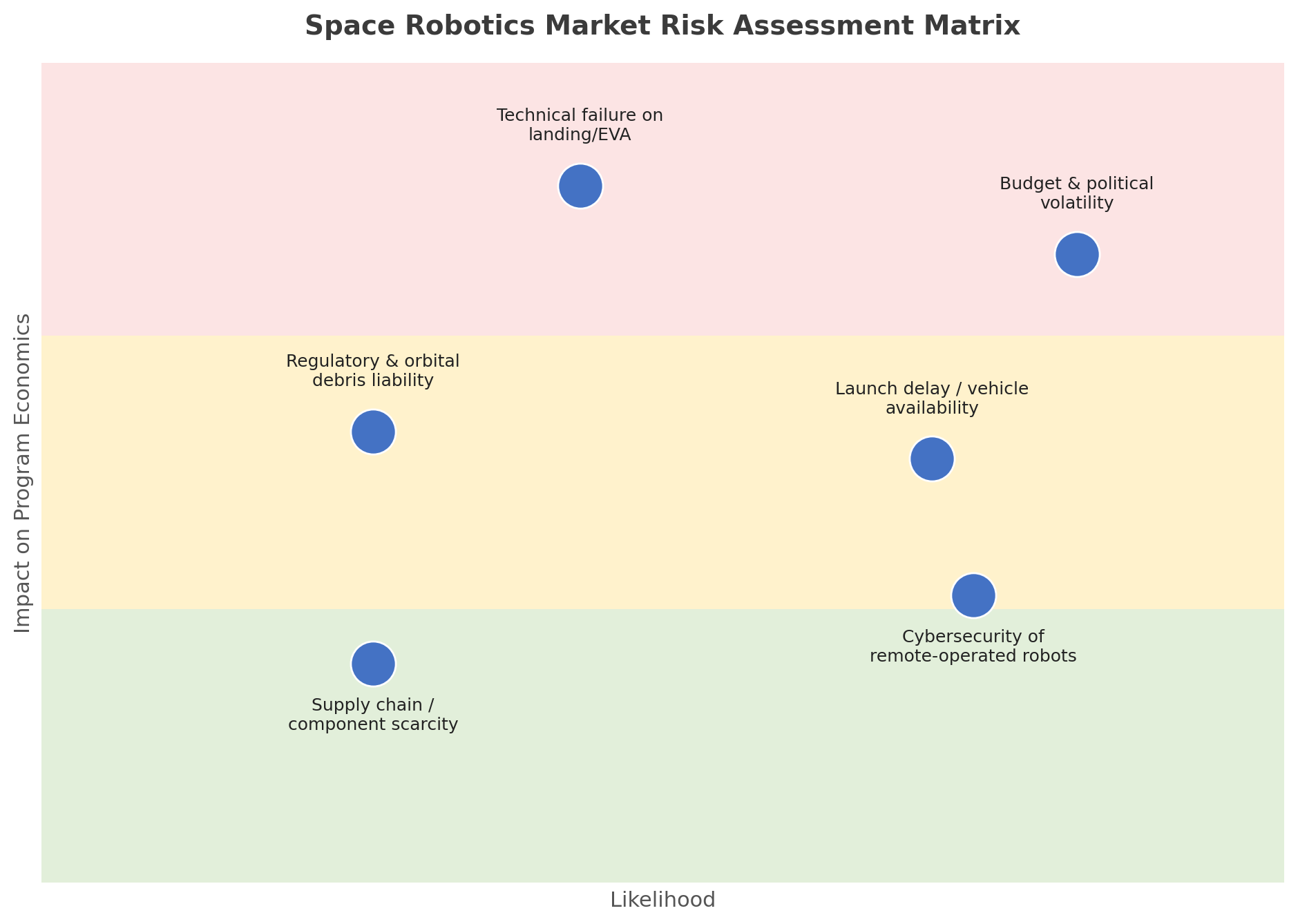
Figure 6: Space robotics market risk assessment matrix, plotting likelihood against potential impact on program economics for six principal risk categories identified in this analysis.
Budget and political volatility sits in the highest-risk quadrant. The roughly $5.6 billion gap between NASA's proposed FY2026 request and its enacted appropriation, and the cancellation-then-partial-restoration debate around the Space Launch System, Orion and Lunar Gateway programs, demonstrates how quickly funding assumptions can change even for flagship exploration robotics. Technical failure during landing or extravehicular robotic operations is similarly high-impact: Astrobotic's Peregrine Mission One and Intuitive Machines' IM-1 both experienced significant in-mission anomalies, even though both were ultimately credited with achieving partial or full mission objectives.
Moderate risks include launch vehicle availability, given the still-limited number of providers capable of translunar injection on the cadence NASA is targeting, and supply chain constraints for the specialized actuators, radiation-hardened electronics, and precision sensors that robotic arms and rovers require. Cybersecurity of remotely operated and teleoperated robots is a growing but currently lower-probability concern, while regulatory and orbital debris liability risk remains comparatively contained today but is likely to increase in weight as on-orbit servicing missions become routine and international space debris rules mature.
Competitive Landscape
The space robotics supplier base spans established prime contractors, venture-backed lunar and servicing specialists, and terrestrial robotics companies extending into orbital and planetary applications. Intuitive Machines has emerged as a leading commercial lunar robotics integrator, with four NASA CLPS task orders, a pending multi-billion-dollar Lunar Terrain Vehicle Services opportunity, and a growing national security and communications backlog following its 2025 acquisition of Lanteris Space Systems. Astrobotic and Firefly Aerospace round out the leading group of CLPS lander providers, each carrying distinct cost and schedule track records from their completed missions.
In on-orbit servicing, Northrop Grumman's
Space Logistics unit holds the strongest flight heritage, having already extended the operational life of commercial GEO satellites through its Mission Extension Vehicles ahead of the more advanced, DARPA-funded Mission Robotic Vehicle. Astroscale continues to build out debris-removal and satellite-servicing capability. At the same time, GITAI, a smaller Tokyo-based entrant with roots in the DARPA Robotics Challenge community, has carved out a niche in compact, cost-efficient robotic arms, validated through repeated International Space Station demonstrations.
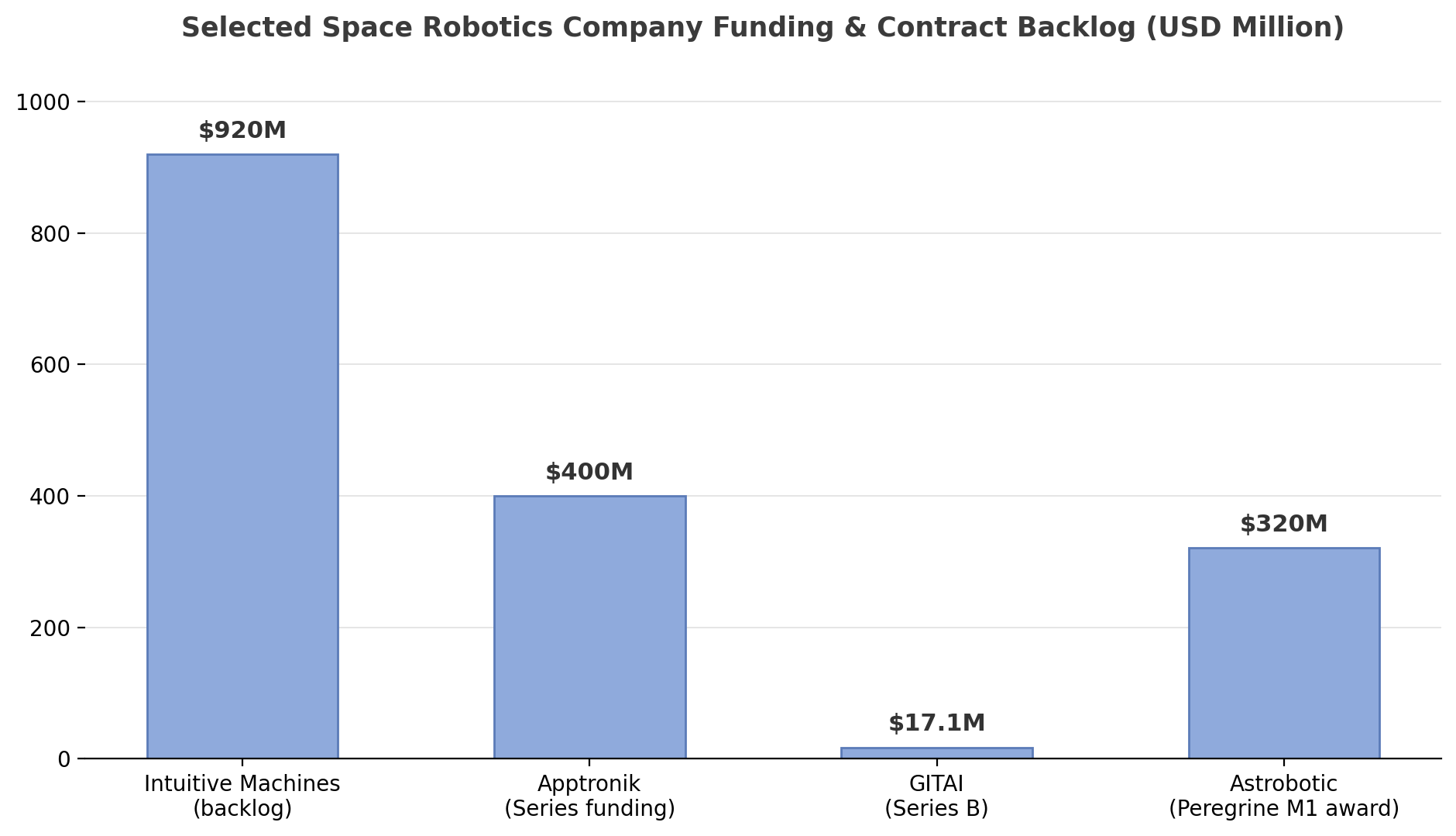
Figure 7: Selected space robotics company funding, contract backlog, or flagship award values (USD million). Sources: Intuitive Machines SEC filings; Apptronik funding announcement (2025); GITAI Series B announcement; NASA CLPS award records.
A distinct fourth category is emerging from terrestrial humanoid robotics. Apptronik, whose Apollo platform draws on NASA-originated actuator and control architecture, has attracted over $400 million in funding from investors including Google and Mercedes-Benz, using Earth-based factory deployments to mature the reliability record that would eventually support space certification. NASA has signaled openness to leveraging this commercially matured technology base rather than developing new humanoid platforms in-house, a pattern likely to be repeated across other robotics subsystems as the agency's own Space Technology budget contracts relative to its Exploration account.
Epignosis Space Robotics Readiness Framework (ESRF)
To help clients consistently evaluate individual robotics programs and suppliers, Epignosis Insights applies the Epignosis Space Robotics Readiness
Framework across five weighted dimensions.
- Technical Maturity: flight heritage, demonstrated autonomy level, and prior mission success rate.
- Funding Durability: dependence on a single appropriations cycle versus diversified government and commercial revenue.
- Platform Reusability: the extent to which hardware or software can be re-flown or adapted across multiple missions rather than custom-built once.
- Regulatory and Export Alignment: exposure to technology transfer restrictions, orbital debris rules, and cross-border partnership constraints.
- Commercial Pull-Through: evidence of paying customers or committed follow-on contracts beyond the originating government demonstration.
Programs scoring strongly across all five dimensions, such as NASA's CLPS lander cohort and DARPA's RSGS servicing initiative, are assessed as best positioned to convert current government investment into durable commercial robotics businesses over the coming decade.