US Steel Scrap Price Tracker
Weekly Pricing & Market Intelligence Report


Weekly Pricing & Market Intelligence Report
U.S. Ferrous Scrap Markets closed out August 2026 in a state of quiet consolidation rather than dramatic repricing. Across the six weeks tracked in this report the week ending July 25 through the week ending August 29 — domestic mill-delivered prices for #1 busheling, HMS 1&2, and shredded grades eased steadily but modestly, shedding roughly 5% of value even as hot-rolled coil (HRC) spot prices at Nucor Corporation continued to climb week over week. This divergence, visualized later in this report, has widened metal margins for electric-arc-furnace (EAF) producers even as it compresses the economics available to scrap generators, processors, and brokers. Meanwhile, the export channel — anchored by cargo-based cost-and-freight (CFR) settlements into Turkey — has held comparatively firm, supported by tight availability from Northern European and Baltic origin points and steady, if unspectacular, demand from Turkish mills. Epignosis Insights compiles this tracker weekly from a deliberately diversified set of primary and secondary inputs — spanning US government statistical releases, industry association production data, publicly disclosed company cost metrics, price-reporting and consulting-firm indices, and trade press coverage — to give buyers, sellers, and financial stakeholders a single, reconciled view of where the market stands and why.
The table below summarizes Epignosis Insights’ weekly compilation of Midwest mill-delivered domestic scrap settlements alongside the Turkey import benchmark for the HMS 1&2 (80:20 mix) grade, expressed on a cost-and-freight basis. Domestic figures are gross-ton ($/gt) delivered-to-mill values; the export reference is quoted in US dollars per metric tonne (CFR main Turkish port), consistent with how the international trade actually settles.
| Week Ending | #1 Busheling ($/gt) | HMS 1&2 ($/gt) | Shredded ($/gt) | Turkey Export HMS 80:20 (CFR $/mt) |
| Jul 25, 2026 | 395 | 355 | 370 | 373 |
| Aug 1, 2026 | 390 | 350 | 365 | 372 |
| Aug 8, 2026 | 385 | 345 | 360 | 371 |
| Aug 15, 2026 | 380 | 340 | 358 | 373 |
| Aug 22, 2026 | 378 | 338 | 356 | 375 |
| Aug 29, 2026 | 375 | 335 | 353 | 374 |
Table 1: Weekly US ferrous scrap prices by grade, week ending July 25 – August 29, 2026. Source: Epignosis Insights compilation.
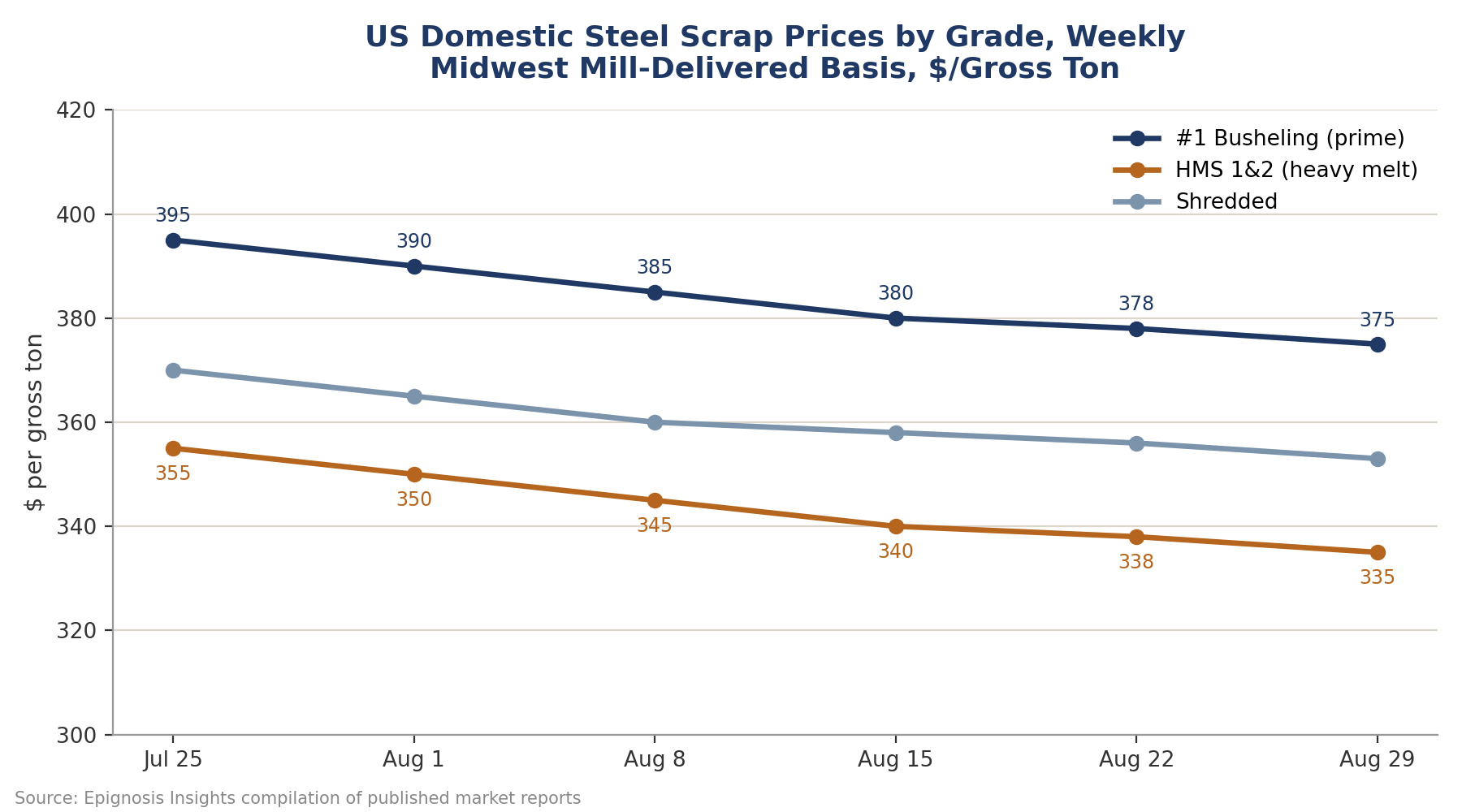
Figure 1: Six-week price trend across three principal domestic grades, Midwest delivered basis.
Scrap demand ultimately traces back to how much raw steel domestic mills are actually melting, and that picture softened slightly through August even as it remained historically strong. According to the American Iron and Steel Institute (AISI), US mills produced 1.870 million net tons of raw steel in the week ending August 1, 2026, at a capability utilization rate of 81.0%, before output eased to 1.820 million net tons and a 78.8% utilization rate in the week ending August 8. By the week ending August 22, weekly production had partially recovered to an estimated 1.848 million net tons across AISI’s five reporting districts, with the
Southern district again the largest single contributor.
Year-to-date production remains comfortably ahead of 2025’s pace, and mills are not, by any measure, starved for melt capacity. What has changed is the marginal urgency with which they are chasing scrap tonnage: with inventories at domestic yards reported as close to seasonal norms and EAF order books described by multiple trade sources as unexceptional heading into the historically slower late-summer stretch, buyers have had the negotiating room to let settlement prices drift lower without triggering a supply response from sellers.
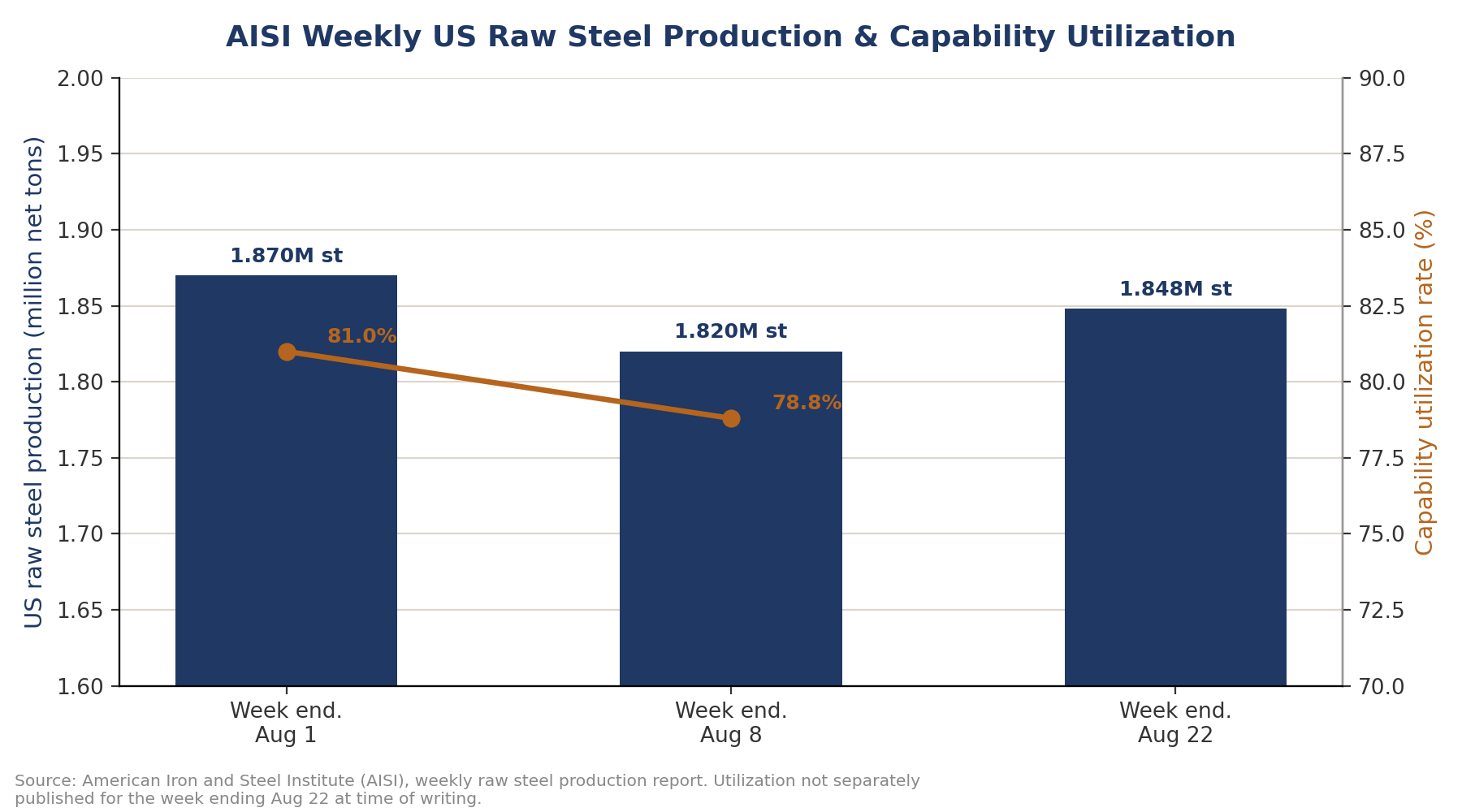
Figure 2: AISI weekly US raw steel production and capability utilization, three most recent reporting weeks.
This production cadence matters for the scrap tracker because EAF steelmaking routes consume scrap as their primary metallic charge, commonly cited as accounting for the majority of variable input cost in a melt shop. A softer, choppier production trajectory — even one still running near 79–81% of capability — removes some of the urgency that otherwise supports scrap tags during a seasonally active buying window, and it lines up closely with the gentle downward drift visible across all three domestic grades in Figure 1.
The most consequential storyline of the tracking period is not the scrap price move itself but what it means for finished-steel economics. Nucor’s publicly announced consumer spot price (CSP) for hot-rolled coil rose in three consecutive $10-per-short-ton increments across the period — from $1,155/st for the week beginning August 3, to $1,170/st for the week of August 17, to $1,180/st for the week of August 24 — even as #1 busheling scrap, the prime grade that most directly feeds HRC production, eased from roughly $388/gt to $378/gt over a comparable span. The result, illustrated in Figure 3, is a mill margin proxy that has widened meaningfully within a single month, a dynamic flagged explicitly in trade coverage of the busheling-to-HRC spread. For EAF flat-rolled producers, this is close to an ideal operating environment: output prices firming on constrained supply and reduced import competition, while the largest single input cost quietly gets cheaper. For scrap suppliers, it is a reminder that pricing power in this market currently sits with the mills, not the yards.
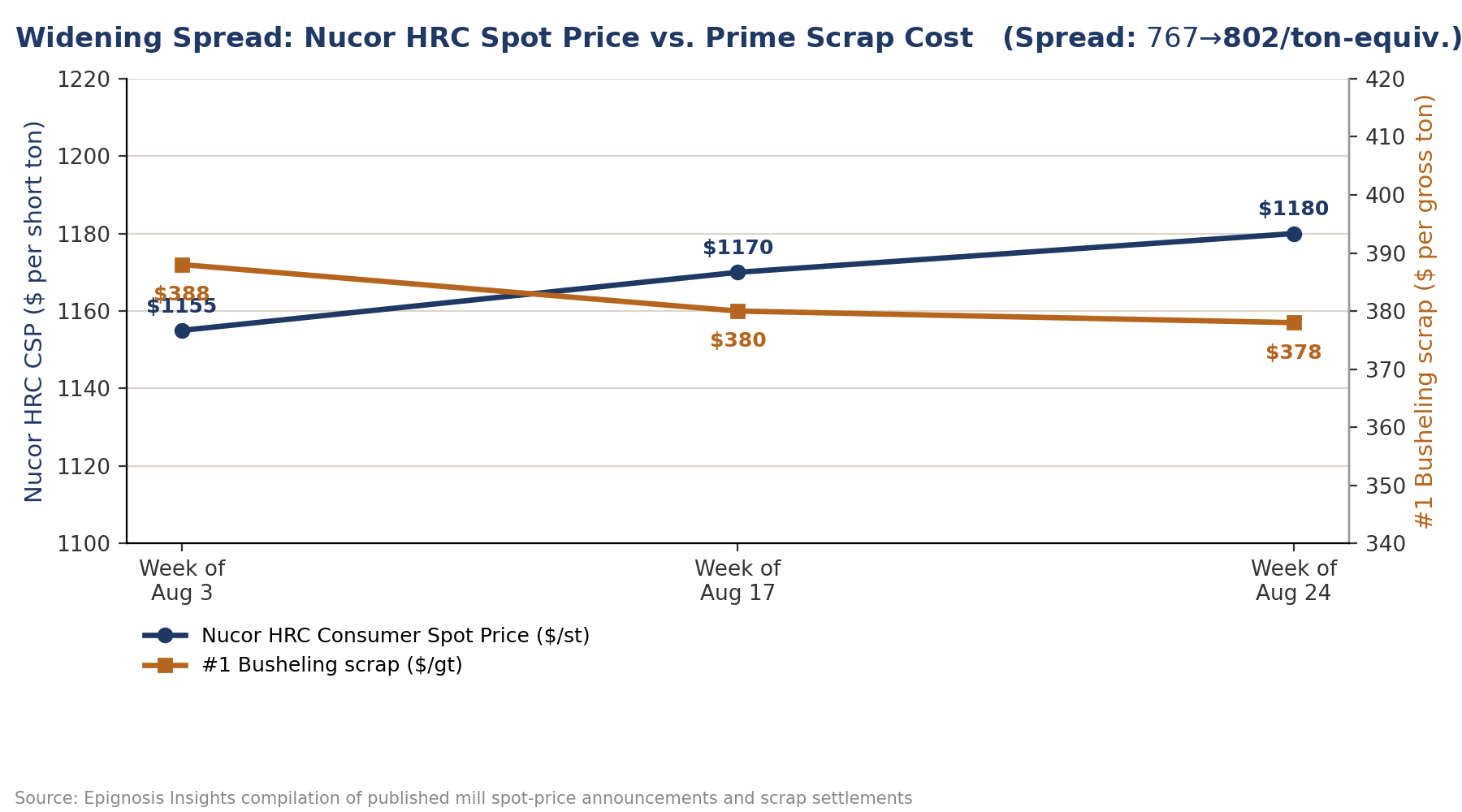
Figure 3: Nucor HRC consumer spot price versus #1 busheling scrap cost, illustrating margin widening across the tracking period.
Outside the domestic mill gate, the US ferrous scrap export trade continues to be priced largely off deals into Turkey, the world’s largest importer of the material and the reference point most closely watched by international traders. Cargo activity during the period showed four Northern European and Baltic-origin shipments booked around $371 per metric tonne CFR for HMS 80:20, alongside a UK-origin cargo at a comparatively elevated $375/mt. US East Coast-origin material found buyers as well, with two mixed cargoes transacting near $375/mt CFR for HMS 80:20 and a $20/mt premium attached to shredded grades, while a separate US East Coast HMS 95:5 cargo cleared at $390/mt and shredded at $395/mt. Notably, domestic HMS and shredded tags fell by roughly $10–$20 per gross ton for August shipment even as the export-market price barely moved — a divergence that effectively swung more material toward offshore buyers and helped keep the Turkish benchmark firmer than the softer US domestic trend alone would suggest. Separate trade commentary mid-month characterized Turkish import pricing as firm, with further declines seen as unlikely in the near term given constrained collection volumes from key European supply origins.
The value chain that connects domestic generation to this export flow, and to the domestic mill alternative, is summarized schematically in Figure 4.
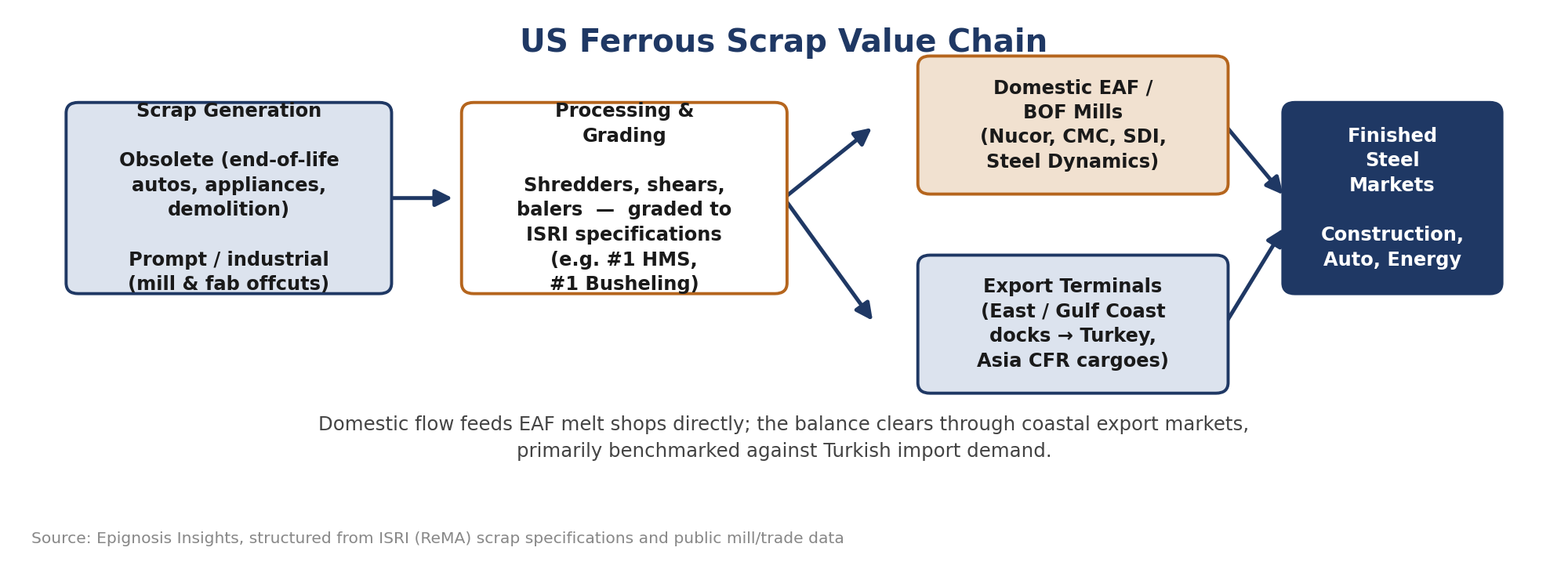
Figure 4: US ferrous scrap value chain, from generation and ISRI-graded processing through to domestic mill and export outlets.
Public company disclosures add a bottom-up view that corroborates the top-down index data. Nucor Corporation, North America’s largest steel producer by shipments, reported approximately 7.1 million tons of steel-mill shipments in the second quarter of 2026, underscoring the scale of scrap demand a single producer represents; the company’s weekly CSP announcements, referenced above, remain the most closely watched public signal of near-term HRC and, by extension, prime scrap sentiment. Commercial Metals Company (CMC), an integrated recycler and EAF steelmaker, disclosed in its fiscal third-quarter 2026 results (quarter ended May 31, 2026) a North America average cost of ferrous scrap utilized of $379 per ton against a steel products metal margin of $610 per ton — both figures running ahead of Wall Street’s consensus estimates at the time and consistent with a market in which scrap cost inflation, rather than scrap cost relief, had been the more pressing concern earlier in the year. Taken together with the softer weekly tags tracked through August, the CMC print suggests the current easing represents a genuine inflection rather than a continuation of the tighter conditions recyclers faced in the spring.
Two structural threads from federal data help frame the tracking period. First, the US Bureau of Labor Statistics’ Producer Price Index for June 2026 identified iron and steel scrap as one of the stage-1 intermediate-demand inputs that rose even as the broader final-demand PPI slipped 0.3% for the month — a signal that scrap-specific cost pressure was still building into early summer before the August easing captured in this tracker took hold. Second, the US Department of Commerce reported that licenses to import steel into the United States surged in July to their highest level since June 2025, a 9% month-on-month recovery following a 3.8% decline in June; higher import licensing activity, if it converts into actual finished-steel volumes landing at US ports, would tend to compete with domestic mill output over time and, indirectly, temper scrap demand at the margin. Neither data series moves the weekly price needle on its own, but both help explain why market participants describe current conditions as balanced rather than acutely tight or loose in either direction.
All grade references in this tracker follow the classification framework maintained by the Institute of Scrap Recycling Industries (ISRI, operating under the Recycled Materials Association brand), the Washington, DC-based trade association whose specifications for #1 busheling, #1 and #2 heavy melting steel (HMS), and shredded scrap function as the common commercial language between generators, processors, mills, and export traders. This standardization is what allows a Midwest delivered settlement and a Turkish CFR cargo price to be meaningfully compared on a like-for-like grade basis, even though the two markets clear through very different logistics and buyer bases.
Heading into September, the balance of signals points to a market searching for direction rather than committing firmly to either a sustained decline or a renewed rally. Consulting-firm sentiment surveys captured a Trend Indicator modestly below the neutral 50-point threshold for August, pointing to continued, if shallow, month-on-month softness, with buyers notably more bearish than sellers in that same survey. Against that, seasonally stronger steel-demand periods approaching in the autumn, combined with a scrap-cost base that has now retraced a meaningful share of its spring-to-summer strength, create conditions consistent with at least a stabilization, and potentially a modest restocking-led firming, in prime grades over the coming weeks. Export markets are likely to remain the swing factor: any renewed weakness in domestic tags without a matching move in Turkish CFR levels would continue to pull incremental tonnage toward coastal terminals, tightening effective domestic availability even as posted mill tags stay soft.