
Supporting Growth Strategy for a Construction Robotics Startup
A construction robotics startup rarely fails for lack of a working prototype; it fails for going after the wrong wedge, in the wrong sequence, with the wrong proof points for enterprise buyers. Government labor data, a leading trade association's own hiring survey, a heavy-equipment giant's investor filings, and this year's venture funding numbers together sketch a growth strategy that does not require guessing: solve the labor shortage first, use safety as the second lever, and let capital markets and one dominant incumbent's own adoption curve validate the expansion path.
The Problem the Product Must Solve: Persistent Labor Shortages
Every growth strategy for a construction robotics company starts with demand, and the demand is unambiguous. The Associated General Contractors of America, in its 2025 Workforce Survey conducted with NCCER, found that 92 percent of construction firms hiring for open positions reported difficulty finding qualified candidates, and 45 percent of firms said project delays were directly attributable to shortages of their own or subcontractors' workers. That gap is precisely where robotics vendors selling layout, material-handling, or autonomous-earthmoving tools should aim their earliest pilots: contractors are not evaluating robots against cheap labor, they are evaluating them against labor that frequently does not show up at all.
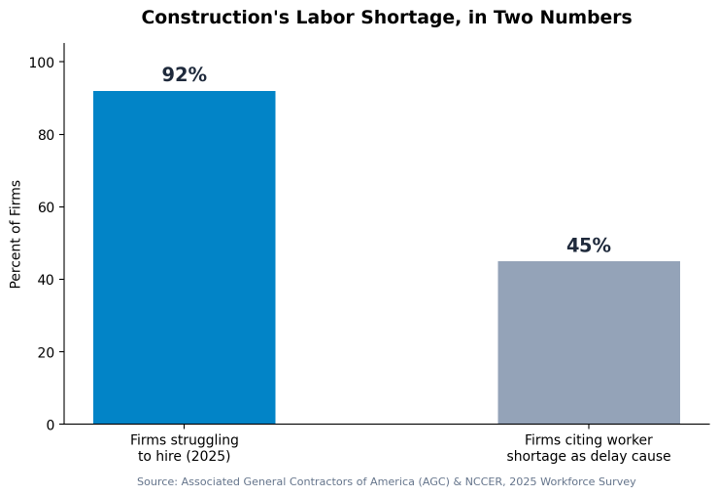
Figure 1: Construction hiring difficulty and project delays. Source: AGC & NCCER, 2025 Workforce Survey.
The Safety Case Is Its Own Growth Lever
A second, underused entry point is safety, and the numbers make the case on their own. According to the U.S. Bureau of Labor Statistics' Census of Fatal Occupational Injuries, construction recorded 1,032 worker deaths in 2024, giving the industry a fatal injury rate of 9.2 per 100,000 full-time equivalent workers, nearly three times the all-industry average of 3.3, even though construction employs a much smaller share of the workforce than that fatality share would suggest. A startup that can quantify how its product removes workers from fall hazards, trench work, or repetitive material handling has a second, independent buying justification beyond productivity, one that speaks directly to a contractor's insurance costs and OSHA exposure rather than just its labor bill.
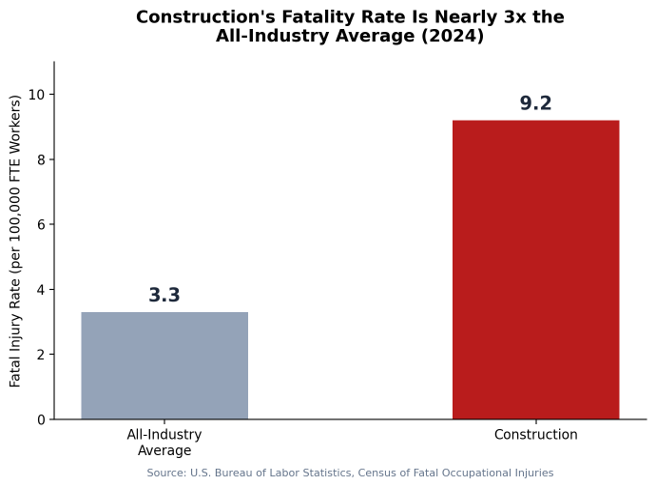
Figure 2: Construction fatality rate vs. all-industry average, 2024. Source: U.S. Bureau of Labor Statistics.
Capital Is Already Flowing Toward This Exact Thesis
Investors have already priced in this demand shift. Construction Dive reported that built-environment technology funding reached 4.4 billion dollars in the third quarter of 2025 alone, a 66 percent year-over-year increase, with construction robotics infusions specifically topping 1.36 billion dollars year to date, up 125 percent from the prior year, according to data the outlet cited from Nymbl Ventures. Within that wave, Austin-based TerraFirma, founded by former SpaceX engineers, raised 115 million dollars, including a 100 million dollar Series A led by Kleiner Perkins, to build a full-stack robotic infrastructure platform spanning preconstruction software and semi-autonomous heavy machinery. The lesson for an early-stage company is less about the dollar figure than the composition: later-stage rounds are increasingly dominant, meaning the market is rewarding startups that can already show fielded units and repeat customers over those still validating a concept.
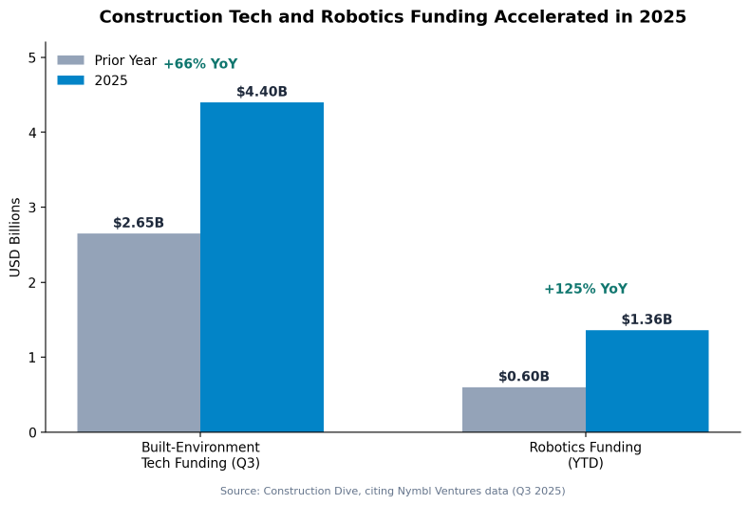
Figure 3: Construction tech and robotics funding growth, 2025. Source: Construction Dive, citing Nymbl Ventures.
The Productivity Gap Is the Total Addressable Market
The reason investors believe this thesis has room to run is structural, not cyclical. The McKinsey Global Institute's construction productivity research found that global labor productivity in construction grew just 1 percent annually over two decades, compared with 2.8 percent for the world economy as a whole and 3.6 percent in manufacturing, a gap MGI estimated represents a 1.6 trillion dollar unrealized opportunity in value added. For a growth strategy, that number matters less as a market-sizing exercise than as a sequencing signal: the industries construction lags most, manufacturing and logistics, are exactly the ones where automation delivered the productivity gains, suggesting a startup's clearest expansion path runs through the most repeatable, most manufacturing-like tasks first, such as layout, rebar tying, or material transport, before tackling bespoke, high-variability work.
What Enterprise Validation Looks Like at Scale
Caterpillar's own FY2025 annual report offers a template for how far that adoption curve can run once it starts. The company disclosed that its autonomous haul truck fleet grew to 827 units in operation in 2025, up from 690 at the end of 2024, and that it signed its first customer agreement for a mixed-fleet autonomy solution, while its quarry-specific autonomy deployment at Luck Stone's Bull Run Quarry has hauled more than two million tons without a human driver. That progression, from a single mining use case to quarries to mixed fleets, is the exact expansion sequence a construction robotics startup should plan for from day one: prove unit economics in one narrow, high-value, controlled environment, then use that same technology stack to expand into adjacent site types where the physics and workflows are similar enough to reuse most of the engineering.
Taken together, these sources point toward one growth sequence rather than five separate strategies: anchor pilots in the labor-shortage numbers contractors already recognize internally, layer in safety data as a second procurement justification aimed at risk and insurance stakeholders, price fundraising against a capital market that now rewards fielded deployments over early-stage promises, and plan the product roadmap along the same narrow-to-adjacent expansion path that both the productivity research and Caterpillar's own fleet growth suggest is the only proven route from pilot to scale in this industry.