
Assessing Overcapacity Risk in China's Chemical Manufacturing Sector
China's chemical manufacturers spent the past decade building faster than the market could absorb, and 2025 is the year the bill came due. What began as a strategy to secure self-sufficiency in basic petrochemicals has produced a sector where a majority of plants reportedly lose cash on every ton they produce, prompting Beijing's most serious capacity-control campaign in a decade. Government filings, a leading trade federation's own data, and multinational producers' investor calls now converge on the same conclusion: overcapacity has moved from a cyclical nuisance to a structural risk that is reshaping both domestic policy and global trade flows in plastics and intermediate chemicals.
The Scale of the Buildout
The imbalance is visible first in global operating rates. According to S&P Global Commodity Insights, worldwide ethylene capacity grew by 40.3 million metric tons per year between 2019 and 2023, reaching 224.8 million metric tons, while demand rose just 13.9 million metric tons over the same period, to 177.1 million metric tons. That gap dragged the average global operating rate down from 88 percent in 2019 to 79 percent in 2023, a level not seen since the early 1980s. China is the dominant driver of that gap: ICIS data shows China's ethylene capacity exceeding domestic demand is forecast to reach an all-time high of 11.5 million tonnes in 2025, a 121 percent jump from 2024, while the country's propylene surplus is projected to hit 20.3 million tonnes, up 179 percent year over year from 7.3 million tonnes of surplus in 2024.
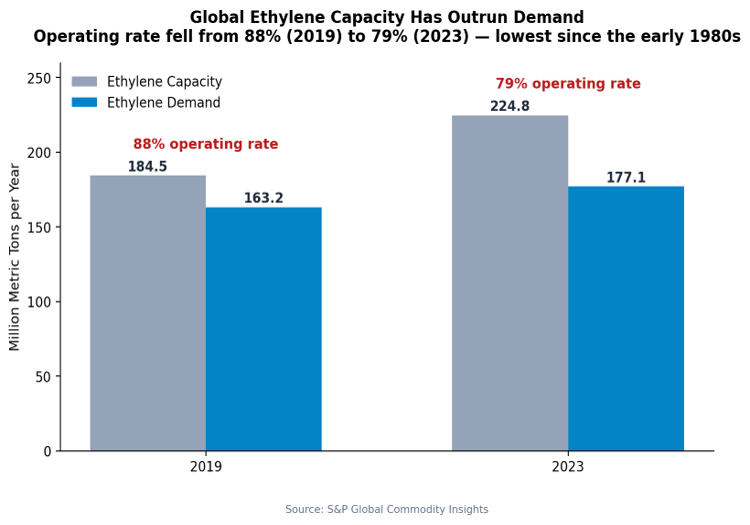
Figure 1: Global ethylene capacity vs. demand, 2019-2023. Source: S&P Global Commodity Insights.
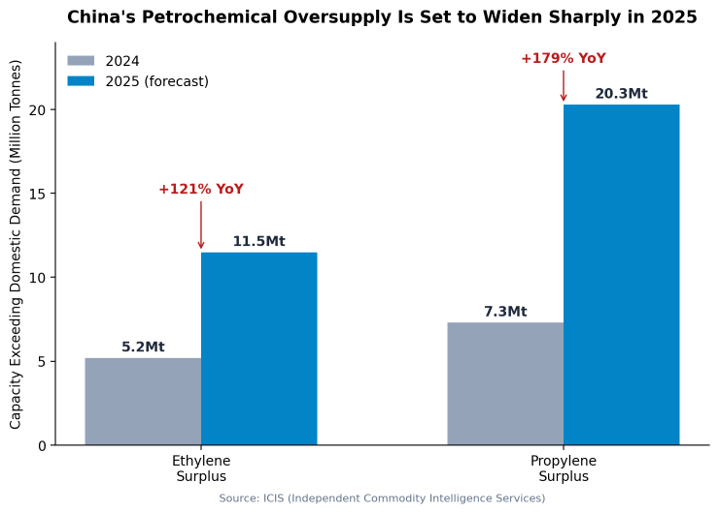
Figure 2: China's ethylene and propylene oversupply, 2024 vs. 2025 forecast. Source: ICIS.
Beijing Responds With “Anti-Involution”
China's own policymakers have stopped describing this as healthy competition. On July 1, 2025, the Central Financial and Economic Affairs Commission revived the concept of an “orderly exit of outdated capacity” for the first time in a decade, explicitly calling for curbs on destructive low-price competition, or “involution.” That was followed in October 2025 by a joint announcement from the National Development and Reform Commission and the State Administration for Market Regulation instructing industry associations to research average industry costs as a reference point for reasonable pricing, and by a revised Anti-Unfair Competition Law, effective the same month, that explicitly prohibits involution-style competition. Petrochemicals, alongside steel, coal, and EV batteries, was named one of three priority sectors for the campaign, with aging steam crackers singled out as the primary target for closure review.
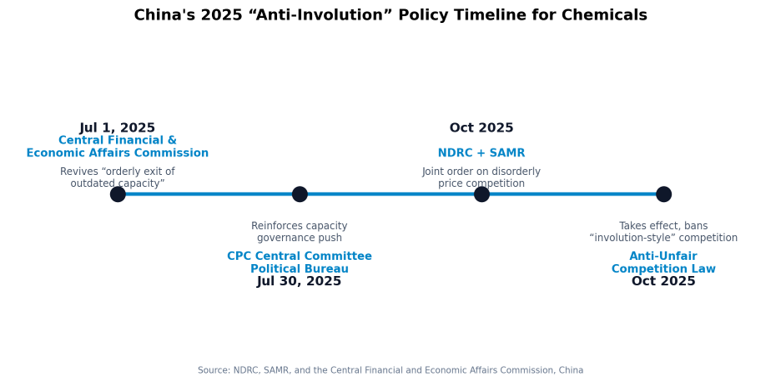
Figure 3: China's 2025 anti-involution policy timeline for chemicals. Source: NDRC, SAMR, and the Central Financial and Economic Affairs Commission.
What the Balance Sheet Says
The financial strain behind that policy shift is already visible in national data. China's National Bureau of Statistics reported that chemical raw materials and chemical products manufacturing generated total profit of 376.62 billion yuan in 2025 across industrial enterprises above designated size, a figure the China Petroleum and Chemical Industry Federation characterized at its February 2026 economic performance conference as consistent with an industry that may only “bottom out and rebound” in 2026, an implicit acknowledgment that 2025 marked a trough rather than a recovery. The European Chemical Industry Council, Cefic, described the competitive pressure in blunter terms, stating that its member companies continue to face fierce competition, particularly from China.
Foreign Producers Are Already Repricing the Risk
Multinational producers are not waiting for Beijing's reforms to play out before adjusting their own strategies. On its second-quarter 2025 earnings call, LyondellBasell told investors it was closely following the NDRC's request for detailed information on older Chinese chemical assets, noting that China has a relatively large number of non-integrated, non-flexible, older, and smaller steam crackers, and that the majority of China's petrochemical assets are losing cash. The company added that Chinese polyethylene has not been globally competitive given its high production costs, even as growing local capacity has pushed domestic operating rates lower still, a dynamic it said would take considerable time to resolve even with regulatory intervention.
Net New Capacity Still Outpaces Closures
The gap between policy intent and physical reality remains the central risk. ADI Analytics' Global Chemicals 2026 outlook estimates that China is still adding roughly 7 to 8 million tonnes per annum of new ethylene capacity and about 6 million tonnes of new polyethylene capacity, and that even after accounting for announced plant closures, the country will post more than 4.0 million tonnes per annum of net new ethylene and derivative capacity. That single figure captures the sector's dilemma: capacity already under construction or committed before the anti-involution campaign began is large enough that closures announced so far cannot offset it, meaning the operating-rate pressure documented across every source above is likely to persist through at least the next planning cycle, regardless of how forcefully Beijing enforces its new pricing law. For multinational producers and investors alike, the practical takeaway is that China's chemical overcapacity is no longer a temporary cyclical dip to be waited out, but a multi-year structural adjustment that will keep margins compressed across the value chain until locked-in capacity finally works its way through the system.