
Why Panel Fatigue Is Quietly Corrupting Your Survey Data

A survey panel that once produced clean, representative data can quietly degrade for months before anyone notices. Respondents who joined years ago start speed-clicking through grids they used to read carefully. Genuine enthusiasm curdles into transactional box-ticking, done purely for the incentive. Nothing about the questionnaire changed, but the data underneath it has. This is panel fatigue, and it is no longer a fringe methodological worry. It is showing up in government statistics, industry benchmarking studies, and the earnings reports of the companies that run the world's survey infrastructure.
The Warning Sign Hiding in Plain Sight: Government Data
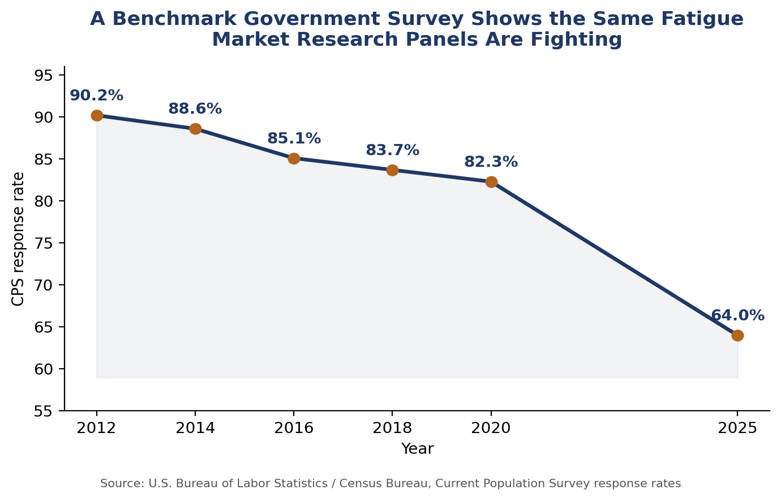
The clearest evidence of respondent fatigue does not come from a market research vendor with something to sell; it comes from the U.S. government's own flagship labor survey. The Current Population Survey, jointly run by the Census Bureau and Bureau of Labor Statistics to produce the national unemployment rate, has watched its response rate slide from 90.2% in March 2012 to 82.3% in February 2020, a gradual decline that held even before the pandemic disrupted fieldwork. The picture has only worsened since: the Census Bureau's own November 2025 data placed the CPS response rate at 64%, its lowest level in the survey's recent history. If a mandatory-feeling, federally run survey with decades of institutional trust cannot hold participation above two-thirds, commercial panels asking people to review ad concepts for a loyalty-point incentive are fighting a much steeper uphill battle.
Two Numbers the Industry Can No Longer Ignore
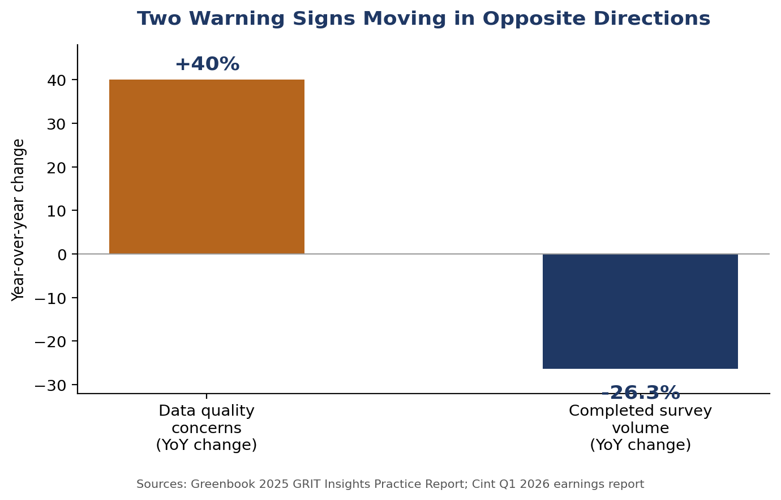
Inside the market research industry itself, the same strain shows up from two different directions at once. Greenbook's 2025 GRIT Insights Practice Report, the industry's most widely cited annual benchmarking study, found that data quality concerns among research buyers and suppliers rose 40% year-over-year, driven specifically by synthetic respondents and what the report calls Gen Z's survey fatigue. At the same time, on the supply side, Cint, the world's largest survey marketplace, reported in its Q1 2026 earnings that completed survey volume had fallen 26.3% over the preceding twelve months. Rising concern about quality and falling completion volume are not two unrelated data points; they are the same underlying problem, described once by the people buying research and once by the platform actually running it.
What Fatigue Actually Looks Like in a Dataset
Panel fatigue rarely announces itself as an outright refusal to participate; it shows up as degraded participation from people who are still technically responding. Straight-lining through matrix questions, implausibly fast completion times, and increasingly generic open-ended answers are the behavioral fingerprints researchers now have to screen for on every wave. A panel member who has completed hundreds of surveys for the same handful of providers is not the same respondent, cognitively, as the one who joined three years ago, and treating their answers as equally reliable is where quiet data corruption begins.
Why the Fix Isn't Just 'Recruit More People
The instinctive response, adding more respondents to a shrinking, fatigued pool, does not actually solve the underlying problem, and a growing body of research points to why. In a review spanning more than twenty academic studies, McKinsey found that the single biggest driver of survey fatigue was not survey length or how often people were asked; it was respondents' belief that their feedback would not lead to any real change. That finding reframes the fix: shorter surveys and better incentives help at the margins, but they do not address a respondent's core suspicion that answering honestly changes nothing. Bigger panels recruited under the same conditions will simply fatigue on the same timeline.
How the Industry Is Responding
Agency leaders are naming this as their top operational problem, not a background nuisance. In the Research Live Industry Report 2026, a survey of research agency leadership published by the Market Research Society's trade title, one insights executive described data quality as the single biggest challenge facing the industry, prompting new investment in survey-level data cleaning tools even as AI-assisted screening handles part of the load. That combination, human-led quality control paired with automated screening, has become the emerging standard response, precisely because neither approach alone catches what fatigue produces: technically valid, statistically clean-looking data from a respondent who has mentally checked out.
Protecting Your Data From Fatigue-Driven Corruption
- Rotate and cap panel exposure, capping how many surveys from the same provider a single respondent completes per quarter.
- Build in mid-survey engagement checks rather than relying only on a single attention-check question near the end.
- Close the feedback loop by showing panelists, even briefly, how prior research shaped a real decision.
- Weight quality signals as heavily as demographic quotas when accepting a completed response into your dataset.
Panel fatigue does not announce its arrival with a dramatic drop-off; it erodes data quality gradually enough that a single wave can look statistically sound while resting on responses nobody meant seriously. The government's own benchmark survey, the industry's own buyer research, and the largest survey marketplace's own earnings are now telling the same story from three independent angles. Treating panel health as a fielding footnote rather than a core methodology decision is how that erosion goes unnoticed until the data it produces stops matching the market it was meant to describe.