
The Psychology of Price Anchoring in E-Commerce

A crossed-out “$129” next to a bold red “$59” is not decoration. It is a number engineered to change how a shopper's brain values everything that follows, and it works because of a well-documented cognitive shortcut called anchoring: once a reference price lands in view, every subsequent price gets judged against it rather than on its own merits. E-commerce has turned that shortcut into infrastructure, running quietly beneath product pages, checkout timers, and holiday sale calendars. The numbers behind it, from federal regulation to record-breaking sales days, show just how deliberately it is engineered, and how thin the line is between a legitimate reference price and a fabricated one.
What the Law Actually Says About That Crossed-Out Price
The reference price on a product page is not an unregulated marketing flourish; it sits inside a specific federal framework. The Federal Trade Commission's Guides Against Deceptive Pricing, codified at 16 CFR 233.1, state plainly that if a former price advertised alongside a discount is not a bona fide price but an artificial, inflated figure established specifically to enable a large-looking reduction, the resulting bargain is false and the “reduced” price is, in reality, probably just the seller's regular price. That single sentence, written decades ago, is the legal test underneath every “was/now” price pair a shopper sees today, and it is the reason anchoring in e-commerce is a compliance question as much as a psychological one.
Retailers Are Leaning Harder Into the Anchor Every Holiday Season
Anchoring shows up most visibly in the size of the discounts retailers advertise against list prices. Adobe Analytics reported that Cyber Monday 2025 generated a record 14.25 billion dollars in US online spending, up 7.1 percent year over year, with discounts peaking at 31 percent off listed price in electronics, 28 percent in toys, and 25 percent in apparel. Cyber Week as a whole, the five days from Thanksgiving through Cyber Monday, brought in 44.2 billion dollars, with Black Friday alone setting a record at 11.8 billion dollars, up 9.1 percent year over year. Every one of those percentages is, by definition, an anchor: a listed price the retailer wants remembered even as the discounted price is what actually gets charged at checkout.
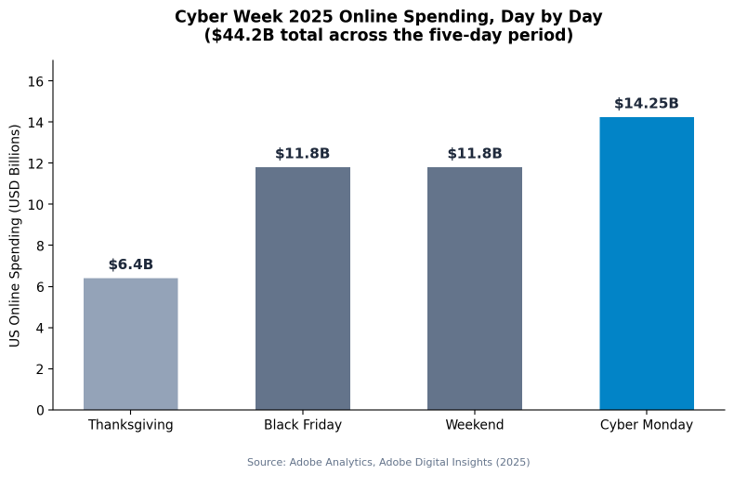
Figure 1: US online spending across Cyber Week 2025, by day. Source: Adobe Analytics, Adobe Digital Insights.
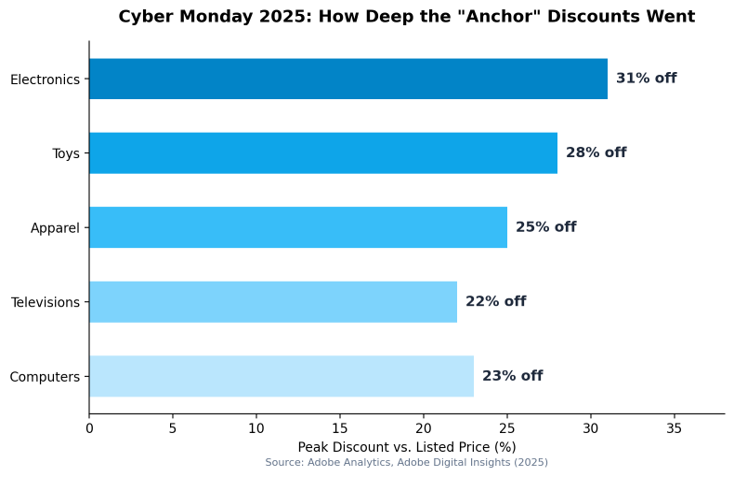
Figure 2: Peak Cyber Monday 2025 discounts by category, expressed against the listed “anchor” price. Source: Adobe Analytics.
Shoppers Are Trained to Wait for the Anchor to Drop
Consumers have learned to time their purchases around when that anchor is expected to move. The National Retail Federation's 2025 holiday survey found that 63 percent of shoppers planned to wait until Thanksgiving weekend to do the bulk of their holiday buying, up from 59 percent in 2024, even as average per-person holiday spending held near a record at 890.49 dollars. That is anchoring operating in reverse: shoppers now anchor their own timing decisions to the calendar dates when retailers have trained them to expect the deepest markdowns, turning the entire holiday shopping season into a choreographed reference-price event rather than a series of independent purchase decisions made on need.
Why a One Percent Anchor Shift Moves the Whole Business
The stakes of getting a reference price right are asymmetric in ways most shoppers never see. A McKinsey analysis of the Global 1200 found that if companies raised prices by just 1 percent while demand held steady, average operating profits rose by 11 percent on average, with some companies seeing far larger swings from that same one-point move. That lopsided math is exactly why anchoring is worth engineering carefully: a reference price that is even slightly higher makes every discounted price beneath it look more generous without costing the retailer a cent in actual margin, which is precisely the incentive regulators worry about when they scrutinize how a “before” price gets set in the first place.
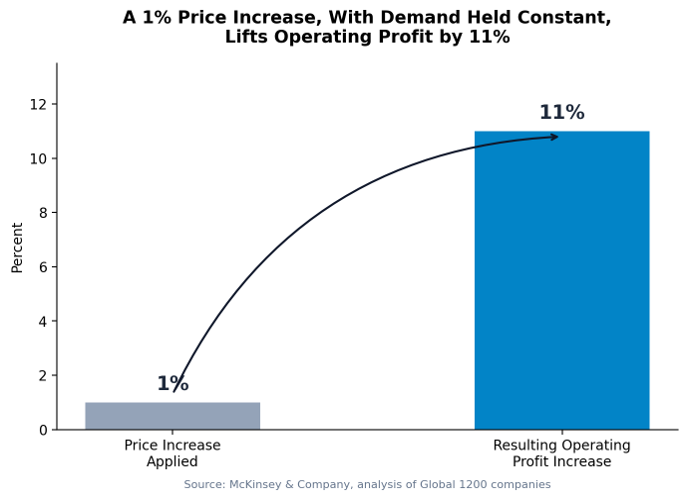
Figure 3: The profit impact of a 1% price increase, holding demand constant. Source: McKinsey & Company, Global 1200 analysis.
When the Anchor Is Fake, Someone Eventually Notices
That incentive occasionally tips into outright fabrication, and it does get caught. Consumer researcher Edgar Dworsky's tracking of retailer pricing, reported by CBS-affiliated newsrooms, identified Gap, JCPenney, Bass Pro Shops, Wayfair, and Dick's Sporting Goods among the most frequent runners of perpetual “sales,” where the discounted price is effectively the everyday price and the crossed-out figure never reflected real sales activity. A former deputy director of the FTC's Bureau of Consumer Protection, Monica Vaca, has said the agency has not enforced its own deceptive pricing rules in more than 40 years, leaving state attorneys general, such as Missouri's office in its case against Dollar General over register-price discrepancies, to fill the gap.
The pattern across every one of these sources is consistent: anchoring is not a marketing trick that occasionally misfires, it is a calibrated system with a legal boundary, a measurable payoff, and just enough enforcement gaps to keep tempting retailers toward the fictitious end of that boundary rather than the honest one.