
Plant-Based to Precision Fermentation: The Next Wave of Food Tech
Plant-based burgers are quietly disappearing from freezer aisles while, one lab over, investors are writing bigger checks than ever for meat, egg, and dairy proteins grown from microbes. That split is not a coincidence, and it is not well captured by the breathless market-size projections that dominate coverage of “food tech.” Government filings, company earnings, and nonprofit industry trackers tell a more precise story: one branch of alternative protein is contracting while another is being rebuilt from the fermentation tank up, and the difference comes down to taste, price, and who is willing to fund the infrastructure to close both gaps.
The Plant-Based Reckoning
Retail data from SPINS, the industry's standard source for natural and specialty channel sales, shows US plant-based food sales fell 2 percent in 2025 to 7.9 billion dollars, the second consecutive annual decline after a 4 percent drop the year before. Plant-based meat and seafood were hit hardest, with dollar sales down 10 percent and unit sales down 11 percent to just over 1 billion dollars. Household penetration has stalled near 40 percent for plant-based milk and 13 percent for plant-based meat, with most categories still priced two to four times higher than their conventional counterparts per pound or per gallon. The exceptions were telling: soy and coconut milk formats grew, and shreds, chunks, and strips gained unit share, suggesting consumers stuck around for formats that behave more like the real thing rather than abandoning the category outright.
Beyond Meat's Balance Sheet Tells the Story
No single filing captures the plant-based slowdown better than Beyond Meat's own numbers. The company's third-quarter 2025 results showed net revenue of 70.2 million dollars, down 13.3 percent year over year, marking a third straight quarter of declining sales. Gross margin collapsed to 10.3 percent from 17.7 percent a year earlier, and the company booked a 77.4 million dollar non-cash impairment charge on long-lived assets. Management has since pursued a debt exchange to push out note maturities and cut costs toward EBITDA breakeven, but guided fourth-quarter revenue down again to between 60 and 65 million dollars. It is a useful reminder that a category's sentiment problem shows up first on an income statement, long before it shows up in headlines.
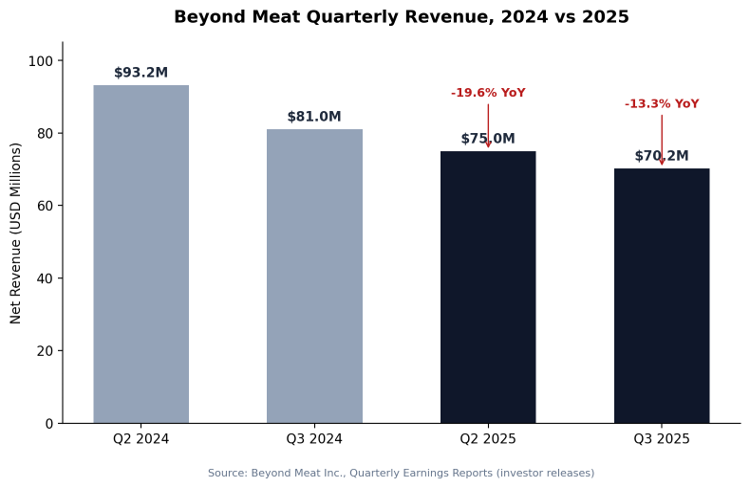
Figure 1: Beyond Meat quarterly net revenue, 2024 vs 2025. Source: Beyond Meat Inc. earnings releases.
Where the Money Actually Went in 2024
Capital simply moved. According to the Good Food Institute's State of the Industry report, fermentation companies raised 651 million dollars in private funding in 2024, up 43 percent from 2023, plus an estimated 510 million dollars in public investment from governments. That stands in sharp contrast to plant-based projects, where funding fell 64 percent to 309 million dollars, and cultivated meat, where funding dropped 40 percent to 139 million dollars. The largest fermentation deals of the year, Meati's 100 million dollar Series C, Perfect Day's 90 million dollar Series E, Formo's 61 million dollar Series B, and Infinite Roots' 58 million dollar Series B, all went to companies producing mycelium steaks or animal-free dairy proteins rather than soy- or pea-based burgers.
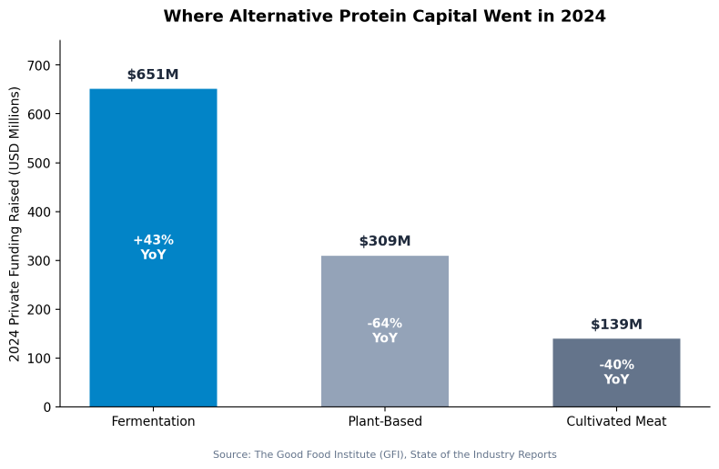
Figure 2: Where alternative protein capital went in 2024, by segment. Source: The Good Food Institute (GFI), State of the Industry Reports.
Regulators Are Opening the Door
Precision fermentation's momentum also rests on a widening regulatory pathway. The US Food and Drug Administration issued its first “no questions” letter for a fermentation-derived animal-free whey protein to Perfect Day in 2020, followed by Remilk in 2022 and Imagindairy in 2024, each using a different microbial strain to produce the same dairy-identical beta-lactoglobulin protein. That third approval also let Imagindairy use its ingredient at concentrations up to 35 percent across products ranging from yogurt and cheese to nutrition bars and meal replacements, evidence that regulators are growing more comfortable treating these proteins as functional ingredients rather than novel curiosities requiring case-by-case caution.
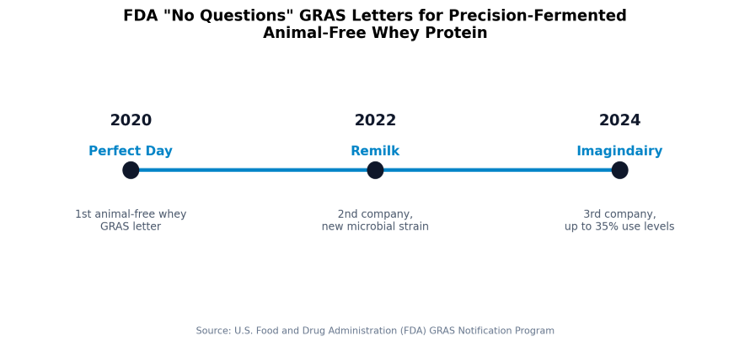
Figure 3: FDA GRAS approval timeline for precision-fermented whey protein. Source: U.S. Food and Drug Administration (FDA).
The Trillion-Dollar Bet Consultants Are Making
Consulting firms are treating this as a structural shift rather than a passing trend. McKinsey estimates that fermentation-derived proteins could reach 4 percent of the global protein market by 2050, a market worth 100 to 150 billion dollars annually, but reaching that scale would require more than 250 billion dollars of infrastructure investment, an amount the firm argues private capital alone cannot supply. Boston Consulting Group's earlier protein-transformation analysis, produced with Blue Horizon, projected the broader alternative protein category could still reach 290 billion dollars and 11 percent of the total protein market by 2035 in its base case, rising to 22 percent under faster cost and regulatory progress.
The pattern connects every one of these sources: plant-based retail is correcting on price and taste rather than disappearing outright, fermentation is absorbing the capital and regulatory goodwill that plant-based spent the last decade building, and the next wave of food tech will likely be judged less on how it tastes on a bun and more on how cheaply a bioreactor can brew a protein that used to require a cow.