
Floating Solar: An Underused Solution for Land-Constrained Markets
A Technology Sitting on Untapped Real Estate
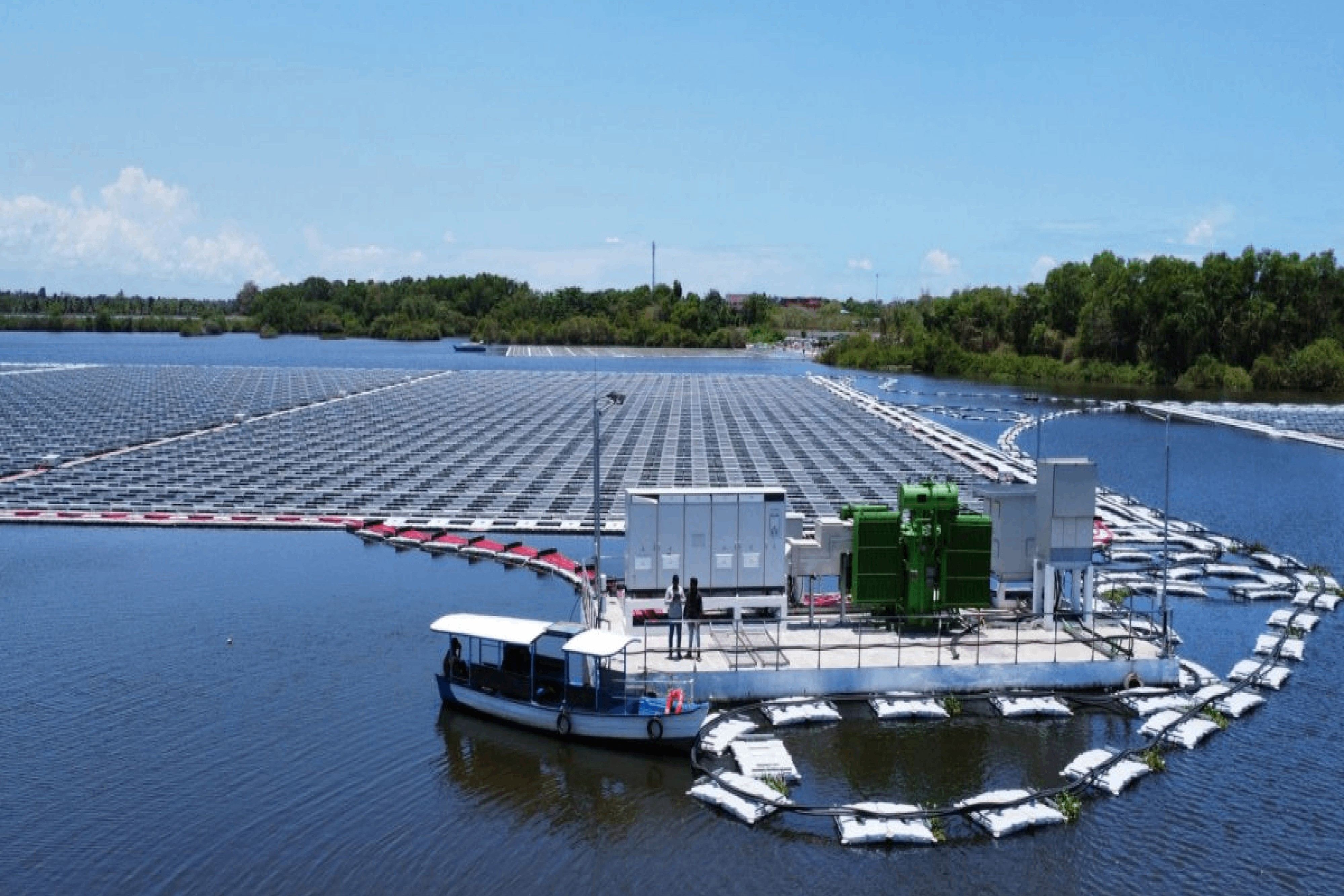
Solar developers spend enormous effort securing land, negotiating leases, and fighting permitting battles for ground-mounted arrays, while an alternative surface sits largely unused: the world's reservoirs, lakes, and hydropower dams. Floating solar, or FPV, mounts panels on pontoons anchored to the water's surface instead of the ground. It is not a new idea, but it remains dramatically underbuilt relative to where the resource actually is, particularly in countries where land is the binding constraint on solar growth, not sunlight.
The Resource Base Dwarfs What's Been Built
A World Bank and Solar Energy Research Institute of Singapore assessment found that floating solar could technically support at least 400 gigawatts of installed capacity worldwide, even under the conservative assumption that only 1% of the surface area of man-made freshwater reservoirs is used. Despite that potential, global floating solar capacity remains under 10 gigawatts, compared with more than 1,000 gigawatts of ground-mounted solar installed worldwide — meaning less than 3% of the theoretical floating opportunity has been captured so far.
Growth Rates Are Accelerating From a Small Base
Where floating solar has been deployed, growth has been fast. SolarPower Europe's data shows the global FPV market expanded at a 51% compound annual growth rate between 2019 and 2022, rising from 1.89 gigawatts to 5.7 gigawatts, with analysts estimating the technical potential on man-made water bodies could ultimately range between 3 and 7 terawatts globally. That is a market still finding its footing, not one that has plateaued.
Asia-Pacific Is Where the Capacity Actually Is
Wood Mackenzie's Floating Solar Landscape 2024 report projects global cumulative FPV capacity will reach 77 gigawatts by 2033, with the Asia-Pacific region alone accounting for 57 gigawatts, or 81% of that total. India, China, and Indonesia already combine for roughly 31 gigawatts-DC of installed capacity today and are expected to remain the three largest markets, while annual global additions are forecast to nearly quadruple from 1.7 gigawatts in 2024 to 6.7 gigawatts in 2025.
What a Flagship Project Actually Delivers
Indonesia's Cirata plant, developed by Masdar with state utility PLN, shows what floating solar looks like at commercial scale. The 145-megawatt first phase, built for roughly $100 million on a 250-hectare section of the Cirata reservoir, generates enough power for 50,000 homes and offsets 214,000 tons of carbon dioxide annually — all without acquiring a single hectare of new land, since it sits on an existing hydropower reservoir. Masdar and PLN have since agreed to more than triple the project's capacity to 500 megawatts in a second phase.
The Untapped Pipeline Is Larger Than What's Built
Cirata is a demonstration of potential, not its ceiling. A senior Indonesian energy ministry official told Reuters that the country could generate an additional 28 gigawatts of solar power from floating installations across 375 suitable lakes and reservoirs nationwide — nearly 200 times Cirata's first-phase capacity, and a reminder that even successful flagship projects are only a small fraction of the identified opportunity in a single country.
Why Land-Constrained Markets Should Pay Attention
The common thread across these sources is that floating solar's constraint has never really been resource availability — it has been the pace of policy support, financing structures suited to a still-maturing technology, and mooring and anchoring costs that remain higher than ground-mounted systems. For land-scarce, water-rich markets across South and Southeast Asia, Africa, and parts of Europe, floating solar offers a way to add gigawatts of generation without the land-acquisition fights that increasingly slow conventional utility-scale solar. The countries capturing this opportunity first, led by China, India, and Indonesia, are likely to hold a multi-year head start over slower-moving markets once financing costs for FPV fall further.