
The Quiet Boom in Industrial Robotics You're Not Hearing About
While the tech world debates chatbots and humanoid robot demos, a steadier industrial shift has been compounding quietly on factory floors most people never see. It shows up not in viral videos but in order books, customs data, and quarterly filings, where the numbers tell a story that generic market-research blurbs rarely capture. This is the real robotics boom, and it is bigger, more geographically lopsided, and stranger than most coverage suggests. Understanding it means looking past unit-shipment headlines and into who is buying, who is selling, and who is footing the bill.
The Installation Curve Nobody Is Talking About
According to the International Federation of Robotics World Robotics 2025 Report, 542,000 industrial robots were installed globally in 2024, more than double the figure from a decade earlier, with annual installations topping 500,000 units for a fourth consecutive year. The IFR projects growth of 6 percent to 575,000 units in 2025, crossing 700,000 by 2028. Asia absorbed 74 percent of new deployments in 2024, against 16 percent for Europe and just 9 percent for the Americas. China alone accounted for 54 percent of global installations, and for the first time, domestic Chinese suppliers outsold foreign robot makers inside their own market. Global operational stock reached 4.664 million units, up 9 percent year on year, with the general industry segment, rather than automotive, now supplying more than half of all installations worldwide.
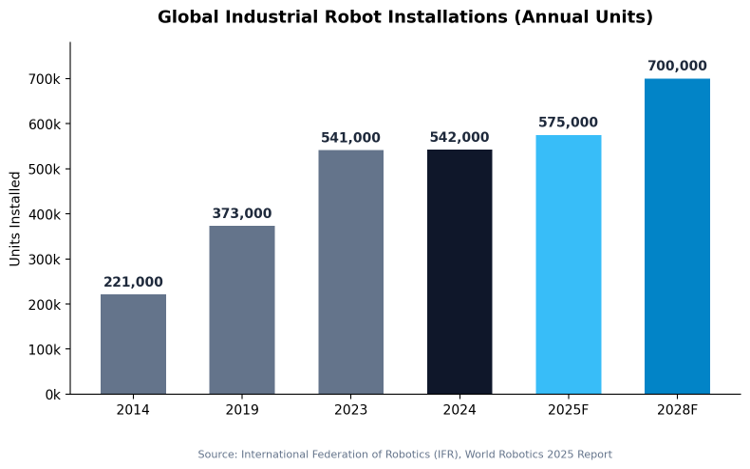
Figure 1: Global industrial robot installations, 2014–2028 (forecast). Source: IFR World Robotics 2025 Report.
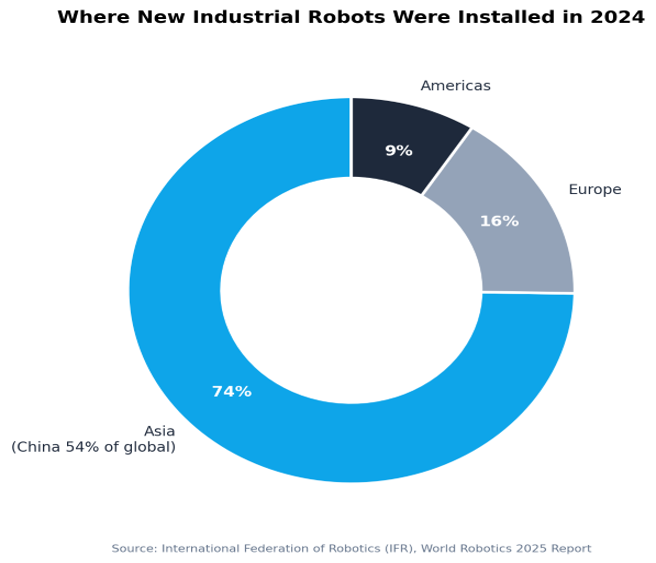
Figure 2: Regional share of 2024 industrial robot installations. Source: IFR World Robotics 2025 Report.
America Finds Its Footing Again
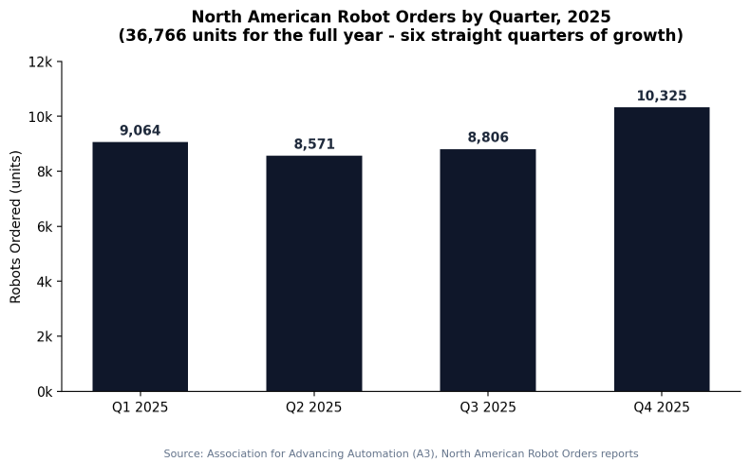
North America tells a quieter but no less notable story. The Association for Advancing Automation reports that companies across the region ordered 36,766 robots worth 2.25 billion dollars in 2025, a 6.6 percent rise in units and a 10.1 percent jump in revenue over 2024. The fourth quarter alone brought 10,325 units, marking six consecutive quarters of year-on-year growth and the highest annual total since 2022. Notably, non-automotive buyers, spanning food and consumer goods, semiconductors, and life sciences, drove the bulk of demand, while collaborative robots climbed to nearly 29 percent of all units ordered in the final quarter. That shift matters because cobots typically cost a fraction of traditional caged industrial arms, meaning unit growth alone understates how fast the installed base of automation is actually spreading through smaller manufacturers.
When a Robotics Pioneer Steps Back
ABB's own investor filings show orders climbing 9 percent to 9.1 billion dollars in the third quarter of 2025, with the group's order backlog swelling to 25 billion dollars. Yet in October 2025, ABB agreed to sell its entire Robotics division, a unit of roughly 7,000 employees generating 2.3 billion dollars in 2024 revenue, to SoftBank Group for an enterprise value of 5.375 billion dollars, abandoning an earlier plan to spin the unit off as a standalone listed company. SoftBank framed the deal as a move into what it calls Physical AI, merging robotics hardware with artificial intelligence and adding to a portfolio that already includes warehouse-automation firms. The transaction is less a verdict on robotics demand than a reshuffling of who owns the factory floor's most capital-intensive assets, and a signal that AI-native firms now see hardware manufacturing as strategically essential rather than a legacy business.
Governments Are Quietly Bankrolling the Shift
Much of this growth has a policy scaffold behind it. India's Press Information Bureau reports that the country's Production Linked Incentive scheme, carrying an outlay of nearly 1.97 lakh crore rupees, has drawn 806 approved applications across 14 sectors and attracted 1.76 lakh crore rupees in committed investment, generating over 12 lakh direct and indirect jobs. India's 2025 budget went further, cutting customs duties on imported industrial robots and CNC machines and floating a National AI and Robotics Mission to fund automation research. The payoff is already visible: the IFR recorded a record 9,100 robots installed in India in 2024, up 7 percent, pushing the country to sixth place worldwide, just ahead of Germany, with automotive manufacturing supplying 45 percent of that demand.
What Forecasters Actually Expect
Consulting firms see the shift as structural rather than cyclical. McKinsey's Global Industrial Robotics Survey found that industrial companies expect automated systems to account for 25 percent of capital spending over the next five years, even as executives cite hardware costs and limited in-house experience as the biggest adoption barriers. Boston Consulting Group's earlier analysis of 21 industries across the world's 25 largest manufacturing-export economies projected that falling costs would push robots from performing roughly 10 percent of industrial tasks to 25 percent, concentrated in machinery, electrical equipment, computing, and transportation manufacturing.
The pattern across every one of these sources is consistent: robotics adoption is broadening beyond automotive, concentrating capital in Asia while diversifying who supplies and owns the hardware, and drawing direct government subsidy in ways that rarely make headlines. That is precisely why it counts as a quiet boom: it is compounding in balance sheets and installation counts rather than launch events, and it will likely keep expanding whether or not anyone is watching.