
Telehealth's Second Wave: What's Driving Renewed Growth in Digital Health

Telehealth's pandemic-era surge was always going to cool off, and for four straight years it did. What's newer, and less widely reported, is that the cooling has reversed. Early 2026 data shows utilization climbing again, not because of another public health emergency, but because of a mix of policy stabilization, a decisive shift toward mental health care, and payers finally building telehealth into permanent benefit design rather than treating it as a temporary accommodation.
The First Wave Crested, Then Quietly Deflated
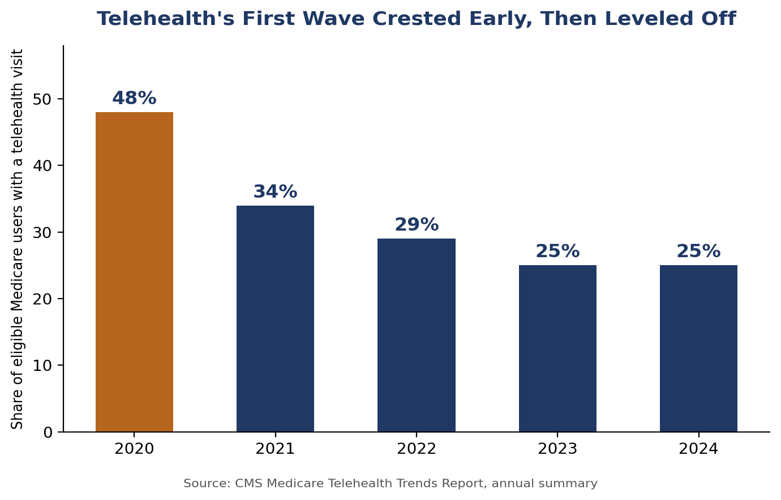
The scale of the original shift is easy to forget. CMS's own Medicare Telehealth Trends Report shows that 48% of telehealth-eligible Medicare beneficiaries used a telehealth service in 2020. That share fell every year after: 34% in 2021, 29% in 2022, 25% in 2023, and 25% again in 2024, essentially flatlining at roughly half of where it started. This wasn't a collapse; it was a return toward a new, lower baseline as in-person care resumed and pandemic-era urgency faded. McKinsey's own tracking told a similar story on the commercial side, finding utilization stabilizing at roughly 38 times pre-pandemic levels but confined to a narrow 13% to 17% band of all visits, essentially flat for years rather than continuing to climb.
The Turn: Early 2026 Data Shows Utilization Climbing Again
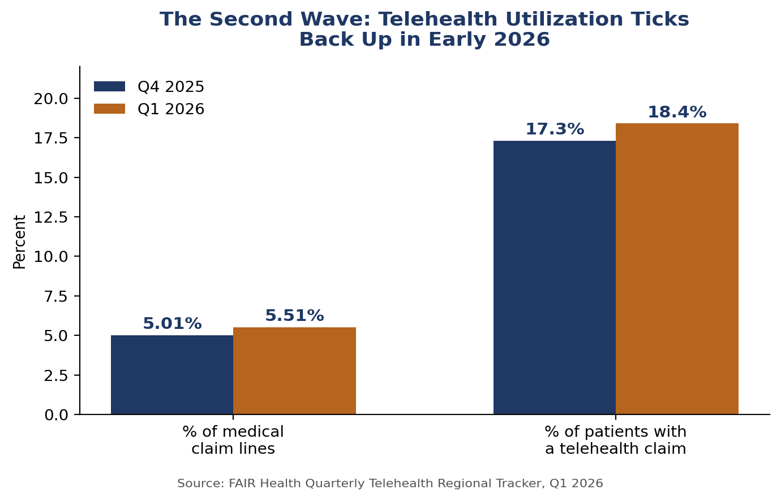
The reversal is now visible in claims data. Reporting on FAIR Health's newly launched Quarterly Telehealth Regional Tracker, healthcare news outlet Fierce Healthcare found that U.S. telehealth utilization rose 10.1% from the fourth quarter of 2025 to the first quarter of 2026, with the share of medical claim lines delivered via telehealth climbing from 5.01% to 5.51%. The share of patients filing at least one telehealth claim rose in parallel, from 17.3% to 18.4%, a gain recorded in every U.S. Census region rather than concentrated in one market. That breadth matters: a single-region bump could be a local anomaly, but a national, cross-regional uptick after years of flat or declining utilization is the clearest signal yet of a genuine second wave rather than statistical noise.
Mental Health Is Doing the Heavy Lifting
The renewed growth is not evenly distributed across specialties. In the same FAIR Health data, mental health conditions ranked as the top telehealth diagnostic category nationally and in every age group, including children ages 0 to 9, accounting for 52.1% of all patients with a telehealth claim. Behavioral health has effectively become telehealth's anchor use case: it travels well over video, patients report high satisfaction with virtual therapy, and provider shortages in mental health make virtual access a practical necessity rather than a convenience, giving this segment of the second wave a structural rather than cyclical basis.
Why Policy Stability Matters More Than It Sounds
Utilization data alone doesn't explain why the trend turned when it did; the policy backdrop does. The American Telemedicine Association's advocacy arm, ATA Action, documented a 43-day lapse in Medicare telehealth flexibilities during the 2025 government shutdown, a period Congress ultimately resolved by extending the waivers and Acute Hospital at Home program through the Consolidated Appropriations Act of 2026, which was signed into law and secured coverage for two years rather than the usual single-year patch. ATA Action's leadership publicly welcomed the extension as sending 'an important message' that policymakers value telehealth access, but also renewed its push for permanent authorization, arguing that repeated short-term extensions still leave providers and patients bracing for the next funding deadline.
The Business Side Is Recalibrating, Not Retreating
Telehealth vendors are adjusting their models around the same dynamics. In its Q2 2026 earnings call, Teladoc Health reported that its cash-pay BetterHelp segment declined 11.6% year-over-year, even as insurance-covered revenue grew, prompting a strategic pivot toward building out its U.S. insurance network. Company leadership cited internal data showing 70% to 80% of potential users in certain markets now prefer insurance-covered access over paying out of pocket. Read alongside the utilization uptick, this suggests the second wave is less about consumers rediscovering telehealth from scratch and more about telehealth completing its move from a pandemic novelty into standard, insurance-backed care infrastructure.
What This Means for Digital Health Strategy
- Prioritize behavioral health service lines, where utilization and diagnostic share are both structurally strongest.
- Build insurance-network integration rather than cash-pay-only models, following the direction payer preference data is already pointing.
- Track policy deadlines as a business risk, not a footnote, given the demonstrated double-digit utilization swings tied to funding lapses.
- Watch regional data rather than only national averages, since the second wave's cross-regional consistency is what distinguishes it from a temporary blip.
None of this points to a return to 2020-level telehealth adoption, and nobody serious is forecasting one. What the data does show is a more durable, second phase of growth: narrower in scope, concentrated in behavioral health, dependent on stable federal policy, and increasingly built into insurance benefit design rather than offered as a stopgap. For digital health strategy, that combination is arguably a better foundation to build on than the pandemic spike ever was.