
Luxury Market 2026: Why Growth Is Coming Back on Different Terms
The global luxury goods market spent 2024 and 2025 in a rare and uncomfortable place: shrinking. After years of relentless post-pandemic expansion, personal luxury goods spending slipped from €364 billion in 2024 to an estimated €358 billion in 2025. For an industry built on the promise of perpetual desirability, a two-year contraction was a genuine shock. Now, according to Bain & Company and Altagamma's spring 2026 Worldwide Luxury Market Monitor, the market is turning a corner, projected to grow 2% to 4% this year, reaching between €365 billion and €373 billion, with an upside scenario of 4% to 6% if Middle East tensions continue easing and Chinese demand keeps recovering.
But anyone researching this market for a business decision should resist the temptation to read this as a simple return to form. The 2026 recovery is being built on a different foundation than the 2015–2023 boom, and understanding that foundation matters more than the headline growth number itself.
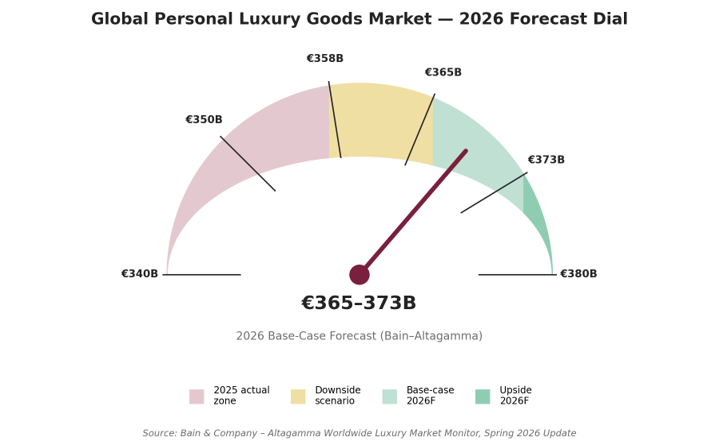
Global Personal Luxury Goods Market 2026 Forecast Dial. Source: Bain & Company – Altagamma Worldwide Luxury Market Monitor, Spring 2026.
A Different Kind of Recovery
Three shifts define this cycle. First, the geography of growth has flipped. China, the engine of the last decade's expansion, is only now stabilizing after an 18–20% contraction in 2024 and a further 3–5% decline in 2025. In its place, the United States has become the most consistent large-market growth driver, with all three major European luxury conglomerates LVMH, Kering, and Richemont citing accelerating or robust American demand in their most recent earnings. Deloitte's Global Powers of Luxury 2026 survey of 420 senior executives across ten countries reinforces this diversification: China, Japan, the Middle East, and India are now named almost interchangeably as the top growth engines for the year ahead, a meaningfully more balanced picture than the China-centric growth model of the past decade.
Second, the categories driving growth have changed. Jewelry has emerged as the standout performer of 2026, with collectors increasingly rewarding craftsmanship and rarity over brand recognition, and buyers in the Americas treating fine jewelry as a store of value amid broader market volatility. Apparel, eyewear, and fragrance are holding up. At the same time, leather goods and footwear, the categories hit hardest by three years of aggressive price increases, remain under pressure, even if Bain describes both as being on an improving trajectory.
Third, and perhaps most importantly, the consumer has changed. This is not the same aspirational shopper who powered the last boom. Bain estimates the global luxury customer base has contracted from roughly 400 million buyers in 2022 to around 340 million in 2025, with a further loss of 20 to 30 million projected. Years of price increases outpacing improvements in craftsmanship or service have left even the wealthiest clients, who account for some 46–47% of total spending, feeling, in the words of Bain partner Federica Levato, “betrayed.” The customer who remains is more selective, more value-conscious, and considerably harder to win back once lost.
What's Actually Driving the Numbers
- U.S. demand normalization: American consumers are providing a steadier growth base, with gains across beauty, apparel, and hard luxury (jewelry and watches), disproportionately fuelled by younger shoppers.
- Jewelry's investment appeal: a flight to tangible, value-retaining assets is lifting jewelry well above the rest of personal luxury goods. Richemont's Jewelry Maisons grew 24% at constant exchange rates in the quarter ended June 2026.
- Chinese repatriation of spend: narrower price gaps between mainland and overseas retail have pushed domestic consumption to roughly 65% of total Chinese luxury spending, up from about 60% in 2024.
- A more diversified geography: Japan, the Middle East, and India are increasingly cited by executives as standalone growth engines rather than overflow markets for Chinese tourists.
The Headwinds Worth Watching
Growth is not guaranteed to be smooth. U.S. tariff policy introduced in 2025 has already raised landed costs on imported leather goods and footwear, and analysts covering the leather supply chain warn of further price increases of up to 22% over the next two years as tariffs, sourcing bottlenecks, and a shrinking U.S. cattle herd compound one another. Tourist retail in Japan and parts of Europe has also softened, even where local demand has held up. And the pricing question looms largest of all: research from Business of Fashion and McKinsey found that roughly 80% of luxury market growth between 2023 and 2025 came from price increases rather than volume, with average prices up 61% over that period a pace McKinsey describes as unsustainable given how much of the customer base has already been priced out.
Bain's own scenario planning captures this uncertainty well: a base case of 2–4% growth for 2026, an upside case of 4–6% if geopolitical and Chinese conditions improve further, and a downside case of flat to 2% growth if headwinds intensify. None of these scenarios involve a return to the price-led, volume-agnostic growth of 2019–2023.
What This Means for Businesses Watching This Market
For brand owners, suppliers, retail partners, and investors evaluating the luxury sector, the message from the 2026 data is that category and geography selection now matters more than industry-wide sentiment. A business primarily exposed to leather goods and mainland Chinese tourist retail is operating in a fundamentally different environment from one exposed to jewelry and the U.S. market. Pricing strategy also needs fresh scrutiny: with four in five recent growth dollars coming from price rather than volume, and a customer base that has already shrunk by 15% since 2022, further blanket price increases are a riskier lever than they were even two years ago.
The stabilization underway in 2026 is real, but it is a stabilization on new terms: different buyers, different categories, different geographies, and a pricing environment that finally has to answer to demand elasticity rather than assume it away.
Businesses evaluating entry, repositioning, or investment within this sector can read Epignosis Insights' full Luxury Goods Market: Global Demand Outlook report for a detailed breakdown of segmentation, regional dynamics, competitive positioning, and pricing analysis.