
Jewelry's Moment: Why It's Outperforming the Rest of Luxury in 2026
Walk through the personal luxury goods numbers for 2026, and one category stands apart from every other. While leather goods and footwear are still climbing out of a three-year slump and prestige cosmetics growth is cooling, jewelry has become the undisputed standout performer of the year. Bain & Company and Altagamma's spring 2026 Worldwide Luxury Market Monitor names jewelry the single strongest-performing segment within personal luxury goods, and the company-level results back that up in a big way: Richemont's Jewellery Maisons Cartier, Van Cleef & Arpels, Buccellati, and Vhernier grew 24% at constant exchange rates in the quarter ended June 2026, while LVMH's Watches & Jewellery division posted 9% organic growth in the first half, the strongest of any division in the group.
For anyone researching the luxury sector for a strategic decision on where to invest, which category to expand into, which brand relationships to prioritize, the jewelry story is arguably the single most important thread running through the 2026 data.
What's Actually Behind the Jewelry Boom
Two forces are doing most of the work. The first is a shift in what collectors value. Bain's 2026 commentary describes a move away from hype-driven, logo-forward buying toward craftsmanship and rarity a dynamic that shows up clearly in watches too, where collectors are increasingly rewarding mechanical complexity and provenance over brand recognition alone. This is a meaningful cultural shift: for much of the 2015–2023 boom, luxury purchasing was driven substantially by visible brand signaling. The 2026 buyer is, by contrast, behaving more like a connoisseur, and jewelry, with its inherent material value, craftsmanship story, and resale liquidity, fits that mindset better than almost any other category.
The second force is more macroeconomic: jewelry is increasingly being treated as a store of value. Amid continued market volatility, buyers, particularly in the Americas, are gravitating toward tangible assets that can hold or appreciate over time, a dynamic more typically associated with fine art or real estate than with a handbag or a jacket. This investment-oriented behavior helps explain why jewelry has proven far more resilient to the broader pullback among luxury customers than fashion or leather goods.
How Jewelry Compares to the Rest of the Category
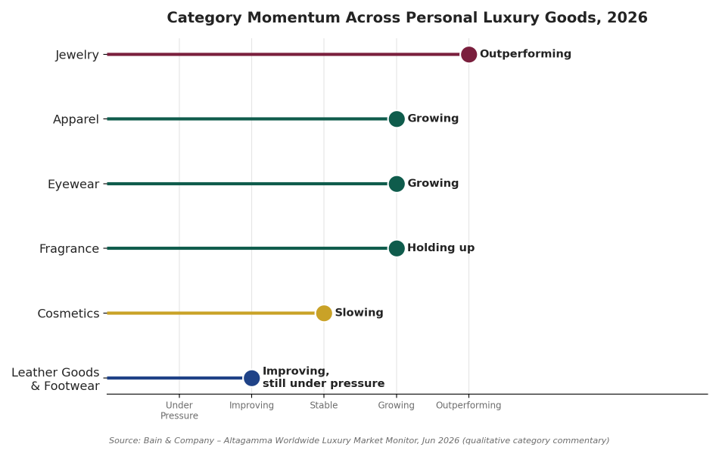
The contrast with other segments is stark. Leather goods and footwear remain the most pressured categories in personal luxury goods, the segment that absorbed the brunt of 2023–2025 price elevation and is now facing further cost pressure from U.S. tariff policy, with industry analysts warning of price increases of up to 22% over the next two years. Prestige cosmetics, meanwhile, is described by Bain as “slowing” after several exceptionally strong years, while apparel, eyewear, and fragrance are holding up but not accelerating the way jewelry is.
- Jewelry: outperforming Richemont's Jewelry Maisons +24% constant FX; LVMH Watches & Jewelry +9% organic, H1 2026.
- Apparel, eyewear, fragrance: growing or holding up, but without the same acceleration.
- Cosmetics: slowing after multiple years of strong prestige-beauty growth.
- Leather goods & footwear: improving off a low base, but still the most pressured category, squeezed further by tariff-driven input costs.
This divergence matters because it changes what “luxury exposure” actually means for a business. A supplier, retailer, or investor whose exposure is primarily in leather goods is operating in a fundamentally tougher environment in 2026 than one exposed to fine jewelry or hard luxury more broadly, even though both technically sit within the same “luxury goods” category.
The Watches Angle: A Related but Distinct Story
Watches deserve a specific mention alongside jewelry, because the underlying dynamic is closely related but not identical. In watches, Bain describes a move away from hype-driven purchasing, the kind that characterized certain steel sports watch categories at their peak, toward craftsmanship and rarity. That shift is also feeding directly into the resale and pre-owned watch market, where collectors are increasingly comfortable buying vintage or pre-owned pieces specifically for their provenance rather than insisting on new-in-box purchases. For brands and retailers, this means the traditional new-watch sales funnel is no longer the only, or even the primary, way collectors engage with the category.
What This Means for Businesses in the Category
For brand owners already in jewelry, the strategic imperative is to lean further into narratives of craftsmanship, provenance, and rarity rather than competing purely on logo visibility. The qualities driving the category's outperformance are exactly the ones that are hardest for mass-market competitors to replicate quickly. For businesses outside jewelry that are considering category expansion or diversification, the 2026 data offers a fairly clear signal: jewelry is where structural demand is currently strongest, and companies with adjacent capabilities in materials sourcing, craftsmanship, or authentication may find real opportunity in expanding into or partnering in this space.
For investors and retail partners more broadly, jewelry's performance is a useful bellwether. A category built on tangible value, dwindling ultra-rare inventory, and increasingly discerning collectors tends to be more resistant to the kind of broad-based price fatigue currently weighing on leather goods and apparel a distinction worth pricing into any category-level investment or partnership decision made in 2026.
For a full breakdown of category-level performance, company positioning, and pricing dynamics across the sector, see Epignosis Insights' complete Luxury Goods Market: Global Demand Outlook report.