
From Landers to Robotic Arms: A Technology and Cost-Efficiency Analysis of the Space Robotics Market
Why Cost Efficiency Is the Real Scorecard for Space Robotics
A lunar lander that reaches the surface is only half the story; what increasingly matters is the cost to get there and how repeatable that cost is for the next mission. As NASA, ESA and China all push toward higher flight cadences, cost efficiency, not just successful landings, has become the clearest signal of which robotics providers are building a durable business rather than a one-off engineering demonstration.
Lunar Lander Costs Are Rising, and the Reasons Are Instructive
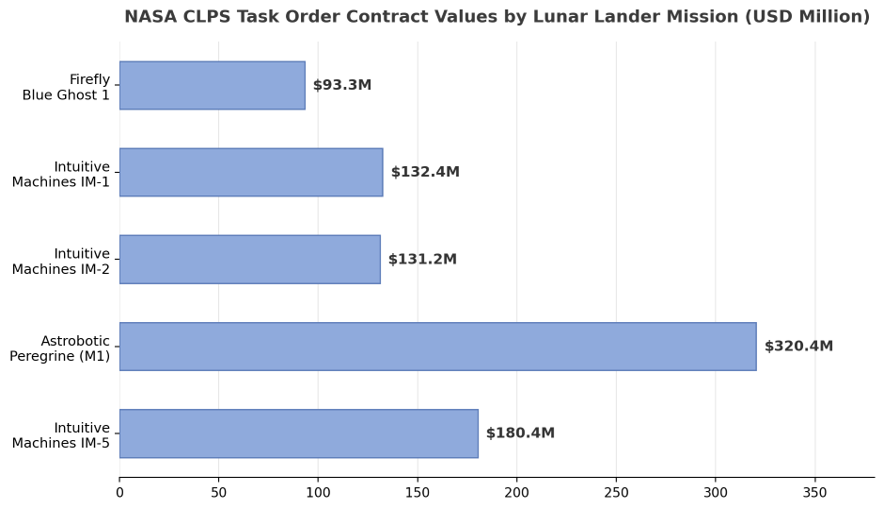
Contract values for NASA's Commercial Lunar Payload Services (CLPS) missions vary with payload mass and landing-site difficulty, but a clear cost trend has emerged. Firefly Aerospace's Blue Ghost Mission 1 was awarded in 2021 for $93.3 million to carry ten NASA payloads. Intuitive Machines' IM-1 and IM-2 missions closed out at $132.4 million and $131.2 million, respectively. In comparison, Astrobotic's Peregrine Mission One grew from an initial $226.5 million award to $320.4 million after additional testing requirements were imposed following early technical issues.
Cost Growth Has a Paper Trail
A June 2024 NASA Office of Inspector General audit found that, across the CLPS portfolio, cost growth on awarded task orders averaged 26 percent and schedule slippage averaged 14 months, figures that reflect the technical difficulty of soft lunar landings even for experienced contractors. Industry participants have acknowledged that early CLPS landers were 'slightly bespoke,' customized to each payload manifest, but expect greater standardization as flight rates climb, which should compress costs over time for providers who commit to reusable designs rather than one-off builds.
Robotic Arms Follow a Different Cost Curve
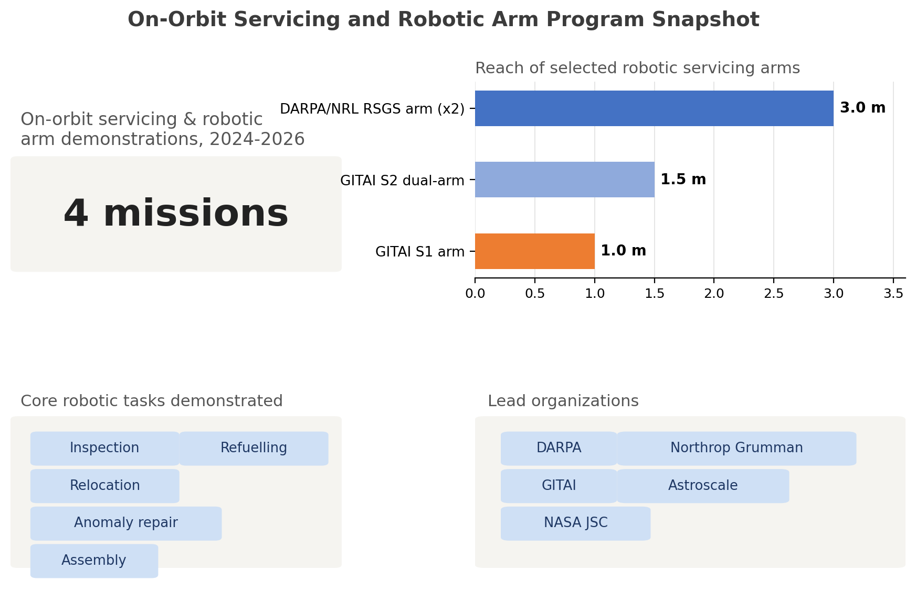
Robotic manipulator hardware scales with orbital regime and task complexity rather than payload count. Tokyo-based GITAI's compact S1 arm, with roughly a one-meter reach, offers a low-cost entry point for task-specific work such as cable and switch operation. At the same time, its dual-arm S2 system extends reach to 1.5 meters for more complex assembly and inspection tasks. At the top of the spectrum sits DARPA's Robotic Servicing of Geosynchronous Satellites (RSGS) payload, a set of dexterous, three-meter-class arms built by the Naval Research Laboratory and integrated by Northrop Grumman's SpaceLogistics unit, designed for years of repeated satellite servicing rather than a single mission.
Standardization Is the Next Efficiency Frontier
The clearest opportunity for cost compression lies in platforms that can be reused or adapted across multiple contracts rather than being custom-built once. Lander architectures flexible enough to serve successive CLPS task orders, robotic arms that can be re-flown or upgraded in place, and modular servicing vehicles like Northrop Grumman's Mission Extension Vehicles all reduce the effective capital cost per mission. Providers still building fully bespoke hardware for each customer remain exposed to the same cost growth and schedule slippage documented across the CLPS portfolio.
What This Means for Buyers and Investors
For agencies awarding contracts and investors backing suppliers, the efficiency signal to watch is not the size of a single award but whether a provider's cost per mission is falling as its flight count rises. Intuitive Machines' declining total contract revenue from IM-1 to IM-2, despite growing mission complexity, and GITAI's incremental arm upgrades from S1 to S2 are early evidence that some providers are already climbing this learning curve. In contrast, others remain anchored to the higher, less predictable costs typical of first-of-kind hardware.