
Funding the Frontier: How Government Space Budgets Are Powering the Space Robotics Market Through 2035
Why Government Budgets Are the Defining Metric for Space Robotics
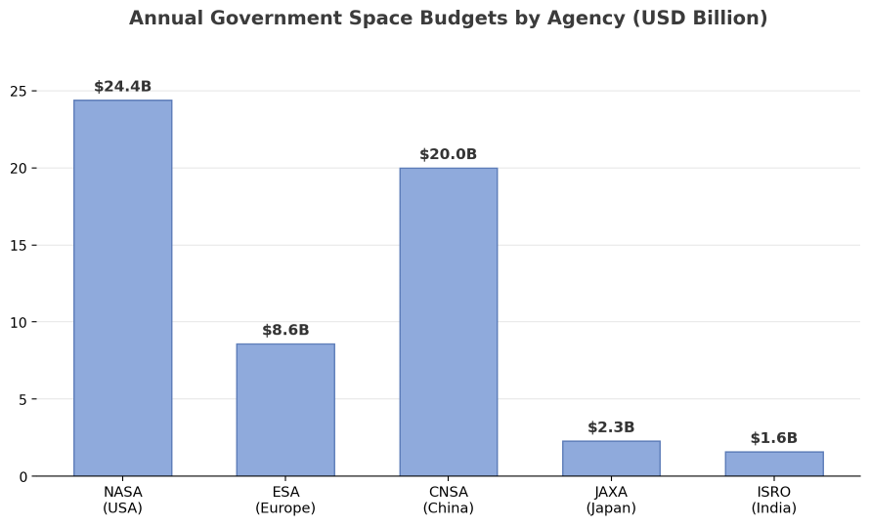
Every robotic arm that flies to the International Space Station and every lander that touches down near the lunar south pole traces its funding back to a government appropriations line before it ever reaches a commercial balance sheet. NASA, ESA, China's CNSA, Japan's JAXA, and India's ISRO collectively directed more than $55 billion toward civil space activity in 2025-2026, and the reliability with which that money arrives year after year is shaping the pace of robotic exploration more than any single technology breakthrough.
NASA's Exploration Account Is the Engine of Lunar Robotics
NASA's enacted FY2026 budget stands at approximately $24.4 billion, and within that total, the Exploration account has grown to $8.31 billion to fund Moon-to-Mars transportation and lunar surface systems. Much of that spending flows through the Commercial Lunar Payload Services (CLPS) program, which NASA restructured in 2026 by raising its contract ceiling from $2.6 billion to $4.2 billion as the agency targets up to 30 robotic lunar landings a year starting in 2027, up from two landings completed in 2025.
ESA's Record Ministerial Outcome Reshapes Europe's Role
Europe has just delivered its own budget inflection point. At the November 2025 Ministerial Council in Bremen, ESA member states committed a record €22.3 billion (about $25.9 billion) for 2026-2028, a 30 percent increase over the prior cycle. Of that total, roughly €2.98 billion is earmarked for human and robotic exploration, including continued backing for the ExoMars Rosalind Franklin rover. The increase signals that Europe now funds robotic exploration as strategic autonomy, even as ESA's consensus-driven, 23-member governance model still moves more slowly than single-agency programs.
China's Opaque but Fast-Growing Robotics Budget
China does not publish an itemized space budget. Still, open-source analysis by the nonpartisan Center for Security and Emerging Technology places China's civil space spending at close to $20 billion annually, the world's second largest. That funding underwrites a multi-mission robotics pipeline: Chang'e-7, launching in the second half of 2026, will deploy a lander, rover and hopping probe to search the lunar south pole for water ice, while Chang'e-8, expected around 2028, will test robotic in-situ resource utilization ahead of a basic International Lunar Research Station targeted for 2035.
The Space Technology Squeeze Is a Warning Sign for Early-Stage Robotics
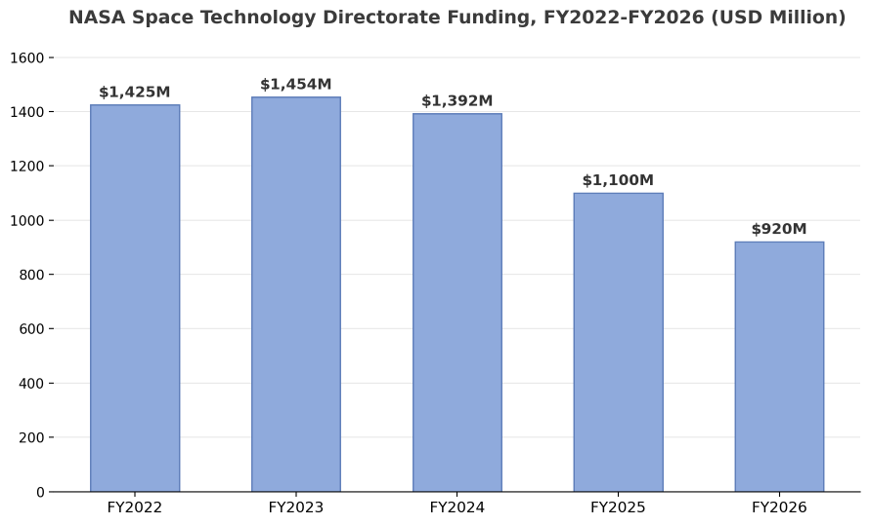
Not every budget line is expanding. NASA's dedicated Space Technology account, historically the primary source for early-stage robotics demonstrations such as in-space assembly and autonomous rendezvous, has fallen from $1.425 billion in FY2022 to $920.5 million in enacted FY2026 funding. That matters because Space Technology is where next-generation robotic capabilities are typically proven out before they graduate into flight programs. A market weighted toward flight-ready CLPS contracts leaves less runway for the research that produces tomorrow's breakthroughs.
Smaller Agencies, Outsized Efficiency
Japan's JAXA and India's ISRO operate on a fraction of NASA's or ESA's budgets, at roughly $2.3 billion and $1.6 billion per year, respectively. Yet, both have built reputations for capital-efficient robotics engineering. JAXA's Hayabusa2 sample-return mission and ISRO's Chandrayaan program show that funding scale is not the only determinant of program success, making both agencies attractive partners for cost-sensitive robotic payload collaborations.
The Risk: Budget Volatility Is Structural, Not Incidental
Robotics suppliers dependent on government contracts should treat budget volatility as a permanent planning variable. NASA's own FY2026 cycle makes the point: the initial request proposed cutting the agency to $18.8 billion and canceling the Space Launch System, Orion, and Lunar Gateway programs, before Congress enacted $24.4 billion, roughly $5.6 billion above the request. Suppliers need contract structures and cash reserves that can absorb such swings without stalling development.
Outlook
Government budgets will remain the primary source of demand for space robotics through 2035, even as commercial financing plays a larger role in fulfilling that demand. The clearest opportunities lie with suppliers who can deliver flight-proven hardware to meet NASA's accelerating CLPS cadence, ESA's enlarged exploration envelope, and China's steady, multi-year lunar robotics roadmap, while treating appropriations uncertainty as a cost of doing business rather than an exception to plan around.