
Ethnographic Research in the Age of Remote Work
The anthropologist with a notebook in someone's living room used to be the defining image of ethnographic research. That image is fading. As work, shopping, and social life have migrated onto screens, the discipline built on watching people in their "natural" environment has had to redefine what natural even means. The result is not the death of ethnography but its most significant methodological shift in decades, one driven as much by how researchers now work as by how their subjects live.
The Remote Work Backdrop Reshaping Fieldwork
Remote and hybrid arrangements are no longer a pandemic-era anomaly; they are the operating baseline for a large share of the workforce. The U.S. Bureau of Labor Statistics puts the national telework rate at roughly 22.6% as of March 2026, accounting for about 35.1 million Americans who work from home for at least part of their week. In the European Union, Eurostat's harmonised Labour Force Survey shows a smaller but still structurally elevated share, with 8.9% of employed people usually working from home in 2025, roughly double the pre-pandemic baseline. These are not temporary blips; both series have held within a narrow band for more than three years, signalling a durable behavioural shift rather than a passing adjustment.
Hybrid Has Become the Default, Not the Exception
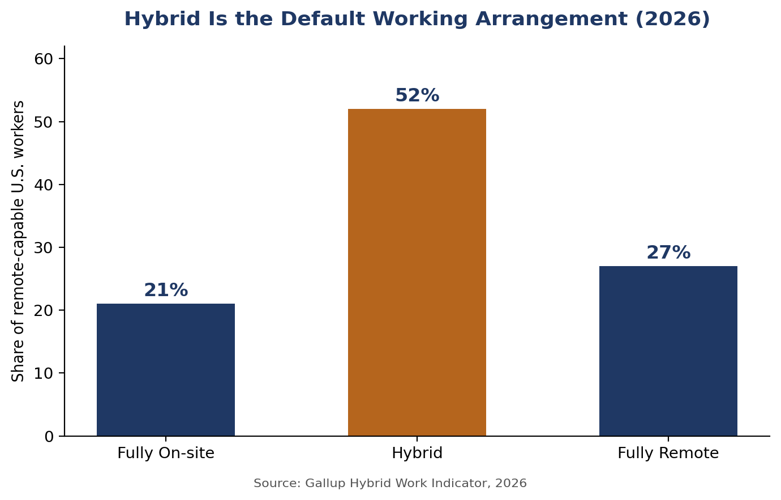
Even as high-profile return-to-office mandates dominate headlines, the underlying data tells a steadier story. Reporting compiled by Fortune, drawing on workplace analytics firm Leesman's ongoing survey of more than a hundred large employers, found the combined rate of hybrid and fully remote work running at 22.3% in January 2026 and 22% in February, barely moved from two years earlier. Leesman's managing director noted that fully in-office mandates remain a minority position among large employers despite the volume of coverage they attract. For ethnographers, this matters directly: the home is now where a meaningful share of work, purchase decisions, and daily routines actually happen, and fieldwork that ignores it is incomplete by design.
From Field Notes to Feeds: The Rise of Digital Ethnography
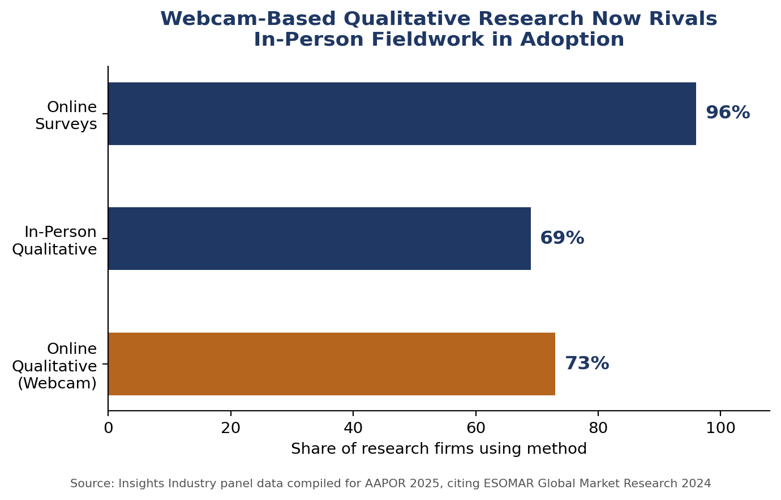
Market researchers have not simply moved focus groups onto video calls; they have built entire methodologies around asynchronous, participant-led documentation. Mobile diary studies, screen-recorded path-to-purchase walkthroughs, and webcam-based in-home interviews now sit alongside, and increasingly substitute for, the shop-along and the in-home visit. Industry-panel data compiled for the 2025 AAPOR conference, drawing on ESOMAR's Global Market Research report, shows 73% of surveyed research firms now use online qualitative methods involving webcams, compared with 69% still running in-person qualitative work. The gap has narrowed to the point where webcam-based observation is no longer the fallback option; for many briefs, it is the first one.
Why Researchers Are Rethinking the House Visit
Part of the shift is practical. A remote workforce of researchers, spread across time zones and no longer centralised in agency offices, cannot easily dispatch a two-person field team to a participant's kitchen. Part of it is methodological: participants document their own routines with smartphones in the moment, which reduces the recall bias built into a researcher-led interview conducted after the fact. And part of it is simply where the behaviour now lives. When work, browsing, and shopping increasingly happen from the same home office, video-based and mobile-first ethnography captures that context more naturally than a scheduled visit ever could.
The Business Case: Speed, Scale, and Spend
This is not a marginal trend within the insights industry; it is where growth is concentrated. Ipsos, one of the world's largest market research groups, reported in its 2025 annual results that its Ipsos.Digital platform grew 27% for the year, continuing to outpace the group's broader 0.6% organic growth. Separately, McKinsey Global Institute's analysis of 2,000 work tasks across nine countries found that more than 20% of the workforce could work remotely three to five days a week as effectively as they could from an office, a structural condition that keeps both the research subject and the research team distributed rather than co-located. Together, these figures point to the same conclusion: remote-capable methodologies are being funded because they scale, not merely because they are convenient.
What Gets Lost When the Researcher Isn't in the Room
None of this is a costless substitution. A participant filming their own kitchen frames the shot, consciously or not; a researcher physically present notices the unopened mail, the child interrupting, the smell of the room, details no lens is pointed at. Digital ethnography also skews toward participants who already have the devices, bandwidth, and comfort with self-documentation, quietly narrowing who gets studied even as geographic reach expands. The strongest practices now treat remote and in-person methods as complementary layers rather than replacements, using distributed digital fieldwork for scale and reach, and reserving in-person immersion for the smaller set of questions where context cannot be captured through a screen.
Building a Remote-Ready Ethnographic Practice
- Pair asynchronous video diaries with a smaller in-person cohort to validate what the camera misses.
- Recruit deliberately across device access and digital comfort levels to avoid skewing samples toward the already-connected.
- Train remote moderators to probe for context, not just narrative, since participants tend to narrate rather than simply show.
- Budget fieldwork around where participants and research teams now actually live and work, not around agency office locations.
The house call is not disappearing from ethnographic research, but it has stopped being the default. As remote and hybrid work settle into a stable, multi-year pattern rather than a passing disruption, the discipline's centre of gravity is moving toward distributed, self-documented, and video-mediated fieldwork, with in-person immersion reserved for where it earns its cost. The researchers who adapt fastest are the ones treating this shift as a redesign of the method, not a downgrade of it.