
The Semiconductor Inventory Cycle: Are We Headed for Another Glut?
The chip industry is in the steepest upswing in its history. Sales have more than doubled in a year, memory makers are posting record margins, and capacity investment is surging. Every previous boom of this kind has ended in excess inventory and falling prices. Epignosis Insights' review of the latest data suggests the next correction is not imminent, but the conditions for one are building, and they are concentrated in specific segments.
The Boom in Numbers
Sales have more than doubled
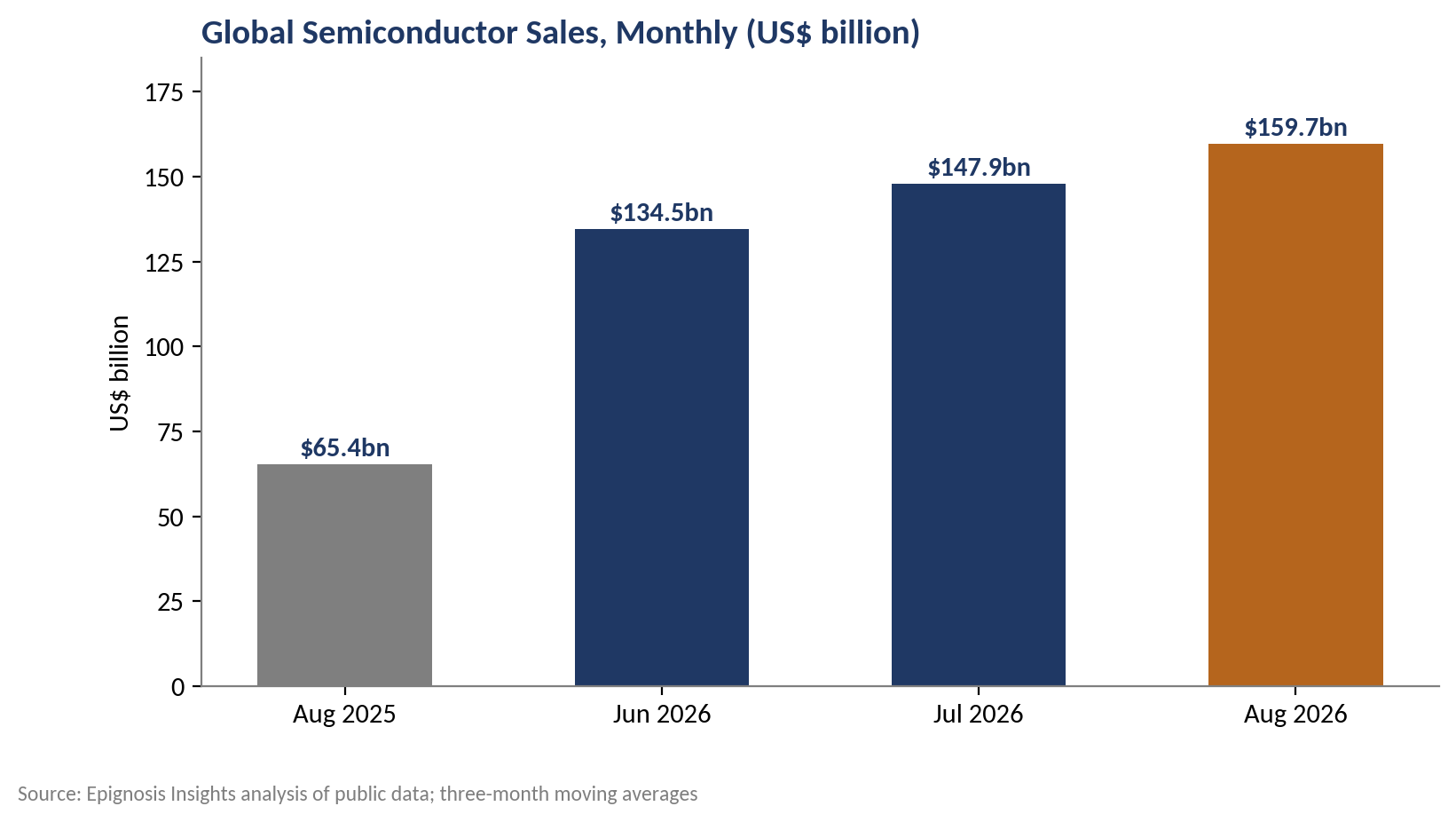
Global semiconductor sales reached $159.7 billion in August 2026, up 144.3% from $65.4 billion a year earlier, marking the 18th consecutive month of growth. Year-to-date sales have already passed $1 trillion, and full-year 2026 sales are projected to exceed $1.6 trillion (Semiconductor Industry Association).
Memory is doing the heavy lifting
The industry's own forecasters expect 2026 sales to grow 90% to $1.51 trillion, driven above all by memory, before slowing to 27% growth in 2027 (World Semiconductor Trade Statistics). Micron illustrates the scale: fiscal fourth-quarter 2026 revenue reached $54.23 billion, compared with $11.32 billion a year earlier, at an 86.8% gross margin, and the company has already agreed terms for most of its 2027 high-bandwidth memory supply (Micron). South Korea's chip exports hit a record $60.3 billion in September alone, up 262.8% year-on-year (Ministry of Trade, Industry and Resources, South Korea).
Early Warning Signs
Price increases are slowing
Conventional DRAM contract prices are still projected to rise 10% to 15% in the fourth quarter of 2026, but that is a slowdown from earlier quarters, and consumer-side demand is weakening. Mobile DRAM buyers are already holding 12 to 14 weeks of inventory, well above normal levels, as smartphone makers struggle to pass higher memory costs on to consumers (TrendForce).
A wave of new capacity is coming
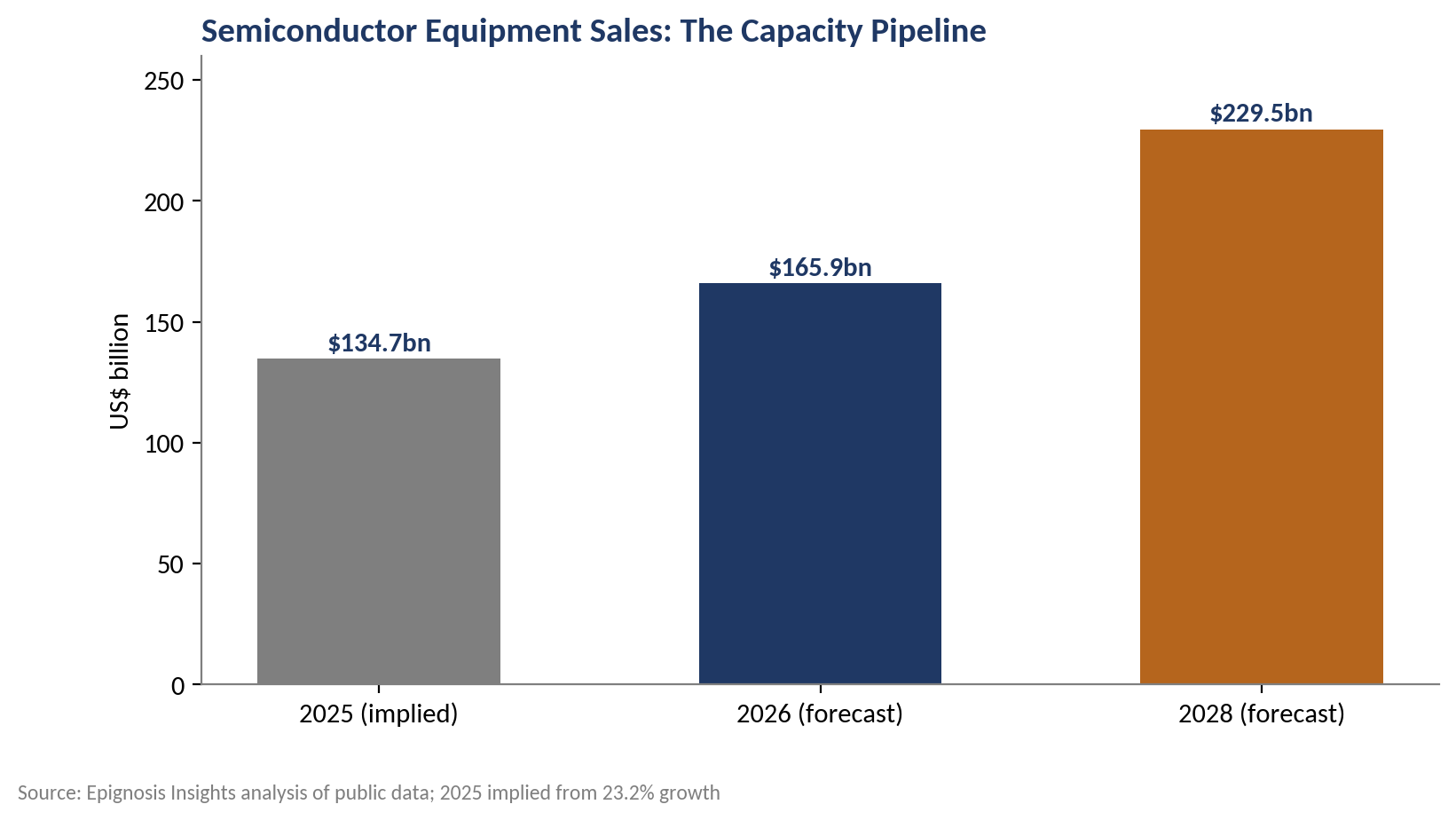
Semiconductor equipment sales are forecast to rise 23.2% to $165.9 billion in 2026 and reach $229.5 billion by 2028. DRAM equipment spending alone is projected to jump 39% to $38.8 billion this year (SEMI). Fabs ordered in 2026 typically reach volume output 18 to 24 months later, which places the bulk of this new supply in 2028.
Why This Cycle Is Different, For Now
Three factors are delaying the usual correction. First, long-term agreements with cloud providers have locked in large shares of 2027 memory supply, reducing the volume sold on spot markets. Second, high-bandwidth memory uses roughly three times the wafer area per bit of standard DRAM, absorbing capacity that would otherwise flood conventional markets. Third, AI demand is driven by capital spending from a small number of very large buyers rather than consumers, which makes it less sensitive to price.
However, the same concentration is a risk. If a few hyperscalers slow their AI spending, demand could fall faster than in a consumer-led cycle, and long-term agreements may be renegotiated. Epignosis Insights also notes that inventories are building in consumer channels, where demand is already soft.
What Past Cycles Teach
Previous memory upcycles followed a familiar pattern. Strong prices encouraged aggressive capacity additions, customers built safety stock to avoid shortages, and when end demand softened, that stock was released at the same moment new fabs came online. The downturns of 2019 and 2023 both arrived within a few quarters of peak pricing, and both were deepened by inventory held by customers rather than by chipmakers. The lesson for 2026 is that the most important inventory to watch is not in suppliers' warehouses, where it remains low, but in the hands of device makers and cloud providers, where it has been rising steadily as they build buffers against expected shortages in 2027.
Epignosis Insights' View: Where a Glut Could Appear
Epignosis Insights does not expect a broad semiconductor glut in 2026 or most of 2027. The higher-risk window is the second half of 2027 into 2028, when new memory capacity comes online just as AI infrastructure spending is likely to moderate. The most exposed segments are consumer DRAM and NAND, where inventories are already rising and pricing power is weakest. High-bandwidth memory, advanced logic and AI-linked packaging should remain tighter for longer.
Buyers and investors should watch four signals: customer inventory weeks in mobile and PC memory, the share of supply under long-term agreements, quarterly contract price changes turning flat or negative, and hyperscaler capital spending guidance. A simultaneous turn in two or more of these would be the clearest warning that the cycle is peaking.
For procurement teams, the practical response is to avoid over-buying consumer memory at today's peak prices, keep contract terms flexible beyond mid-2027, and prioritise supply security only for AI-critical parts such as high-bandwidth memory, where tightness is likely to persist longest.