
China's Domestic Chip Push: How Close Is It to Self-Sufficiency?
China now makes most of the chips it uses by count, but still buys most of its chip value from abroad. That gap, between volume and value, is the clearest way to measure how far Beijing's self-sufficiency drive has come and how far it still has to go. Epignosis Insights' review of the latest trade, production and company data shows a country that has largely won the mature-node race and is still years away from closing the gap at the leading edge.
Two Numbers, Two Very Different Stories
Volume: the 70% milestone
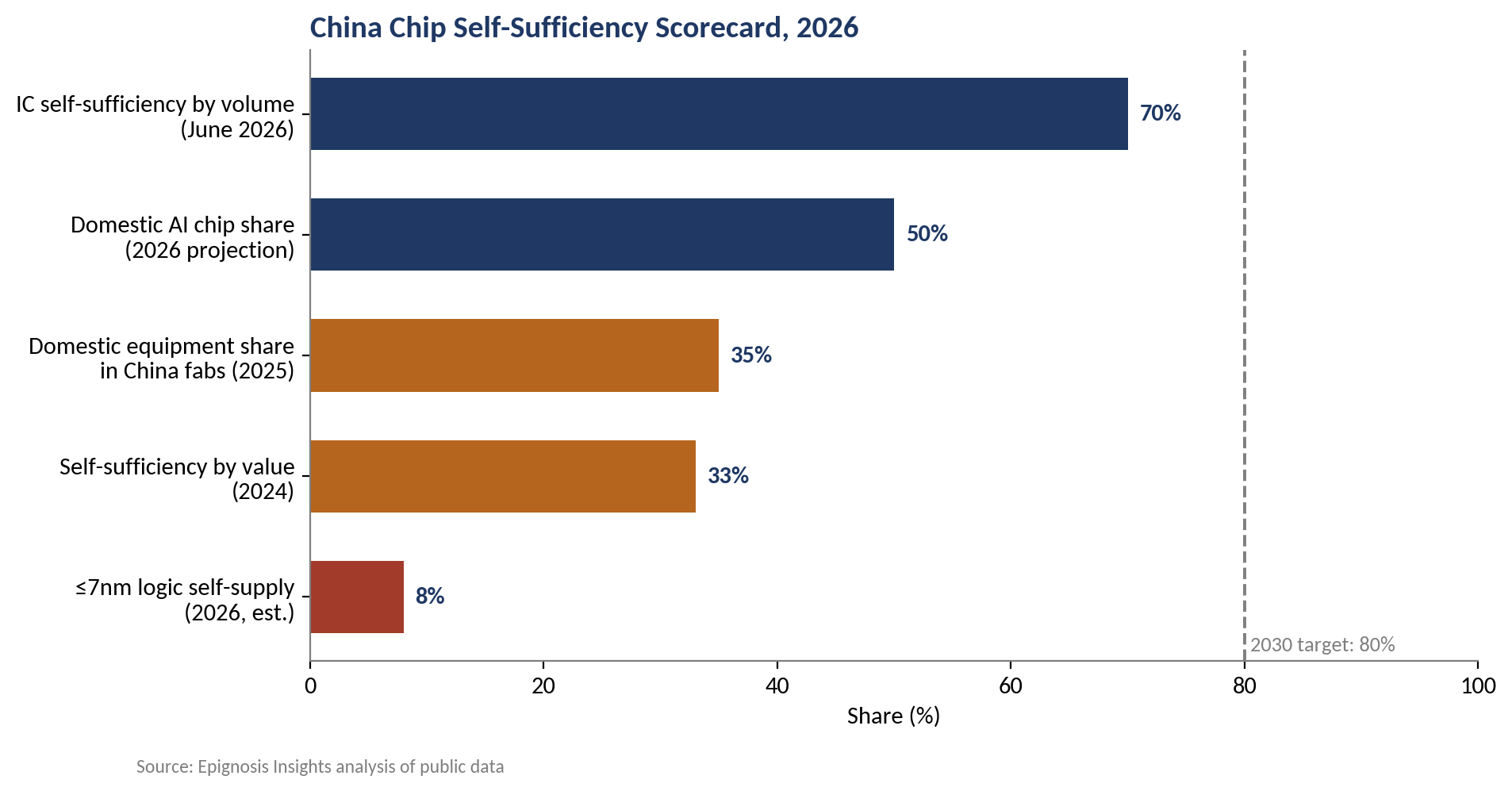
Measured by unit volume, China's integrated circuit self-sufficiency reached 70% in June 2026, up from 38% in 2010 (Goldman Sachs). Domestic output is surging: China produced 279.8 billion integrated circuits in the first half of 2026, 23.1% more than a year earlier, or more than 1.5 billion chips a day (National Bureau of Statistics of China).
Value: still a one-third player
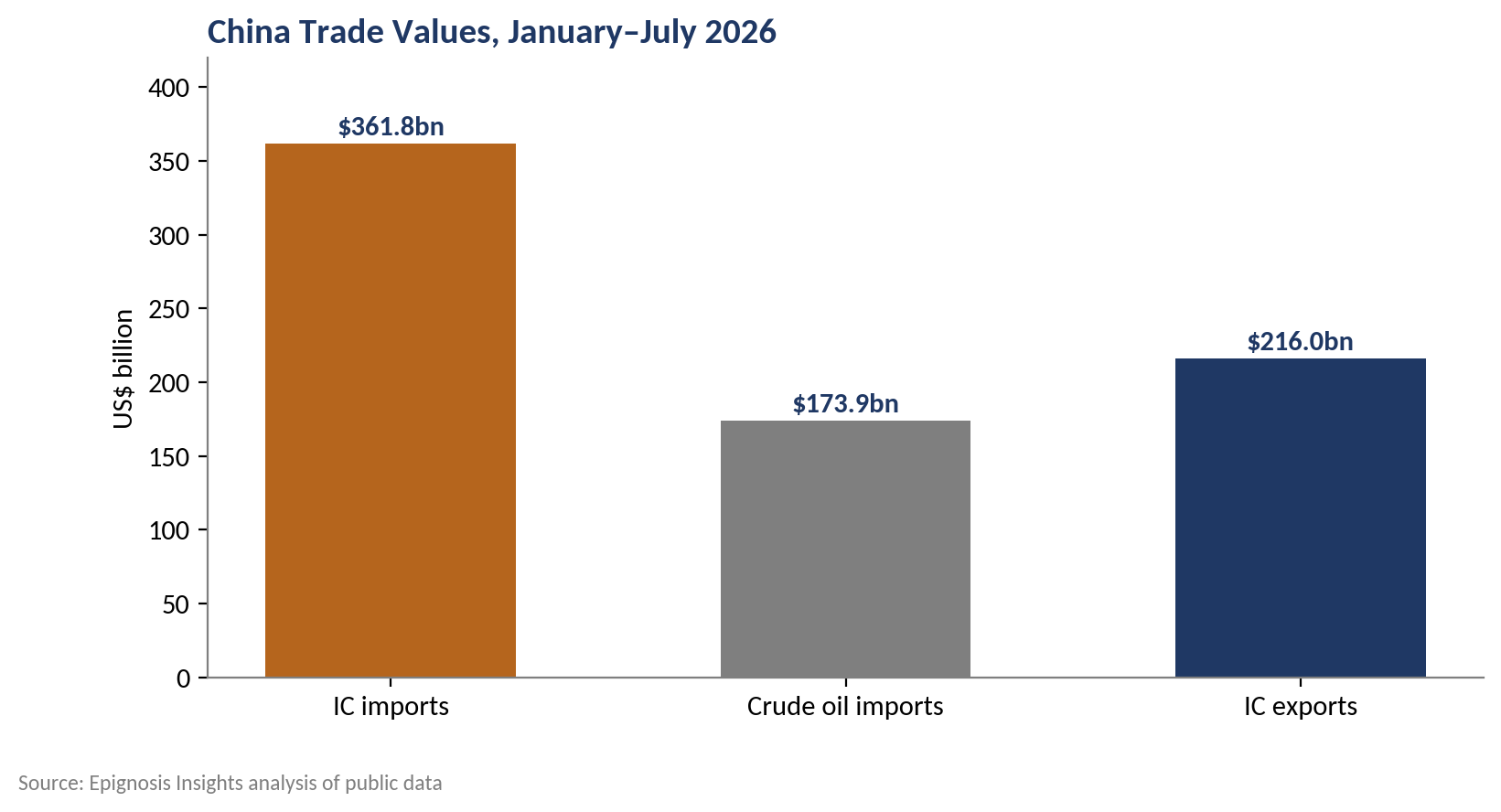
Measured by value, the picture changes sharply. Chinese companies supplied only about 33% of domestic chip demand in 2024, which is why industry leaders have set a new target of 80% by 2030 after the Made in China 2025 goal of 70% was missed (Nikkei). The trade data confirm the imbalance: China's chip import bill of $361.84 billion in January to July 2026 was 2.08 times what it spent on crude oil over the same period (General Administration of Customs of China).
Where China Is Winning
Mature-node foundry capacity
China's leading foundry is running near full capacity. SMIC reported record Q2 2026 revenue of $3.006 billion, up 36.1% year-on-year, with utilization at 93.7%, China accounting for 90.2% of sales and monthly capacity of 1.1 million 8-inch-equivalent wafers (SMIC). China's share of global mature-node production capacity is projected to rise from 25% in 2024 to 42% by 2028 (SEMI).
Memory and equipment
Domestic DRAM maker CXMT reported first-half 2026 revenue of RMB 150.31 billion, up 873.6%, as a tight global memory market lifted prices (CXMT). In equipment, the domestic share of tools used in Chinese fabs rose from 25% in 2024 to 35% in 2025, beating the 30% target (China Semiconductor Industry Association). NAURA, the largest local toolmaker, grew first-half revenue 24.9% to RMB 20.16 billion (NAURA).
Where the Gap Remains
Leading-edge logic
The hard limit is advanced lithography. China's domestic shortfall in 7nm-and-below chips is estimated at 92% today and, under a decade-long forecast, narrows only to 34% by 2035, with SMIC's advanced-node yields assumed to rise from 23% in 2026 to 75% over that period (Indoneo). Epignosis Insights estimates that China supplies under 10% of its own leading-edge logic needs today.
Global equipment presence
Local toolmakers have grown at home but remain small globally. Chinese vendors capture only about 6% of worldwide wafer fab equipment revenue, even though mainland China accounts for more than one-third of global equipment demand (Yole Group).
The Export Paradox
China's chip exports reached $256.75 billion in January to August 2026, up 103.9% year-on-year (Global Times). The headline is misleading: in the first half, export value rose 96% while unit volume rose only 6.9%, implying an average exported chip worth about $0.99 and pointing to memory price inflation and re-exports of packaged parts rather than advanced processors (Tom's Hardware).
Epignosis Insights' View: How Close Is China?
Epignosis Insights' assessment is that China is close to self-sufficient in mature-node logic, power, analog and packaging, where volume self-sufficiency already exceeds 70%. AI accelerators are the middle ground: the domestic share of China's AI chip market is projected to reach 50% in 2026 (TrendForce). At the leading edge, the country remains structurally dependent on imports and is unlikely to exceed 40% to 50% value self-sufficiency before 2030 without access to EUV lithography. The 80% target is achievable for volume; for value, the gap will persist through the decade.
For global suppliers, the implication is a split market. Mature-node foundries and equipment vendors face intensifying Chinese competition and price pressure, while suppliers of advanced logic, high-bandwidth memory and lithography tools retain pricing power in China for at least the next five years.
What to Watch Next
Three signposts will show whether the value gap starts to close. The first is SMIC's advanced-node yield: progress toward the 50% mark would make domestic 7nm and 5nm supply commercially viable at scale. The second is the domestic equipment share, which needs to keep rising toward the 50% level now required for new capacity if local toolmakers are to win business beyond mature-node lines. The third is the import bill: a sustained fall in chip imports relative to domestic output, rather than a rise in export values driven by memory prices, would be the clearest evidence that self-sufficiency is improving in value terms and not just in volume.