
Photonics and Optical Interconnects: Solving the AI Data Bottleneck

The limiting factor in AI clusters is increasingly not how fast a GPU computes, but how fast and how efficiently data moves between thousands of them. Copper links lose signal and burn power as speeds rise, which is why optical interconnects, from pluggable transceivers to co-packaged optics, have become one of the fastest-growing segments in semiconductors. Epignosis Insights' review of 2026 data shows demand outrunning supply, a power case that is now quantified, and a supply chain racing to scale.
Why Data Movement Is the New Bottleneck
Power is the binding constraint
Data centres consumed around 415 TWh of electricity in 2024, about 1.5% of global demand, and that figure is projected to more than double to roughly 945 TWh by 2030 (International Energy Agency). Every watt spent moving bits between chips is a watt not available for computation, so the efficiency of interconnects now shapes how large an AI cluster can grow within a fixed power budget.
Copper is running out of reach
At 200G per lane and above, electrical signals degrade within a metre or two, forcing more retimers, more heat and more failure points. Optics carries data over far longer distances with lower loss, which is why it is moving from rack-to-rack links into the rack itself, and eventually onto the chip package.
Demand Is Outrunning Supply
A market growing at AI speed
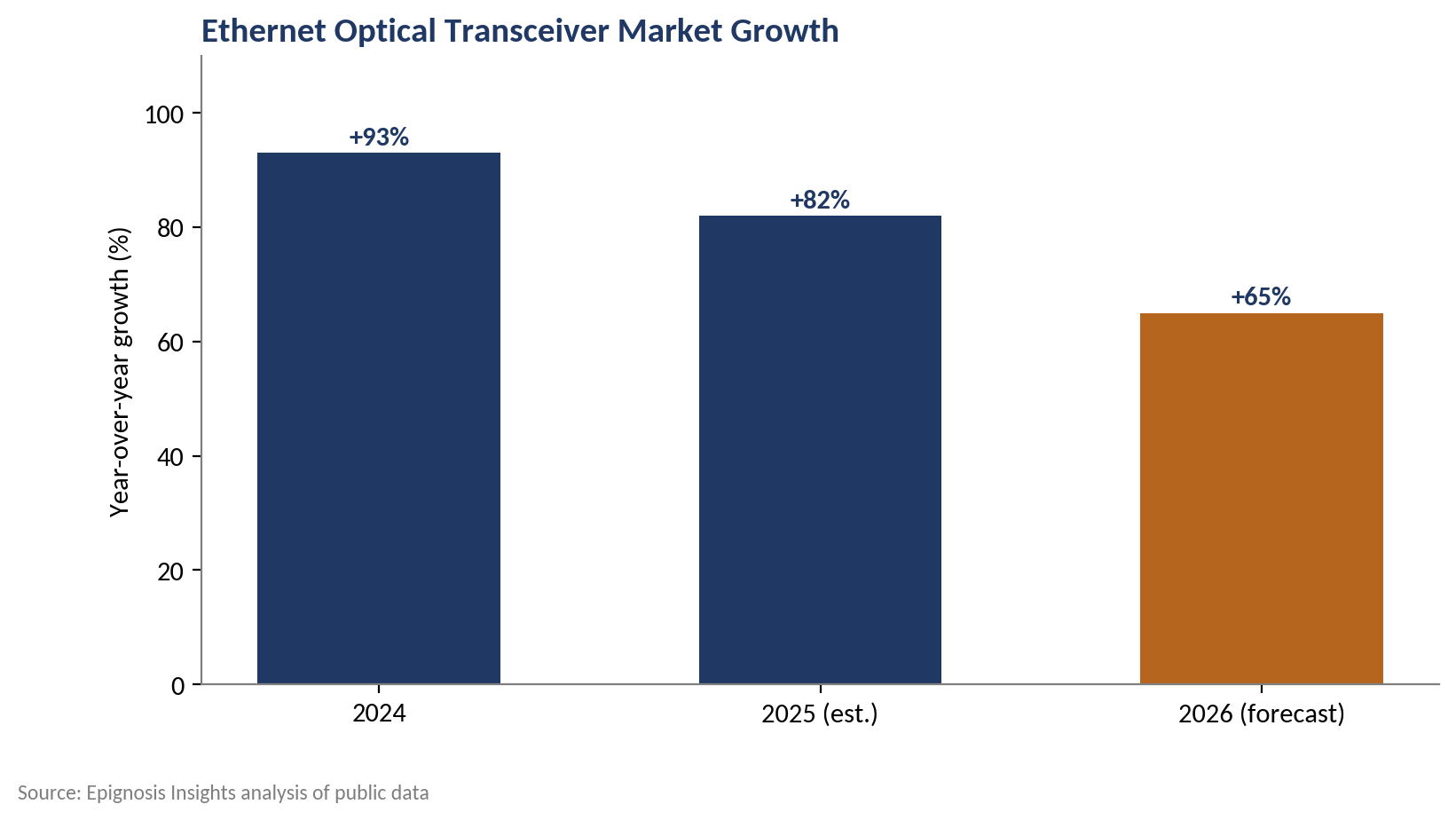
The Ethernet optical transceiver market grew 93% in 2024 and an estimated 82% in 2025, with a further 65% forecast for 2026. Demand currently exceeds supply by about 30%, with shortages expected to ease only by the end of 2026 (LightCounting). The same forecast points to a second wave from scale-across networks linking AI clusters in different buildings, boosting 800G ZR/ZR+ sales in 2026 and 1.6T ZR/ZR+ in 2028–2029.
Suppliers report record results
Lumentum reported fiscal fourth-quarter 2026 revenue of $1.01 billion, up from $480.7 million a year earlier, and guided the next quarter to $1.225–1.275 billion. Its optical circuit switch line has passed a $100 million quarterly run rate, and the company has received a multi-hundred-million-dollar co-packaged optics order for delivery in the first half of 2027 (Lumentum).
Co-Packaged Optics Moves into Production
The power case is now quantified
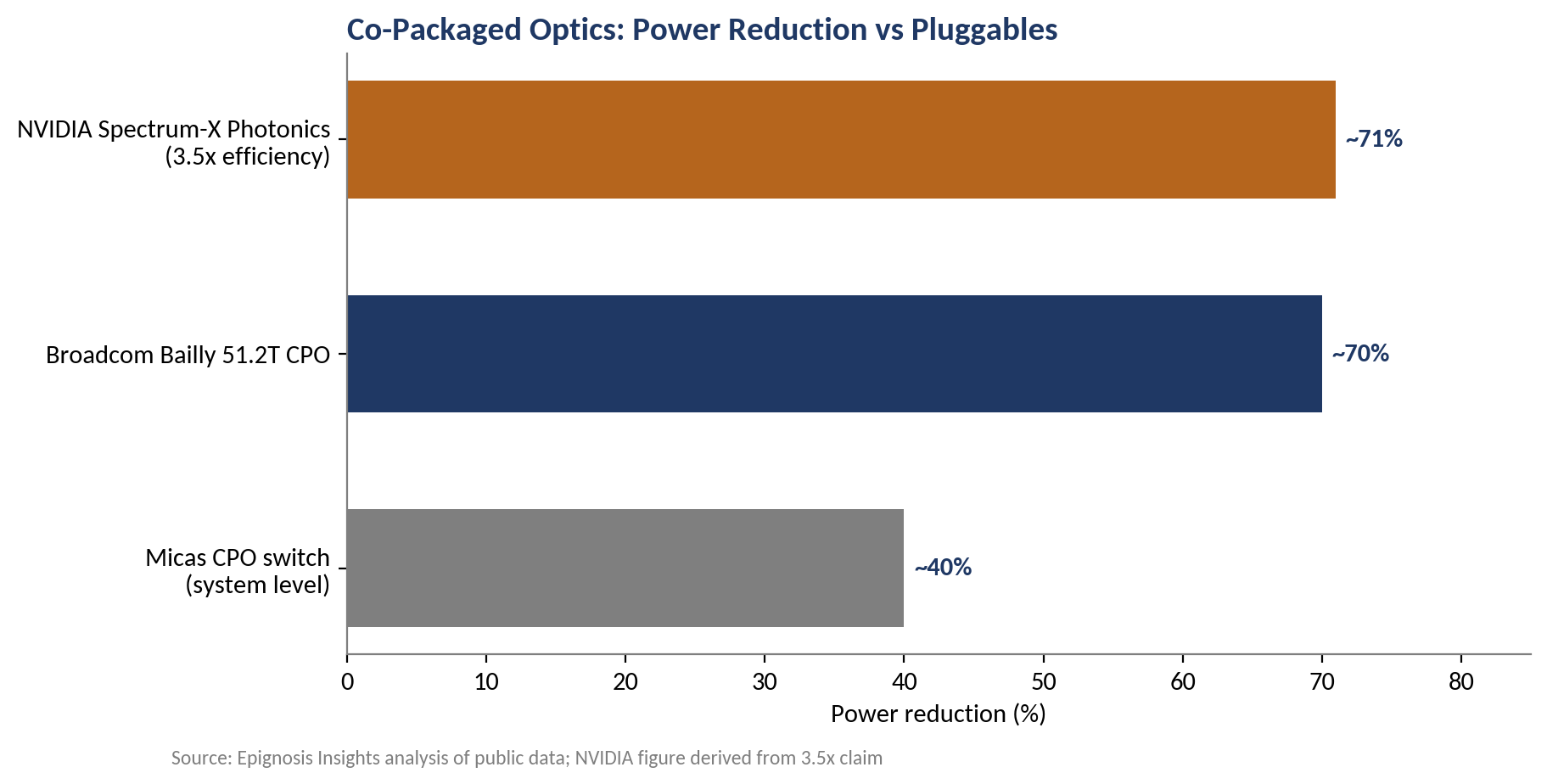
Co-packaged optics (CPO) places the optical engine next to the switch chip, cutting the electrical path from inches to millimetres. NVIDIA states that its Spectrum-X Photonics switches use 4x fewer lasers and deliver 3.5x better power efficiency, 63x greater signal integrity and 10x better resiliency than traditional pluggable designs (NVIDIA). An earlier Broadcom-based CPO switch from Micas Networks promised 40% power savings at system level versus standard pluggables (IEEE Spectrum).
Volume shipments have begun
NVIDIA has started shipping its Spectrum-X CPO switch, built on TSMC's COUPE packaging and offering up to 400 Tb/s of switching capacity, while Broadcom's 51.2T Bailly CPO switch has entered volume manufacturing and cuts power by up to 70% versus pluggable transceivers. Optical engine yield and advanced packaging capacity are now the key bottlenecks to further expansion (TrendForce).
Pluggables, Linear Optics or CPO?
Buyers now face three architectural choices. Conventional pluggable transceivers remain the easiest to deploy and replace, but their digital signal processors consume a large share of module power. Linear pluggable optics remove the processor to save power while keeping the familiar form factor, at the cost of tighter signal margins. Co-packaged optics delivers the largest savings but changes how networks are serviced, because the optics can no longer be swapped from the front panel. External laser sources, which keep the most failure-prone component replaceable, are emerging as the industry's answer to that serviceability concern. In Epignosis Insights' assessment, most operators will run all three side by side through 2028, matching the technology to the power, reach and maintenance profile of each tier of the network.
Epignosis Insights' View
Epignosis Insights expects pluggable transceivers to remain the volume workhorse through 2027, with 800G dominant and 1.6T ramping, while co-packaged optics captures the highest-radix switches first. The real constraint is shifting from optical demand to manufacturing: laser supply, optical engine yields and advanced packaging capacity will decide who captures the growth. Suppliers with in-house laser chips and packaging partnerships are best placed, while buyers should expect tight allocation and firm pricing for high-speed optics until late 2026.
The longer-term prize is the scale-up network inside the rack, where GPUs talk to each other directly. As optics moves into that space, the addressable market for photonics could expand several-fold beyond today's switch-to-switch links, making optical interconnect one of the defining technologies of the next phase of AI infrastructure.