
Scope 3 Emissions Research: Why It's the Hardest Part of Net Zero

The Emissions Companies Don't Actually Control
Net zero commitments are easy to announce and hard to verify, and Scope 3 is the reason why. Under the GHG Protocol's Corporate Value Chain Standard, Scope 3 covers every indirect emission a company is responsible for but does not own or operate from the mining of raw materials a supplier uses, to how a customer eventually disposes of the finished product. According to CDP, these value-chain emissions run on average 26 times larger than a company's combined Scope 1 and Scope 2 operational emissions, which means most corporate climate math is dominated by a category companies can only influence indirectly, through suppliers and customers rather than direct control.
Boston Consulting Group and CDP jointly estimate that disclosed upstream emissions from just the manufacturing, retail, and materials sectors carried a footprint 1.4 times the total CO2 emitted by the entire European Union in 2022, implying a carbon liability north of $335 billion sitting largely outside company balance sheets and, in most cases, outside investor scrutiny too.
Why Scope 3 Dominates the Footprint
The scale of Scope 3 is not uniform — it depends heavily on what a company actually makes or sells. The GHG Protocol and CDP's sector-relevance analysis shows value-chain emissions ranging from a low of roughly 16% of total footprint in cement, where fuel-intensive Scope 1 emissions from kilns dominate, up to nearly 100% in financial services, where a bank's own offices barely register against the emissions financed through its loan and investment portfolio (GHG Protocol Category 15).
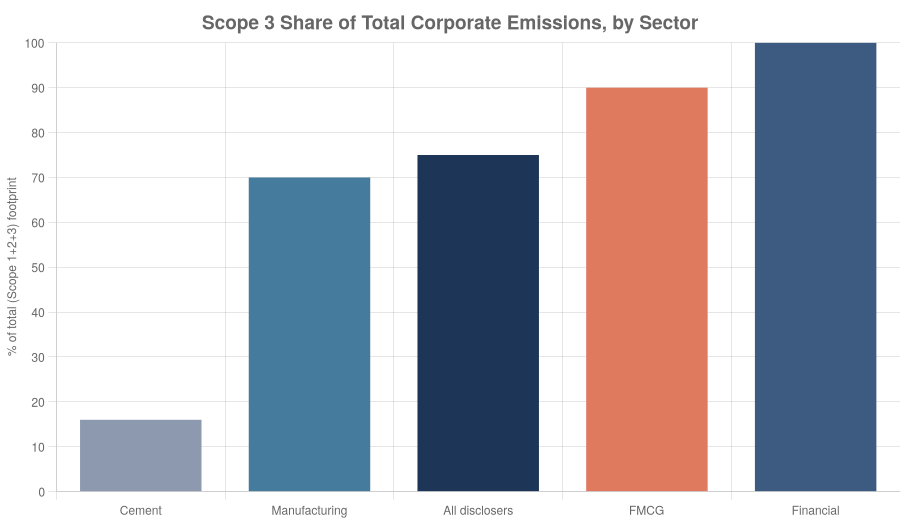
Fig. 1 — Scope 3 as a share of total corporate emissions, by sector.
Source: CDP Technical Note on Scope 3 Relevance by Sector; GHG Protocol.
Apple's own sustainability disclosures put a number on this at the product level: roughly 65% of emissions tied to its products come from supplier manufacturinga single Scope 3 category that dwarfs the company's operational footprint, which has been carbon-neutral since 2020. That is precisely why Apple now requires the same clean-energy commitments from suppliers that it applies internally, rather than treating decarbonization as an in-house exercise.
The Measurement Problem: Data That Lives Outside the Company
The core operational difficulty is that most of the data a company needs to calculate Scope 3 sits inside other companies' systems. CDP reports that fewer than half of companies that request environmental data from their suppliers actually receive usable figures back, forcing most reporting entities to fall back on spend-based estimation multiplying procurement dollars by industry-average emissions factors rather than supplier-specific activity data. The result shows up directly in disclosure quality: even among companies that voluntarily report to CDP, only 41% disclosed any Scope 3 data in 2024, and fewer than 35% disclosed quantified figures across all 15 GHG Protocol categories.
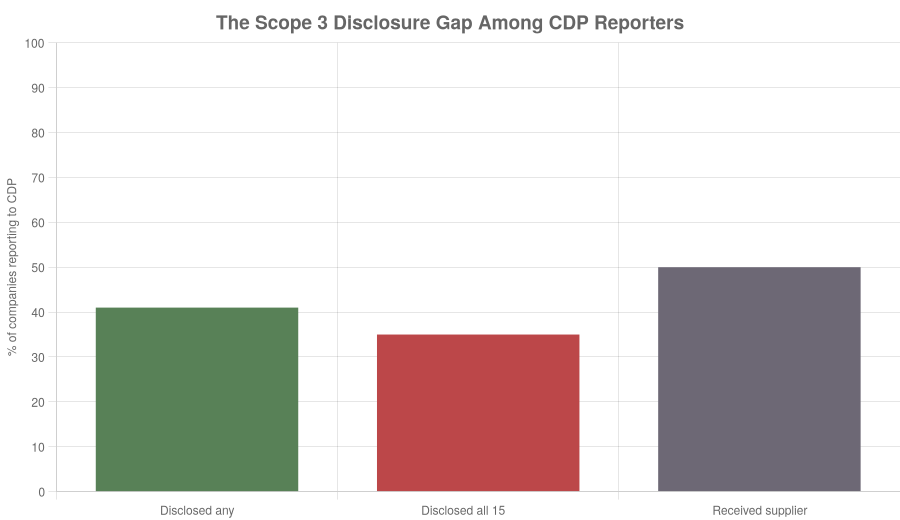
Fig. 2 — The Scope 3 disclosure gap among companies reporting to CDP.
Source: CDP; GHG Protocol / World Resources Institute.
Category 1, Purchased Goods and Services, is usually the single largest contributor within Scope 3, typically representing 40–70% of total value-chain emissions for manufacturers and retailers meaning the bulk of a company's footprint often traces back to a relatively small number of high-spend suppliers, which is also where targeted supplier-engagement programmes tend to deliver the fastest measurable results.
Regulation Is Forcing the Issue
Voluntary disclosure is rapidly becoming a mandatory one. The EU's Corporate Sustainability Reporting Directive, even after the Omnibus I package narrowed its scope, still applies to roughly 11,000 companies with more than 1,000 employees and €450 million in turnover, requiring Scope 3 disclosure under the European Sustainability Reporting Standards. California's SB 253 and the evolving SEC climate rule add overlapping obligations for companies doing business in the US, meaning a multinational can no longer treat Scope 3 reporting as optional in any major market it operates in.
Target-setting is accelerating in parallel. The Science Based Targets initiative reports that more than 10,200 companies now hold validated near-term targets and over 2,300 hold validated net-zero targets as of early 2026 — a 40% year-on-year rise in validated targets and a 61% jump in net-zero validations, together covering more than 40% of global market capitalisation. Under SBTi rules, a credible net-zero target must include Scope 3 wherever value-chain emissions exceed 40% of a company's total footprint, which in practice captures most manufacturers, retailers, and service businesses.
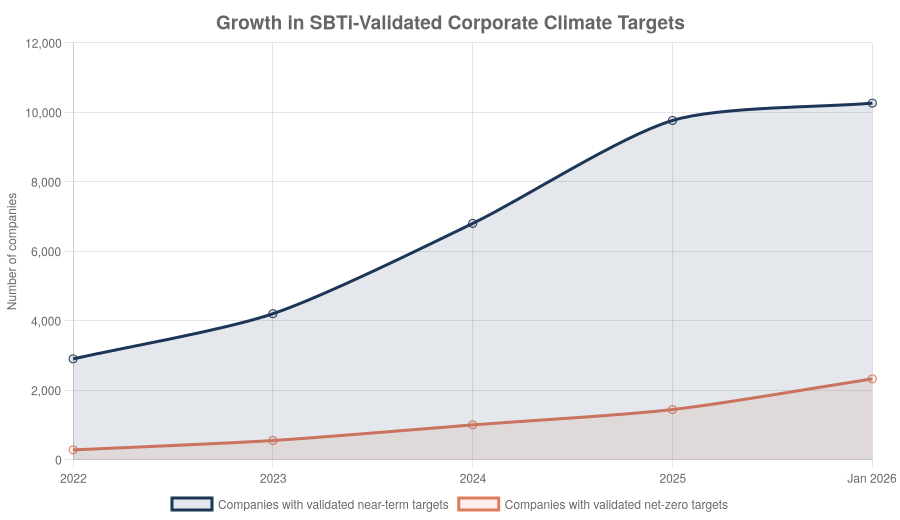
Fig. 3 — Growth in SBTi-validated near-term and net-zero corporate targets, 2022–2026.
Source: Science Based Targets initiative, SBTi Trend Tracker 2025/2026.
What Progress Actually Looks Like
Walmart's FY2026 ESG report illustrates the asymmetry companies are wrestling with: it cut absolute Scope 1 and 2 emissions by 7.5% year-over-year a 24.6% reduction against its FY2016 baseline while total Scope 3 emissions still rose about 3% to roughly 635 million metric tons CO2e, driven by business growth and product-mix changes even as Scope 3 emissions intensity improved 8.29% versus FY2022. Through its supplier-facing Project Gigaton platform, Walmart reports that participating suppliers have logged more than 1.37 billion metric tons of CO2e in cumulative avoided, reduced, or sequestered emissions since 2017 evidence that supplier engagement can move the needle even when absolute Scope 3 numbers keep climbing on the back of growth.
Independent analysis of the SBTi progress dataset finds that companies with validated targets are cutting emissions at a median annual rate of roughly 5.4%, which is broadly consistent with the trajectory required to stay on a 1.5°C-aligned pathway to 2030 provided the reduction rate holds as Scope 3 data quality, and not just target-setting, keeps improving.
The Takeaway
Scope 3 is hard not because the concept is complicated, but because it requires companies to measure and influence a system they do not own. The data gap between what CDP calls "relevant" categories and what companies can actually "calculate" is closing slowly, supplier engagement programmes are proving their worth at scale, and regulation is now removing the option to wait. For most companies, credible progress toward net zero increasingly depends less on their own factories and offices and more on how effectively they can move an entire value chain of suppliers and customers along with them.