
Circular Economy Business Models: A Market Opportunity Map

The Linear Model Is Running Out of Road
For four decades, industrial economies have run on a simple loop: extract, produce, discard. That loop is now visibly breaking. Material use has tripled globally since 1970, and resource productivity the economic output generated per unit of material consumed has effectively stalled over the past decade, meaning businesses are pulling in more raw material without generating proportionally more value from it.
The 2026 Circularity Gap Report, published by Circle Economy in partnership with Deloitte Netherlands, puts a number on that inefficiency: €25.4 trillion in avoidable economic value is lost every year to linear material use equivalent to almost 31% of global GDP. In practical terms, for every €3 of value the world economy creates, roughly €1 is being wasted through processing losses, premature asset deterioration, and end-of-life waste. Only 6.9% of materials entering the global economy today come from secondary, recycled sources — down from 7.2% the year before, meaning the gap is widening even as circular economy rhetoric grows louder.
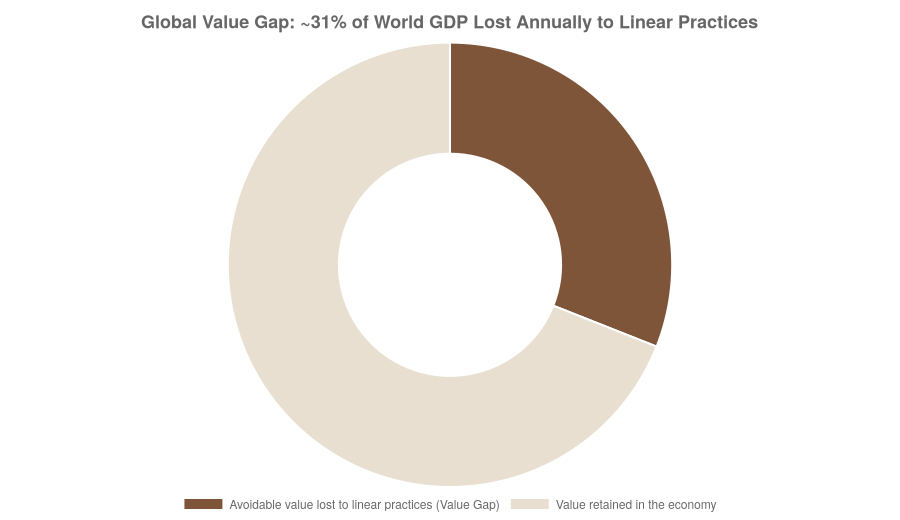
Fig. 1 — Share of global GDP lost annually to linear (non-circular) material use.
Source: Circularity Gap Report 2026, Circle Economy & Deloitte Netherlands.
Sizing the Opportunity
The flip side of the waste figure is an investment thesis. Accenture Strategy estimates that circular business models could unlock $4.5 trillion in additional global economic output by 2030 by closing the gap between resource supply and demand a figure the World Economic Forum has echoed in its own circular economy briefings. Sector-level breakdowns make the opportunity concrete rather than abstract: Accenture calculates that optimizing packaging circularity alone could let the fast-moving consumer goods industry capture up to $110 billion by 2030, while circular approaches to electricity generation and distribution could unlock as much as $250 billion over the same period.
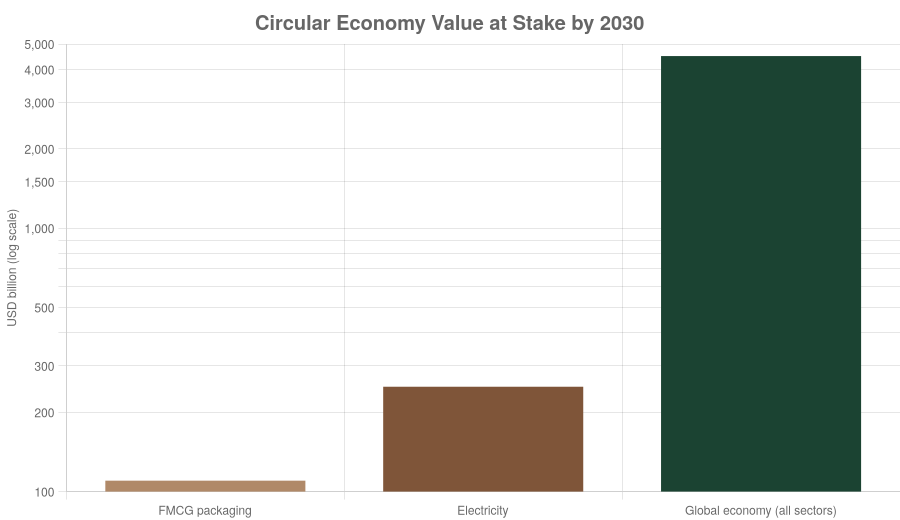
Fig. 2 — Estimated circular-economy value at stake by 2030, selected sectors (log scale).
Source: Accenture Strategy, "Waste to Wealth"; World Economic Forum.
Five Business Models Doing the Work
Rather than treating "circularity" as a single strategy, Accenture's widely cited framework breaks the opportunity into five distinct, combinable business models each with a different revenue logic:
- Circular supply chains: swapping virgin, scarce, or high-carbon inputs for renewable, recycled, or biodegradable materials that can cycle through multiple product lives.
- Resource recovery and upcycling: extracting economic value from waste streams instead of paying to dispose of them, turning a cost center into a materials-supply line.
- Product life extension: repair, refurbishment, and remanufacturing that keep assets economically useful well past a single use cycle Caterpillar's four-decade-old Reman programme is a frequently cited case.
- Sharing platforms: monetizing idle capacity in products or assets rather than manufacturing new units for infrequent use.
- Product-as-a-service: shifting customers from ownership to a lease or outcome-based subscription, which gives the seller a direct financial incentive to design for durability and take products back at end of life — Philips' lighting-as-a-service and ultrasound-subscription lines are examples in active commercial use.
These models are not mutually exclusive; the companies furthest along typically stack two or three of them across a single value chain rather than betting on one.
Policy Is Turning Circularity Into a Compliance Line Item
Regulation is now a primary demand driver rather than a background condition. The European Commission's remanufacturing market analysis projects that sector growing from €31 billion today to €100 billion by 2030, adding roughly 500,000 jobsa target embedded in the forthcoming EU Circular Economy Act, due for adoption in 2026, which aims to double the bloc's circular material-use rate from 12% to 24% by 2030. Employment data already shows the trend building: Eurostat and the European Environment Agency record EU circular economy employment rising from 3.35 million people in 2005 to 4.28 million in 2021, even as circular sectors still account for a modest 2.1% share of total EU employment.
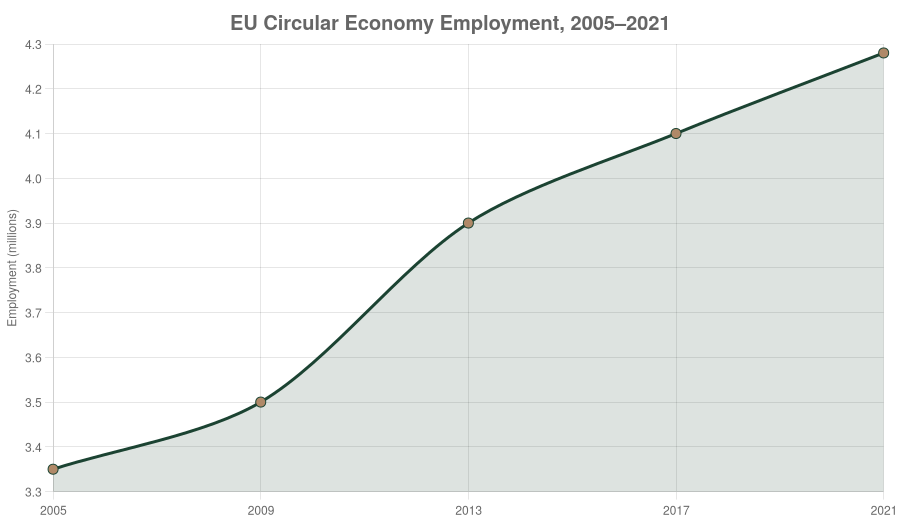
Fig. 3 — Growth in EU circular-economy employment, 2005–2021.
Source: Eurostat; European Environment Agency (EEA).
On the technology side, product traceability is becoming enforceable: Digital Product Passports begin rolling out in 2026, with battery passports made mandatory from February 2027, reshaping how materials are tracked from manufacture to end of life. Separately, AI-assisted sorting is materially lifting recovery rates — automated sorting systems are now reporting accuracy above 95%, versus roughly 60–80% for manual sorting lines, a gap wide enough to change the unit economics of recycling infrastructure.
Where the Early Revenue Is Landing
India's materials-recovery sector illustrates how policy and private capital are converging on the ground. The Ministry of Environment, Forest and Climate Change's Plastic Waste Management and E-Waste Management Rules now mandate 60% e-waste collection through 2025–26, rising to 80% by 2027–28, alongside a 70% lithium-ion battery recovery target for the same window. Diversified recyclers such as Gravita India report that remelting aluminium scrap back into usable alloy consumes roughly 5% of the energy required for primary aluminium production — a margin advantage that is drawing organized-sector capital into a space historically dominated by informal collection.
What Still Holds Back Scale
- Source segregation in tier-2 Indian cities remains below 30%, which caps polymer recovery yields at 40–50% versus 70–80% for properly segregated waste streams.
- Circular economy sectors still represent a small base EU private investment in the space rose only about 9% and value added roughly 5% between 2015 and 2019, showing steady but slow capital reallocation.
- Digital tracking infrastructure (passports, material flow data) is only now becoming mandatory, so much of today's "circular" activity is still unverifiable at the transaction level.
The Takeaway for Operators and Investors
The market opportunity map for circular business models is no longer theoretical: regulatory deadlines, employment data, and sector-specific value estimates now exist in parallel across Europe, India, and global consulting research. The companies capturing early value are not the ones simply recycling more they are the ones redesigning revenue models around product-as-a-service, resource recovery, and life extension, then using digital traceability to prove it. As mandatory reporting frameworks like Digital Product Passports come online through 2026 and 2027, the businesses that built circular capability early are positioned to convert a compliance requirement into a competitive moat.