
EUV Lithography Explained Why One Company Controls the Bottleneck
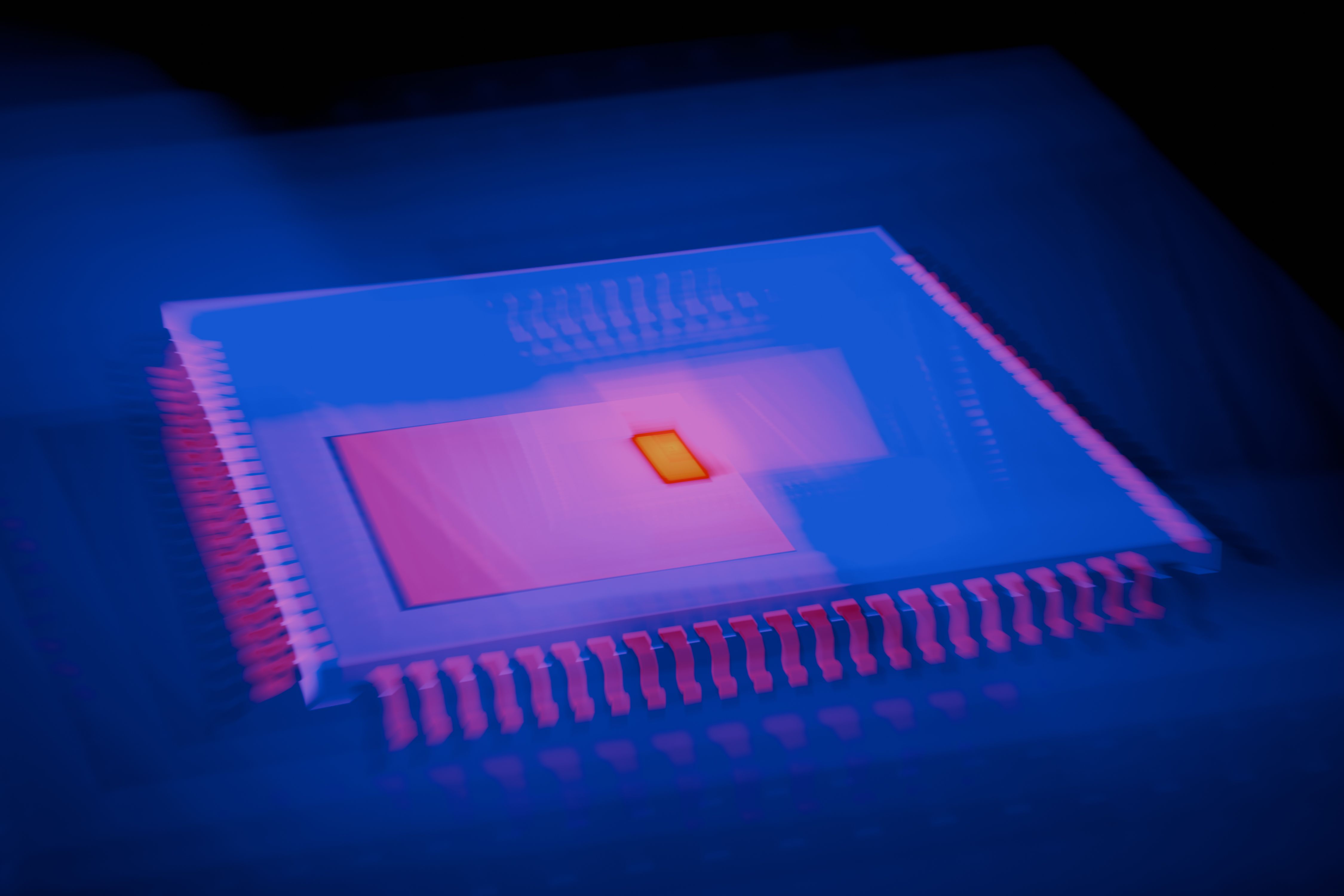
A €32.7 Billion Monopoly Hiding in Plain Sight
Every advanced chip made today the logic dies inside Nvidia GPUs, Apple silicon, and AMD processors passes through machines built by exactly one company. ASML's Form 6-K filing for fiscal year 2025 shows total net sales of €32.7 billion at a 52.8% gross margin, with net income of €9.6 billion and earnings per share of €24.73, up 28.4% year-on-year.
Within that total, EUV system sales grew 39% to €11.6 billion on 48 systems delivered, while DUV system sales actually fell 6% to €12.0 billion a sign that the industry's cutting edge, not its legacy volume, is where the real growth and the real chokepoint now sit. Tom's Hardware reporting confirms the scale of ASML's dominance directly: the company holds a 100% monopoly on EUV lithography and roughly 83% of the global lithography market overall, ending 2025 with a €38.8 billion order backlog.
Figure 1: ASML annual net sales, 2024–2026 (guided).
Why No One Else Can Build These Machines
Three Decades and Billions in R&D
McKinsey's research on semiconductor value creation notes that ASML invested more than $6 billion in R&D for EUV lithography over more than 17 years to perfect the technology roughly twice what peer companies spent on comparable efforts before it became commercially viable. EUV systems fire 13.5-nanometer light at silicon wafers to etch features far smaller than conventional deep ultraviolet (DUV) tools can achieve, and no competitor, including Japan's Nikon or Canon, has managed to bring a production-ready EUV alternative to market. Industry analysis describes ASML's advantage as resting on more than 16,000 active patents and an exclusive supplier ecosystem including Carl Zeiss SMT for optics and Cymer for laser light sources components so specialized that replicating them from scratch would take competitors years, not quarters.
A Customer Base That Cannot Walk Away
ASML's top two customers, TSMC and Samsung, account for 38% of total revenue, with TSMC alone representing roughly 24% of net sales per the 2025 Annual Report. That concentration cuts both ways: analysts at Bernstein estimate that under TSMC's expanded 2026 capital expenditure guidance of $52-56 billion, ASML's revenue from TSMC alone could grow approximately 27% year-on-year, well above the roughly 10% consensus had priced in. SK Hynix independently placed a record $7.9 billion order covering roughly 30 EUV systems over two years, while Samsung has committed to around 20 additional systems for its Pyeongtaek P5 fab worth approximately $4 billion demonstrating that even the world's most sophisticated chipmakers have no alternative supplier to turn to.
Export Controls Turn a Chokepoint Into a Weapon
The Dutch Government's Widening Role
Since 2019, the U.S. and Dutch governments have coordinated to keep ASML's EUV systems out of China, a restriction one policy analysis calls arguably the single most consequential decision in protecting Western AI dominance. The Netherlands has steadily extended that control: a 2023 measure required licenses for DUV immersion machines, a 2024 expansion covered servicing of already-installed Chinese equipment, and in 2025 the Dutch government formally retook licensing authority over ASML's mid-range 1970i and 1980i DUV tools from the United States, with Dutch Trade Minister Reinette Klever citing rising security risks. Despite the restrictions, ASML still shipped over $7 billion worth of chipmaking equipment to China in 2024, though the government does not break down these sales by machine type in public disclosures.
China's Shrinking Share of ASML's Business
The financial effect of tightening controls is now visible in ASML's own numbers. China represented 33% of ASML's total 2025 revenue, but company guidance points to that falling to roughly 20% in 2026, and the drop has already begun: China's share of quarterly system sales fell from 36% in the fourth quarter of 2025 to just 19% in the first quarter of 2026, according to ASML's Q1 2026 financial results. The decline is concentrated in lower-margin DUV shipments rather than EUV, which was never approved for export to China in the first place.
Figure 2: China's share of ASML system sales, 2025 vs. 2026 guidance.
Can Anyone Close the Gap?
China's own roadmap illustrates just how difficult replicating this chokepoint will be. A Congressional Research Service report on U.S. export controls notes that Chinese firms have repeatedly redesigned chips to fall just below the thresholds set by BIS's October 2022 controls rather than build around them entirely. Independent supply-chain mapping estimates China's semiconductor equipment self-sufficiency reached only about 14% in 2024, with the gap in EUV lithography estimated at 15-plus years behind ASML and photoresist chemistry roughly a decade behind Japanese suppliers. Even the most optimistic unconfirmed industry reports cited by JPMorgan analysts referencing The Information suggest a state-backed Chinese manufacturer has only begun producing domestically developed immersion DUV tools, with initial output of roughly five machines in 2026 and about 20 projected for 2027, nowhere close to the scale needed to threaten ASML's position.