
AI Chip Wars: Custom Silicon vs. General-Purpose GPUs
One Chip Architecture Still Rules the Data Center
NVIDIA closed fiscal 2026 with data center revenue of roughly $193.7 billion, up 68% year-over-year, and the company’s own investor disclosures put its share of AI accelerator revenue at somewhere between 75% and 90% depending on the quarter and the analyst measuring it. That dominance rests on a decade-old moat: the CUDA software stack, priority allocation of TSMC’s advanced packaging capacity, and a full-stack platform that spans chips, networking, and systems. NVIDIA itself has told investors it expects data center capital spending industry-wide to compound at roughly 40% annually between 2025 and 2030, reaching $3–$4 trillion in annual spend by the end of the decade a forecast that assumes GPUs remain the default building block even as the market around them fragments.
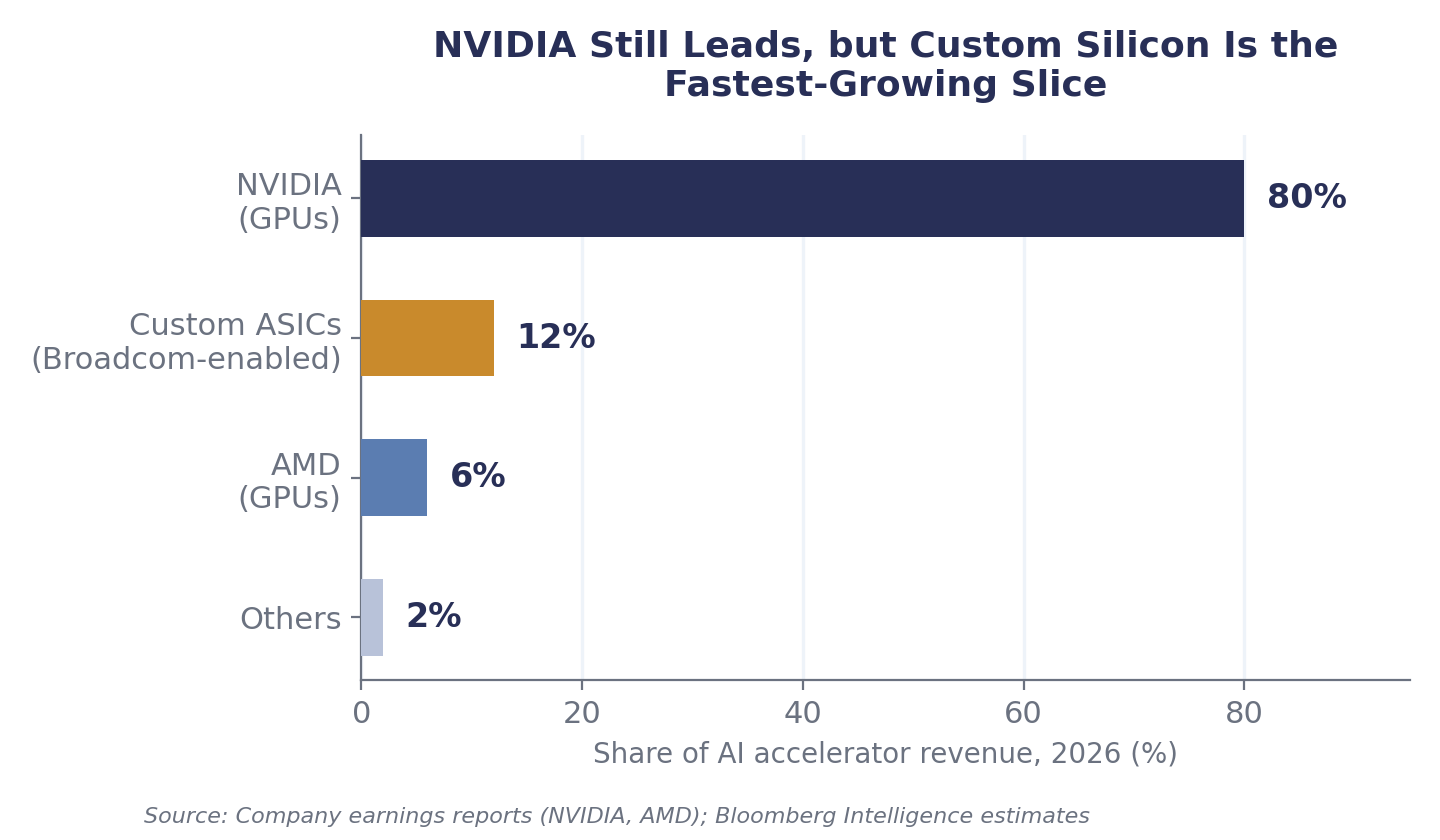
Figure 1: Estimated share of AI accelerator revenue by architecture, 2026.
The Custom Silicon Challenge Is No Longer Experimental
Every major hyperscaler now fields its own accelerator, and the revenue behind those programs has moved from rounding error to headline number. Broadcom, which designs custom AI accelerators (XPUs) for Google, Meta, and other undisclosed customers, guided fiscal 2026 AI semiconductor revenue to approximately $56 billion nearly triple its fiscal 2025 total of $19.9 billion and disclosed a $73 billion backlog for custom chips and networking gear over the next 18 months on its most recent earnings call. Google’s TPU program, the oldest of the hyperscaler efforts, is now on its seventh generation (Ironwood) and became visible to public markets when Broadcom confirmed Anthropic had placed a $10 billion order for TPU capacity. Amazon Web Services CEO Andy Jassy told the re:Invent 2025 audience that AWS had "already deployed more than 1 million Trainium processors," with a dedicated 2.2-gigawatt, $11 billion Trainium campus in Indiana supporting Anthropic workloads alone.
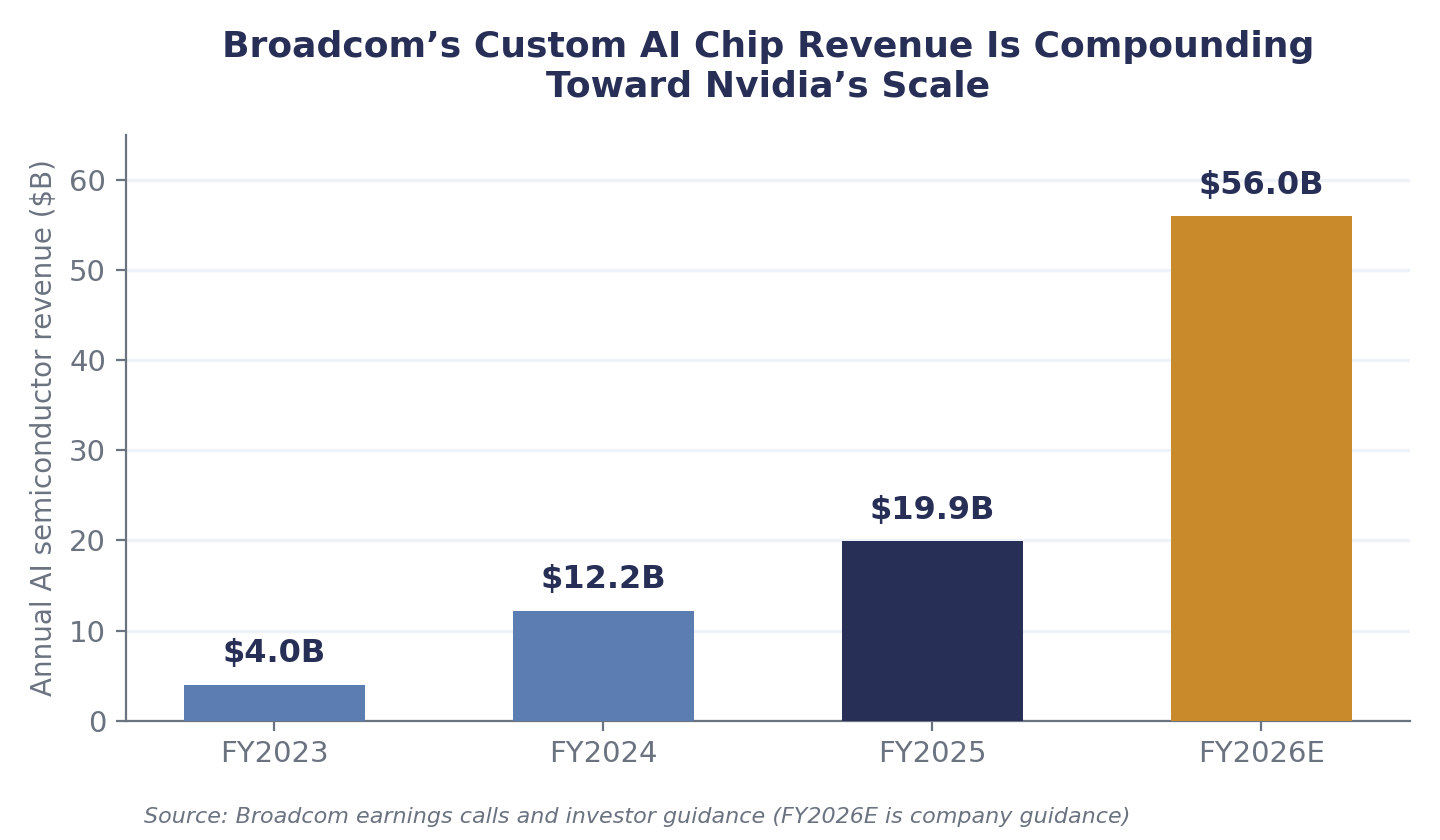
Figure 2: Broadcom custom AI semiconductor revenue, actual vs. company guidance.
Why Hyperscalers Are Building Their Own Silicon
The economics are the whole argument. Industry analysis citing HSBC estimates puts Google’s TPU cost at roughly $13,000 per chip versus $30,000–$40,000 for a single NVIDIA B200 and vertical integration lets a hyperscaler price inference workloads on its own silicon well below what it would cost to run the same workload on a purchased GPU, a margin advantage a merchant-silicon competitor cannot match without absorbing the loss itself. That said, the "every hyperscaler builds alone" narrative overstates the independence involved: Broadcom and Marvell together enable more than 80% of hyperscaler custom AI silicon programs, per Bloomberg Intelligence estimates, meaning the shift is less about hyperscalers becoming chip manufacturers and more about them becoming chip co-designers with two concentrated ASIC partners.
The Policy Layer Is Now Part of the Competitive Map
Export controls have become a second axis of competition alongside architecture. The U.S. Congressional Research Service documents that the Commerce Department’s Bureau of Industry and Security added 42 Chinese entities to its Entity List in March 2025 and another 23 in September 2025, while separately requiring NVIDIA to obtain a license for China sales of its H20 chip. That policy reversed in part in December 2025, when the administration authorized sales of NVIDIA’s more powerful H200 to China in exchange for a 25% revenue-linked fee a mechanism confirmed in NVIDIA’s own SEC filings, which disclose that "export controls targeting GPUs and semiconductors associated with AI have subjected and may in the future subject downstream users of our products to restrictions." No equivalent public framework yet governs exports of custom ASICs, leaving hyperscaler chip programs comparatively insulated from the same swings.
The Market Is Growing Fast Enough for Both Models to Win
Total addressable demand may be large enough that the GPU-versus-ASIC contest is additive rather than zero-sum, at least for now. The Semiconductor Industry Association reported record global chip sales of $795.6 billion in 2025 and projects the market will reach roughly $1.5 trillion by 2026 on AI-driven demand, while Gartner separately forecasts that AI semiconductors will represent approximately 30% of total semiconductor revenue in 2026, with hyperscaler AI infrastructure spending rising more than 50% over the same period. Deloitte’s 2026 semiconductor outlook frames the divergence starkly: generative AI chips could account for roughly half of industry revenue in 2026 while representing less than 0.2% of total chip unit volume a reminder that this is a battle over a small number of extremely expensive parts, not mainstream chip demand.
The Data Table at a Glance
| Metric | Figure | Source |
| NVIDIA data center revenue, FY2026 | $193.7B | NVIDIA investor materials / 10-K |
| NVIDIA share of AI accelerator revenue | ~80% | Company filings; Bloomberg Intelligence |
| Broadcom custom AI chip revenue, FY2026 (guided) | $56B | Broadcom Q4 FY2025 earnings call |
| AWS Trainium processors deployed | 1M+ | AWS re:Invent 2025 (Andy Jassy) |
| Global semiconductor sales, 2025 | $795.6B | Semiconductor Industry Association |
| AI share of total semiconductor revenue, 2026 | ~30% | Gartner |