Key Findings
- Market Growth: Singapore's semiconductor market is projected to grow from USD 219 billion in 2025 to USD 1.87 trillion by 2034, registering a 27.5% CAGR during 2027–2034.
- Strong Manufacturing Base: Singapore is a major global semiconductor manufacturing hub, with capabilities spanning IC design, wafer fabrication, packaging, testing, equipment, and materials.
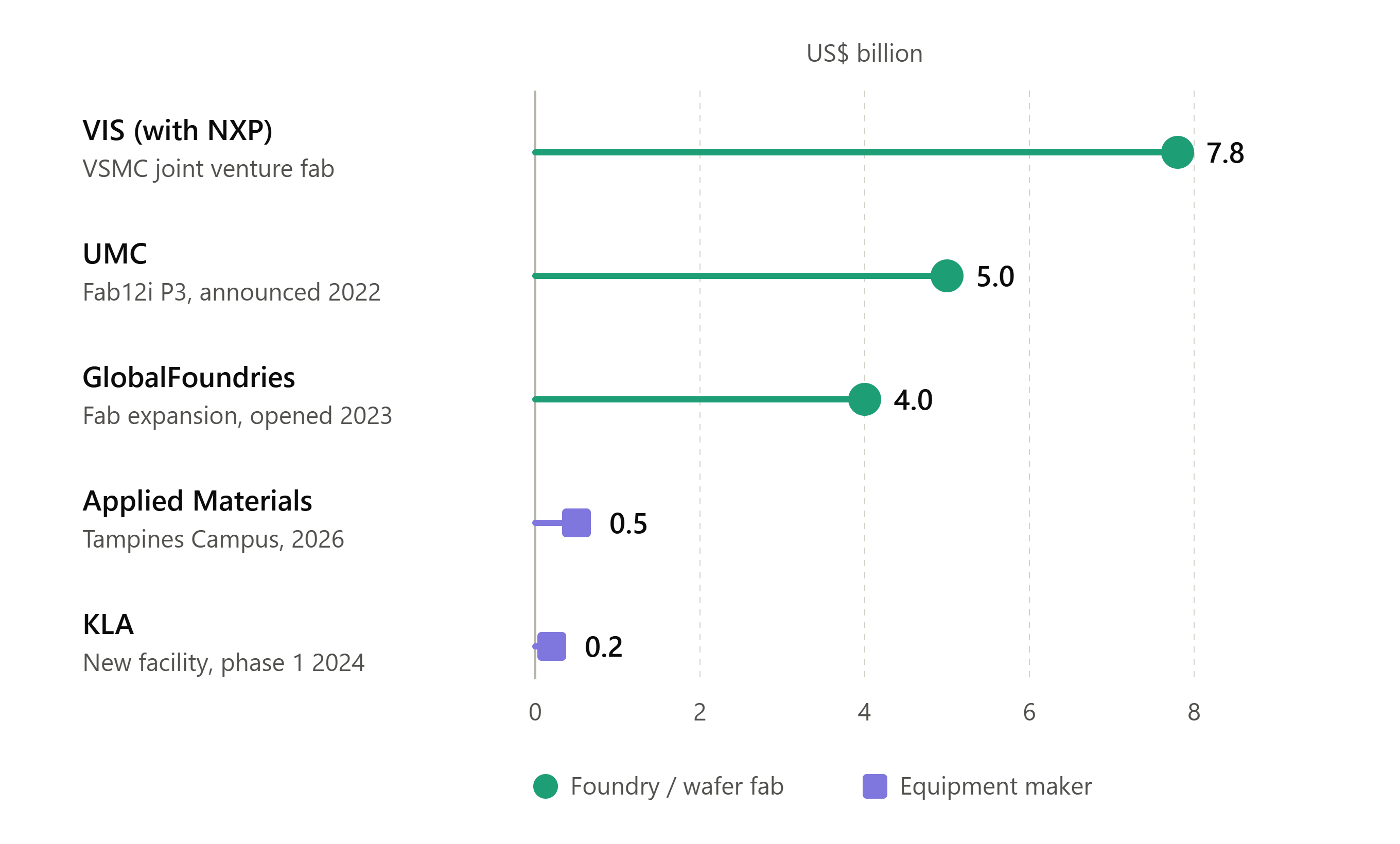
- Capacity Expansion: Major investments by UMC, VSMC, GlobalFoundries, Micron, and Soitec are expanding local manufacturing and specialty-wafer capacity.
- Advanced Packaging: Growing demand for HBM, chiplets, 2.5D/3D packaging, and heterogeneous integration is creating new opportunities in the country.
- AI & Data Centers: Increasing demand for AI processors, memory, servers, and data-center infrastructure is becoming a major growth driver.
- Automotive Demand: Automotive electronics, EVs, MCUs, sensors, and power semiconductors are strengthening semiconductor demand.
- Equipment Strength: Singapore accounts for approximately 20% of global semiconductor equipment production, highlighting its importance in the equipment ecosystem.
- Export-Oriented Industry: Semiconductor manufacturing is highly export-driven, with international markets forming a major source of industry demand.
Singapore Semiconductor Industry Market Outlook
Singapore semiconductor industry recorded a market value of USD 219 billion in 2025 and is estimated to reach a value of 1,870 billion by 2034 with a CAGR of 27.5% during the forecast period.
Singapore Semiconductor Industry Market Dynamics
Expansion of Advanced Packaging
The expansion of advanced packaging is emerging as a significant growth driver for the Singapore semiconductor industry, as the rapid adoption of artificial intelligence (AI), high-performance computing and data-center infrastructure increases demand for high-bandwidth memory (HBM) and other high-performance semiconductor solutions.
Advanced packaging technologies such as HBM, chiplets, 2.5D/3D integration and heterogeneous integration enable greater computing performance, memory bandwidth and energy efficiency by integrating multiple semiconductor components into compact packages. Singapore is strengthening its position in this segment through major investments and ecosystem development. In January 2025, Micron broke ground on Singapore's first HBM advanced packaging facility, with an investment of approximately US$7 billion (S$9.5 billion) through the end of the decade and beyond.
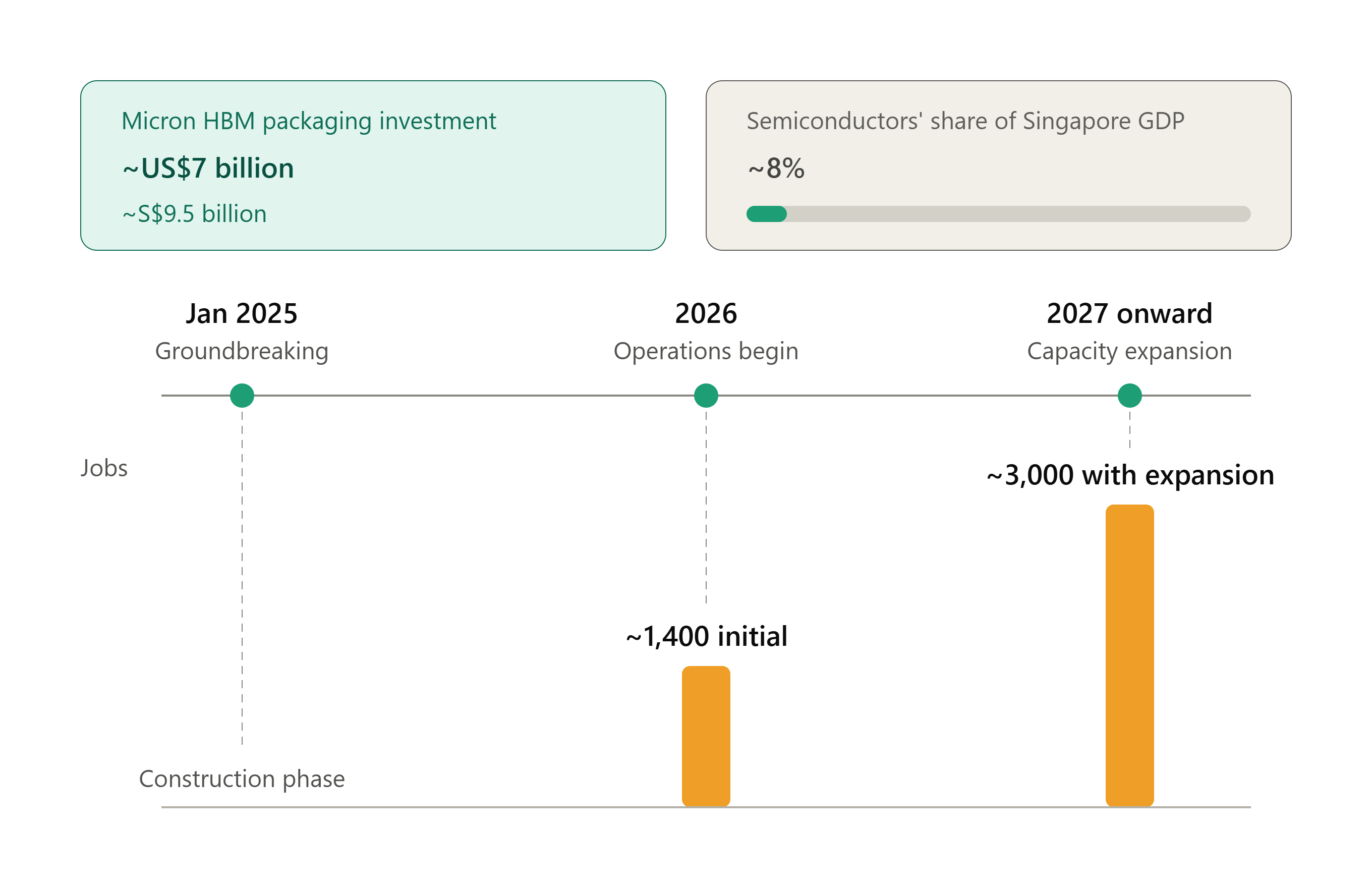
The facility is scheduled to begin operations in 2026, while meaningful expansion of Micron's overall advanced-packaging capacity is expected from 2027 to support AI-driven demand. The project is expected to initially create approximately 1,400 jobs, with expansion plans potentially increasing employment to around 3,000 positions. Singapore's broader semiconductor ecosystem also benefits from complementary investments in advanced packaging, equipment and R&D, strengthening linkages between memory manufacturing, packaging, assembly and testing.
The country's Ministry of Trade and Industry notes that the semiconductor industry contributes approximately 8% of Singapore's GDP, while advanced packaging represents an opportunity to expand into new semiconductor technology segments driven by AI. Consequently, increasing investment in HBM and advanced packaging is expected to support capacity expansion, technology development, skilled employment and supplier opportunities across the Singapore semiconductor industry, while strengthening its role in the global AI semiconductor supply chain.
High capital and operating costs
High capital and operating costs represent a key challenge for the Singapore semiconductor industry, particularly as manufacturers move toward advanced wafer fabrication, high-bandwidth memory (HBM), advanced packaging and other technology-intensive production. Semiconductor fabs require substantial upfront expenditure on cleanrooms, specialized manufacturing equipment, automation, utilities and process-control systems, while ongoing operations require significant electricity, water, cooling and highly skilled engineering resources.
The scale of recent investments illustrates the capital intensity of the sector: Micron's new advanced wafer fabrication facility in Singapore represents approximately US$24 billion (S$31 billion) of planned investment over 10 years, while its HBM advanced-packaging facility involves approximately US$7 billion (S$9.5 billion).
The Singapore semiconductor industry also faces higher resource requirements as fabs become increasingly sophisticated and energy-intensive. EDB notes that high-end chip manufacturing is both capital-intensive and land- and energy-intensive, requiring Singapore to carefully manage industrial land and utilities capacity.
Operating costs can also increase as manufacturers compete for specialized semiconductor engineers, equipment specialists and process-development talent. At the same time, companies must continually reinvest in newer equipment and production technologies to maintain competitiveness as semiconductor architectures evolve.
Utility efficiency therefore becomes an important cost-management consideration. For example, Singapore's largest industrial district cooling system, launched at STMicroelectronics' facility in 2025, is expected to reduce cooling-related electricity costs by 20% annually and repurpose more than 500,000 cubic meters of water consumption per year. These investments demonstrate how companies are adopting efficiency measures to manage resource costs. Consequently, while Singapore's infrastructure and established semiconductor ecosystem continue to attract major investments, the high capital intensity, utility requirements, land constraints and skilled-labor costs remain important considerations for companies evaluating expansion within the Singapore semiconductor industry.
Singapore Semiconductor Industry Capacity expansion analysis
Capacity expansion is becoming a major structural development in the Singapore semiconductor industry, with new wafer-fabrication facilities and expanded production capabilities increasing the country's ability to serve demand from automotive, AI, 5G, IoT and other high-growth electronics applications.
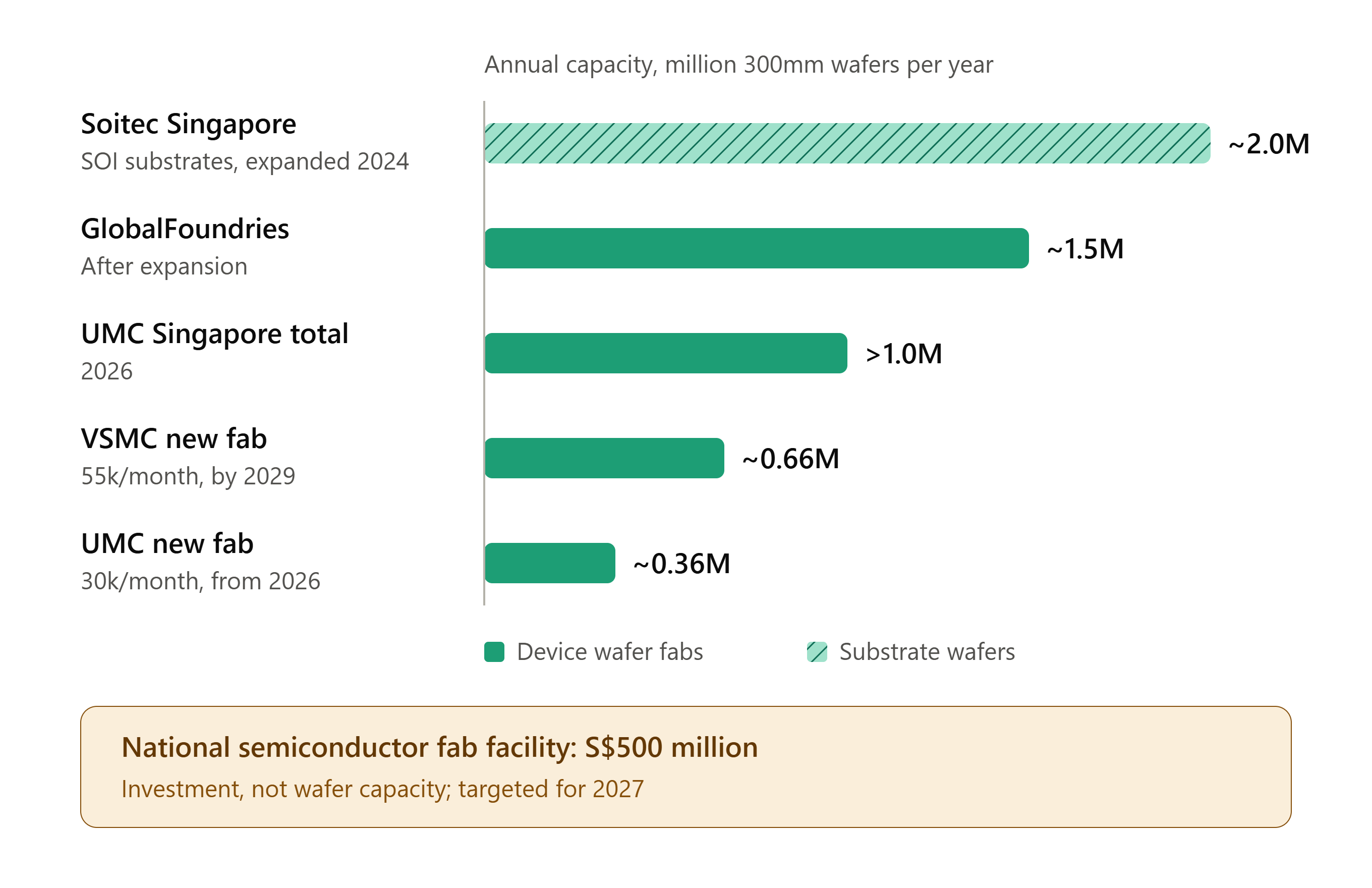
A key development is the expansion of United Microelectronics Corporation (UMC), whose new facility at Pasir Ris is designed around 22nm and 28nm specialty processes. The first phase is scheduled to enter volume production in 2026 and will operate at up to 30,000 wafers per month, taking UMC's total Singapore capacity to more than 1 million wafers annually.
Capacity is also being added through VisionPower Semiconductor Manufacturing Company (VSMC), the joint venture between Vanguard International Semiconductor and NXP Semiconductors. Its new 300mm facility is scheduled for initial production in 2027 and is expected to reach 55,000 wafers per month by 2029, expanding Singapore's specialty semiconductor manufacturing base.
At the upstream level, Soitec's expansion has increased its Singapore production capability to approximately 2 million 300mm SOI wafers annually, strengthening the local supply of specialty substrates used in smartphones, vehicles and smart devices. GlobalFoundries has also expanded its Singapore footprint, with its expansion facility adding approximately 450,000 300mm wafers annually and taking its Singapore capacity to around 1.5 million wafers per year. Beyond commercial fabs, Singapore is developing additional domestic semiconductor R&D and translation capacity through a S$500 million national fabrication facility, targeted for availability by 2027. Together, these projects indicate that capacity expansion in the Singapore semiconductor industry is occurring across foundry manufacturing, specialty wafers and R&D infrastructure rather than being concentrated in a single semiconductor segment. This expansion also broadens Singapore's ability to support regional supply-chain diversification and growing demand for specialized semiconductor technologies.
Singapore Semiconductor Industry Value-added contribution to Singapore's economy
The Singapore semiconductor industry has become a major contributor to the country's economic value creation, reflecting Singapore's successful transition toward high-value manufacturing and technology-intensive activities. According to Singapore's Department of Statistics, the semiconductor industry generated S$60.3 billion in value added in 2022, making it the dominant contributor within the electronics cluster. In the same year, semiconductors accounted for 9.0 percentage points of Singapore's total economic value added, while the broader electronics cluster contributed 9.9%.
The structural importance of semiconductors has increased substantially over time: the segment's share of nominal value added within Singapore's electronics cluster increased from 45.6% in 2000 to 80.2% in 2025, while semiconductor value added grew at a 7.3% CAGR between 2000 and 2025. This indicates that semiconductor activities have increasingly shifted toward higher-value manufacturing, technology development and specialized production. The export orientation of the Singapore semiconductor industry is also significant. In 2022, approximately 98% of semiconductor industry value added was derived from exports, demonstrating the industry's strong integration with international semiconductor supply chains and its role as a global production and export hub.
The industry's economic importance is further reflected in employment: EDB currently reports that more than 35,000 people are employed directly by Singapore's semiconductor industry. In addition, the industry represents approximately 8% of Singapore's economy according to MTI's 2025 industry commentary. More recently, Singapore's electronics cluster benefited from strong demand for AI-related semiconductors, servers and server-related products, supporting manufacturing growth in 2025. Therefore, the Singapore semiconductor industry contributes to the economy not only through direct value added, but also through exports, skilled employment, manufacturing capabilities and linkages with precision engineering, equipment and other supporting industries.
Semiconductor Singapore Industry Analysis by Type
The Singapore semiconductor industry has a diversified product structure spanning memory, logic, microprocessors and microcontrollers, analog devices, power semiconductors, discrete devices, sensors, optoelectronics and RF components. Based on the latest publicly available market-research estimates, the broader Singapore semiconductor market generated approximately US$6.18 billion in revenue in 2025, with integrated circuits representing the largest component category at 48.1% of total market revenue. Within integrated circuits, memory, logic, analog and micro integrated circuits form the principal product groups.
The Singapore semiconductor industry has a notable position in high-end memory, particularly through Micron's manufacturing footprint; EDB reported that Singapore commanded approximately 10% of the global high-end memory market, according to HSBC. Logic semiconductors are also strategically important as AI, cloud computing and high-performance computing increase demand for processors and other computing components. The Singapore semiconductor industry additionally has established capabilities in microcontrollers, with Infineon operating automotive IC design activities in Singapore; EDB states that one in two new cars worldwide uses Infineon microcontroller units designed and tested in Singapore. Power semiconductors represent another important technology area, supported by Singapore's research and pilot-production capabilities in silicon carbide (SiC) and gallium nitride (GaN), particularly for electric vehicles and energy-efficient power systems. Sensors and MEMS are also receiving research and manufacturing support through Singapore's Lab-in-Fab ecosystem, while optoelectronics and photonics benefit from ongoing advanced semiconductor R&D.
The Singapore semiconductor industry also maintains capabilities in RF and wireless technologies, supporting telecommunications, 5G and connected-device applications. Market-research estimates indicate that sensors and MEMS are among the faster-growing device categories, with a projected 10.41% CAGR from 2024 to 2030, reflecting increasing demand from automotive, industrial and connected-device applications. Overall, the Singapore semiconductor industry combines a substantial integrated-circuit base with specialized capabilities in memory, automotive microcontrollers, power devices, sensors and advanced photonics, giving the country exposure to multiple semiconductor technology cycles rather than relying on a single device category.
Singapore Semiconductor Industry Export Analysis
The Singapore semiconductor industry is highly integrated with international trade, reflecting the country's role as both a manufacturing hub and an intermediate processing and distribution center within the global semiconductor supply chain. Singapore's semiconductor trade is concentrated in HS 8541, covering diodes, transistors and other semiconductor devices, and HS 8542, covering electronic integrated circuits and microassemblies.
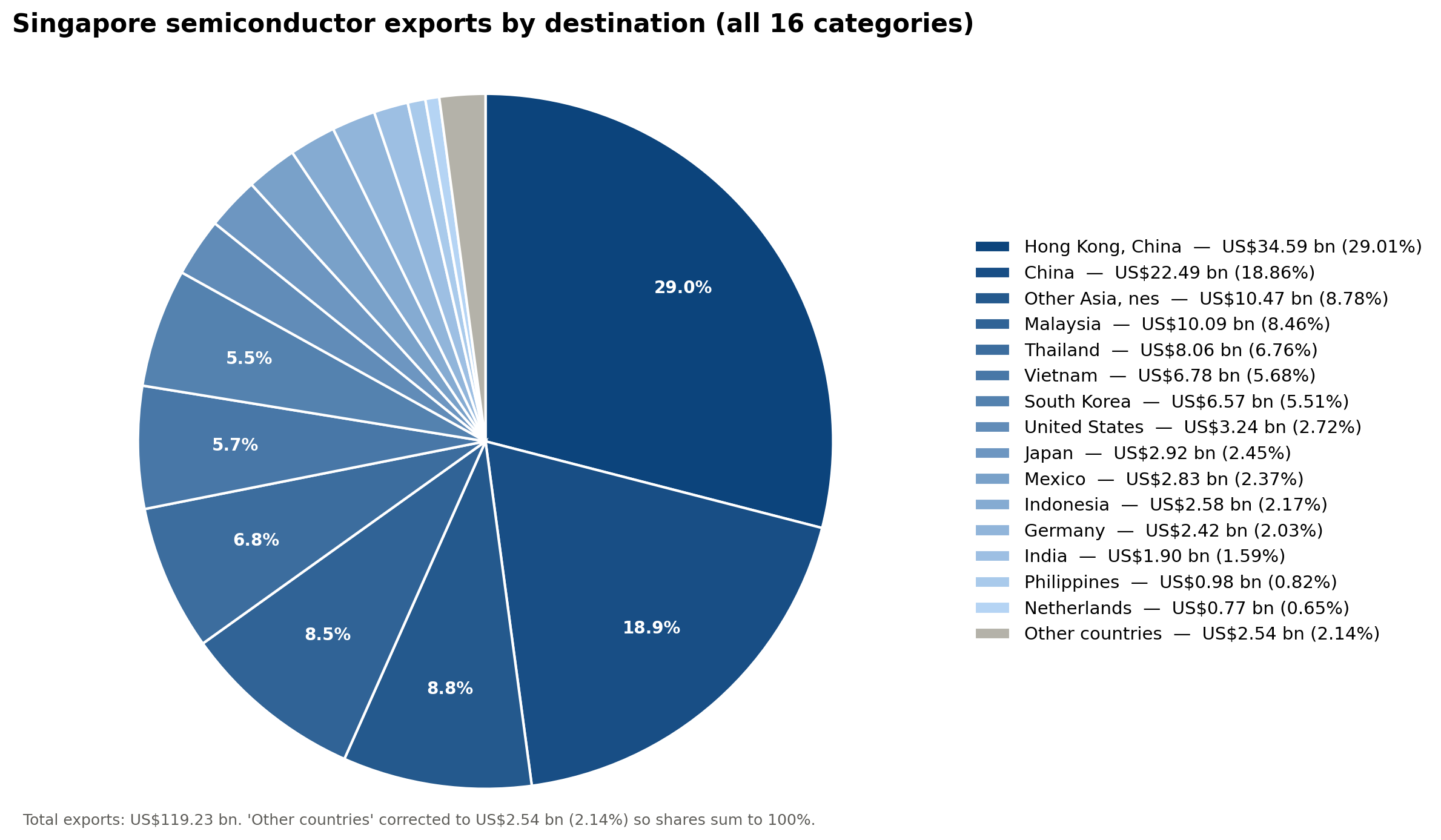
In 2024, Singapore exported approximately US$119.23 billion of HS 8542 integrated circuits, demonstrating the substantial scale of its integrated-circuit trade. The Singapore semiconductor industry also exported approximately US$11.04 billion of HS 8541 semiconductor devices, while imports under the same category amounted to approximately US$5.93 billion, giving Singapore a surplus of about US$5.11 billion for HS 8541 products. Singapore's trade pattern illustrates the importance of regional Asian supply chains. For HS 8541 semiconductor devices, Malaysia and Hong Kong were the two largest export destinations in 2024, followed by China, the United States and Germany. On the import side, Malaysia and China were the largest suppliers, followed by Japan and the Philippines.
The Singapore semiconductor industry therefore operates through extensive cross-border flows of intermediate and finished semiconductor products rather than relying solely on domestic consumption. Singapore's Department of Statistics estimates that 98% of semiconductor industry value-added was derived from exports in 2022, the highest export dependency among the industries examined in its analysis.
This high export orientation means changes in global electronics demand, inventory cycles, trade restrictions and regional manufacturing activity can materially affect Singapore's semiconductor trade performance. The Singapore semiconductor industry also has strong links with China and Hong Kong: together, these destinations accounted for a substantial portion of Singapore's 2024 HS 8542 exports, while Malaysia is important for both semiconductor-device imports and exports. Overall, the trade structure demonstrates Singapore's role as a regional semiconductor production, processing and redistribution hub, with exports substantially exceeding imports in selected semiconductor-device categories and a strong dependence on international markets.
Competitive Analysis
Key companies analyzed within the Singapore semiconductor industry are: GlobalFoundries, United Microelectronics Corporation (UMC), Vanguard International Semiconductor (VIS), Systems on Silicon Manufacturing Company (SSMC), AMD, Broadcom, MediaTek, Marvell Technology, NVIDIA, Qualcomm, Applied Materials, Lam Research, KLA Corporation, ASML, Tokyo Electron, ASM International, Others.