Global Helium Market: Pricing Tracking Report
Detailed Pricing Scenarios, Regional Analysis, and 2026-2030 Forecast


Detailed Pricing Scenarios, Regional Analysis, and 2026-2030 Forecast
Global Helium Pricing has entered its fourth major shortage cycle since 2006, and Q1 2026 marks one of the sharpest spikes on record. Long-term contract prices, historically anchored between 80 and 100 dollars per thousand cubic feet (Mcf) before 2016, have climbed past 500 to 550 dollars per Mcf in early 2026, while spot market prices have breached 1,000 to 1,200 dollars per Mcf in shortage-hit zones, according to industry pricing trackers. The proximate trigger is a combination of a shutdown at Qatar's Ras Laffan processing complex and shipping constraints tied to the Strait of Hormuz, compounding a structural shift that began with the June 2024 sale of the U.S. Federal Helium System to German industrial gas group Messer for 460 million dollars, which permanently removed the government's role as a strategic swing supplier. This report tracks pricing behavior across contract and spot markets, breaks down regional price differentials, and models three forward-looking pricing scenarios through 2030.
Helium is not exchange-traded; pricing is negotiated privately between buyers and sellers, which makes published price trackers and government commodity summaries the most reliable available benchmarks. As of Q1 2026, long-term contract pricing for established supply agreements typically runs between 500 and 600 dollars per Mcf, while spot market pricing for immediate delivery has ranged from 1,000 to 1,200 dollars per Mcf, according to industry market-risk trackers. That represents a roughly five-fold increase in contract pricing and a more than ten-fold increase in spot pricing compared with the sub-100-dollar baseline that prevailed before the first major shortage cycle began around 2006.
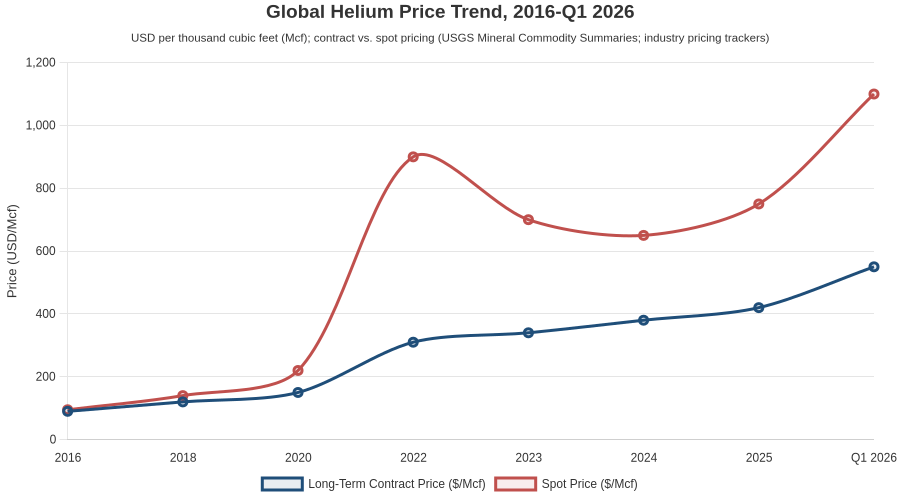
Figure 1: Global helium price trend, 2016-Q1 2026, contract vs. spot pricing in USD/Mcf. Source: USGS
The gap between contract and spot pricing is itself a signal of market stress. In stable periods, spot prices track close to contract levels; the current spread, with spot prices running roughly double contract rates, reflects buyers scrambling to secure cargoes outside their existing agreements amid weekly price swings of 10 to 15 percent recorded at the Shanghai and Tokyo trading hubs. The U.S. Geological Survey's own benchmark, drawn from its Mineral Commodity Summaries series, placed private industry Grade-A helium pricing at approximately 11 dollars per cubic meter, or 310 dollars per Mcf, in 2022, illustrating how sharply pricing has moved even relative to the already-elevated levels of just three to four years ago.
Helium pricing varies meaningfully by region, driven by proximity to production, shipping-route exposure, and end-use demand concentration. European markets currently trade at a 10 to 15 percent premium to North American spot prices, while Asia-Pacific markets, where semiconductor manufacturing demand is most heavily concentrated, command a 20 to 25 percent premium over North American levels, according to industry pricing analysis.
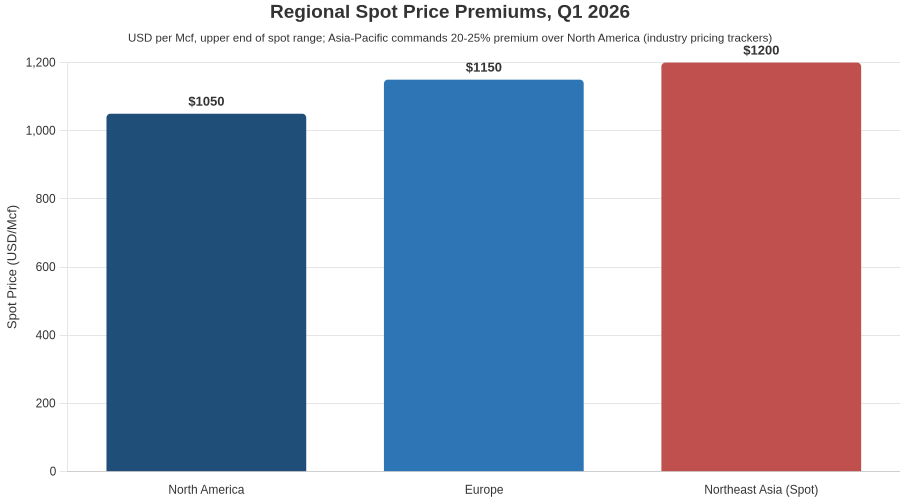
Figure 2: Regional spot price premiums, Q1 2026, USD/Mcf. Source: industry pricing trackers.
This regional spread is reinforced by diverging price trajectories across producing countries. Russian helium, exported primarily through Gazprom's Amur Gas Processing Plant in the Russian Far East, is priced at a significant discount to Qatari and U.S. supply, averaging approximately 310 dollars per Mcf versus roughly 470 dollars per Mcf for Qatari volumes, enabling Russia to gain market share rapidly in China and other Asian markets despite geopolitical trade barriers with Western buyers. Chinese import data for 2025 indicates Russian helium volumes to China grew substantially, with annualized December 2025 export rates implying more than a doubling of capacity from the Amur facility.
The helium market's price volatility is a direct function of its extreme supply concentration. According to the U.S. Geological Survey's Mineral Commodity Summaries 2026, estimated world helium production in 2025 reached approximately 190 million cubic meters, with the United States and Qatar together responsible for roughly 65 to 76 percent of total global supply, depending on the measurement basis used. Russia contributes approximately 10 percent of global output, and Algeria, through Sonatrach's Skikda and Arzew LNG processing facilities, adds a further 5 to 6 percent, supplying primarily European buyers.
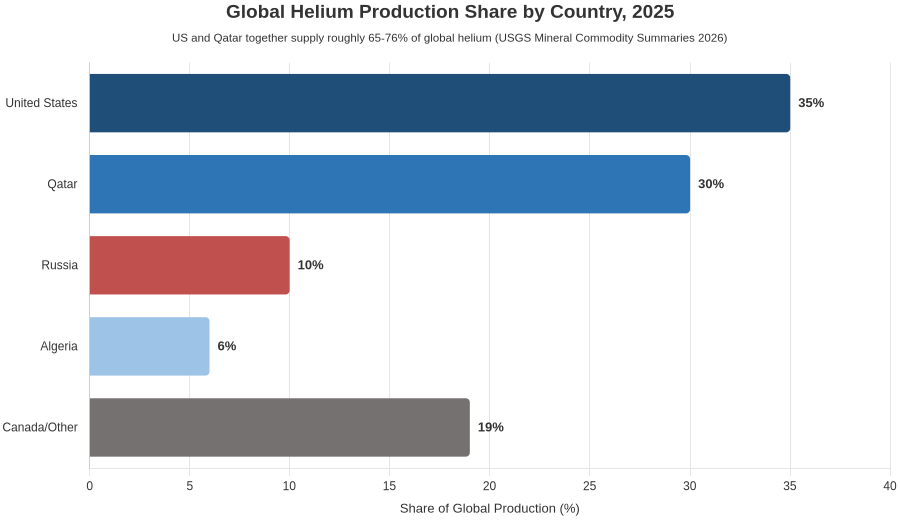
Figure 3: Global helium production share by country, 2025. Source: USGS Mineral Commodity Summaries 2026.
This concentration among fewer than fifteen meaningful global producers means that even minor production disruptions translate into immediate, outsized price movements. The current shortage cycle illustrates this dynamic precisely: the shutdown at Qatar's Ras Laffan complex, combined with Strait of Hormuz shipping constraints reported by NPR in April 2026, removed a substantial share of global seaborne helium capacity within a matter of weeks, a disruption large enough to push spot prices up 70 to 100 percent in the affected window. End-users including Seagate and Western Digital have reported full 2026 production allocations already booked, with price increases of 20 to 30 percent arriving as early as March 2026, while South Korean chipmakers Samsung and SK Hynix are estimated to hold approximately six months of helium inventory as a buffer against further disruption.
A structural factor distinguishes the current shortage from earlier cycles: the permanent removal of the U.S. government's role as a price-stabilizing swing supplier. Historically, the Bureau of Land Management's Federal Helium System, anchored by the Cliffside Field storage reservoir and Bush Dome reservoir near Amarillo, Texas, functioned as a buffer that could release federally owned helium during global outages to moderate price spikes. Following the Helium Stewardship Act of 2013's privatization mandate, the Federal Helium System's remaining assets, including approximately 28 million cubic meters of crude helium and the associated pipeline infrastructure, were sold in two lots on January 25, 2024, with the full asset package, encompassing the Cliffside Field, a 423-mile distribution pipeline, and Bush Dome's remaining roughly 4 billion cubic feet of stored helium, transferring to Messer for 460 million dollars. With that transaction finalized, global helium supply is now wholly dependent on private commercial logistics, removing the central pricing buffer that had existed since the reserve's creation.
Given the market's structural supply concentration and the ongoing integration of new capacity from Canada, Tanzania, and Russia's Amur facility, this report models three pricing scenarios for long-term contract pricing through 2030. The high scenario assumes continued geopolitical disruption affecting Middle East export corridors, keeping contract prices elevated above 500 dollars per Mcf through the forecast window. The base scenario assumes gradual market rebalancing as new supply comes online, with contract prices declining steadily from current levels toward the 380 to 400 dollar range by 2030. The low scenario assumes accelerated new-capacity ramp-up, particularly from Canadian and African projects alongside continued Russian Amur expansion, pulling contract prices down toward 280 to 300 dollars per Mcf by 2030, though still well above the pre-2016 historical baseline.
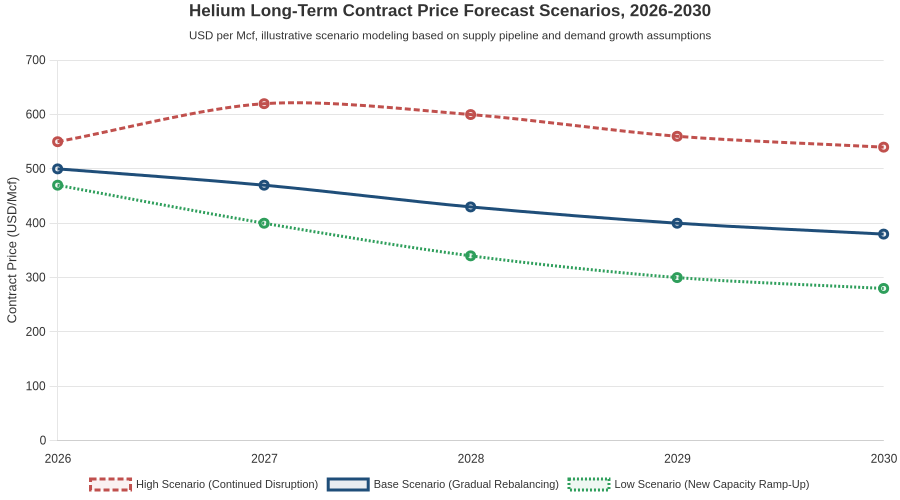
Figure 4: Helium long-term contract price forecast scenarios, 2026-2030, USD/Mcf. Illustrative scenario modeling based on supply pipeline and demand growth assumptions.
Across all three scenarios, one conclusion holds: helium pricing is unlikely to return to its pre-2016 baseline of 80 to 100 dollars per Mcf within the forecast horizon. Even the low scenario projects contract prices roughly three times that historical level by 2030, reflecting both the permanent loss of the U.S. strategic reserve as a price buffer and structurally higher demand from sectors including semiconductor manufacturing, aerospace, and quantum computing, which are projected to help push global helium demand value toward 6 billion dollars by 2030.
Pricing pressure is not solely a supply-side story; demand growth across several high-value end uses is compounding the effect of constrained supply. Magnetic resonance imaging remains the single largest end-use category for Grade-A helium in the United States, followed by lifting-gas applications, analytical and laboratory use, and electronics and semiconductor manufacturing, according to USGS consumption data. Semiconductor fabrication in particular has emerged as a disproportionately price-inelastic source of demand, since helium shortages can halt chip production lines entirely, giving fabs strong incentive to secure supply at premium pricing rather than risk output disruption. Emerging demand from quantum computing infrastructure and specialized cooling for fusion energy research adds a further structural growth vector that is expected to persist regardless of near-term price levels.
The current disruption is widely characterized by industry analysts as the market's fourth major shortage cycle since 2006, a pattern that distinguishes helium from most other industrial gases in how it responds to supply shocks. Unlike commodities with liquid futures markets that smooth price discovery, helium's privately negotiated contract structure means that mechanical failures or geopolitical disruptions at a handful of concentrated processing hubs translate almost immediately into allocation restrictions rather than gradual price adjustment. During the 2021-2023 shortage cycle, categorized by industry analysts as Helium Shortage 4.0, cascading mechanical failures at major processing hubs pushed wholesale prices above 300 dollars per Mcf and left end-users, ranging from medical research laboratories to aerospace manufacturers, receiving only 45 to 65 percent of their historically contracted volumes despite being willing to pay prevailing market rates. That episode established the allocation-based rationing pattern now recurring in the current 2026 disruption, where buyers face volume constraints that cannot be resolved through price alone.
What differs this cycle is the starting point: previous shortages occurred while the U.S. strategic reserve still existed as a theoretical backstop, even if rarely deployed at scale. The current disruption is the first major shortage to unfold entirely within a fully privatized global supply structure, removing any expectation that government-held inventory could be released to dampen the spike. This structural difference is a key reason industry forecasters expect the current price elevation to prove more persistent than prior cycles, even after the immediate Ras Laffan and Strait of Hormuz disruptions are resolved.
The table below consolidates current pricing benchmarks across the major producing and consuming regions tracked in this report, providing a quick-reference view for procurement and strategic sourcing teams.
| Market/Segment | Q1 2026 Price Range (USD/Mcf) | Key Driver |
| North America Contract | 500-600 | Post-reserve-sale private market structure |
| North America Spot | 1,000-1,200 | Ras Laffan shutdown, Hormuz shipping constraints |
| Europe Spot | 10-15% premium to N. America | EU sanctions exposure, Sonatrach dependency |
| Asia-Pacific Spot | 20-25% premium to N. America | Semiconductor demand concentration |
| Russian Export (China-bound) | ~310 (discounted) | Amur GPP capacity ramp-up, sanctions workaround |
Table 1: Regional and segment pricing summary, Q1 2026. Compiled from USGS Mineral Commodity Summaries 2026 and industry pricing trackers.
Three implications follow from this quarter's pricing data. First, given supply concentration among fewer than fifteen meaningful global producers and the demonstrated speed with which regional disruptions propagate into global price spikes, end-users with critical helium dependencies, particularly MRI manufacturers, semiconductor fabs, and quantum computing facility operators, should consider maintaining 90 to 180 days of strategic inventory, since the cost of a production stoppage typically exceeds the procurement premium associated with holding buffer stock. Second, geographic diversification of supply contracts across U.S., Qatari, and Russian sources, where geopolitically feasible, offers meaningful price arbitrage given the roughly 150-to-160-dollar per Mcf discount currently available on Russian volumes relative to Qatari supply. Third, buyers should treat the current price spike as partially structural rather than purely cyclical: the permanent removal of the U.S. strategic reserve means future disruptions are less likely to be buffered by government intervention, making long-term contract diversification a more durable hedge than reliance on spot-market opportunism.
Taken together, this quarter's tracking data confirms that global helium pricing has moved into a structurally higher, more volatile regime than existed before 2016, and that near-term relief depends heavily on the pace at which new capacity from Canada, Tanzania, and Russia's Amur facility can be integrated into global supply chains.