Key Findings
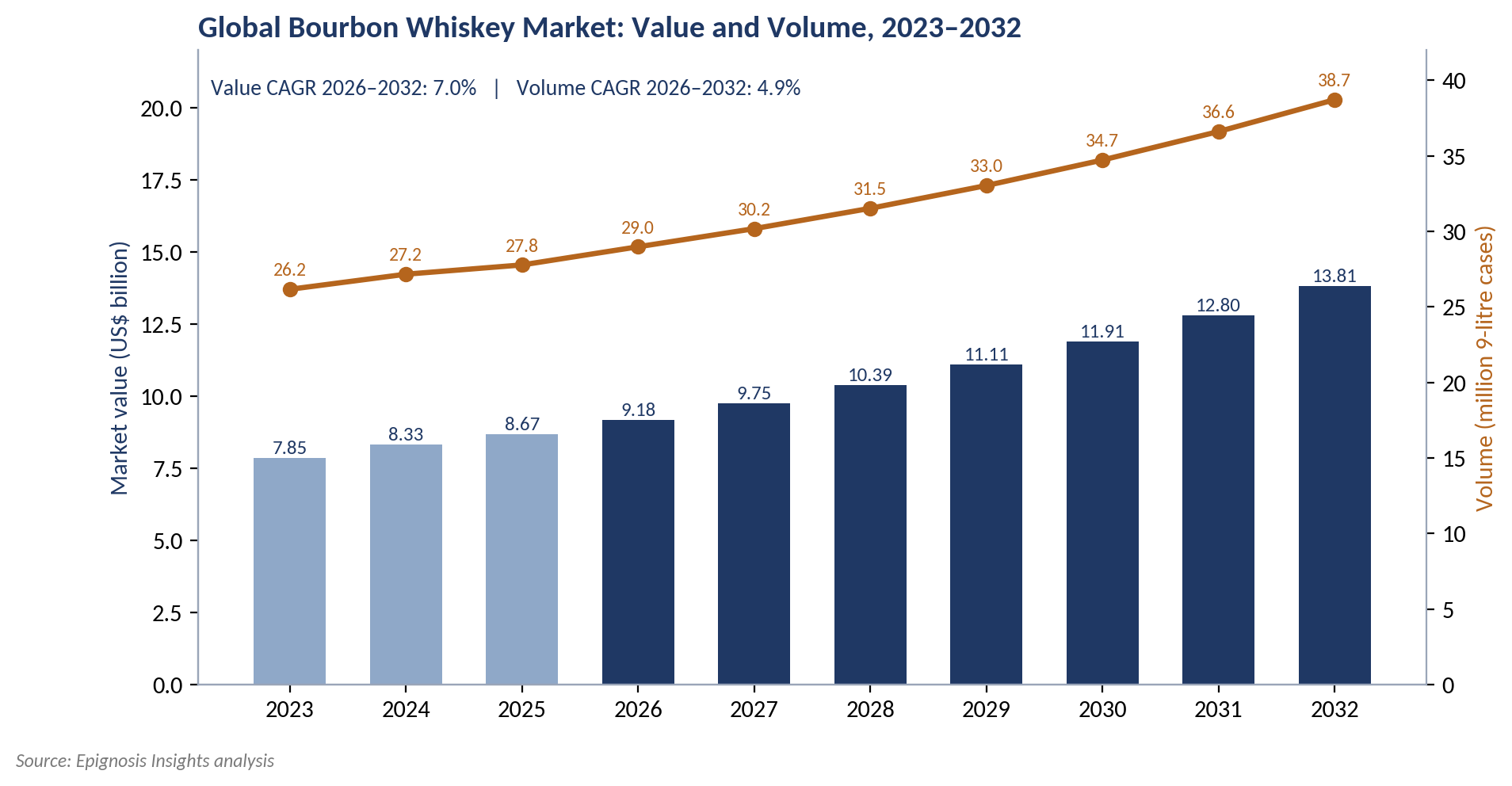
- Global bourbon whiskey market is projected to reach US$13.81 billion by 2032 from US$8.67 billion in 2025.
- Market revenue is expected to grow at a 7.04% CAGR from 2026 to 2032, adding approximately US$4.63 billion in incremental value over the forecast period.
- Global bourbon consumption is estimated at 27.8 million 9-litre cases (250.0 million litres) in 2025 and is projected to reach 38.7 million cases (348.4 million litres) by 2032, a volume CAGR of 4.9%.
- Average realised price is projected to rise from approximately US$312 per 9-litre case in 2025 to US$357 per case by 2032, meaning close to 30% of value growth is driven by price and mix rather than volume.
- North America accounted for 41.3% of global value in 2025, while Asia Pacific is the fastest-growing region at 8.02% CAGR and is expected to lift its share to 25.1% by 2032.
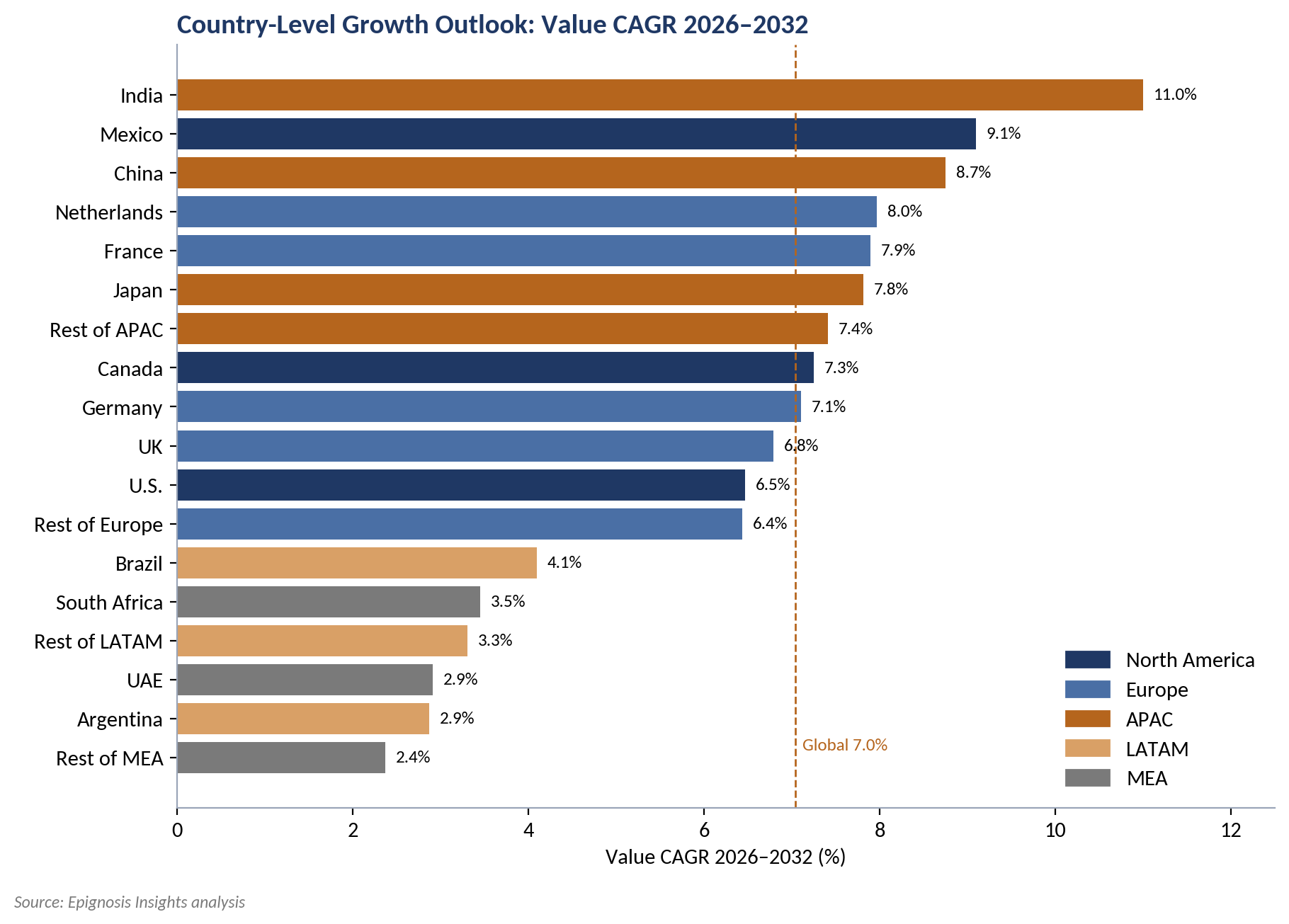
- India is the fastest-growing country market at an 11.00% CAGR, followed by Mexico at 9.10% and China at 8.75%.
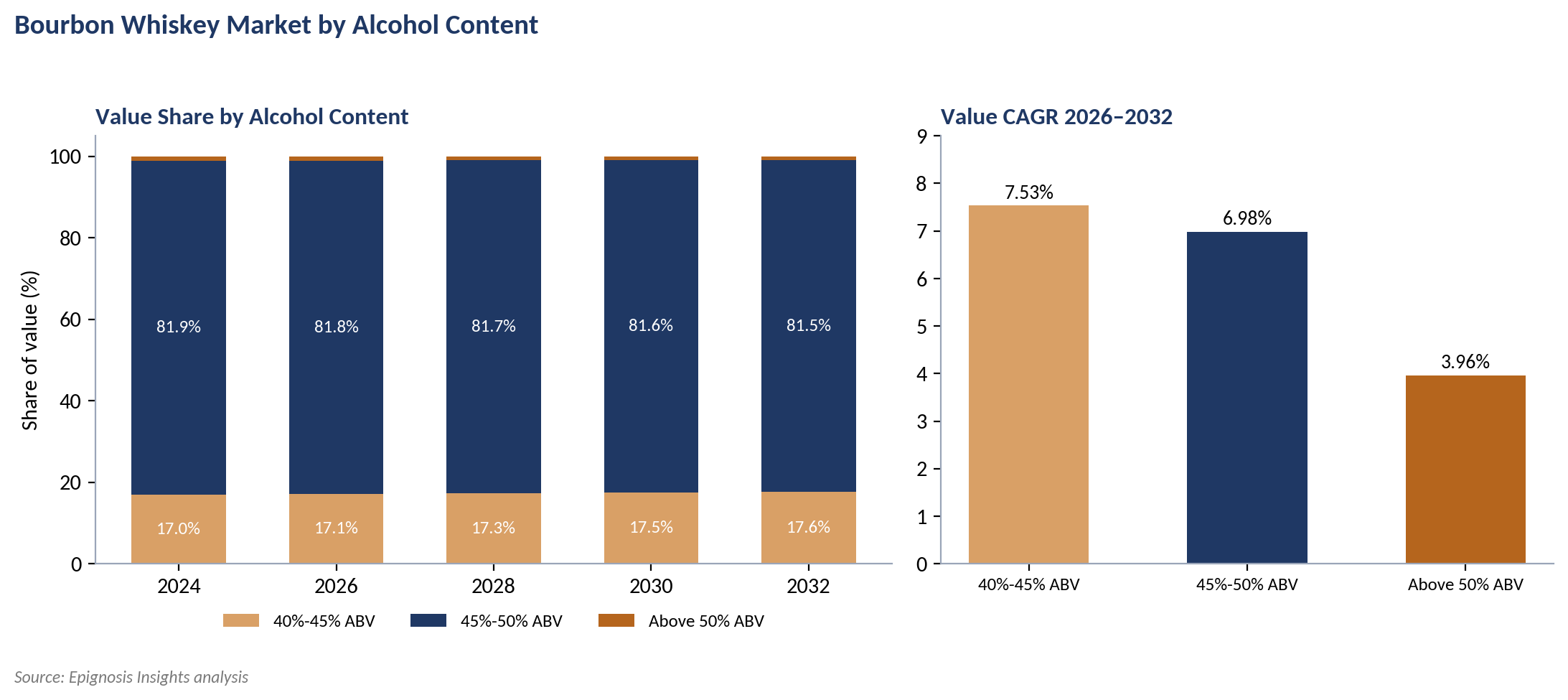
- Straight bourbon held 91.7% of global value in 2025, and the 40%–45% ABV band is the fastest-growing strength segment at a 7.53% CAGR.
- The on-trade (HoReCa) channel led with a 41.8% value share in 2025 and is projected to reach 43.2% by 2032.
- Record maturing stocks in Kentucky are moving the industry from allocation-led selling to inventory-led selling, moderating price growth through the late 2020s.
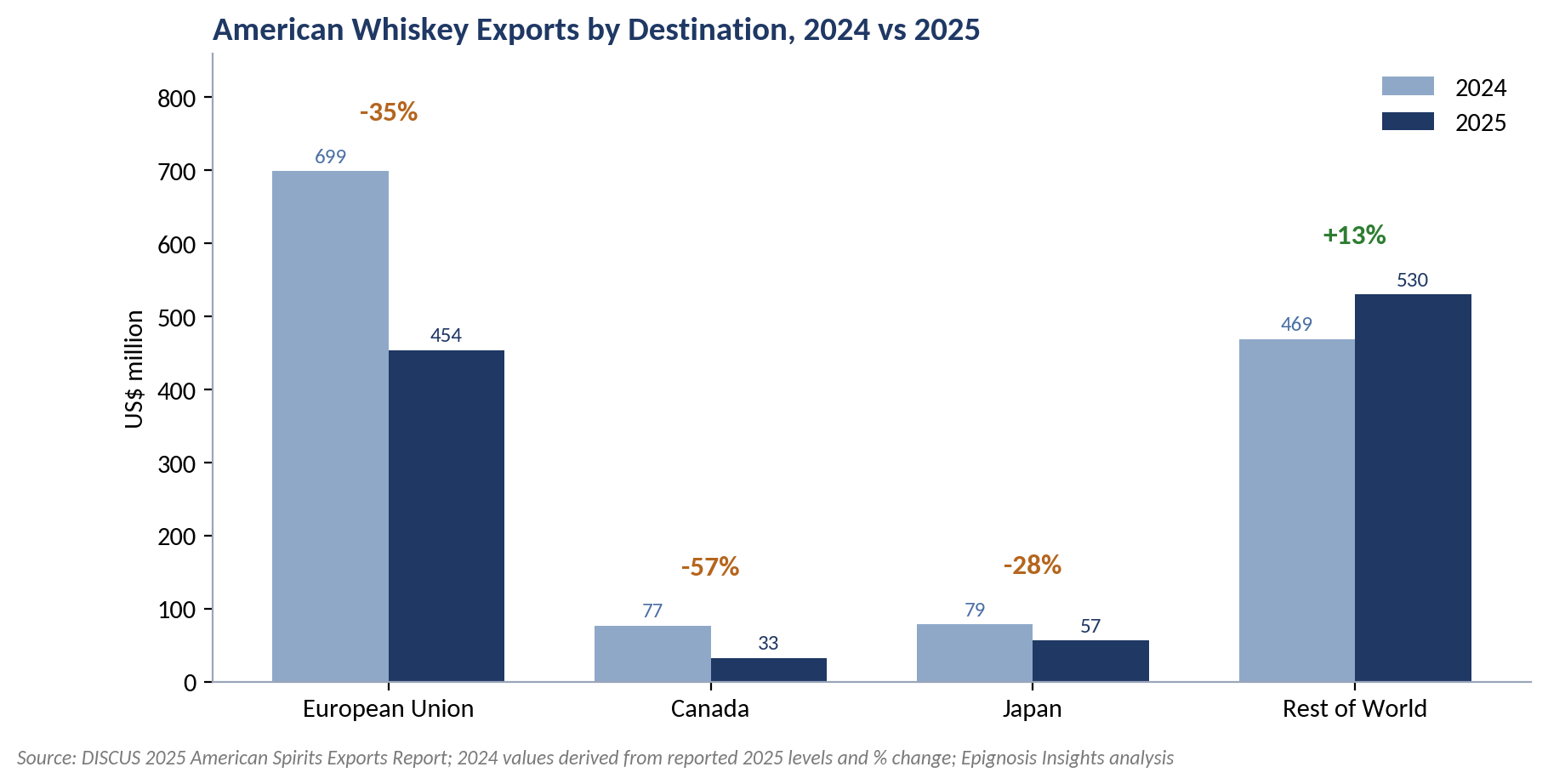
- Trade policy volatility reduced American whiskey exports in 2025, but shipments to markets outside the EU, Canada and Japan grew, signalling a structural diversification of export demand.
Global Bourbon Whiskey Market Outlook
The global bourbon whiskey market was valued at US$8.33 billion in 2024 and is estimated at US$8.67 billion in 2025. Epignosis Insights projects the market to reach US$9.18 billion in 2026 and US$13.81 billion by 2032, registering a CAGR of 7.04% between 2026 and 2032. In volume terms, the market recorded consumption of 27.2 million 9-litre cases (244.5 million litres) in 2024 and is estimated to reach 38.7 million cases (348.4 million litres) by 2032, growing at a volume CAGR of 4.9% during the forecast period.
The growth trajectory is not linear. Value growth slowed from 6.1% in 2024 to 4.1% in 2025, the weakest year in the historical series, as distributors worked down stock built ahead of anticipated tariffs and as several export markets were disrupted. Growth is forecast to recover to 5.9% in 2026 and to accelerate progressively to 7.9% by 2032, supported by normalising trade conditions, a widening consumer base in Asia Pacific and a gradual return of pricing power as the current inventory overhang is absorbed.
Figure 1: Global Bourbon Whiskey Market: Value and Volume, 2023–2032
Table 1: Global Bourbon Whiskey Market: Value, Volume and Average Realised Price, 2023–2032
| Year |
Value (US$ Mn) |
YoY Growth |
Volume (Mn 9L Cases) |
Volume (Mn Litres) |
Avg Price (US$/Case) |
| 2023 |
7,850.0 |
– |
26.17 |
235.5 |
300 |
| 2024 |
8,328.9 |
6.1% |
27.17 |
244.5 |
307 |
| 2025 |
8,670.3 |
4.1% |
27.78 |
250.0 |
312 |
| 2026 |
9,181.0 |
5.9% |
28.98 |
260.8 |
317 |
| 2027 |
9,752.1 |
6.2% |
30.18 |
271.6 |
323 |
| 2028 |
10,390.8 |
6.5% |
31.53 |
283.7 |
330 |
| 2029 |
11,105.7 |
6.9% |
33.03 |
297.3 |
336 |
| 2030 |
11,906.4 |
7.2% |
34.72 |
312.5 |
343 |
| 2031 |
12,804.2 |
7.5% |
36.61 |
329.5 |
350 |
| 2032 |
13,811.9 |
7.9% |
38.71 |
348.4 |
357 |
Source: Epignosis Insights analysis
Global Bourbon Whiskey Market Dynamics
Tariff Liberalisation Opening High-Growth Whisky Markets in Asia
The most significant structural opportunity for the bourbon whiskey market is improving access to large, fast-growing whisky-consuming economies in Asia, where bourbon's share of total whisky consumption remains small. India is the clearest example. In February 2025, India's Ministry of Finance notified a reduction in the basic customs duty on bourbon whiskey to 50% from 150%, while duties on most other imported spirits were left unchanged at the time. Although state excise, distribution margins and labelling rules still determine the final shelf price, the duty change materially improves the landed-cost position of American bourbon relative to other imported whiskies and gives brand owners room to introduce more accessible price points.
The effect is visible in the forecast. Epignosis Insights estimates the Indian bourbon market at US$67.6 million in 2025 and projects it to reach US$139.3 million by 2032, an 11.00% CAGR that is the highest among all countries analysed. India's demand profile is also distinctive: blended bourbon accounts for 18.3% of the country's value in 2025, more than double the global share, and is projected to grow at 11.70% annually. PET bottles hold a 10.2% share in India compared with less than 1% globally. Both indicators point to an entry-tier, trial-led market in which affordability and pack-price architecture matter as much as heritage storytelling.
The opportunity is not without competition. Under the India–UK Comprehensive Economic and Trade Agreement, India's import duty on Scotch whisky was reduced to 75% from 150% on 15 July 2026, with a further phased reduction to 40% over ten years. Bourbon's tariff advantage over Scotch has therefore narrowed sooner than many exporters expected. For bourbon producers, the practical implication is that duty relief alone will not secure share; investment in on-trade visibility, bartender advocacy and differentiated flavour education will be required to convert curiosity into repeat purchase among India's young urban drinkers.
Beyond India, China and the wider Asia Pacific region provide a broader growth platform. China's bourbon market is projected to rise from US$345.2 million in 2025 to US$614.5 million by 2032 at an 8.75% CAGR, with blended bourbon growing even faster at 9.83%. Collectively, Asia Pacific is expected to add approximately US$1.28 billion of value between 2026 and 2032, making it the region with the highest growth rate and the second-largest absolute value gain after North America.
Record Maturing Inventory and Rising Holding Costs
The defining supply-side challenge for the bourbon whiskey market is an unprecedented level of maturing stock. According to the Kentucky Distillers' Association, Kentucky warehouses held a record 16.1 million barrels of bourbon, within a total of 17.1 million barrels of all aging spirits, and the tax-assessed value of that inventory exceeded US$10 billion for the first time. Distillers paid approximately US$75 million in aging barrel taxes in 2025, a 27% year-on-year increase and a 163% rise over five years. Most of the barrels laid down during the production boom will not reach optimal maturity until after 2030, which means the inventory will continue to weigh on the market well into the forecast period.
The overhang is already changing producer behaviour. James B. Beam Distilling Co., owned by Suntory Global Spirits, announced that production at its main distillery in Clermont, Kentucky, would be paused for the whole of 2026, an unusual decision for one of the category's largest producers and a signal that supply discipline has become a strategic priority. Smaller distillers and non-distiller producers face a harder position because they carry the same holding costs without the brand scale or distribution reach needed to clear stock quickly.
For market economics, the inventory cycle has three implications. First, the allocation model that defined much of the past decade, in which scarce aged releases supported rapid price increases, is giving way to promotional activity and wider availability of age-stated products. Epignosis Insights therefore models average realised prices rising by only 1.5% to 2.0% per year over the forecast period. Second, abundant aged liquid lowers the cost of entering new export markets with mid-tier straight bourbon, which supports volume growth in Asia Pacific and Latin America. Third, holding-cost relief is arriving slowly: legislation enacted by Kentucky in 2023 begins a 20-year phase-out of the barrel tax from 2026, with only a 4% reduction in the first year, so balance-sheet pressure will persist for most producers through the late 2020s.
Trade Policy and Export Exposure Analysis
Bourbon is unusual among global spirits categories because production is concentrated in a single country while a large share of demand growth lies overseas. This makes the category highly sensitive to trade policy. The Distilled Spirits Council of the United States (DISCUS) reported that U.S. spirits exports declined 3.8% to US$2.37 billion in 2025, while American whiskey exports, of which bourbon is the largest component, fell 19% to US$1.08 billion. American whiskey's share of total U.S. spirits exports dropped to 45%, the first time it has fallen below half since 1996.
The decline was concentrated in three destinations. Exports to the European Union fell 35% to US$454 million, partly because importers had accelerated shipments in the second half of 2024 ahead of potential retaliatory tariffs. Exports to Canada fell 57% to US$33 million after many provincial liquor boards removed American products from shelves from March 2025, and shipments to Japan declined 28% to US$57 million as importers adjusted inventories. In contrast, exports to all other markets rose 13% to US$530 million, demonstrating that demand outside traditional strongholds remained resilient.
Figure 2: American Whiskey Exports by Destination, 2024 vs 2025
The European outlook has improved materially in 2026. spiritsEUROPE confirmed that the EU legislative acts implementing the bloc's tariff commitments under the EU–US Turnberry agreement entered into force on 1 July 2026. The 25% tariffs on EU and U.S. spirits linked to the earlier aircraft dispute had been suspended from 11 July 2021 to 11 July 2026, and the agreement removes the immediate risk of retaliatory duties on American whiskey being reimposed. Epignosis Insights' forecast for Europe, a 7.37% CAGR between 2026 and 2032, assumes continued tariff-free access to the EU market.
Canada represents the most material downside risk to the North American outlook. The base case assumes a progressive restoration of provincial listings over the forecast period; a prolonged delisting would primarily affect the liquor store and supermarket channels, where provincial boards control distribution. Exporters are responding by spreading risk across a wider set of destinations, a shift that favours markets in Asia Pacific, Latin America and the Middle East where tariff exposure to U.S. trade disputes is lower.
Volume and Pricing Analysis
Separating price from volume provides a clearer view of underlying bourbon demand. Epignosis Insights estimates that 2025 value growth of 4.1% comprised volume growth of approximately 2.3% and an increase in average realised price of approximately 1.8%. Over 2026–2032, volume is projected to grow at 4.9% per year while average realised price rises by about 2.0% per year, from US$317 per 9-litre case in 2026 to US$357 per case in 2032. Price and mix therefore account for close to 30% of value growth, a lower contribution than during the allocation-driven period earlier in the decade, when price increases were the dominant growth lever.
Regional volume patterns differ from value patterns because realised prices vary by market. North America, where bourbon is sold closest to its production base and without import duties in the United States, has the lowest average realised price per case and therefore a higher share of volume than of value. North America consumed an estimated 12.9 million 9-litre cases in 2025, rising to 17.6 million cases by 2032. Europe is projected to grow from 7.6 million to 10.9 million cases and Asia Pacific from 5.7 million to 8.5 million cases, with Asia Pacific recording the fastest volume CAGR at 5.9%. Latin America and the Middle East and Africa remain small in volume terms at 1.2 million and 0.5 million cases respectively by 2032.
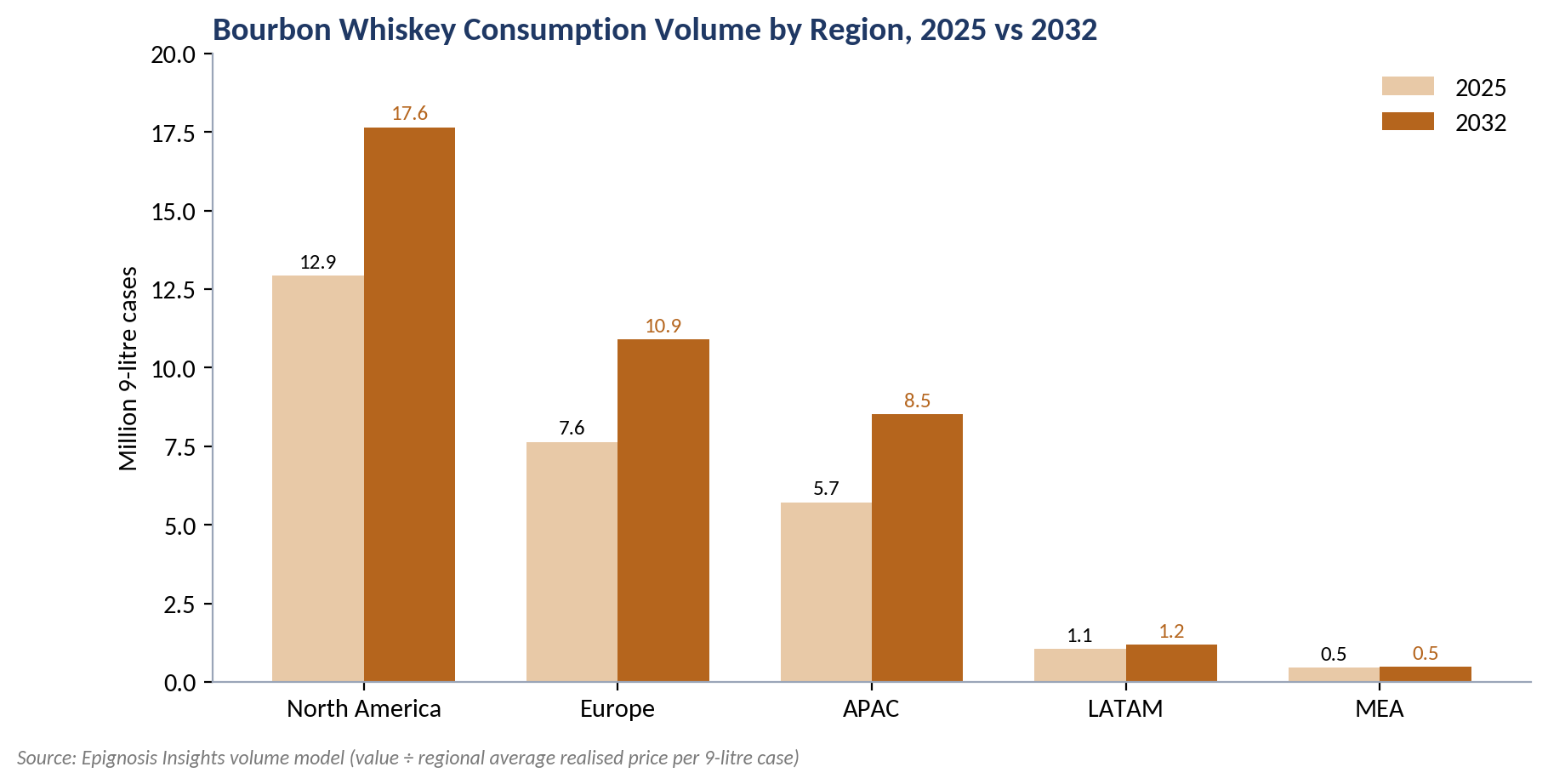 Figure 3: Bourbon Whiskey Consumption Volume by Region, 2025 vs 2032
Table 2: Bourbon Whiskey Consumption Volume by Region, 2024–2032 (Million 9-Litre Cases)
| Region |
2024 |
2025 |
2026 |
2028 |
2030 |
2032 |
CAGR 2026–2032 |
| North America |
12.67 |
12.92 |
13.44 |
14.54 |
15.92 |
17.64 |
4.6% |
| Europe |
7.44 |
7.64 |
7.99 |
8.76 |
9.71 |
10.90 |
5.3% |
| APAC |
5.54 |
5.72 |
6.02 |
6.68 |
7.49 |
8.51 |
5.9% |
| LATAM |
1.06 |
1.05 |
1.07 |
1.10 |
1.13 |
1.18 |
1.7% |
| MEA |
0.46 |
0.45 |
0.45 |
0.46 |
0.47 |
0.48 |
0.8% |
| Global |
27.17 |
27.78 |
28.98 |
31.53 |
34.72 |
38.71 |
4.9% |
Source: Epignosis Insights analysis
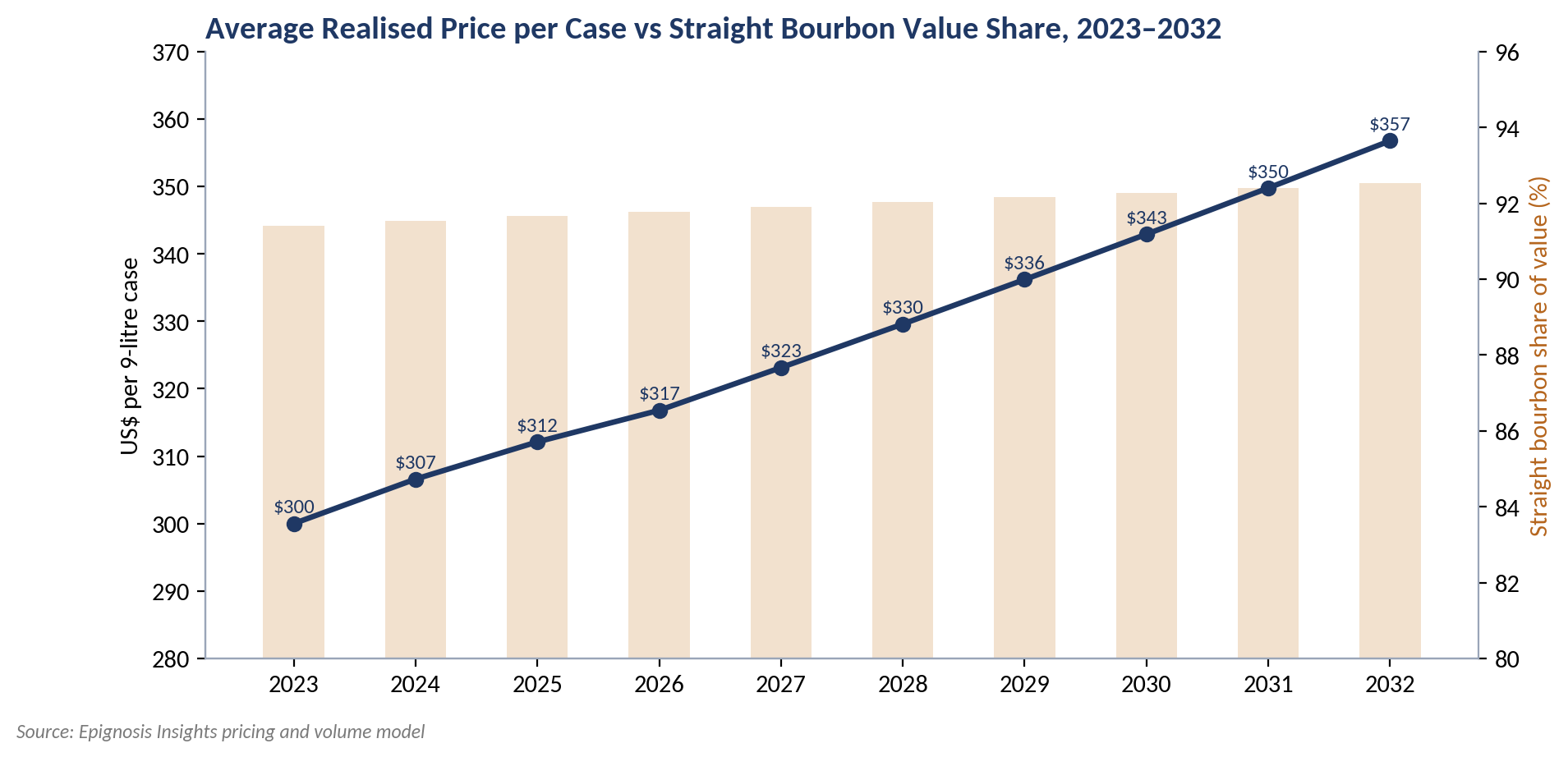 Figure 4: Average Realised Price per Case vs Straight Bourbon Value Share, 2023–2032
Volume estimates are derived by dividing market value by an average realised price per 9-litre case, anchored at approximately US$300 per case in 2023 and adjusted for regional differences in duties, logistics costs and premium-tier mix. The resulting series should be interpreted as consumption-equivalent volume at the supplier and importer level rather than as shipments recorded at a single point in the supply chain.
Segment Analysis
By Product Type
Straight bourbon whiskey dominated the market with a value of US$7.95 billion in 2025, representing 91.7% of global value, and is projected to reach US$12.78 billion by 2032 at a 7.19% CAGR. Its dominance reflects the category's regulatory foundations: under U.S. federal standards of identity, straight bourbon must be aged for at least two years in new charred oak containers with nothing added other than water to adjust proof, giving it a clear quality signal that consumers and bartenders associate with authenticity. The current inventory surplus further strengthens the straight segment because producers have ample aged liquid to support age-stated and small-batch expressions at accessible prices.
Blended bourbon whiskey was valued at US$723.3 million in 2025 and is projected to reach US$1.03 billion by 2032 at a 5.37% CAGR. Its global share is expected to decline from 8.3% to 7.5%, but the segment behaves very differently across markets. In mature markets such as the United States, blended bourbon is losing share to straight expressions, whereas in emerging markets it serves as an affordable entry point. China's blended share of 17.5% and India's 18.3% in 2025 both exceed the global average by a wide margin.
By Alcohol Content
The 45%–50% ABV band is the core of the market, accounting for US$7.09 billion or 81.8% of global value in 2025. This range covers most flagship 90 to 100 proof expressions, including bottled-in-bond releases, and it is projected to reach US$11.25 billion by 2032 at a 6.98% CAGR.
The 40%–45% ABV band is the fastest-growing segment at a 7.53% CAGR, rising from US$1.48 billion in 2025 to US$2.43 billion by 2032. Three factors support this band: its suitability for highballs and mixed drinks, a broader consumer shift toward moderation, and alcohol duty structures that tax by strength. HM Revenue & Customs' strength-based alcohol duty system, introduced in the United Kingdom in August 2023, illustrates how such regimes raise the relative cost of higher-proof products.
Growth in this band is particularly strong in India and China, at 12.28% and 9.68% respectively. The above-50% ABV band, which includes barrel-proof and cask-strength releases, held a 1.1% share in 2025 and is the slowest-growing segment at a 3.96% CAGR. Collector interest remains real, but secondary-market prices for limited releases have softened as inventories have grown, reducing the scarcity premium that previously drove this niche.
Figure 5: Bourbon Whiskey Market by Alcohol Content
By Packaging
Glass bottles are the near-universal format for bourbon, accounting for 99.1% of value in 2025, or US$8.59 billion, and projected to reach US$13.71 billion by 2032 at a 7.06% CAGR. Glass remains integral to brand identity through embossing, wax seals, decanter shapes and collector packaging. The main pressure point is cost and carbon: glass is energy-intensive to produce and heavy to ship, which is leading brand owners to test lightweight bottles and increase recycled cullet content.
PET bottles represented US$75.5 million in 2025 and are projected to grow at a 4.50% CAGR to US$101.9 million by 2032. PET is largely confined to value-tier products, travel formats and large-pack sizes, but its role is significant in India, where it holds a 10.2% share and is projected to grow at 11.74% annually. Metal cans are used mainly for bourbon-based ready-to-drink cocktails, which are outside the core scope of this market definition.
By Sales Channel
The on-trade (HoReCa) channel led the market with a value of US$3.62 billion in 2025, representing 41.8% of global value, and is the fastest-growing channel at a 7.54% CAGR, reaching US$5.97 billion by 2032. Bars and restaurants are where most new bourbon drinkers first encounter the category, frequently through cocktails such as the Old Fashioned and the Whiskey Sour, which makes the channel central to recruitment as well as to premium price realisation.
Supermarkets and hypermarkets held 33.9% of value in 2025 and are projected to grow at a 6.74% CAGR, while liquor and wine stores accounted for 19.8% and are projected to grow at 6.91%. The others category, which includes e-commerce, direct-to-consumer and travel retail, represented 4.5% of value in 2025. Channel structure varies widely by country: the on-trade accounts for 55.8% of India's market, while in the UAE supermarkets and hypermarkets hold a larger share than the on-trade.
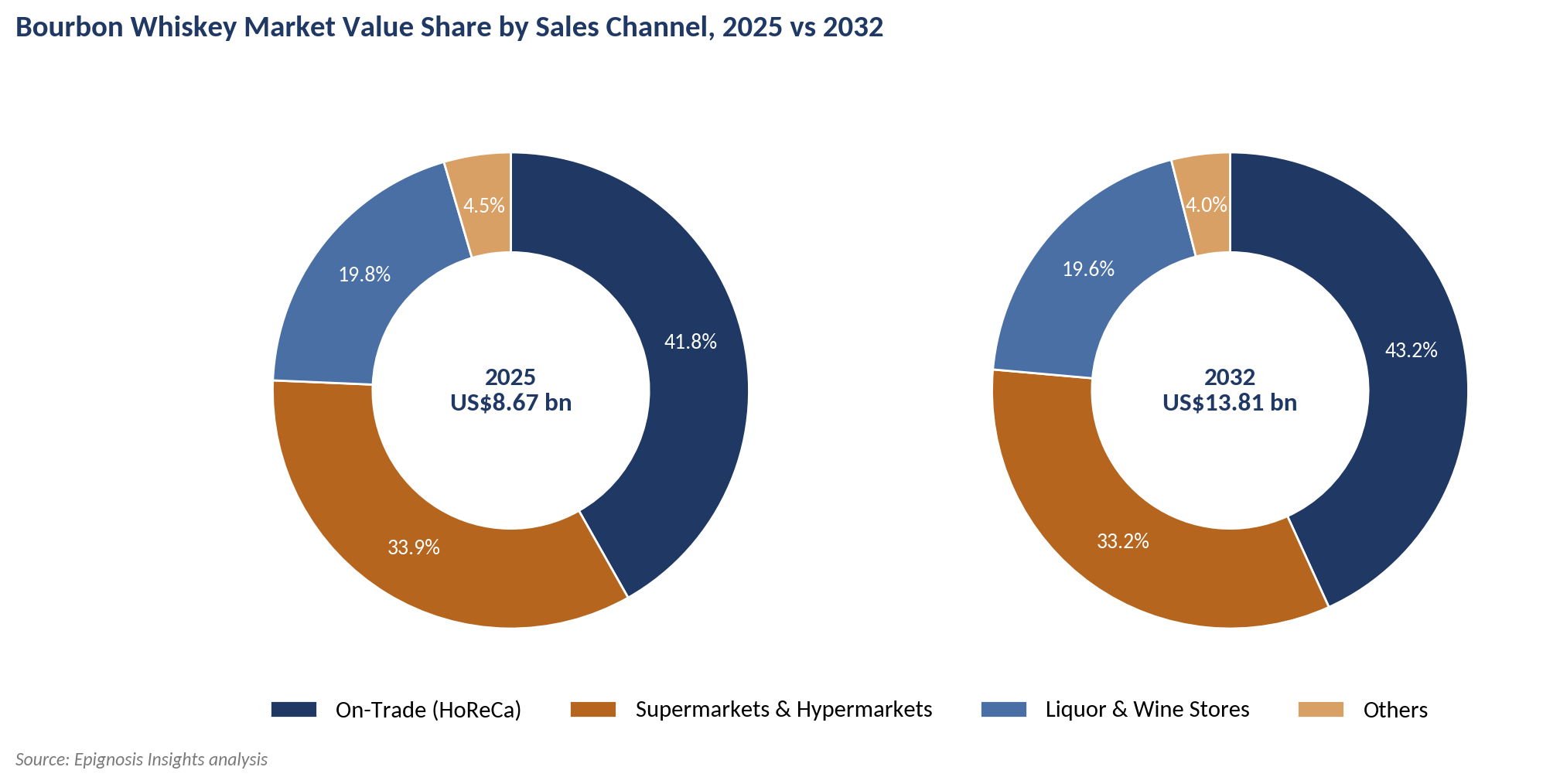 Figure 6: Bourbon Whiskey Market Value Share by Sales Channel, 2025 vs 2032
Regional Analysis
North America
North America was the largest regional market with a value of US$3.58 billion in 2025 and is projected to reach US$5.58 billion by 2032 at a 6.69% CAGR. The United States accounted for 82.7% of the regional market in 2025 at US$2.96 billion and is projected to grow at 6.47%, reflecting a mature consumer base in which premiumisation and on-trade recovery matter more than recruitment of new drinkers. Mexico is the fastest-growing North American market at a 9.10% CAGR, rising from US$146.5 million to US$267.1 million, supported by duty-free trade under the USMCA framework and strong premium on-trade demand in tourism corridors. Canada is projected to grow from US$474.6 million to US$766.5 million under the base-case assumption of normalised provincial listings.
Europe
Europe was valued at US$2.54 billion in 2025 and is projected to reach US$4.13 billion by 2032 at a 7.37% CAGR. The Netherlands is the largest European market at US$722.0 million, a position that reflects its role as a logistics and bonded-warehousing gateway for American whiskey entering continental Europe, and it is also the fastest-growing at 7.97%. France follows closely at 7.90% CAGR, growing from US$464.5 million to US$782.4 million, while Germany is projected to rise from US$646.0 million to US$1.03 billion. The United Kingdom, at US$379.7 million in 2025, is expected to grow at a more measured 6.79%, reflecting intense competition from domestic Scotch.
Asia Pacific
Asia Pacific was valued at US$2.04 billion in 2025 and is projected to reach US$3.47 billion by 2032 at an 8.02% CAGR, the fastest among all regions. Japan accounted for 59.9% of the regional market in 2025 at US$1.22 billion and is projected to reach US$2.05 billion, supported by a well-established highball culture and strong convenience-store distribution. China and India are the region's growth engines at 8.75% and 11.00% CAGR respectively, while the rest of Asia Pacific, including South Korea, Australia and Southeast Asian markets, is projected to grow from US$406.2 million to US$663.1 million.
Latin America
Latin America was valued at US$337.4 million in 2025 and is projected to reach US$431.9 million by 2032 at a 3.71% CAGR. Brazil represents 57.2% of the region and is projected to grow at 4.10%, while Argentina's growth of 2.87% reflects currency volatility and periodic import restrictions that limit the predictability of premium spirits supply.
Middle East and Africa
The Middle East and Africa was valued at US$169.4 million in 2025 and is projected to reach US$204.1 million by 2032 at a 2.78% CAGR. The UAE dominates the region with a 69.0% share, driven by tourism, an expatriate consumer base and travel retail. South Africa is a small but faster-growing market at a 3.45% CAGR.
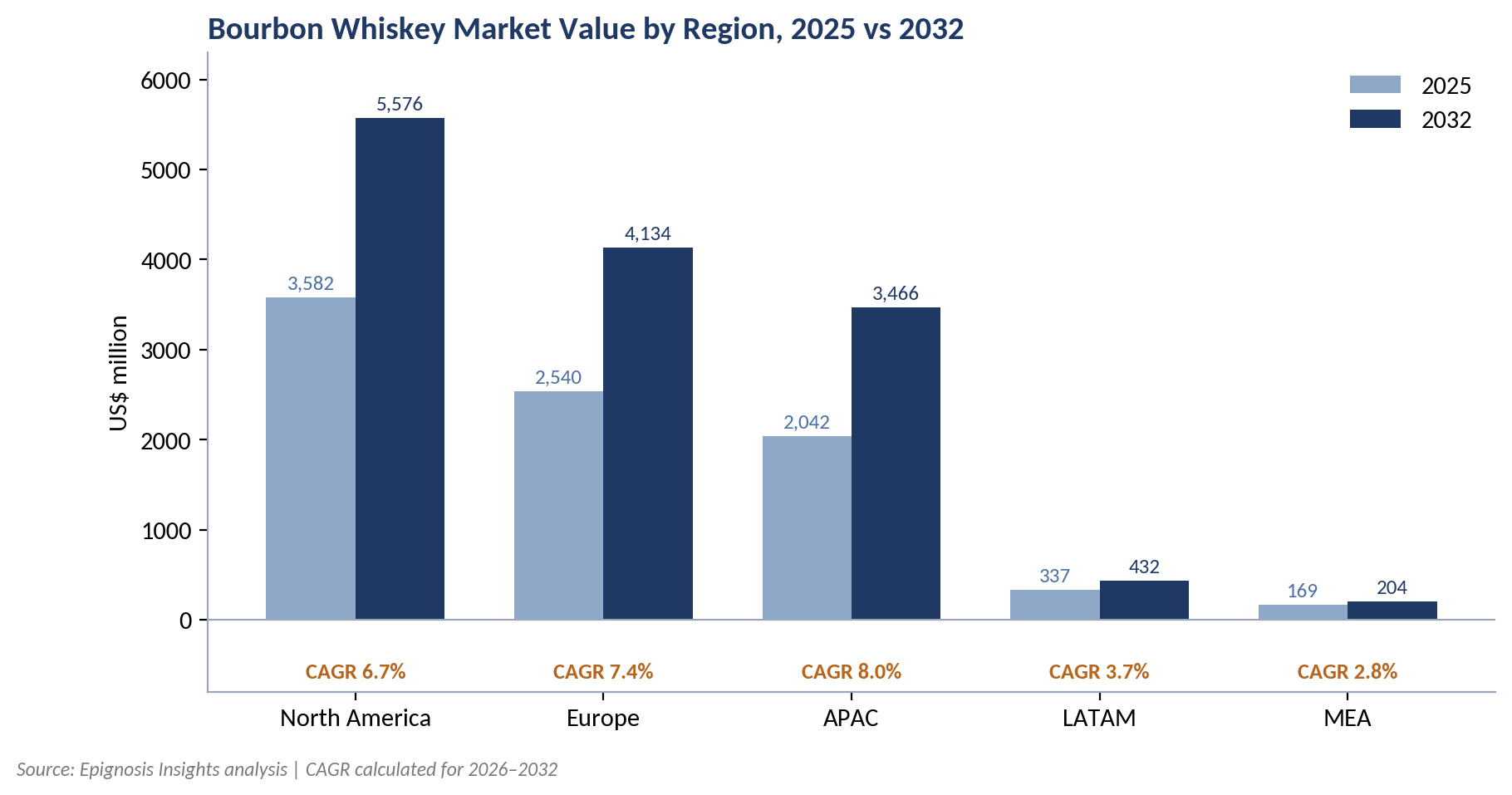 Figure 7: Bourbon Whiskey Market Value by Region, 2025 vs 2032
Figure 8: Country-Level Growth Outlook: Value CAGR 2026–2032
Global Bourbon Whiskey Market: Competitive Landscape
Key companies analysed within the global bourbon whiskey market are: Suntory Global Spirits (Jim Beam, Maker's Mark, Knob Creek), Brown-Forman Corporation (Woodford Reserve, Old Forester), Diageo plc (Bulleit), Sazerac Company (Buffalo Trace), Heaven Hill Brands (Evan Williams, Elijah Craig), Campari Group (Wild Turkey), Michter's Distillery, Barrell Craft Spirits, MGP Ingredients (Luxco), Pernod Ricard and others.
Epignosis Insights Competitive Assessment Framework (EICAF)
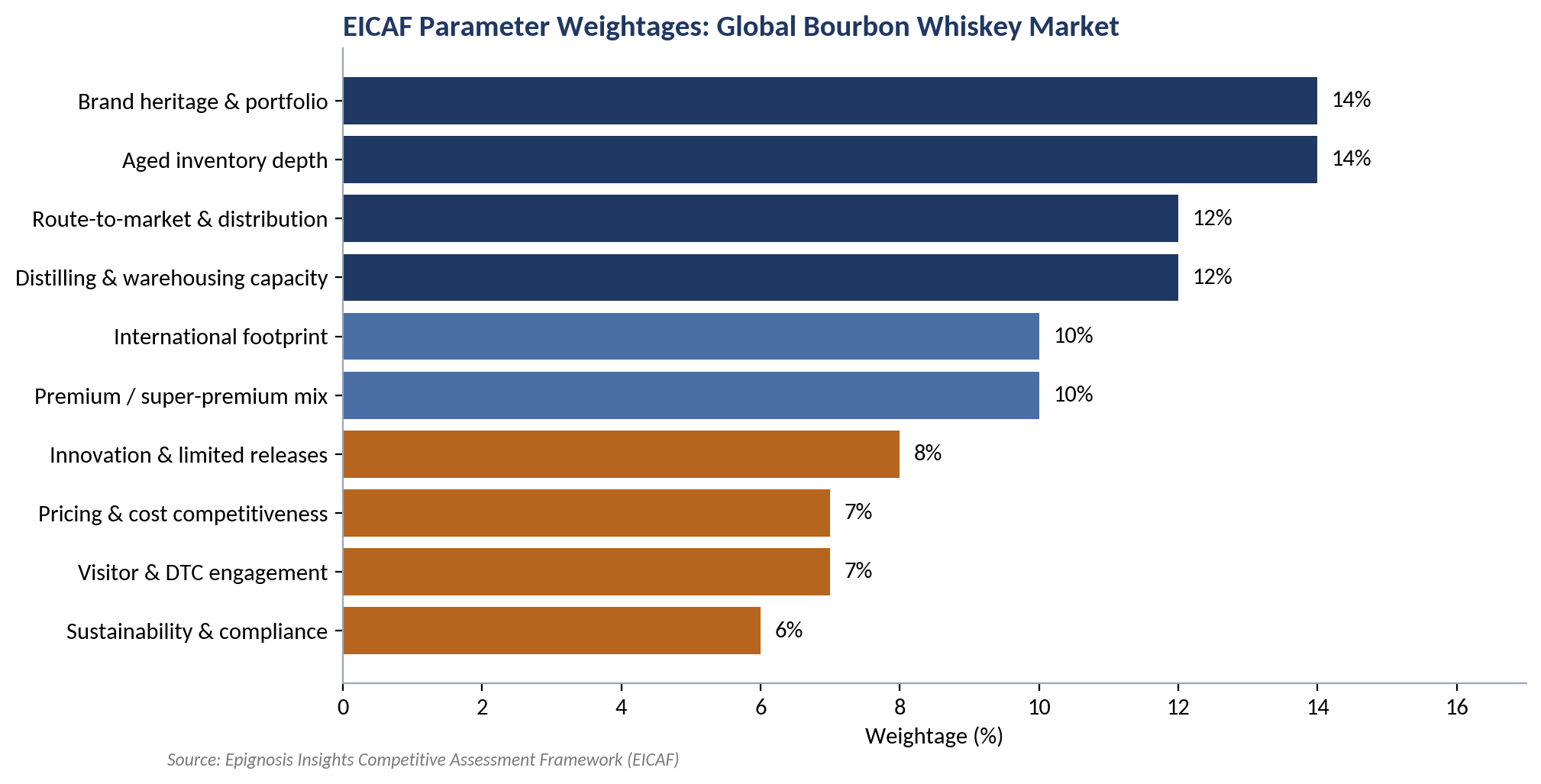
The Epignosis Insights Competitive Assessment Framework (EICAF) for the global bourbon whiskey market evaluates companies across 10 weighted parameters reflecting the category's unique economics, in which maturation time, warehouse capacity and brand heritage shape competitive advantage more than in most spirits categories. Brand heritage and portfolio receives 14% because consumer choice in bourbon is strongly influenced by distillery provenance and recognisable flagship labels. Aged inventory depth also receives 14%, as the ability to supply consistent age statements and small-batch releases depends on stock laid down years in advance. Distilling and warehousing capacity receives 12% and route-to-market and distribution receives 12%, reflecting the importance of scale and access to on-trade and retail networks. Premium and super-premium mix and international footprint each receive 10%, followed by innovation and limited releases at 8%, visitor and direct-to-consumer engagement at 7%, pricing and cost competitiveness at 7%, and sustainability and compliance at 6%. The total weighting equals 100%.
EICAF Scoring Method
Each company can be assigned a score from 1 to 5 against every parameter, with the weighted score calculated as Company Score × Parameter Weightage. The resulting EICAF score provides a structured comparison of competitive capability without relying solely on revenue or volume share. This approach is particularly relevant to the bourbon whiskey market because companies compete through very different models, including diversified multinational portfolios, family-owned heritage distilleries and independent bottlers that source and blend aged stock from third-party producers.