Global Cocoa Price Tracker
Weekly Edition — Week Ending 22 September 2026 (Week 39)


Weekly Edition — Week Ending 22 September 2026 (Week 39)
Cocoa futures closed the week in clear bearish territory as near-term supply abundance overwhelmed the forward-looking weather narrative that had lifted prices to 11.5-month highs at the end of August. According to Epignosis Insights' weekly price assessment, the benchmark ICE New York December 2026 contract settled at approximately USD 5,406 per tonne on Tuesday, 22 September, down 8.8% week-on-week, while ICE London December settled near GBP 3,999 per tonne, a weekly decline of 7.3%. The week was defined by a single violent session on Friday, 18 September, when New York fell 7.7% and London 7.5% as the market capitulated to a combination of record-scale Ivorian port arrivals and exchange stocks sitting at a two-year high.
The early-week recovery on Monday and Tuesday was modest and driven by short-covering against forecasts of dry weather across Côte d'Ivoire's cocoa belt, rather than by any change in physical fundamentals. Epignosis Insights' core view is that the market is now caught between a comfortable 2025/26 inventory position and a 2026/27 balance that forecasters have compressed to near-zero surplus. That tension is likely to keep realised volatility elevated through the October–November window, when the main-crop harvest pace and the arrival of harmattan conditions become visible.
Table 1 summarises the benchmark settlement levels tracked by Epignosis Insights for the reporting week. The Tuesday-to-Tuesday window is used to capture the full effect of the Friday sell-off and the partial rebound that followed.
| Indicator | 15 Sep 2026 | 22 Sep 2026 | W/W Change | Week Range |
| ICE NY Dec-26 (USD/t) | 5,927 | 5,406 | -8.8% | 5,331 – 5,983 |
| ICE London Dec-26 (GBP/t) | 4,315 | 3,999 | -7.3% | 3,935 – 4,378 |
| ICE certified stocks (M bags) | ~3.43 | 3.435 | Flat | Near 2-yr high |
| Largest daily move (NY) | — | 18 Sep | -7.7% | 7-week low |
| Epignosis weekly signal | Neutral | Bearish | Downgrade | - |
Table 1 — Settlement values reconstructed by Epignosis Insights from reported daily ICE settlement changes; indicative to within ±5 points.
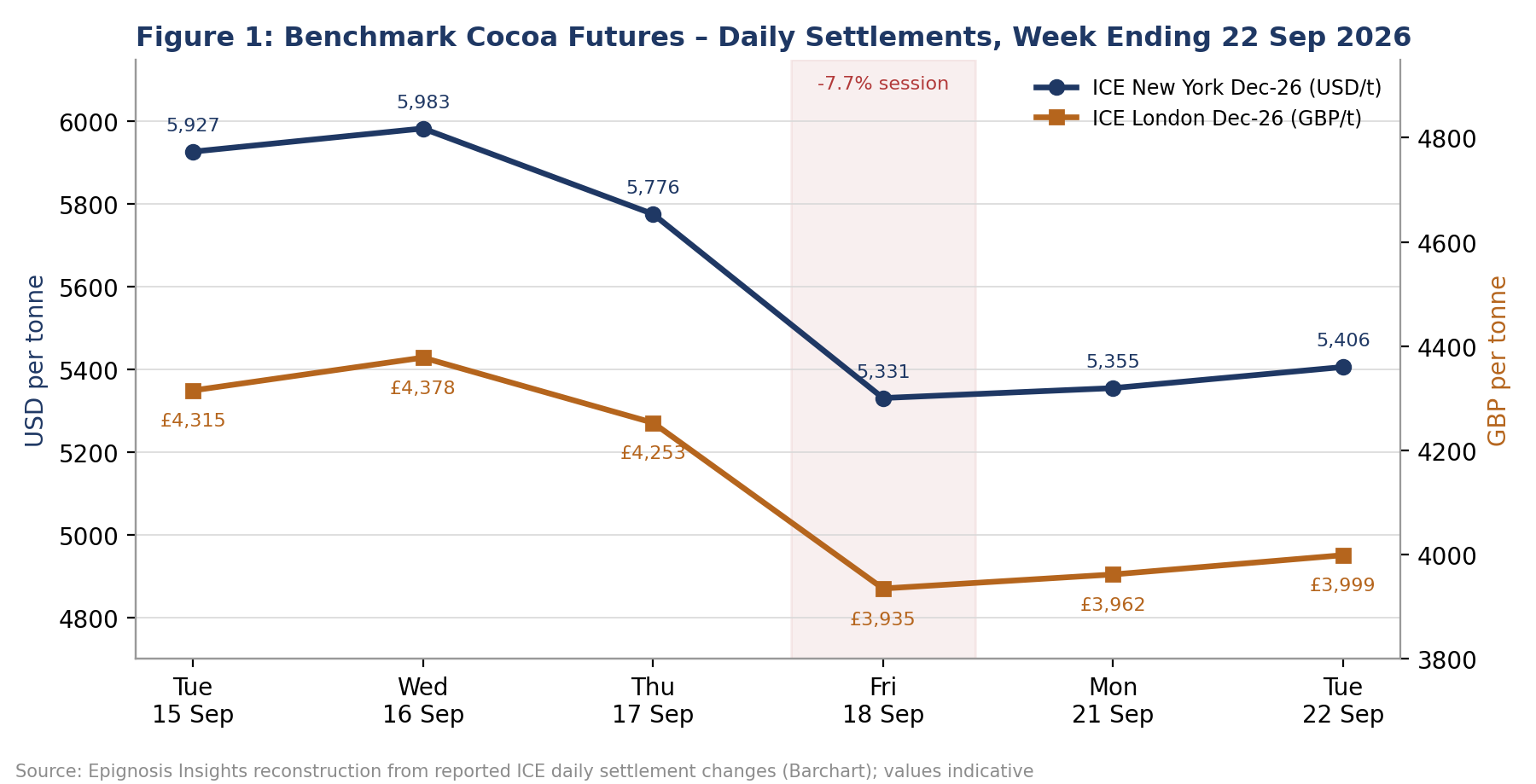
Daily settlement data compiled from Barchart's exchange coverage [1] show that New York opened the week firmly, adding 0.95% on Wednesday to reach USD 5,983 as the market consolidated beneath its late-August peak. Selling resumed on Thursday with a 3.5% decline and then accelerated into Friday, when the contract fell USD 445 in a single session. Sterling weakness partially cushioned London in the early part of the week, which explains the slightly smaller percentage loss on the European contract. Importantly, the rebound in the final two sessions recovered only around 15% of the Friday loss, signalling that buyers remain cautious rather than aggressive at current levels.
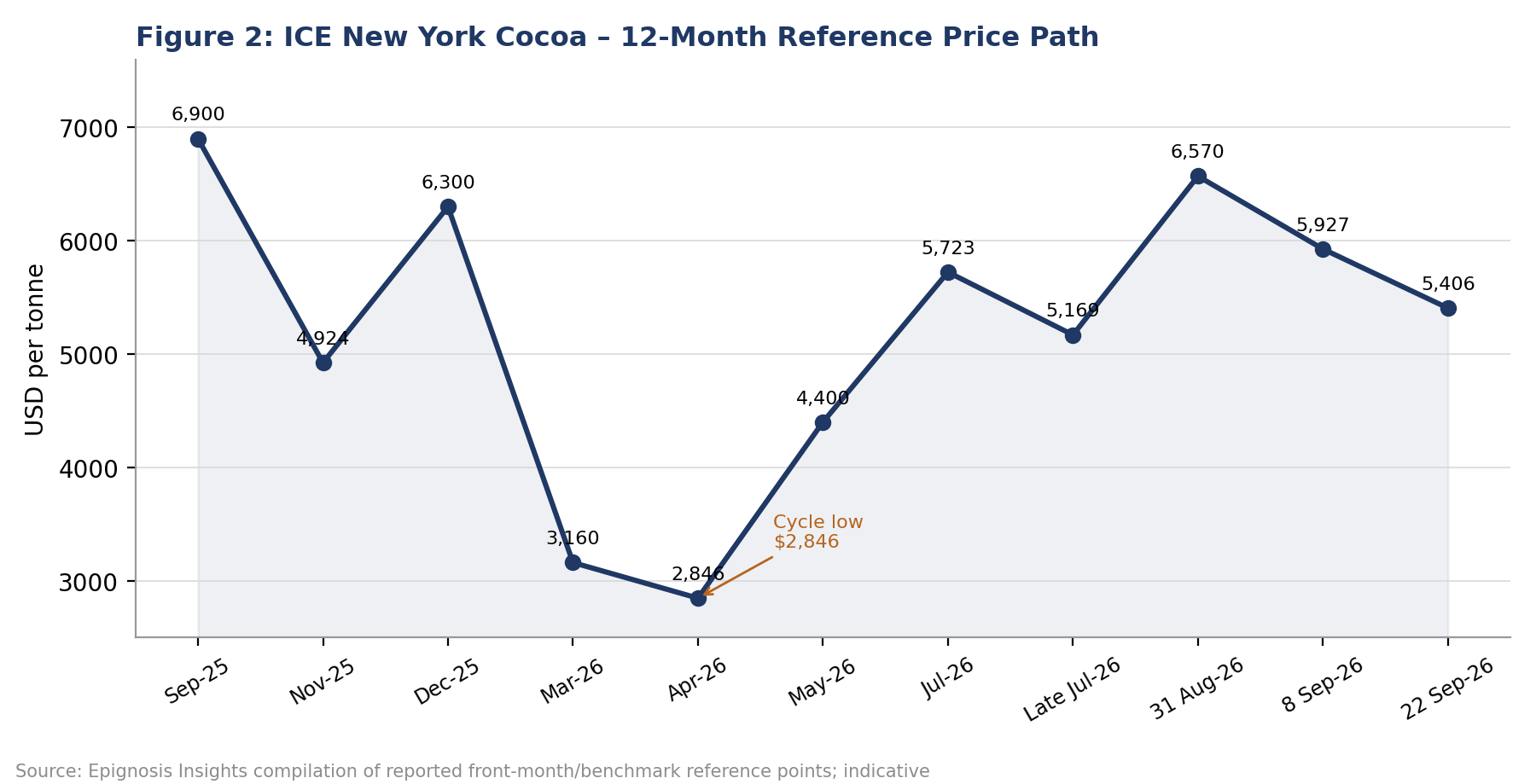
The current price level must be read against one of the most extreme cycles in the history of the cocoa market. After peaking near USD 12,900 per tonne in December 2024, prices fell below USD 5,000 in November 2025 and collapsed to a cycle low of roughly USD 2,846 in April 2026 as the 2025/26 West African crop recovered and demand destruction became visible in grind data. The subsequent recovery was equally dramatic: prices more than doubled between April and the end of August, driven by the unwinding of heavy speculative short positions and then by fundamental downgrades to the 2026/27 crop outlook. At USD 5,406, the market now sits roughly 18% below its late-August high but still about 90% above the April trough. Epignosis Insights interprets this as a market that has repriced forward risk but is now testing whether that repricing was premature given the physical supply currently available.
The dominant bearish input this week was the confirmed scale of Ivorian supply. Bloomberg's port-arrival tracking [2] showed that farmers delivered 2.14 million tonnes to ports in the international marketing year through 13 September, 18% above the prior year. This follows confirmation from Le Conseil du Café-Cacao [3] that the country harvested 2.06 million tonnes between June 2025 and June 2026, a 30% year-on-year increase, alongside the regulator's ambition to double domestic processing capacity to 1.3 million tonnes in 2026/27. However, the picture for the new season is materially different. Côte d'Ivoire has moved its marketing year to begin on 1 September, and Reuters' tally of new-season deliveries [4] recorded just 26,000 tonnes in the first thirteen days, down roughly 46% from the equivalent period of the prior season. Epignosis Insights views this divergence as the crux of the current market: old-crop abundance is visible in warehouses, while new-crop weakness is only beginning to appear in arrival data.
Ghana's supply outlook remains the clearest bullish factor. The Ghana Cocoa Board (COCOBOD) [5] estimated in August, following a pod-count survey, that the 2026/27 crop will reach approximately 650,000 tonnes, a 13% decline from 750,000 tonnes last season. Swollen shoot virus, ageing tree stock, illegal mining encroachment and excess moisture that encourages black pod disease all contribute to the downgrade. Compounding the production issue is a financing bottleneck: The High Street Journal [6] reports that COCOBOD is struggling to raise domestic funding for the new season, with licensed buying companies owed an estimated GH¢4 billion in arrears, delaying the start of Ghana's campaign relative to its neighbour.
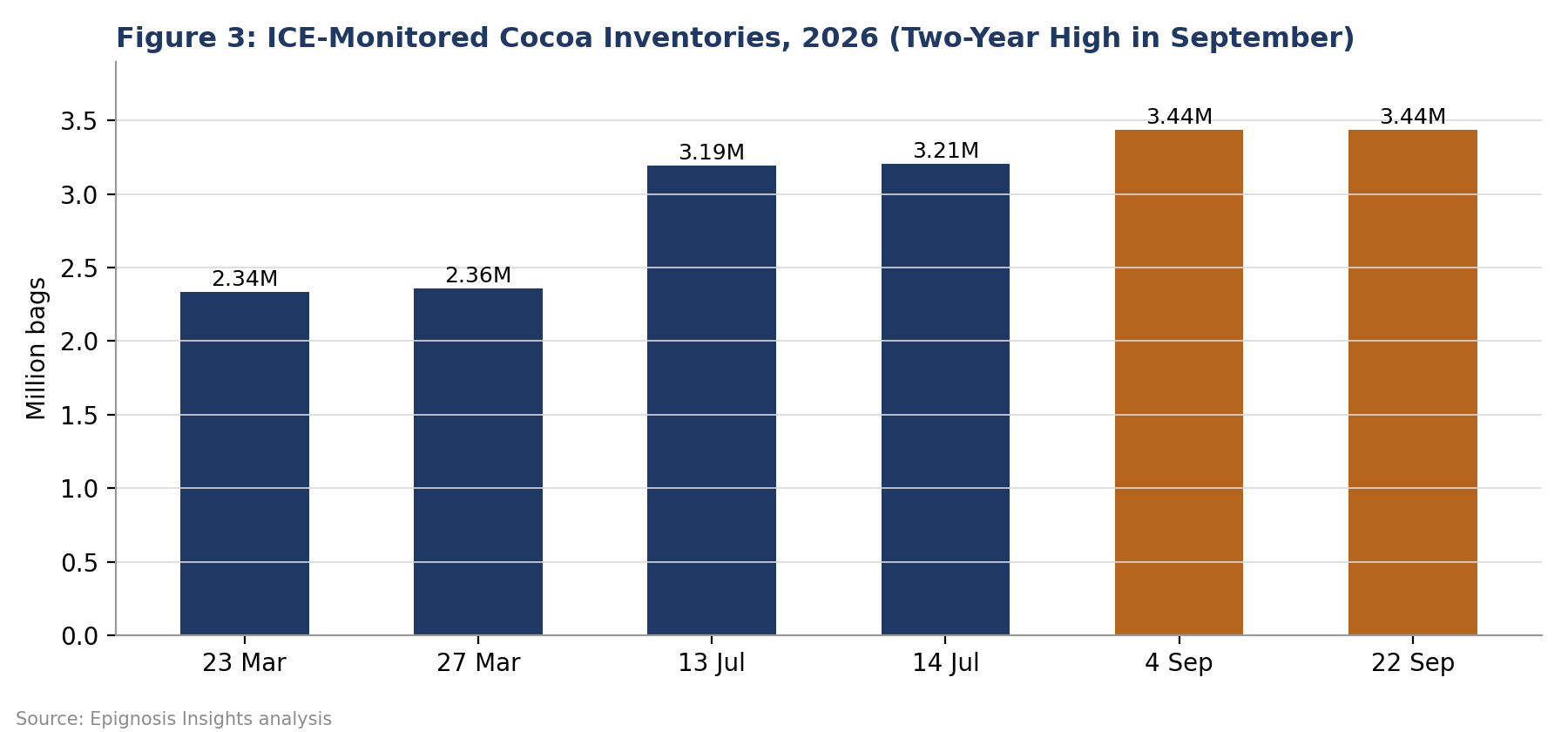
Exchange stocks continue to anchor bearish sentiment. Intercontinental Exchange (ICE) certified inventory data [7] show stocks reaching a two-year high of 3,436,742 bags on 4 September and holding at 3,435,088 bags as of 22 September, roughly 47% higher than levels recorded in late March. For price discovery, this matters because a deep certified stock pile allows short-dated contracts to be delivered against comfortably, suppressing nearby spreads and limiting the ability of weather headlines to sustain rallies.
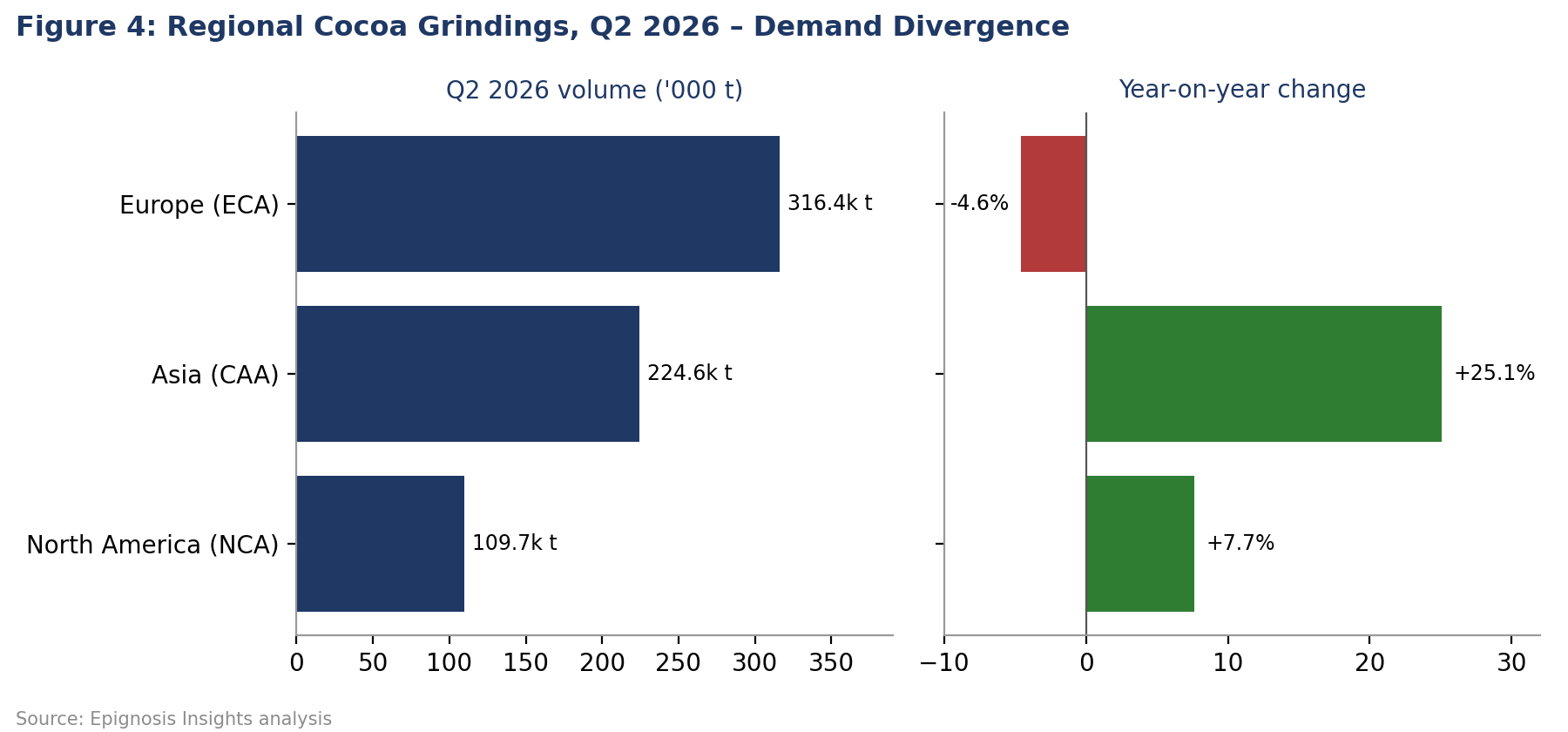
Demand signals remain regionally fragmented. The European Cocoa Association [8] reported Q2 2026 grindings of 316,366 tonnes, down 4.6% year-on-year and the weakest second quarter since 2020, with first-half volumes 7.8% lower. In sharp contrast, the Cocoa Association of Asia [9] reported Q2 grindings of 224,646 tonnes, up 25.1%, reflecting the continued migration of processing capacity to Malaysia and Indonesia. The National Confectioners Association [10] reported North American grindings up 7.65% to 109,659 tonnes, although changes to its reporting panel since Q3 2025 mean this figure should be interpreted cautiously.
Corporate disclosures add nuance. Barry Callebaut [11], the world's largest cocoa processor, reported its first quarterly sales increase in more than two years in its fiscal Q3 update and stated in early September that the global market is well supplied and better positioned to absorb weather risk than during the 2023/24 El Niño. Meanwhile, The Hershey Company's Q2 2026 results [12] showed net sales rising 6.6% to USD 2.79 billion, but this was driven by a 12% price increase that more than offset an 8% fall in volume. Epignosis Insights reads this as evidence that consumer demand has not yet recovered at the retail level; value growth is being manufactured through pricing, which caps the upside for bean demand in mature markets.
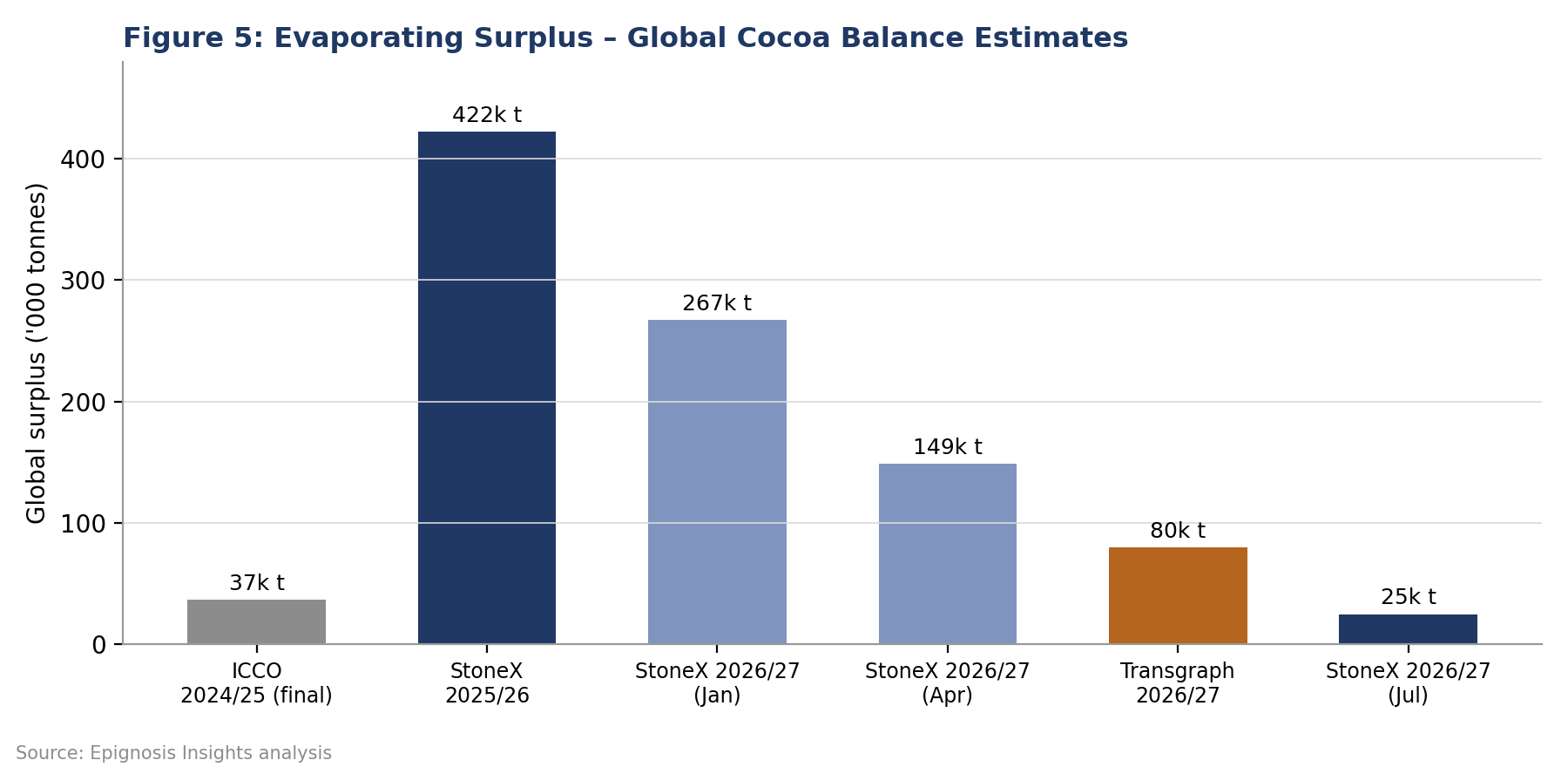
The International Cocoa Organization's August 2026 Quarterly Bulletin [13] estimated the 2024/25 season at 4.733 million tonnes of production against 4.649 million tonnes of grindings, producing a modest 37,000-tonne surplus and a stocks-to-grindings ratio of 28.2%; notably, the Secretariat has temporarily withheld its 2025/26 estimates. Forward estimates have moved sharply. StoneX [14] raised its 2025/26 surplus to 422,000 tonnes while cutting its 2026/27 figure by 83% to only 25,000 tonnes, projecting Ivorian output falling 11% to 1.77 million tonnes and Ghana down 10% to 585,000 tonnes. Transgraph Consulting [15] similarly cut its 2026/27 surplus projection to 80,000 tonnes from 415,000 tonnes. Epignosis Insights' synthesis is that the market is transitioning from a large current-season surplus to an essentially balanced forward season, where any El Niño-driven production shock could quickly flip the balance into deficit.
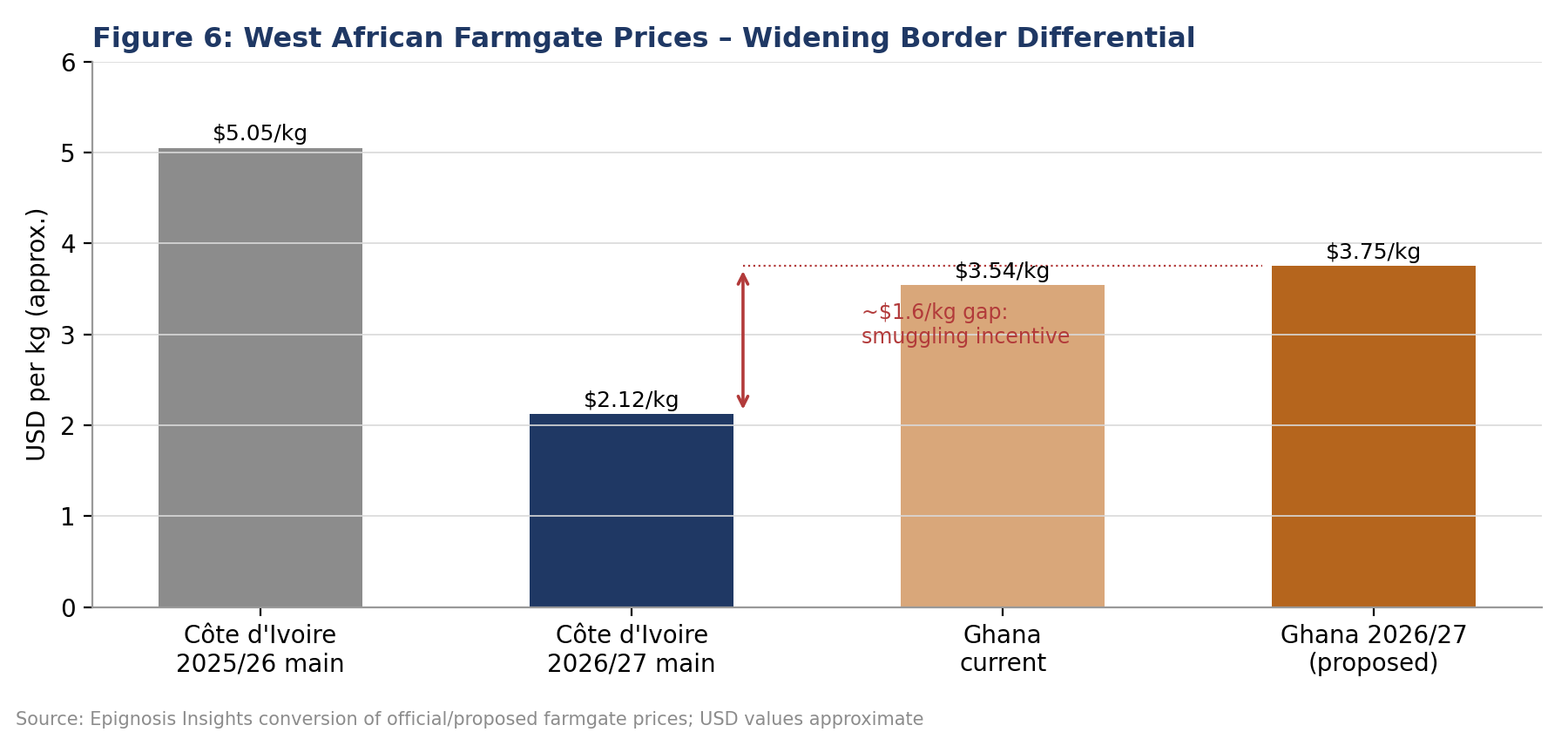
Producer-price policy is becoming an independent source of supply risk. Côte d'Ivoire's Ministry of Agriculture [16] confirmed on 1 September that the 2026/27 main-crop farmgate price will be held at 1,200 CFA francs per kilogram, around USD 2.12 and 57% below the 2,800 CFA francs paid a year earlier. Across the border, Ghana's regulator has proposed a roughly 6% increase to 2,737 cedis per 64-kilogram bag, a proposal still subject to Finance Ministry approval. Epignosis Insights estimates the resulting differential at approximately USD 1.6 per kilogram, a gap wide enough to incentivise cross-border bean movement, distort official crop statistics and erode Ivorian port arrivals later in the season. Separately, the European Union Deforestation Regulation compliance deadline in December 2026 adds traceability costs that depressed farmgate economics make harder to absorb.
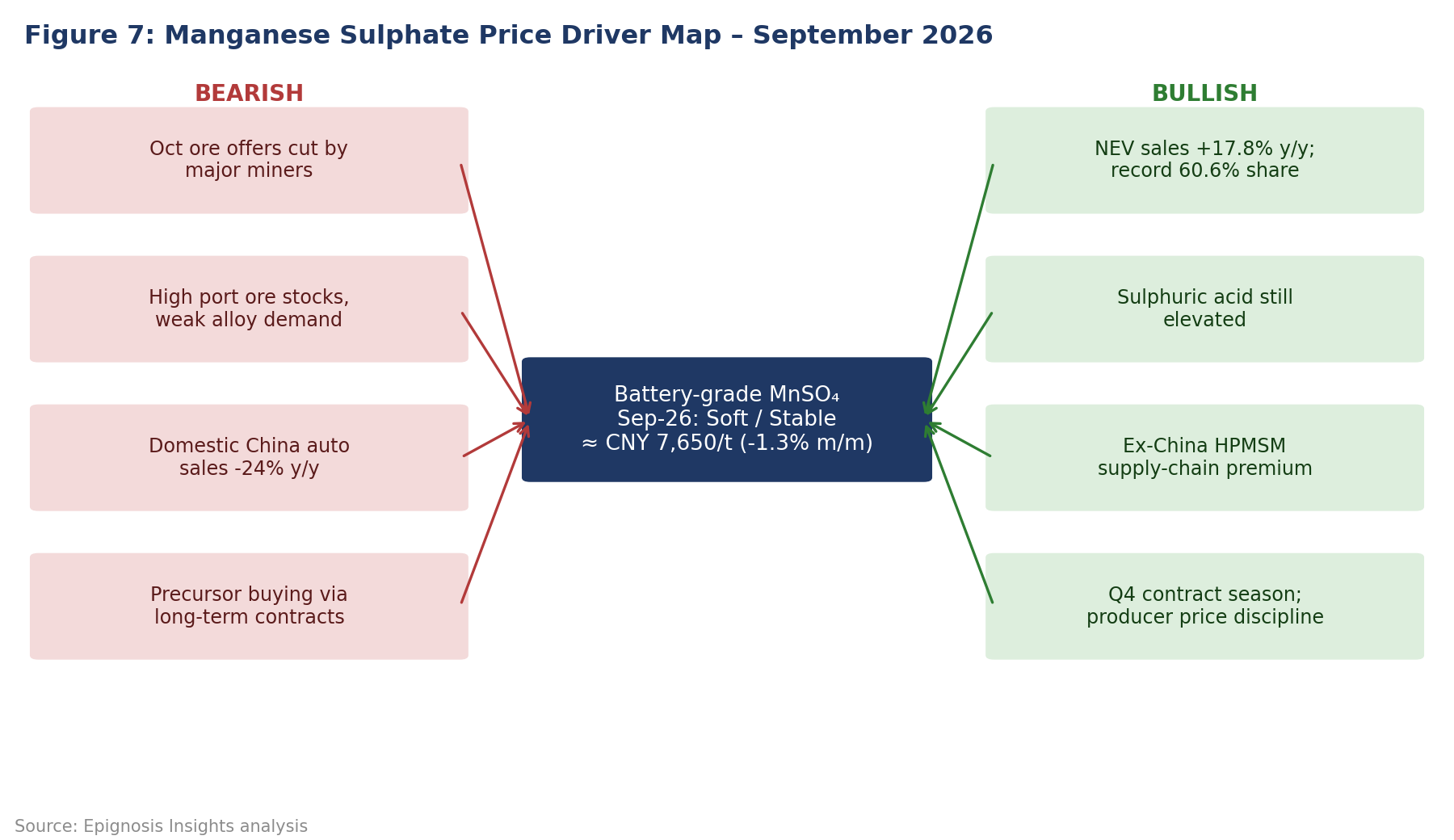
Figure 7 captures the balance of forces as assessed by Epignosis Insights. Near-term factors—inventories, old-crop arrivals and weak European grinding—are uniformly bearish and are currently dominating price action.
Forward factors—El Niño, the Ghanaian downgrade, a vanishing 2026/27 surplus and Asian processing strength—are bullish but not yet confirmed by physical data. The market's direction over the coming month depends on the speed at which forward risks convert into observable supply shortfalls.
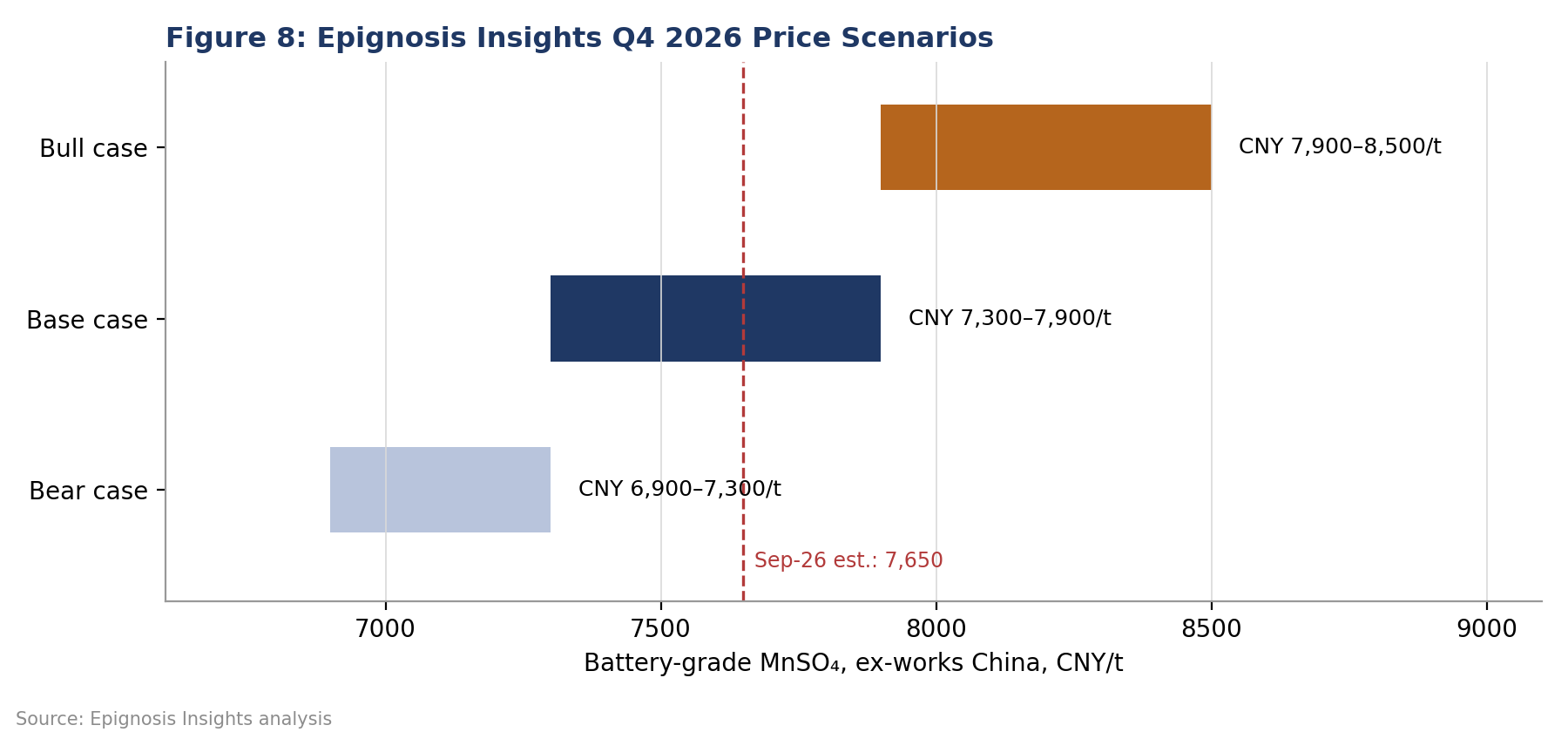
Epignosis Insights' base case places ICE New York December between USD 5,100 and USD 5,900 per tonne through end-October, with range trading as the market awaits new-season arrival data. The bear case (USD 4,600–5,100) assumes regular rainfall, a faster-than-expected Ivorian main-crop start and continued growth in certified stocks. The bull case (USD 5,900–6,800) requires confirmation of dry-weather stress, weak October arrivals and a deterioration in Ghana's campaign financing. Key catalysts to monitor include weekly Ivorian port arrivals, the formal approval of Ghana's producer price, European Q3 grind data due on 15 October, and seasonal forecasts for the timing and intensity of harmattan winds.
For chocolate manufacturers and industrial buyers, the Friday sell-off offers a tactical window to extend first-quarter 2027 cover at prices well below the late-August high. Epignosis Insights recommends staggered forward buying rather than full coverage, given the asymmetric upside risk embedded in the 2026/27 balance and the potential for rapid repricing if arrivals disappoint.