Europe Dairy Price Tracker
Monthly Report: September 2026


Monthly Report: September 2026
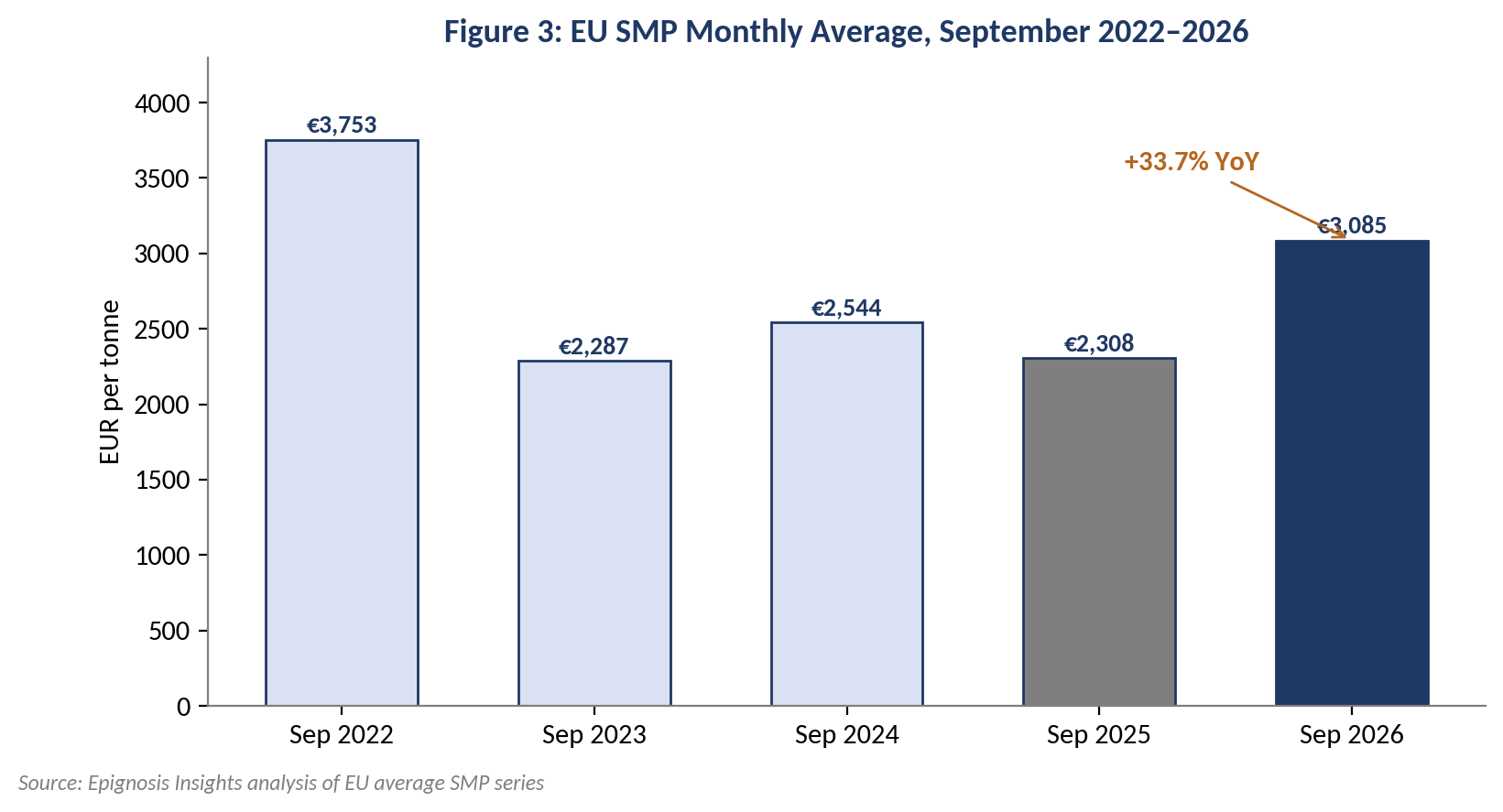
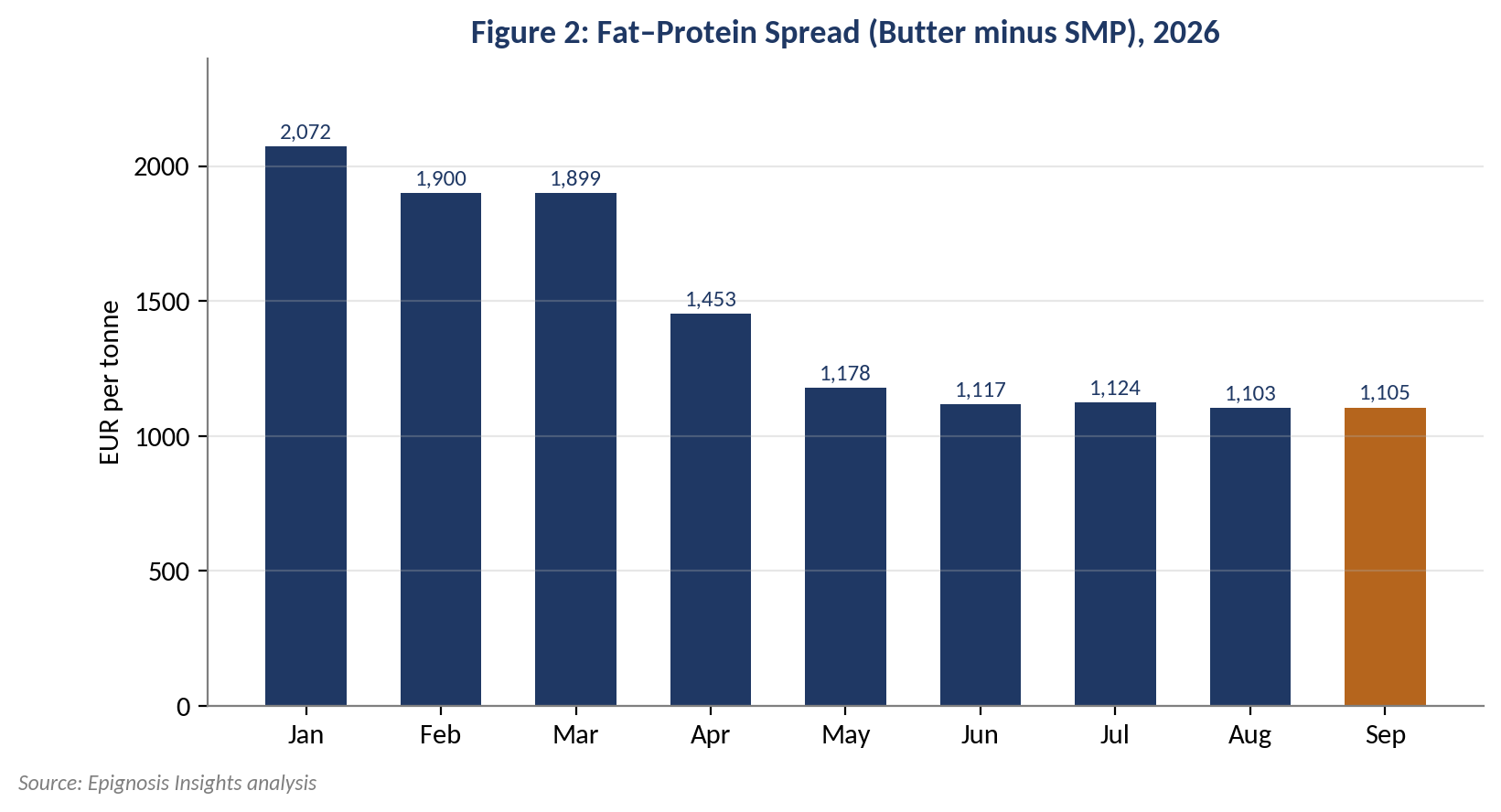
European dairy commodity markets closed September 2026 in a materially different shape from the one in which they opened the year. Epignosis Insights' September tracker places the EU skimmed milk powder (SMP) monthly average at €3,085 per tonne, up 6.9% on August and 33.7% above September 2025, while butter has rebuilt to an indicative €4,190 per tonne after bottoming close to €3,850 through June and July. The defining feature of the month is not the absolute level of either product but the collapse of the fat-protein spread, which narrowed from roughly €2,070 per tonne in January to about €1,100 per tonne in September. In practical terms, protein has replaced fat as the engine of milk valorisation in Europe, reversing the pattern that dominated 2024 and much of 2025.
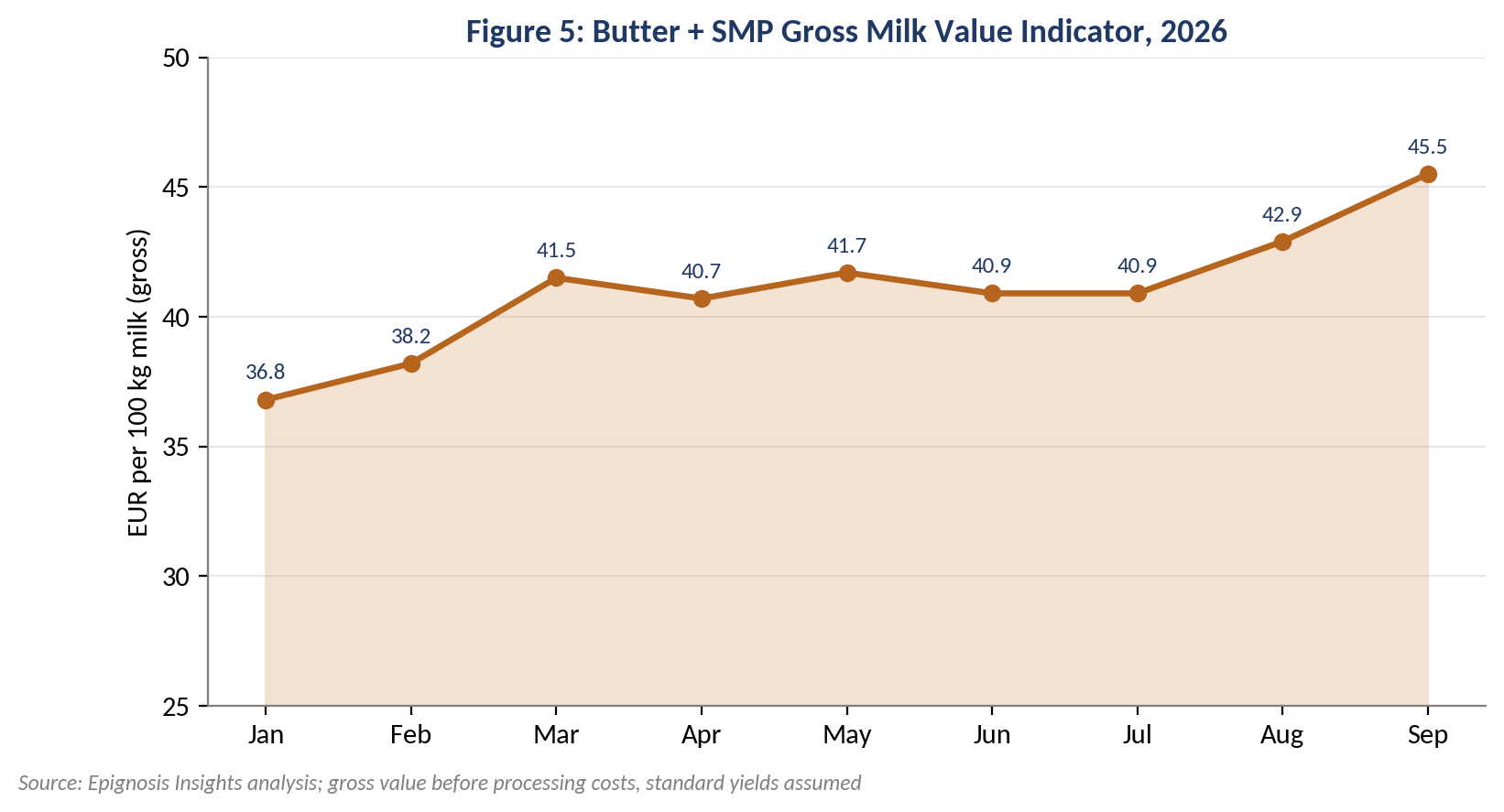
For buyers, the message is that the cheapest phase of the protein cycle has passed, while butter offers a comparatively stable cost base heading into the Christmas baking season. For processors and farmers, the combined butter-plus-SMP milk value indicator compiled by Epignosis Insights has climbed to €45.5 per 100 kg of milk on a gross basis, its highest reading of the year, which points to firmer farm-gate prices in the fourth quarter after an exceptionally weak first half.
| Product (EU average) | Late-Sep level (€/t) | Sep 2026 avg (€/t) | MoM change | YoY change | Signal |
| Butter (82% fat) | 4,250 | 4,190* | +5.0% | c. -38% | Recovering |
| Skimmed milk powder | 3,110 | 3,085 | +6.9% | +33.7% | Firm |
| Whole milk powder | 3,770 | 3,720* | +3.9% | n/a | Firm |
| Butter + SMP milk value (€/100 kg) | n/a | 45.5* | +6.1% | n/a | Improving |
* Epignosis Insights indicative monthly estimate derived from weekly benchmark quotations. Source: Epignosis Insights analysis.
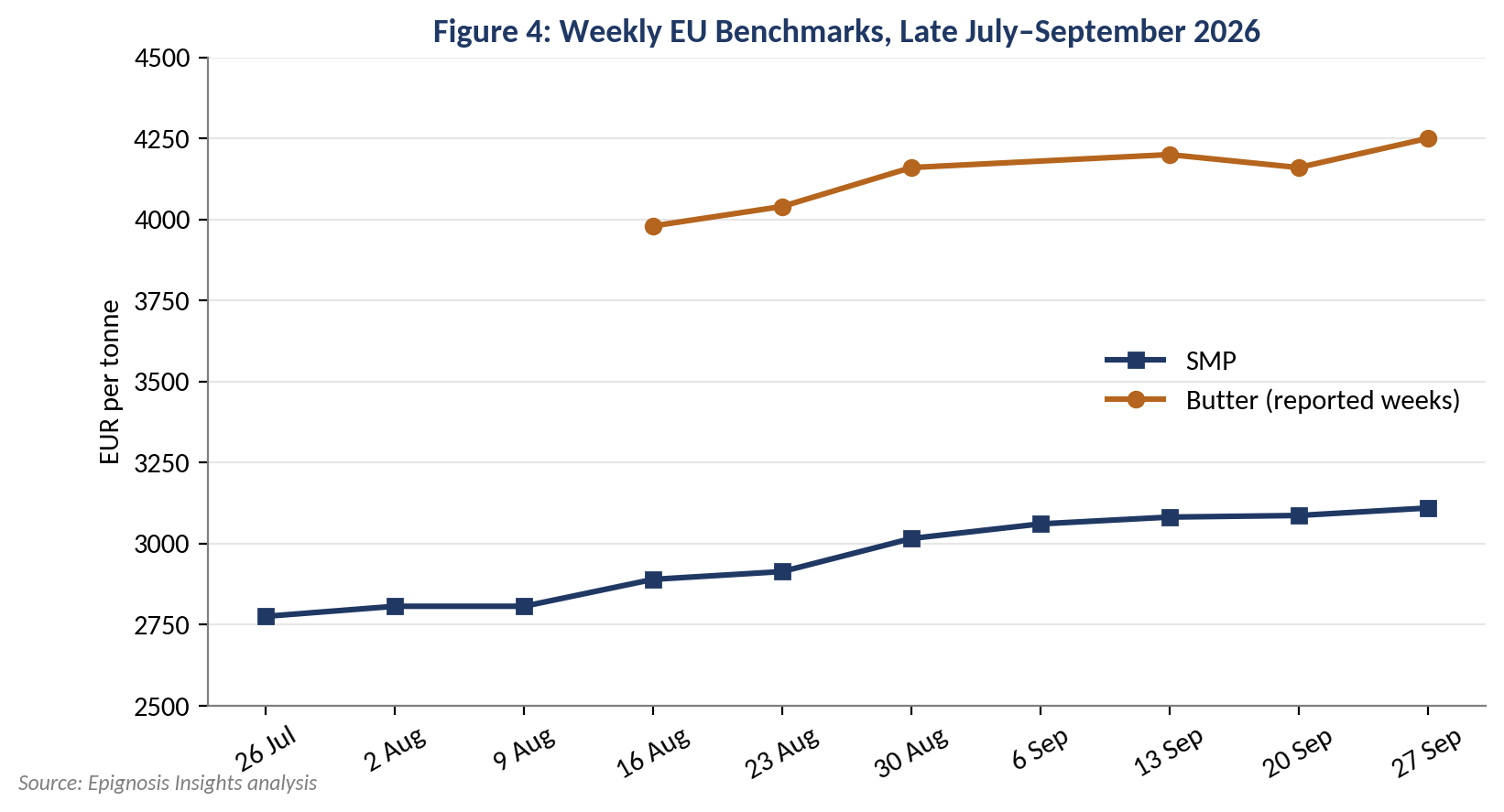
The European Commission's Milk Market Observatory recorded the EU average SMP quotation at €3,110 per tonne and butter at €4,250 per tonne for the week ending 27 September, the strongest weekly reading for both products since the spring. SMP has now gained ground in nine of the last ten reporting weeks, a run that Epignosis Insights regards as evidence of genuine end-user demand rather than short-covering.
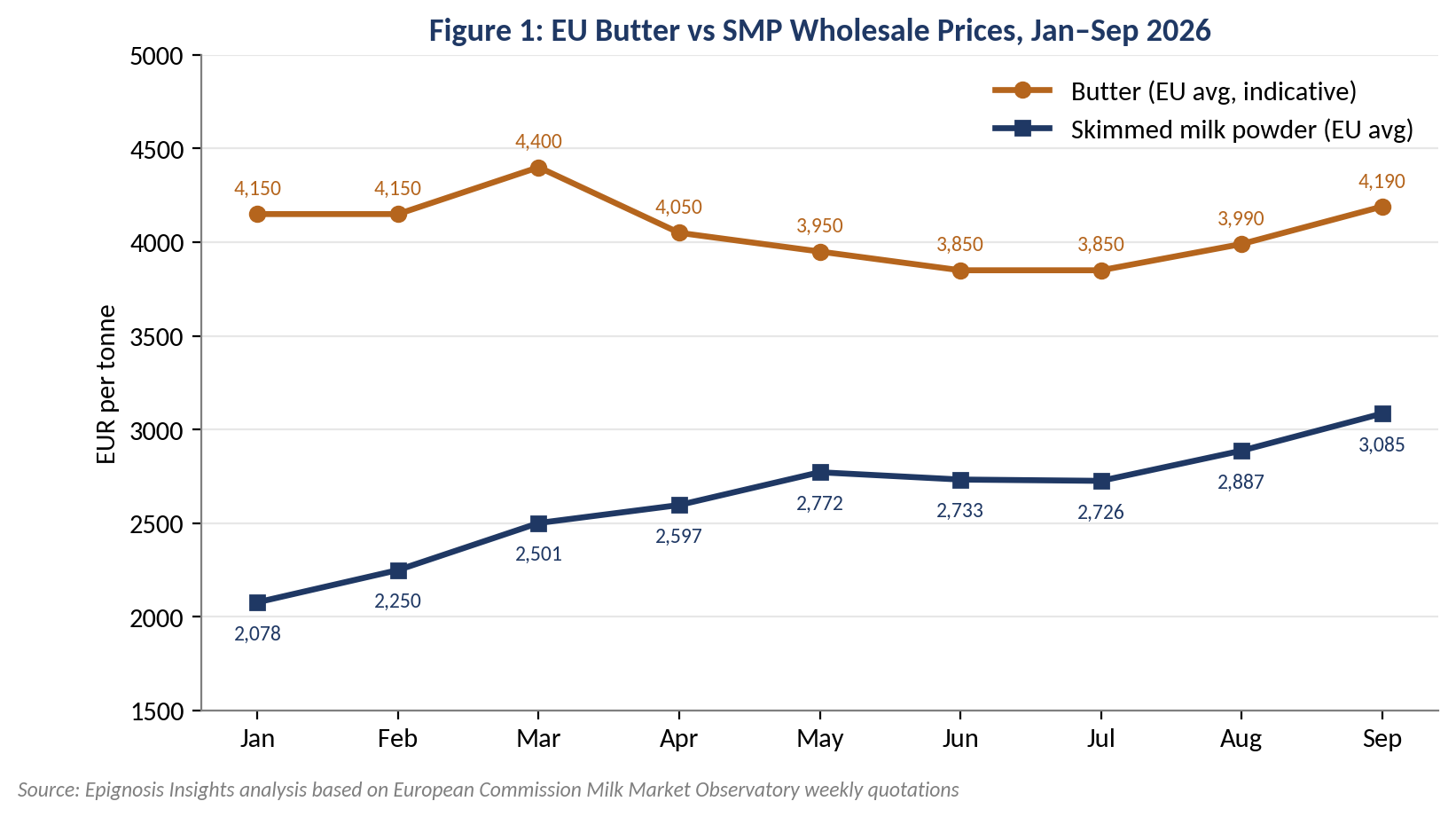
Butter has been the weakest major dairy commodity in Europe for twelve months, and its decline set the tone for the entire complex. The roots of the sell-off lie in 2025, when a production surge built an EU butter surplus of 93,700 tonnes across the first three quarters, according to Vesper, whose price index already stood at €4,090 per tonne in early December. That overhang carried into 2026: a short pre-Easter rally lifted quotations to the mid-€4,000s in early March before the market reversed sharply, and Expana assessed unsalted EU butter at €3,900 per tonne on 31 March, down €500 on the month.
The spring flush then kept cream plentiful and butter churns running at high utilisation, holding prices in a narrow €3,800 to €4,000 band through mid-summer. The Epignosis Insights view is that the floor was set in July, when price-sensitive export buyers in the Middle East and North Africa returned and European retailers began contracting for the fourth quarter at levels well below 2025. The recovery to €4,250 by late September is modest in percentage terms, but it is the first sustained upward move since early 2025 and has occurred while milk fat content remains seasonally high, which suggests the stock overhang has largely cleared.
Year-on-year comparisons remain stark. September 2026 butter sits roughly 38% below the same month of 2025, when European quotations were still in the high €6,000s per tonne. That gap matters for processors who sold forward at last year's prices and for retail pricing, which typically lags wholesale by three to six months.
SMP has been the clear outperformer of 2026. The monthly EU average, as compiled by CLAL from Commission data, rose from €2,078 per tonne in January to €3,085 per tonne in September, a 48% gain in eight months and the highest September reading since 2022. The rally has been driven by three overlapping factors identified in Epignosis Insights' demand monitoring: stronger import appetite from Southeast Asia and Algeria, a structural shift in European processing toward cheese and whey protein that diverts skim milk away from drying towers, and the reappearance of China as a regular, if cautious, buyer on global tenders.
Global auction evidence supports the European picture. Rabobank's Q3 Global Dairy Quarterly reports that SMP prices jumped by more than 10% across Global Dairy Trade events during the quarter, and estimates that global milk production growth slowed to 1.4% year-on-year in the third quarter, the weakest quarterly expansion since early 2025, with the bank's earlier research pointing to an outright contraction in the fourth quarter. A tightening supply outlook combined with resilient protein demand is the classic set-up for a sustained powder market, and European SMP is increasingly priced off that global balance rather than domestic surplus.
Whole milk powder (WMP) has tracked SMP higher, reaching approximately €3,770 per tonne in late September from roughly €3,000 at the start of the summer. European WMP remains a niche export product, and production fell markedly in 2025 as milk was redirected to cheese and butter, so modest demand gains translate quickly into firmer quotations.
Cheese tells a more cautious story. Commodity Board's market analysis shows the major varieties, including Cheddar, Gouda, Edam and Emmental, trading between 16% and 28% below year-earlier levels, reflecting heavy production and full storage. Epignosis Insights expects cheese to lag the powder recovery by one to two quarters, because ripening inventories built during the spring must be worked through before price discovery improves. Whey has remained relatively firm on the back of the protein ingredients boom, which supports cheesemakers' overall returns even as block cheese prices stay subdued.
The most important structural signal in this edition is the compression of the butter-SMP spread. In January, a tonne of butter commanded roughly €2,070 more than a tonne of SMP; by September, that premium had fallen to about €1,100. Historically, a wide spread rewards butter-powder plants for maximising fat output, while a narrow spread shifts the incentive toward protein streams such as SMP, milk protein concentrates and cheese-whey combinations. Epignosis Insights expects the narrower spread to persist through the winter, which will keep European processors oriented toward protein capacity and restrain fresh butter supply.
The butter-plus-SMP milk value indicator, which Epignosis Insights calculates using standard yields of 4.6 kg of butter and 8.5 kg of SMP per 100 kg of milk before processing costs, rose from €36.8 per 100 kg in January to €45.5 in September. After deducting typical conversion costs, the indicator now implies a raw milk value comfortably above the farm-gate prices most European processors paid in the first half of the year, signalling room for price increases into the winter.
The commodity slump fed directly into producer prices. European Dairy Farmers reported that the average EU milk price in its processor comparison fell to €40.48 per 100 kg in March, more than 19% lower year-on-year, while EU deliveries were running 4.5% ahead of 2025 on a year-to-date basis. By June, ZuivelNL calculated the European average price including bonuses at €40.04 per 100 kg, some €10.31 below June 2025, although May had delivered the first monthly increase in almost a year.
Company results confirm the margin squeeze. FrieslandCampina's half-year report shows a guaranteed milk price of €40.49 per 100 kg for the first half of 2026, down 27.2% from €55.63 a year earlier, with operating profit falling to €269 million from €363 million. The cooperative nevertheless guided to higher results in the second half, driven by protein. Arla Foods has moved in the same direction in the UK, lifting its conventional headline price to 38.15 pence per litre for August and noting that protein markets were showing signs of strengthening. Epignosis Insights anticipates further on-account increases from major North-West European cooperatives in October and November as the September commodity gains feed through pricing formulas.
| Milk price reference | Period | Value | Comment |
| EU average (processor comparison) | Mar 2026 | €40.48/100 kg | Over 19% lower YoY |
| European average incl. bonuses | Jun 2026 | €40.04/100 kg | €10.31 below Jun 2025 |
| FrieslandCampina guaranteed price | H1 2026 | €40.49/100 kg | -27.2% YoY |
| Butter + SMP milk value (gross) | Sep 2026 | €45.5/100 kg | Year high |
Source: Epignosis Insights compilation of industry association and company disclosures.
On supply, the United States Department of Agriculture's July balance sheet projects EU cow milk production at 150.0 million tonnes in 2026, up 1.0%, with EU butter exports forecast to rise by about a fifth as competitive pricing reopens export channels. That production base follows a strong 2025: Agriland, reporting on the Commission's milk market data, noted that EU butter output rose 6.2% last year while SMP output grew 5.1%. Growth is now decelerating as margins compress, herds adjust and summer heat curbs yields in parts of Western Europe.
Input costs are the main upside risk to the supply response. Elevated energy, fertiliser and feed prices, partly tied to ongoing Middle East tensions, are squeezing farm margins at the very moment milk prices bottomed, which Epignosis Insights expects to accelerate herd reductions in higher-cost regions over the winter. On the demand side, protein-led consumption trends, recovering Asian imports and a more competitive euro export price are absorbing surplus product more quickly than many market participants anticipated in the spring.
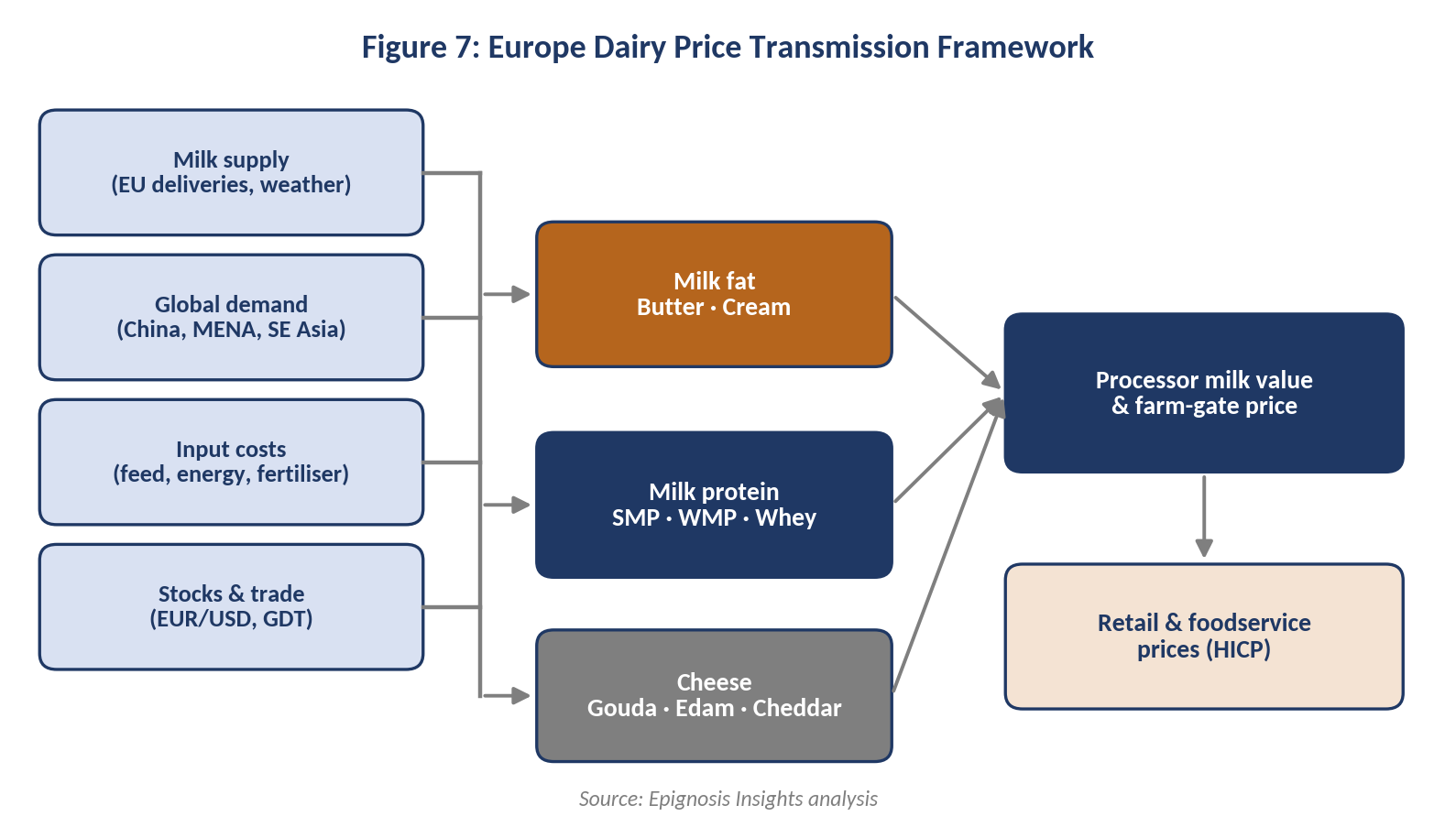
Consumers are only beginning to see the benefit of lower wholesale prices. Eurostat data show that EU consumer prices for butter and other milk fats were 16.6% lower in June 2026 than a year earlier, while cheese prices were down just 2.3%. The gap between a roughly 40% wholesale decline in butter and a 17% retail decline illustrates the lag and margin cushion in retail pricing. With wholesale butter now recovering, Epignosis Insights expects retail butter deflation to narrow through the fourth quarter, while cheese shelf prices are likely to remain broadly flat.
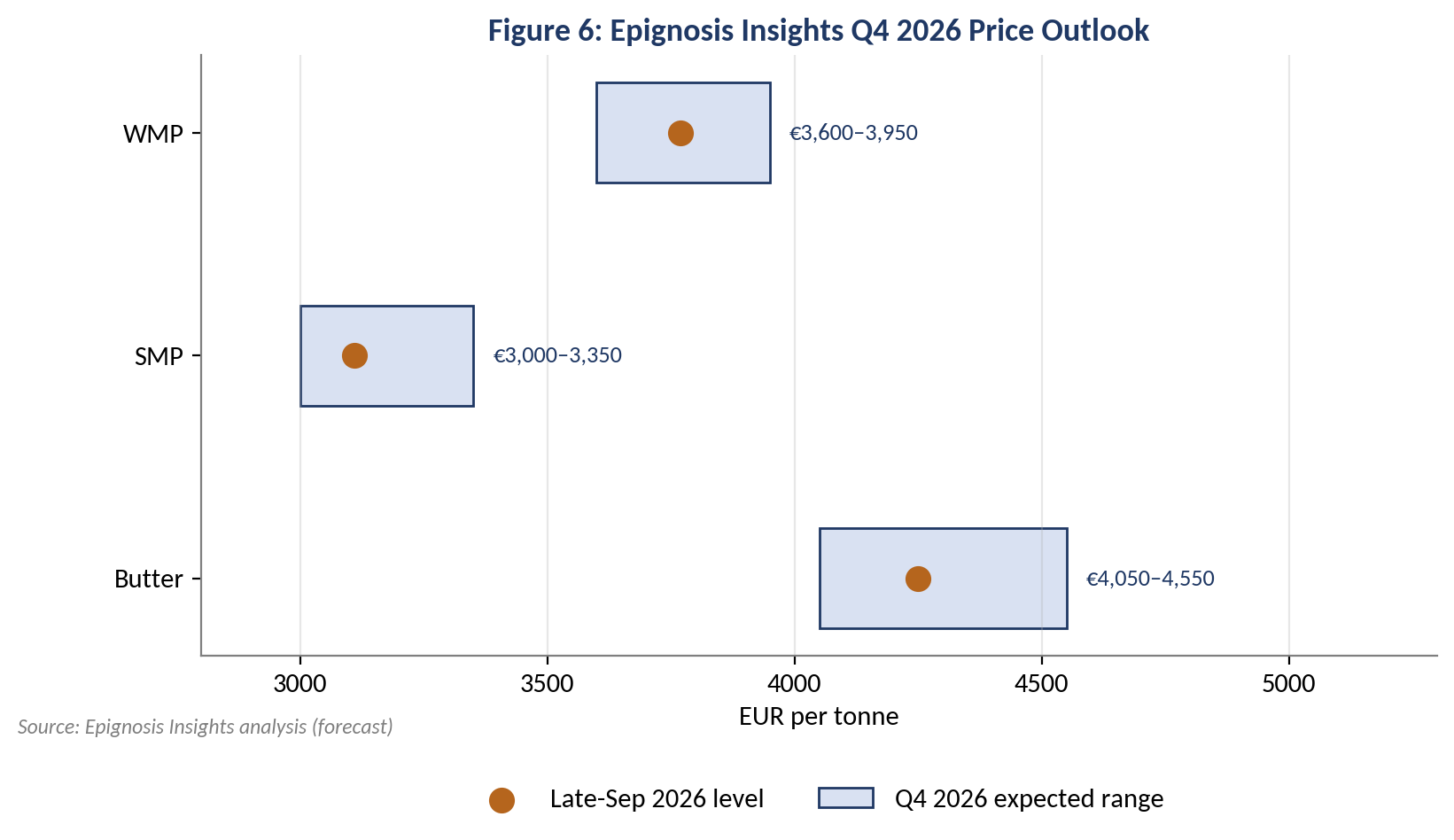
Epignosis Insights' base case is a gradual, protein-led firming of European dairy prices through the fourth quarter. We expect butter to trade in a €4,050 to €4,550 per tonne range, supported by seasonal retail demand and lower fresh production, but capped by remaining stocks and the possibility of renewed buyer resistance above €4,500. SMP is forecast between €3,000 and €3,350 per tonne, with downside protected by tightening global supply and upside limited by buyers who have already covered much of their fourth-quarter requirement. WMP is
expected in a €3,600 to €3,950 band.
The principal downside risks are a milder-than-expected slowdown in EU and New Zealand milk output, renewed weakness in Chinese demand and a stronger euro eroding export competitiveness. Upside risks include adverse autumn weather, faster herd liquidation driven by input costs and any disruption to global freight. Overall, Epignosis Insights assesses the balance of risks as tilted modestly to the upside for protein and neutral for fat.