Key Findings
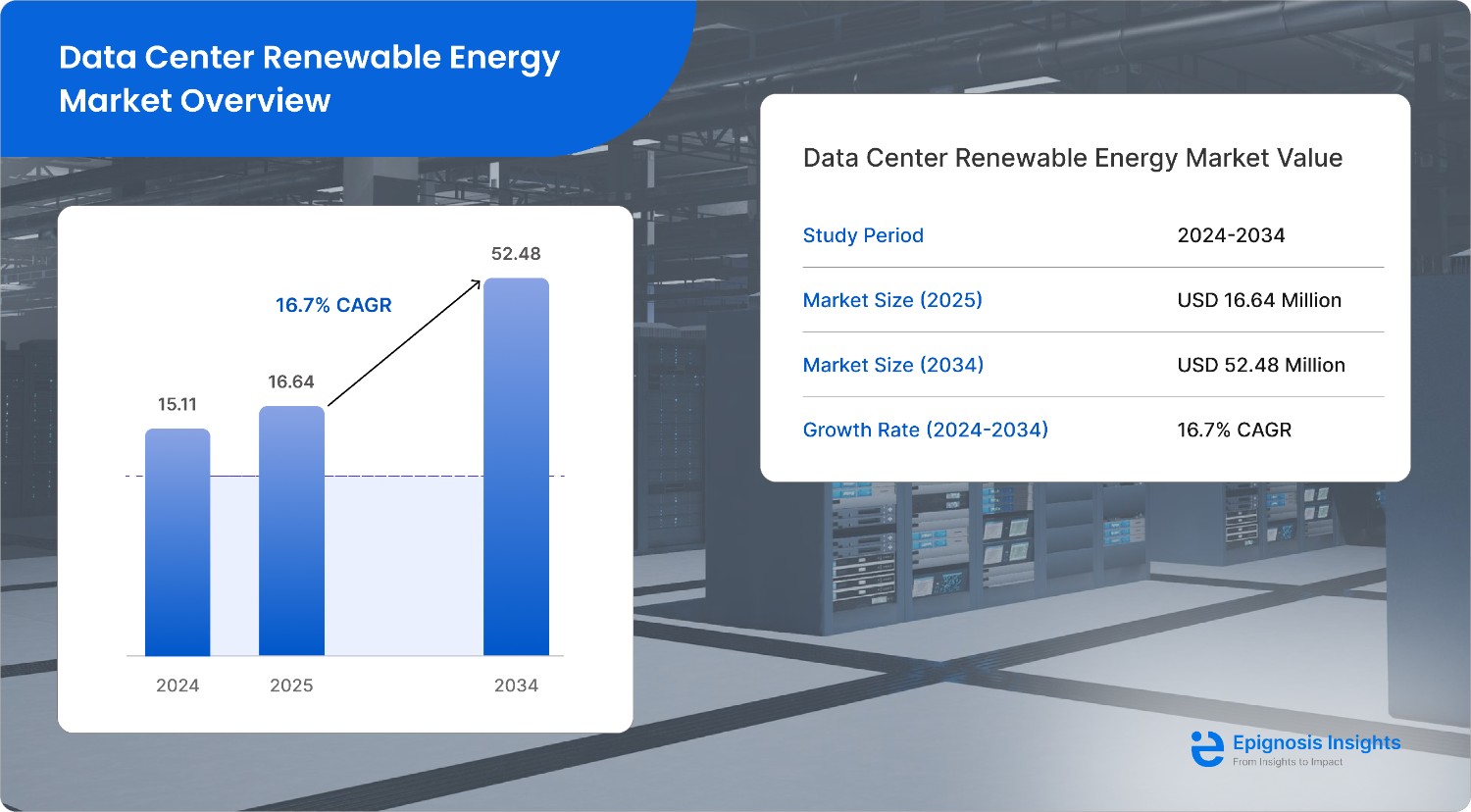
- Market Growth: The market is projected to grow from USD 15.11 billion in 2024 to USD 52.48 billion by 2034, with a 16.7% CAGR during 2027–2034.
- Rising Power Demand: Global data centers consumed approximately 415 TWh of electricity in 2024, with demand expected to more than double by 2030.
- Renewable Penetration: Renewables already supply approximately 27% of electricity consumed by data centers, with solar, wind, and hydropower forming the major sources.
- Solar Leadership: Solar PV is a major renewable option because of its scalability, declining costs, and suitability for both on-site and off-site deployment.
- Wind Expansion: Wind energy is increasingly used through long-term PPAs, particularly by hyperscale and large data-center operators.
- Hydropower Advantage: Hydropower provides relatively stable renewable generation and can complement variable solar and wind resources.
- Procurement Shift: Data-center operators are increasingly adopting physical PPAs, virtual PPAs, RECs, on-site generation, and off-site renewable procurement.
Global Data Center Renewable Energy Market Outlook
Global data center renewable energy market recorded a market value of USD 16.64 billion in 2025 and is estimated to reach a value of USD 52.48 billion by 2034 with a CAGR of 16.7% during the forecast period.
Global Data Center Renewable Energy Market:Renewable Energy Procurement Analysis
Hyperscalers dominate how data centers buy renewable power, the market is shifting from annual certificate matching to 24/7 firm supply, and utility-routed deals are emerging where direct contracting is hard.
Power Purchase Agreements (PPAs) are the backbone of the Global Data Center Renewable Energy Market, and purchasing power is concentrated among hyperscalers. BloombergNEF describes a market running at two speeds: large tech buyers are moving into bigger deals and newer technologies, while smaller companies struggle with current power market conditions. Buyers are also moving from plain wind and solar toward firm, around-the-clock supply. Developers offering "clean, firm power" are now among the top global sellers, which reflects AI workloads needing power every hour, not just matching consumption over a year.
| Indicator |
Value |
| Global corporate clean PPA volume, 2025 |
55.9 GW, down 10% year on year |
| Share of 2025 PPA volume signed by Amazon, Meta, Google and Microsoft |
49% |
| US corporate PPA volume, 2025 |
Record 29.5 GW |
| Change in unique US corporate buyers, 2025 |
Down 51% to 33 buyers |
| Europe, Middle East and Africa PPA volume, 2025 |
17 GW, down 13% |
| Co-located and hybrid deals tracked, 2025 |
5.8 GW |
| Baseload-like clean PPA activity, 2025 |
5.2 GW |
| Largest corporate offtaker, 2025 |
Meta, 10.24 GW |
| North America solar PPA price, Q2 2026 |
USD 61.40/MWh, down 4.8% quarter on quarter |
| North America wind PPA price change, year on year |
Up 17.5% |
| Europe solar PPA price, Q2 2026 |
€56.59/MWh |
| Europe renewable PPAs dedicated to data centers |
About 1.5 TWh (2021) to almost 15 TWh (2025) |
| Microsoft–Brookfield framework agreement |
More than 10.5 GW, 2026–2030 |
| Clearway–Google partnership total |
1.24 GW |
| Digital Edge–Hexa captive solar PPA (India) |
Up to 83 MW |
Virtual and physical PPAs serve different needs in the Global Data Center Renewable Energy Market. Virtual PPAs are financial contracts, which suits buyers with sites spread across several grids. In Meta's deal with Invenergy, the power flows into regional grids while Meta keeps the renewable energy credits for its carbon reporting. Physical PPAs tie a buyer to specific generating assets. Google's first 20-year contracts with Brookfield, for example, cover the output of the Holtwood and Safe Harbor hydro plants in Pennsylvania.
Renewable Energy Certificates (RECs) remain the easiest entry point into the Global Data Center Renewable Energy Market, but their credibility is under pressure. Proposed changes to carbon-accounting (Scope 2) rules could make 100% renewable claims harder to substantiate. In response, companies are moving to more complex deal structures, which favours bundled certificates and time-matched supply over unbundled RECs.
On-site versus off-site procurement splits the Global Data Center Renewable Energy Market along physical lines. Dense data center campuses rarely have room to generate meaningful power on site, so off-site supply dominates. In India, captive structures connect the two: Digital Edge is taking a substantial minority equity stake in Hexa's solar projects to secure captive user status.
Utility green-power programmes are growing in the Global Data Center Renewable Energy Market wherever direct contracting is restricted. Clearway's Royal Slope solar-plus-storage project in Washington, for instance, sells under a 20-year contract to a municipal utility to serve data center demand growth.
Global Data Center Renewable Energy Market: Energy Source Analysis
The Global Data Center Renewable Energy Market is increasingly influenced by the availability, scalability, cost, and reliability of different renewable power sources. Data centers require continuous electricity supply, making the renewable-energy mix particularly important because solar and wind are variable resources while hydropower and geothermal can provide more consistent generation. The International Energy Agency (IEA) estimates that renewables currently provide about 27% of the electricity physically consumed by data centers globally, with wind, solar PV, and hydropower accounting for most of this contribution.
Renewable generation serving data centers is projected to grow at an average annual rate of 22% between 2024 and 2030, meeting nearly half of the sector's additional electricity demand during this period.
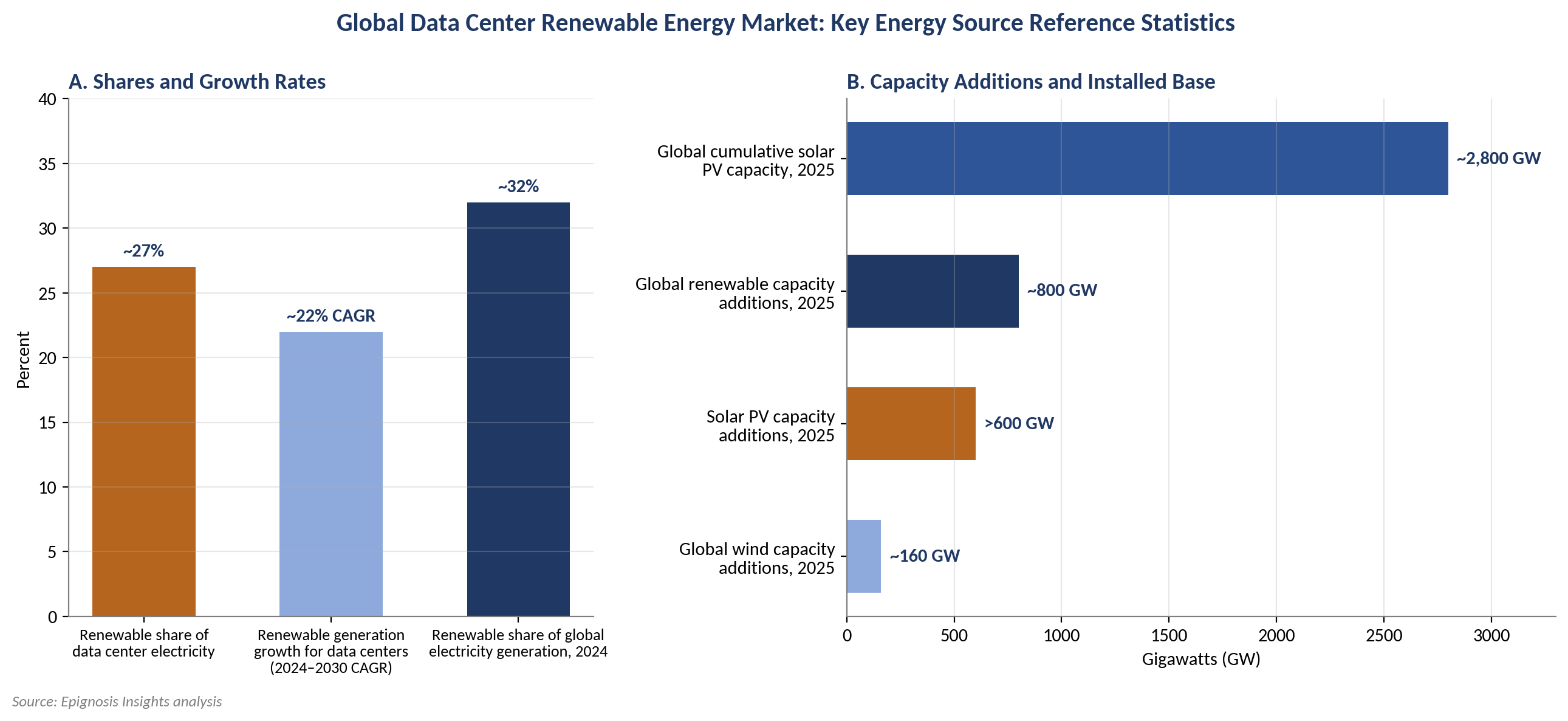
Solar energy represents one of the most scalable renewable options for data centers because photovoltaic systems can be deployed on facility rooftops, adjacent land, or through large off-site projects. The technology is particularly relevant to the Global Data Center Renewable Energy Market because solar PV has become the largest source of new renewable capacity globally. In 2025, solar PV additions exceeded 600 GW, taking cumulative global solar capacity to approximately 2,800 GW. Data center operators can combine solar installations with battery storage to improve utilization and reduce exposure to peak electricity prices.
Wind energy is another major source for data center procurement, particularly through long-term PPAs and off-site renewable projects. Wind can complement solar generation because its production profile differs by geography and time of day. Global wind capacity additions reached approximately 160 GW in 2025, according to the IEA. In the data center sector, wind is especially relevant for hyperscale operators seeking large volumes of contracted renewable electricity without requiring significant on-site land.
Hydropower provides an important reliability advantage because conventional hydroelectric generation can offer relatively stable electricity output and, in some markets, flexible generation. Globally, hydropower represented 14% of electricity generation in 2024, making it the largest individual renewable electricity source at that time. Pumped-storage hydropower also has potential to support data center grids by balancing variable solar and wind resources.
Geothermal energy can provide firm, low-carbon electricity because generation is less dependent on weather conditions. Its role in the Global Data Center Renewable Energy Market remains smaller than solar, wind, and hydropower because suitable geothermal resources are geographically concentrated and project development can involve higher exploration and infrastructure requirements. Nevertheless, geothermal is gaining attention for data centers requiring dependable clean power, particularly where high-quality geothermal resources are available.
Biomass and other renewable sources, including biogas and marine energy, represent additional but comparatively smaller opportunities. Biomass can provide dispatchable renewable electricity, while emerging technologies may contribute to regional energy diversification. Overall, solar and wind are expected to account for the overwhelming majority of new renewable capacity, with the IEA projecting them to represent 95% of renewable capacity additions through 2030. This indicates that data center renewable procurement is likely to remain concentrated around solar and wind, while hydropower, geothermal, and biomass provide complementary sources where local resource availability and grid requirements support their deployment.
Global Data Center Renewable Energy Market: Capacity & Power Demand Analysis
The Global Data Center Renewable Energy Market is being shaped by a rapid increase in data center electricity requirements, particularly from AI workloads, hyperscale facilities, cloud computing, and high-density computing infrastructure. According to the International Energy Agency (IEA), global data centers consumed approximately 415 TWh of electricity in 2024, equivalent to around 1.5% of global electricity consumption. Under the IEA base case, data center electricity consumption is expected to more than double to approximately 945 TWh by 2030. This expansion is increasing the requirement for renewable generation capacity, grid connections, energy storage, and long-term renewable procurement.
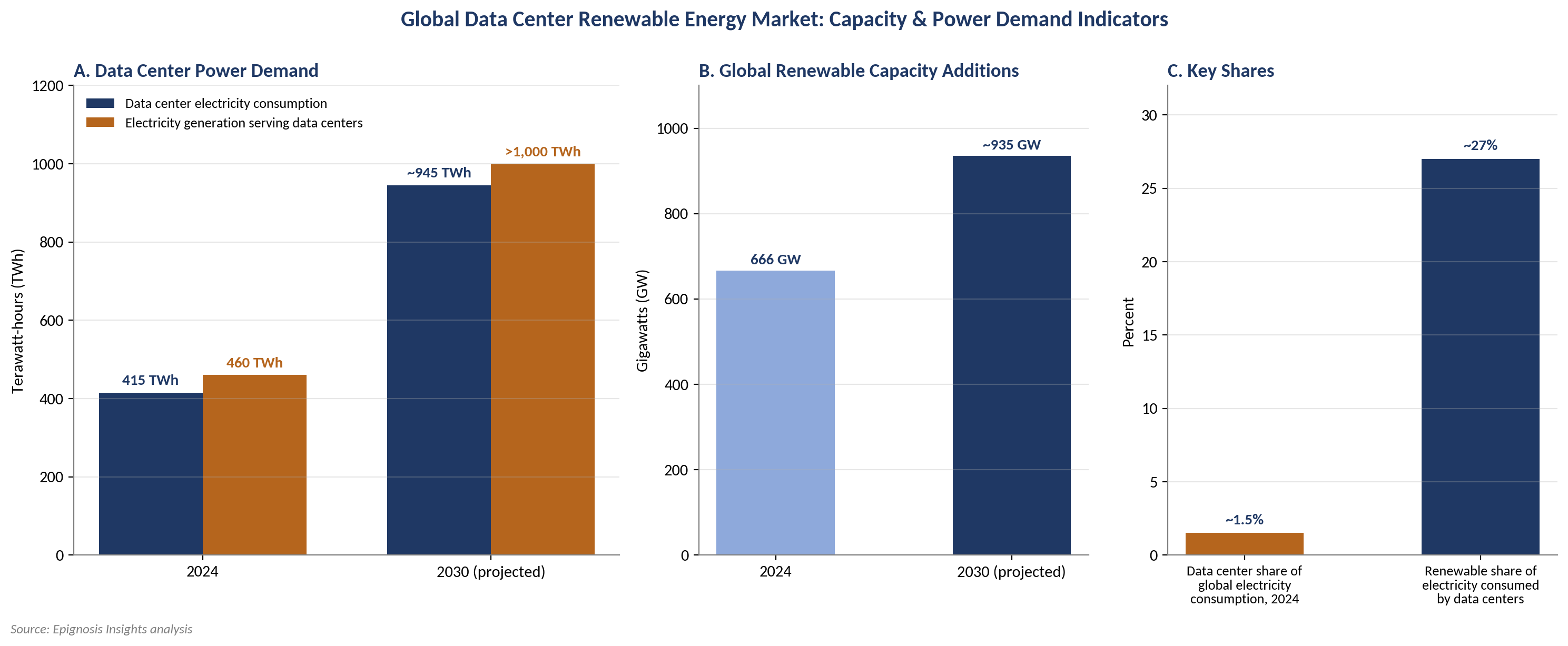
The Global Data Center Renewable Energy Market is particularly dependent on the expansion of renewable generation capacity because data center operators increasingly seek to match rapidly growing electricity consumption with low-carbon power. The IEA estimates that renewables currently supply approximately 27% of electricity consumed by data centers globally, primarily through solar PV, wind, and hydropower. Over 2024–2030, renewables are expected to meet nearly half of the additional electricity demand from data centers, highlighting the growing connection between data center expansion and renewable power development.
Power capacity additions are also important because renewable resources must expand sufficiently to accommodate both existing loads and new data center facilities. Global annual renewable capacity additions are forecast to increase from 666 GW in 2024 to almost 935 GW by 2030, with solar PV and wind expected to account for approximately 95% of additions during the period. This broader renewable build-out provides additional opportunities for data centers to secure electricity through PPAs, virtual PPAs, utility procurement programs, and direct project investments.
Regional demand concentration is a major characteristic of the Global Data Center Renewable Energy Market. The United States, China, and Europe represented the largest data center electricity-consuming regions in 2024. The United States accounted for approximately 45% of global data center electricity consumption, followed by China at 25% and Europe at 15%. The IEA projects that electricity consumption from data centers in the United States will increase by around 240 TWh by 2030, while China's consumption rises by approximately 175 TWh and Europe's by more than 45 TWh.
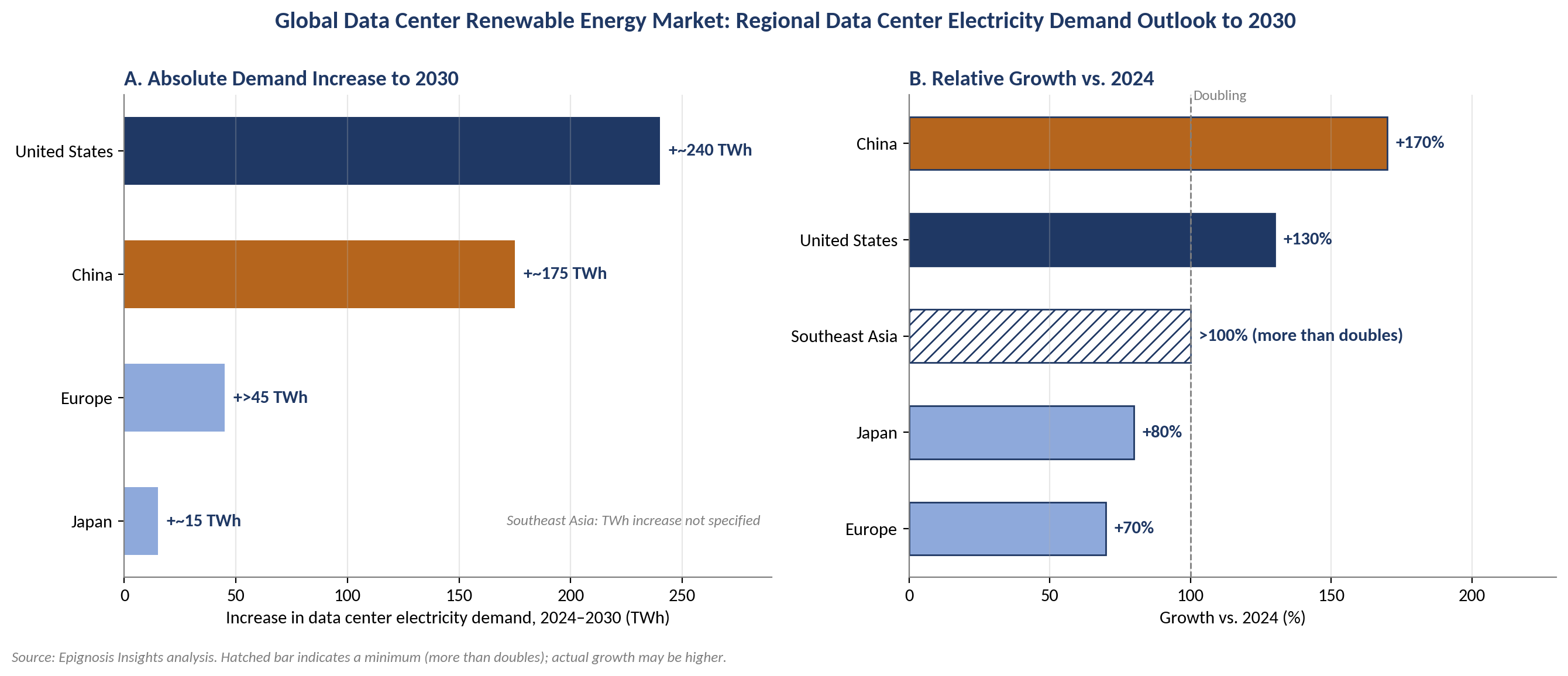
The Global Data Center Renewable Energy Market is also experiencing strong demand growth in emerging data center hubs. Southeast Asian data center electricity demand is expected to more than double by 2030, supported by hubs such as Singapore and southern Malaysia. India and Southeast Asia are also becoming increasingly important within the broader power-demand landscape as digitalization, cloud adoption, AI infrastructure, and electrification accelerate. These regional differences create varying requirements for renewable capacity, grid infrastructure, storage, and power procurement strategies.
Overall, renewable energy penetration in data center power supply is expected to increase alongside expanding generation capacity, although the pace will differ by market depending on grid availability, renewable resources, permitting, transmission infrastructure, and corporate procurement policies. The combination of rapidly increasing data center loads and expanding renewable generation is therefore creating a substantial requirement for coordinated generation capacity, grid infrastructure, storage, and renewable procurement through 2030 and beyond.
Global Data Center Renewable Energy Market: Sustainability & Carbon Analysis
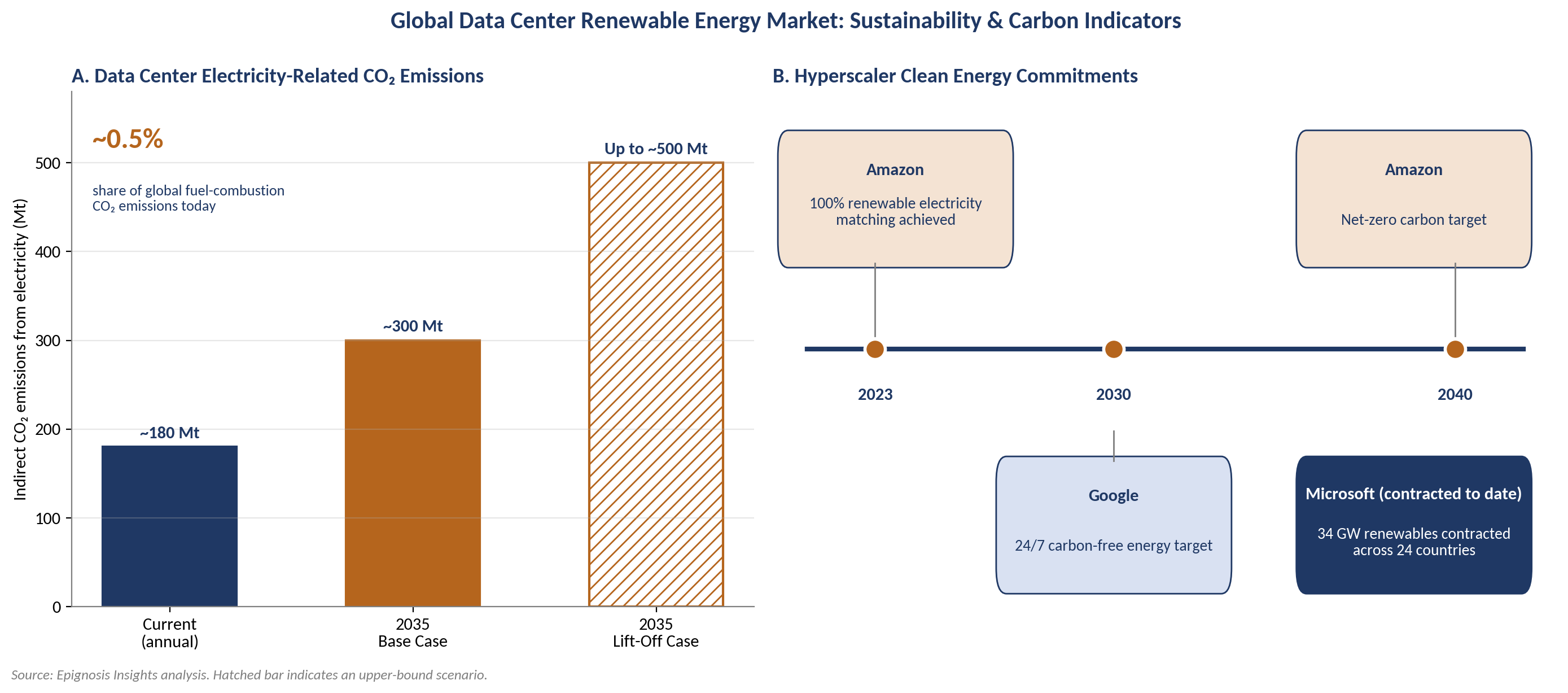
The Global Data Center Renewable Energy Market is increasingly driven by the need to reduce the carbon intensity associated with rapidly expanding electricity consumption. The International Energy Agency (IEA) estimates that data centers currently generate approximately 180 million tonnes (Mt) of indirect CO₂ emissions annually from electricity consumption, excluding emissions from backup generation. In its base case, data-center electricity-related emissions are projected to reach approximately 300 Mt by 2035, while a higher-growth scenario could reach 500 Mt. This makes renewable electricity procurement, energy efficiency, low-carbon infrastructure, and carbon accounting increasingly important components of data center development strategies.
Data center carbon emissions arise from several operational and value-chain activities, with purchased electricity generally representing the most significant source for facilities connected to carbon-intensive grids. The Global Data Center Renewable Energy Market therefore has a direct relationship with the carbon intensity of electricity supply: replacing fossil-fuel-generated electricity with renewable power can reduce market-based Scope 2 emissions, although the overall carbon benefit depends on procurement structure, grid location, additionality, and accounting methodology. The IEA estimates that data-center electricity-related emissions are among the faster-growing sources of emissions within the energy sector.
Renewable energy contribution to emissions reduction is being pursued through solar and wind PPAs, utility renewable-energy programs, renewable certificates, on-site generation, and increasingly granular carbon-free-energy procurement. Google, for example, has maintained annual renewable-energy matching since 2017 and is targeting 24/7 carbon-free energy across its data centers and offices by 2030, meaning electricity consumption would be matched with carbon-free sources on an hourly basis in each operating grid.
Scope 1, Scope 2, and Scope 3 considerations are becoming increasingly important as operators move beyond electricity procurement alone. Scope 1 can include diesel used in backup generators and refrigerant leakage; Scope 2 primarily covers purchased electricity used for computing, cooling, lighting, and other facility operations; while Scope 3 can include embodied emissions from servers, networking equipment, construction materials, upstream energy activities, transportation, and other supply-chain activities.
Google and Microsoft both incorporate these categories into their data-center carbon accounting frameworks.
Carbon-neutral and low-carbon data center strategies increasingly combine renewable procurement with energy-efficiency improvements, high-efficiency cooling, low-carbon construction materials, battery storage, grid optimization, and carbon-removal investments. Microsoft, for instance, is targeting carbon-negative operations by 2030 and has contracted 34 GW of renewable energy across 24 countries. Its sustainability strategy also includes reducing embodied carbon in data-center construction and improving operational efficiency.
Renewable energy targets and net-zero commitments are consequently becoming important competitive and investment considerations within the Global Data Center Renewable Energy Market. Amazon achieved its goal of matching electricity consumption with renewable energy seven years ahead of its original 2030 target, reaching 100% matching in 2023, while maintaining a broader net-zero carbon target for 2040. These commitments are encouraging additional renewable generation, long-term PPAs, carbon accounting, and low-carbon infrastructure investments across major data center markets.
Competitive Landscape
Key companies analyzed within the data center renewable energy market are:
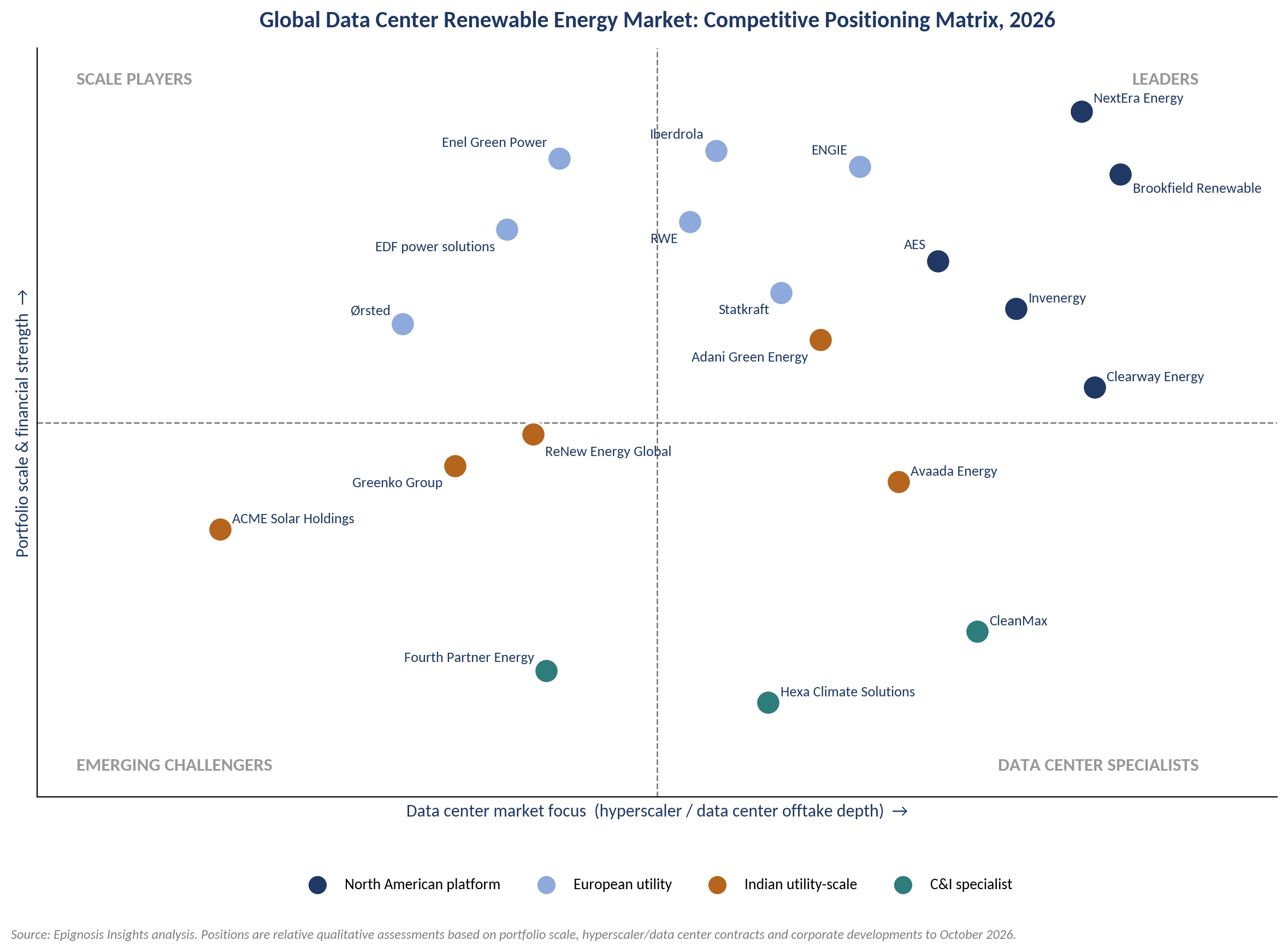
NextEra Energy (Dominion merger pending), Brookfield Renewable Partners, ENGIE, EDF power solutions (formerly EDF Renewables), Ørsted, Enel Green Power (EnelS.p.A.), Iberdrola, RWE, AES Corporation (take-private by GIP/EQT pending), Clearway Energy, Invenergy, ReNew Energy
Global, Adani Green Energy, ACME Solar Holdings (optional; low data-center exposure), Avaada Energy, Greenko Group, Statkraft (replaces Adani New Industries), Clean Max Enviro Energy Solutions (CleanMax), Fourth Partner Energy (Macquarie acquisition in talks), Hexa Climate Solutions.