Asia Passive Components Price Tracker – Q3 2026
Quarterly pricing analysis of MLCCs, tantalum and aluminum capacitors, chip resistors and inductors across Japan, South Korea, Taiwan and China, with an outlook for Q4 2026


Quarterly pricing analysis of MLCCs, tantalum and aluminum capacitors, chip resistors and inductors across Japan, South Korea, Taiwan and China, with an outlook for Q4 2026
Asia's Passive Components Market moved decisively from selective to broad-based price inflation in the third quarter of 2026 (July–September). After a prolonged correction that ran through 2024 and most of 2025, the region's leading suppliers implemented the widest set of price adjustments seen in several years, spanning multilayer ceramic capacitors (MLCCs), tantalum and aluminum capacitors, chip resistors and multilayer inductors. The Epignosis Insights Asia Passive Components Price Index, which tracks contract and spot pricing across six product categories with Q3 2025 as the base of 100, recorded its strongest quarterly gains in high-capacitance MLCCs and tantalum capacitors. Commodity resistors and inductors posted more moderate increases as adjustments made earlier in the year settled into contract pricing.
This cycle is not being driven by a broad recovery in consumer electronics. Three forces have converged instead: concentrated demand from AI servers and accelerator boards, cost inflation in key raw materials such as tantalum, nickel powder and silver, and deliberate capacity reallocation by Japanese and Korean leaders toward high-value products. Epignosis Insights expects prices to keep rising in Q4 2026, although at a slower pace than in Q3, with the highest-specification parts remaining on allocation into 2027.
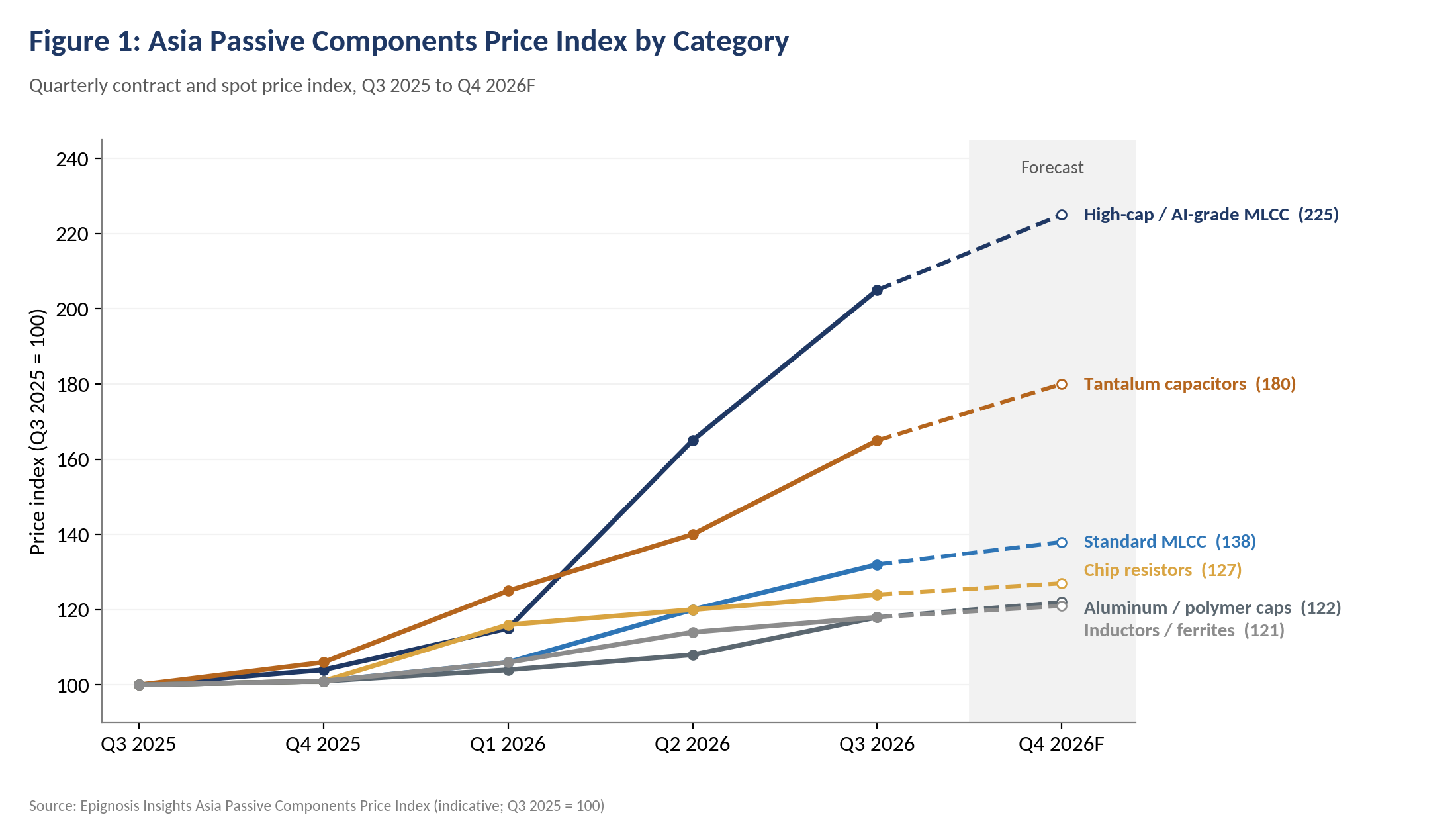
Demand indicators across the region point to an exceptionally tight market at the top end of the product range. South Korea's trade data illustrate the scale of AI hardware activity: according to the Korea Customs Service, the country's semiconductor exports rose 169.6% year on year to US$281 billion in January–August 2026, accounting for 41% of total exports. Industry estimates suggest that AI servers use three to five times more MLCCs than conventional servers, with a strong skew toward high-capacitance, small-case-size parts. Automotive electronics add a second, steadier layer of demand, as electric vehicles carry far more passive content than combustion-engine models and require automotive-qualified grades that take longer to produce and certify.
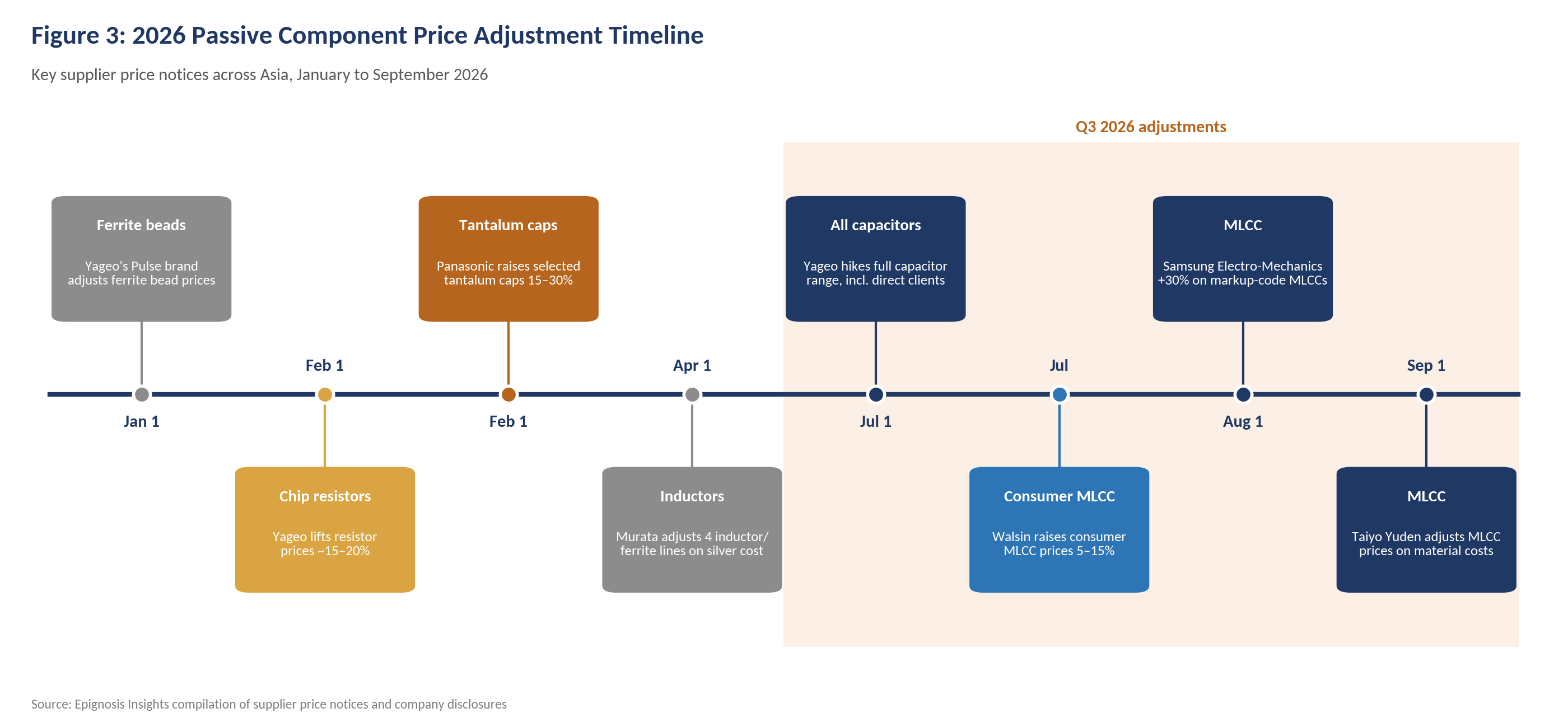
Manufacturers' financial results confirm the strength of the cycle. Yageo, which raised chip resistor prices by approximately 15–20% from February 1, reported August 2026 revenue of NT$16.33 billion (about US$519 million), up 51.8% year on year and its sixth consecutive monthly record, with revenue for the first eight months of the year up 34.9% to NT$115.09 billion. Taiwan's Commercial Times reported that several other Taiwanese suppliers, including Thinking Electronic, Viking Tech and Tai-Tech Advanced Electronics, also posted record second-quarter revenue as their order books shifted toward AI-related and automotive applications.
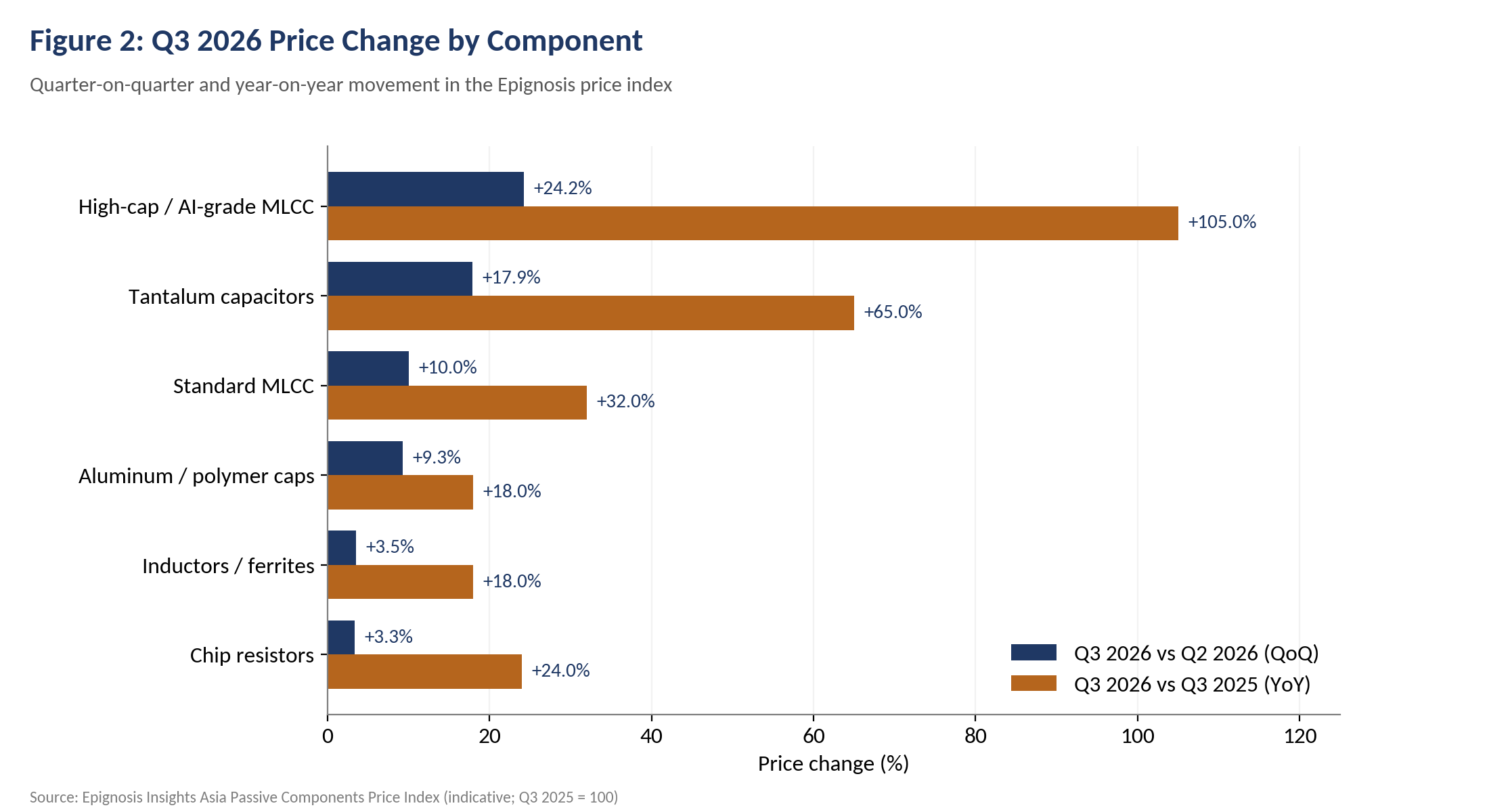
High-capacitance MLCCs remained the most inflationary segment of the market in Q3 2026. Samsung Electro-Mechanics notified partners that MLCC products under its markup business code would rise by 30% for shipments from August 1, and the company disclosed two AI server MLCC long-term agreements worth approximately KRW 745 billion in July, with deliveries locked through 2027. Taiyo Yuden followed with a price adjustment for shipments from September 1, citing sharp increases in the cost of barium titanate powder, nickel powder and rare-earth additives. On the Epignosis Insights index, high-capacitance and AI-grade MLCCs rose by roughly 24% quarter on quarter in Q3 and now stand at about double their Q3 2025 level, reflecting both list-price adjustments and spot premiums on constrained high-capacitance X6S and X7R devices in small case sizes.
The growing use of long-term agreements is itself a pricing signal. Large buyers are moving from quarterly quotations to multi-quarter contracts that lock in volume and price, which embeds scarcity premiums into contract pricing and reduces the spot supply available to small and mid-sized customers. Epignosis Insights views this shift as a key reason why high-end MLCC prices are unlikely to correct quickly, even if AI server build schedules moderate.
Increases in standard MLCCs were smaller than at the high end but broader than in previous quarters. Chinese technology outlet 36Kr reported that spot prices for ordinary standard MLCCs had already risen by 15–20% by the end of May 2026, while high-capacity products for AI servers had climbed 50–60%. The most important development in Q3 was the spread of increases into contract pricing. Taiwan's Economic Daily News reported that Yageo raised prices across its entire capacitor portfolio from July 1, covering MLCCs, aluminum electrolytic, tantalum, polymer, film and supercapacitors, and that for the first time in this cycle the increases applied to direct customers as well as distributors. Walsin Technology raised consumer MLCC prices by 5–15% over the same period and reported June revenue of NT$3.96 billion, its highest monthly level since June 2021. Epignosis Insights estimates that its standard MLCC index rose by about 10% quarter on quarter, with Taiwanese and Chinese vendors winning overflow orders as Japanese and Korean leaders prioritize AI and automotive grades.
Tantalum capacitors faced the most acute supply-side pressure of any passive category. According to the US Geological Survey, the Democratic Republic of the Congo accounts for more than half of global tantalum mine output, leaving the supply chain highly exposed to disruption in the country's conflict-affected eastern provinces. A landslide at the Rubaya mine in early 2026 tightened concentrate supply just as AI server demand for tantalum-polymer capacitors accelerated, and Argus assessed European tantalite prices at US$200–210 per pound in mid-March, a 90% increase since the start of the year. TrendForce has since reported that tantalum ingot prices have risen to nearly three times their previous level and that lead times for some automotive tantalum capacitors now exceed one year. Panasonic's 15–30% increase on selected tantalum capacitors from February 1 set the tone early in the year, and Epignosis Insights estimates that its tantalum capacitor index rose by around 18% quarter on quarter in Q3, with automotive-qualified parts carrying the largest premiums.
Aluminum electrolytic and polymer capacitors recorded their first meaningful price increase in several years, largely as a result of the broad July portfolio adjustments by Taiwanese suppliers. Demand from power supply units in AI server racks, as well as from automotive and industrial power electronics, is supporting higher-value polymer types in particular. Epignosis Insights estimates a quarter-on-quarter increase of around 9% for this category in Q3 2026, with polymer capacitors outpacing conventional wet electrolytic parts.
Chip resistor pricing stabilized at higher levels in Q3 after the sharp adjustments of the first quarter. The 15–20% increases introduced by leading Taiwanese suppliers at the start of the year, together with increases on thick-film resistors from brands serving mainland China, have largely been absorbed into contract prices. Smaller resistor suppliers are gaining share as larger groups prioritize capacitor capacity, and Epignosis Insights estimates a modest rise of about 3% quarter on quarter in its chip resistor index.
Inductor and ferrite pricing reflects silver costs more than capacity constraints. Murata, the world's largest passive component maker, raised prices from April 1 across multilayer chip ferrite beads, multilayer ferrite power inductors, RF inductors and common-mode choke coils, citing silver as the main driver. Its latest disclosures also underline the strength of demand: the company reported first-quarter revenue of ¥502.3 billion for the April–June 2026 period, up 20.7% year on year, a capacitor order backlog at the end of March 2026 that was 89.5% higher than a year earlier, and planned capital expenditure of about ¥250 billion focused on capacitors and power modules. Epignosis Insights estimates that its inductor index rose by around 3–4% in Q3 2026.
Raw material inflation is a second, independent driver of the price cycle. Silver, which accounts for a significant share of electrode and termination costs in MLCCs and multilayer inductors, reached a record above US$120 per ounce in late January 2026 before correcting to roughly US$65–70 per ounce by the end of August, based on Epignosis Insights' tracking of benchmark prices. Even after the correction, prices remain well above 2024 and early-2025 levels, and the Silver Institute projects a sixth consecutive global market deficit in 2026 of 46.3 million ounces. Nickel powder, used in MLCC inner electrodes, has also become more expensive amid tighter Indonesian ore supply, while barium titanate powder, rare-earth additives and the PET release film used in MLCC tape casting have all added to cost pressure.
Epignosis Insights notes that raw material costs now affect component categories unevenly. Tantalum capacitors are the most exposed because tantalum powder represents a large share of their cost and has limited substitutes. MLCCs are exposed to nickel and, to a lesser extent, silver, while thick-film resistors depend on ruthenium and silver pastes. This uneven exposure explains why suppliers have issued category-specific notices rather than uniform increases across their portfolios.
Japan and South Korea. The region's largest MLCC makers are concentrating capacity on AI server, automotive and high-reliability grades, where margins and long-term agreement coverage are strongest. This strategy supports pricing power at the high end but has reduced their availability for commodity consumer parts, pushing smaller buyers toward alternative suppliers.
Taiwan. Taiwanese suppliers are the main beneficiaries of order transfers from Japanese and Korean leaders. Broad portfolio increases in July, combined with strong utilization, have produced record revenues and improved margins across the sector, from large groups to specialist resistor and inductor makers.
China. Mainland Chinese MLCC and resistor makers are gaining share in consumer and standard industrial grades, where qualification barriers are lower. Their pricing remains more competitive and tends to follow regional leaders with a lag, which is moderating the overall increase in standard-grade components across Asia.
| Component | Q2 2026 index | Q3 2026 index | QoQ change | YoY change | Q4 2026 outlook |
| High-cap / AI-grade MLCC | 165 | 205 | +24.2% | +105.0% | Rising |
| Tantalum capacitors | 140 | 165 | +17.9% | +65.0% | Rising |
| Standard MLCC | 120 | 132 | +10.0% | +32.0% | Moderately rising |
| Aluminum / polymer caps | 108 | 118 | +9.3% | +18.0% | Moderately rising |
| Inductors / ferrites | 114 | 118 | +3.5% | +18.0% | Stable to firm |
| Chip resistors | 120 | 124 | +3.3% | +24.0% | Stable to firm |
Source: Epignosis Insights Asia Passive Components Price Index (indicative; Q3 2025 = 100)
Epignosis Insights expects passive component prices across Asia to continue rising in Q4 2026, although at a slower pace than in Q3. High-capacitance and AI-grade MLCCs are forecast to rise by 8–12% quarter on quarter as major AI accelerator platforms ramp shipments, and tantalum capacitors by 8–10% as raw material constraints persist. Standard MLCCs are expected to rise by 4–6%, aluminum and polymer capacitors by 3–4%, and chip resistors and inductors by 2–3% each.
Several risks could change this trajectory. A further correction in silver would ease cost pressure on inductors and terminations, while any pause in hyperscaler capital expenditure could quickly reduce urgency at the high end. Precautionary ordering is another risk, as buyers who build inventory ahead of expected increases may later reduce orders. New high-end capacity from Japanese and Korean leaders, expected from late 2026 into 2027, will be an important signal for when the cycle peaks. Weak consumer electronics demand also limits how far standard-grade prices can rise.
For procurement teams, Epignosis Insights recommends securing long-term agreements for constrained high-capacitance MLCC and tantalum part numbers, qualifying second sources in Taiwan and mainland China for standard grades, and reviewing designs where tantalum parts can be replaced by MLCC or polymer alternatives. Budgets for the first half of 2027 should assume that passive component costs remain well above 2025 levels.
The Epignosis Insights Asia Passive Components Price Index is compiled from supplier price notices, distributor and spot quotations, company disclosures and published third-party data covering Japan, South Korea, Taiwan and mainland China. Indices are indicative, use Q3 2025 as the base of 100, and are weighted toward contract pricing; Q4 2026 values are forecasts.