Asia Methanol Price Tracker
Epignosis Insights Research Desk — Monthly Report, August 2026


Epignosis Insights Research Desk — Monthly Report, August 2026
Asia’s Methanol Market has swung from a year of unusual calm into its sharpest supply shock in at least four years, and the aftershocks are still moving through regional benchmarks a full five months later. S&P Global Platts data shows CFR Southeast Asia methanol prices held in a narrow $315–325 per tonne band from August 2025 through late February 2026, before the February 28, 2026 outbreak of the U.S.–Israel conflict with Iran triggered an effective closure of the Strait of Hormuz and, with it, the loss of Iranian methanol supply that had been meeting a large share of Asian demand. By March 20, 2026, CFR Southeast Asia prices had jumped 72% to $555 per tonne the highest level since March 2021 while CFR China prices rose 46.5% over the same three-week window to $381 per tonne, according to Platts assessments. Trade data from China’s General Administration of Customs shows the strain was already visible before the conflict: first-half 2025 methanol imports fell 14.7% year-on-year to 5.377 million tonnes as overseas plant operating rates outside China averaged just 58%, down seven percentage points from a year earlier.
The regional divergence between China and Southeast Asia is the defining feature of this cycle. China entered the crisis with a lower price base Intratec commodity pricing put CFR China spot at $240 per tonne in December 2025 and Chinese buyers were comparatively insulated from the initial shock because, per Platts reporting, local participants held an estimated eight weeks of inventory and at least three Iran-origin cargoes were already en route when the conflict began. Southeast Asia, South Korea, and Taiwan carried no equivalent buffer: Saudi Arabia and Qatar, the region’s next-largest suppliers after Iran, could not reroute cargoes eastward fast enough to offset the gap, and concurrent plant outages within Southeast Asia itself compounded the shortfall. The result was a CFR China-to-CFR-Southeast-Asia spread that widened to $174 per tonne by late March, according to Platts, briefly reopening an arbitrage window in which China became a source of re-exported cargoes rather than solely an importer.
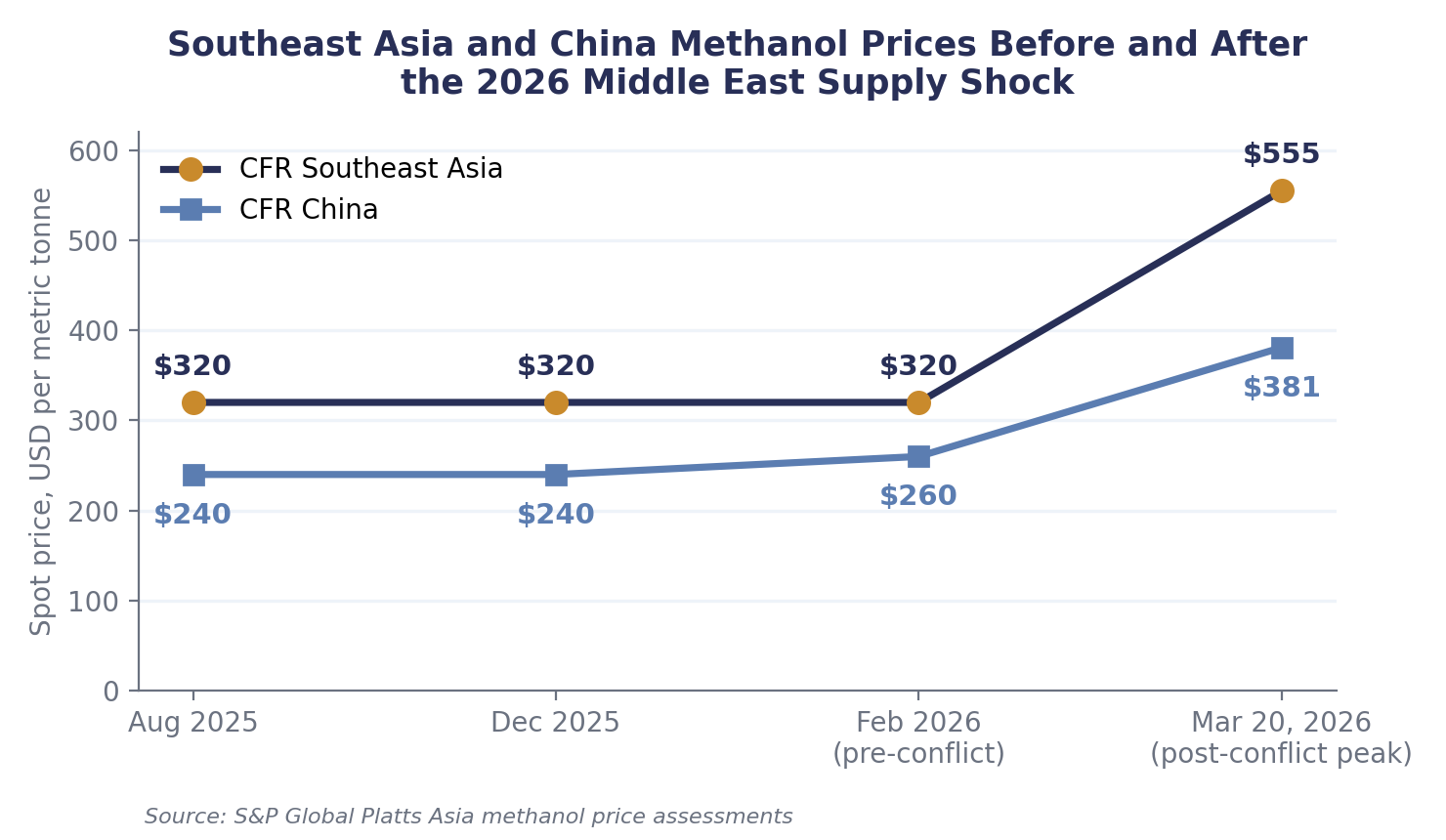
Figure 1: CFR Southeast Asia and CFR China methanol spot prices, August 2025 – March 2026.
The mechanics of the shock trace directly to Iran’s outsized role in seaborne methanol trade. Trade publication CCFGroup reports that Iran is the world’s second-largest methanol producer with 17.16 million tonnes of annual capacity, exports roughly 90% of that output, and ships approximately 90% of those exports through the single port of Assaluyeha concentration that left the market acutely exposed once the March 18, 2026 strike on Iran’s South Pars gas field, one of the world’s largest natural gas fields, disrupted the feedstock underpinning that production. With Strait of Hormuz transit suspended, CCFGroup reported that Iran-origin methanol shipments to China fell to just 80,000 tonnes for the entire month of March, far below normal volumes, while separate S&P Global Energy CERA analysis estimated that 18% of global methanol production capacity was affected by the broader disruption to crude, naphtha, and petrochemical feedstock flows through the strait. India, heavily reliant on Iranian methanol for its formaldehyde and pharmaceutical sectors, saw prices climb to an over-four-year high as importers scrambled for alternative Middle Eastern and Asian cargoes.
Within China, the price story runs somewhat independently of the coastal spot market because a large share of consumption is served by domestic coal-based production rather than imports. China’s domestic methanol futures contract, tracked by Trading Economics, climbed from roughly 2,382 yuan per tonne in early 2026 to a peak of approximately 3,370 yuan per tonne in early April 2026 as the conflict’s effects fed through, before easing to 3,000 yuan by May 19 a 2.2% monthly decline as some Iranian volume resumed moving under a temporary ceasefire and Chinese methanol-to-olefins (MTO) operators, many of which purchase on the open market, cut or idled runs rather than absorb deeply negative margins. That demand destruction proved temporary: futures fell further to 2,382 yuan by July 1, 2026, the lowest level since the March spike began, before Iranian attacks on non-compliant shipping resumed in July and pushed prices back up to 2,786 yuan by July 20. By August 13, 2026, the contract had settled at 2,636 yuan per tonne, still 12.65% above year-ago levels even after retreating from the July high, underscoring that the market has not returned to its pre-conflict baseline despite months of partial de-escalation.
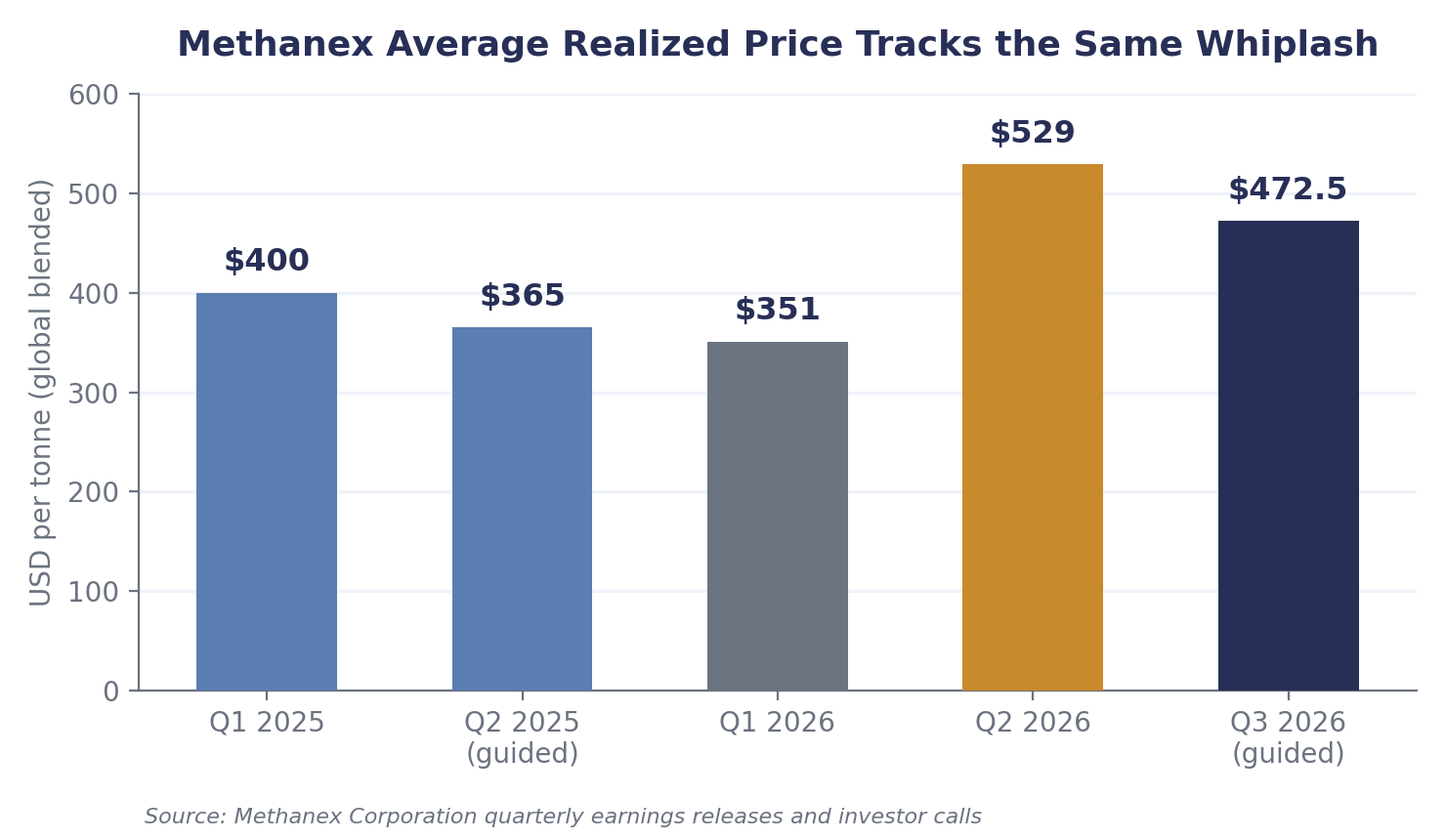
Figure 2: China domestic methanol futures price, March–August 2026.
Downstream demand has been a genuine swing factor rather than a passive backdrop. Traditional consumption channels including formaldehyde, MTBE, and acetic acid held up comparatively well through the price spike, with acetic acid benchmark prices themselves climbing above 3,000 yuan per tonne in March on methanol cost pass-through, according to trade reporting. MTO demand was the more volatile segment: operators buying merchant methanol as opposed to integrated producers with captive supply were the first to cut runs when the cost-margin equation turned negative, and new MTO capacity additions, including a 1.3 million tonne per year unit that started up in December 2025 and a 2.5 million tonne per year unit in the second quarter of 2026 per S&P Global Energy reporting, are expected to add incremental demand once margins normalize.
Producer Economics: What the Numbers Show at the Company Level
Methanex Corporation, the world’s largest methanol producer and supplier, provides the clearest company-level view of how the crisis flowed through to realized pricing. The company’s global average realized price fell from $400 per tonne in the first quarter of 2025 to $351 per tonne in the first quarter of 2026 reflecting the soft pre-conflict pricing environment before jumping to $529 per tonne in the second quarter of 2026, driving adjusted EBITDA of $577 million and adjusted net income of $300 million, the company’s best quarterly results on record according to its own investor materials. Methanex management told investors that only about one-third of the Iran-linked supply gap was offset by inventory drawdowns and demand rationalization during the quarter, with Chinese MTO demand bearing the largest share of the adjustment. Looking ahead, the company guided average realized prices for July and August 2026 to a range of $460–485 per tonne, implying a meaningful step down from the Q2 peak but a level still well above the pre-conflict baseline consistent with the partial, incomplete normalization visible in China’s domestic futures curve. Separately, Methanex disclosed it would indefinitely idle its Titan facility in Trinidad and Tobago, taking a $115 million non-cash impairment charge, after concluding the plant’s gas supply economics no longer supported continued operation a reminder that the current price environment is reshaping production decisions well beyond Asia.
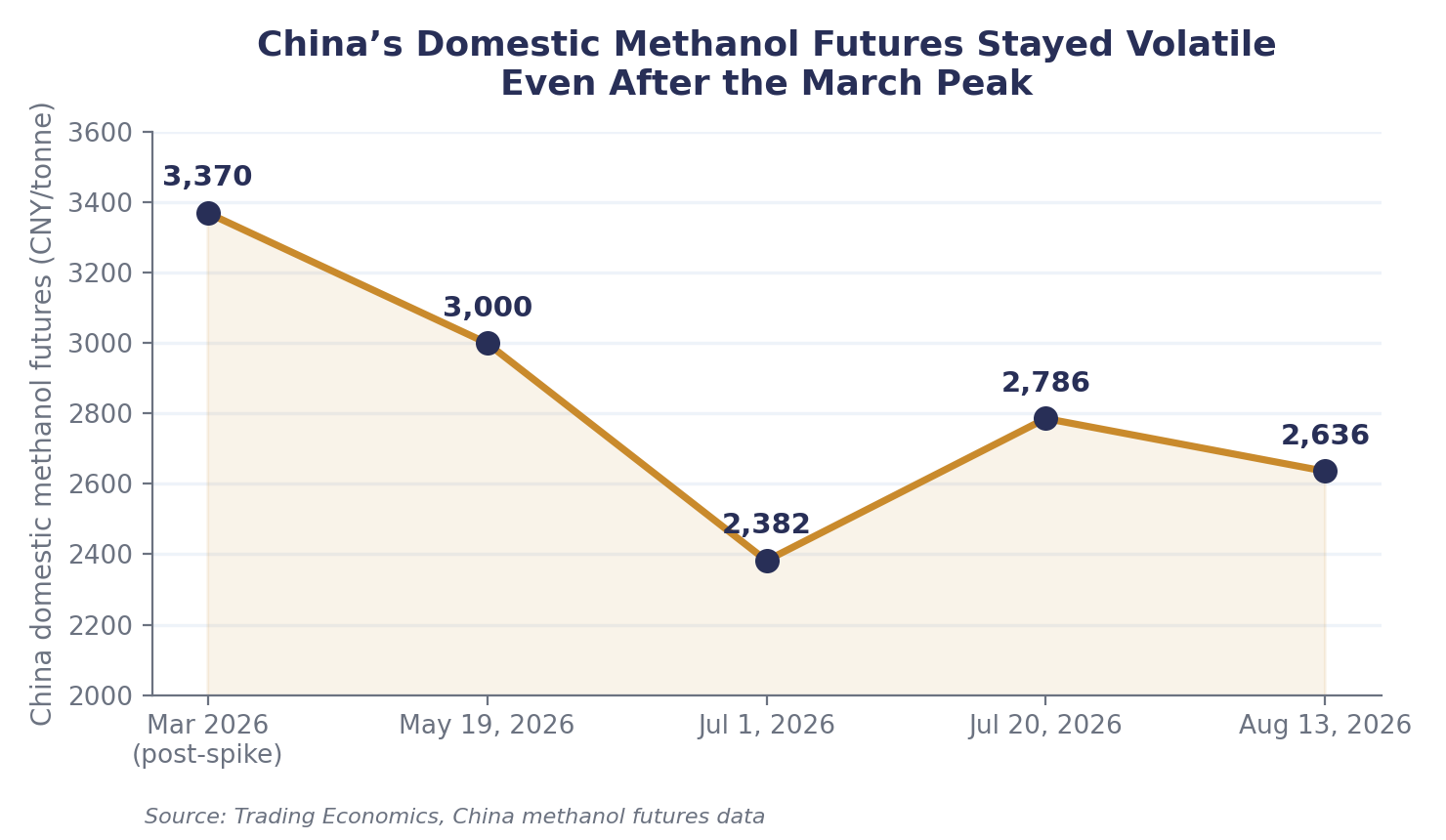
Figure 3: Methanex Corporation quarterly average realized methanol price.
The shock did not stop at China and Southeast Asia. Platts assessments cited by S&P Global show CFR India methanol prices hit an over-four-year high during the crisis after Iranian shipments which typically supply a large share of India’s formaldehyde and pharmaceutical-sector demand were curtailed, forcing Indian buyers toward non-sanctioned Middle Eastern cargoes and alternative supply from China and Malaysia wherever the arbitrage remained workable. South Korean prices reached a 53-week high on March 13, 2026, ahead of the broader regional peak, while Taiwan prices climbed to their highest level in four and a half years, according to the same Platts data. Notably, China’s formula-priced Iranian cargoes which historically trade at a premium to benchmark Chinese methanol prices slipped to a discount of roughly 2% versus parity during the disruption, as some Chinese port terminals grew selective about accepting Iranian-origin material even as buyers elsewhere in the region paid up for any available non-Iranian supply. The net effect was a temporarily fragmented Asian market in which price relationships that normally hold Iranian cargoes at a premium, China at a discount to Southeast Asia partially inverted for several weeks.
Three variables will most likely determine where Asian methanol prices settle over the remainder of 2026. The first is the durability of shipping access through the Strait of Hormuz: the U.S. Congressional Research Service notes that the June 2026 memorandum of understanding required Iran only to make "arrangements using its best efforts" for safe passage, a standard vague enough that both sides have since disputed its scope, and conflict resumed in July with attacks on vessels Iran deemed non-compliant. The second is the pace of Chinese MTO capacity absorption: with a 2.5 million tonne per year MTO unit having started up in the second quarter of 2026, incremental Chinese demand could tighten the domestic balance independently of import flows. The third is non-Iranian supply response North American exports to Asia and Middle Eastern producers outside Iran, principally in Saudi Arabia and Qatar, have already been prioritizing higher-netback Southeast Asian and Indian markets over China, and any further reallocation would continue to widen the China-to-Southeast-Asia spread that opened during the crisis.
Beneath the near-term volatility, the longer-run demand picture remains China-centric and modestly expansionary. Industry body the Methanol Institute expects global methanol demand growth to return to an average annual rate of 2.5% to 3.0% in the coming years, up from under 1% between 2020 and 2025, while cautioning that persistent oversupply in the underlying production base means the industry “typically operates in a balanced way” that leaves prices exposed to exactly the kind of supply-side shock witnessed this year. China’s dominance of that demand base is not in question: the country accounted for roughly a quarter of global methanol consumption in 2024 and remains the largest single import destination even as its own coal-to-methanol capacity continues to expand, with more than 10 million tonnes per year of new coal-based capacity added in Inner Mongolia and Shaanxi between 2024 and 2025 alone. That combination heavy import dependence for marginal supply, concentrated Middle Eastern export exposure, and a large, price-sensitive MTO demand base that can be switched on or off with margins — is precisely what makes the Asian methanol market this volatile, and it is a structural feature of the market rather than a one-off consequence of the current conflict.
Global trade publication data points to continued, if reduced, disruption ahead. Industry analysis compiled by International Trader Publications expects total global methanol trade volume in 2026 to come in below the roughly 40 million tonnes per year that had held steady from 2023 through 2025, specifically because of the ongoing Middle East conflict’s effect on the world’s largest exporting region, even as the same analysis notes Middle East export volumes had been on a rising trend into 2025, up 13% over the prior four years to 17.4 million tonnes. A June 2026 memorandum of understanding between the U.S. and Iran briefly restored some shipping activity, which is visible in the dip in China’s domestic futures to 2,382 yuanby July 1, but renewed Iranian attacks on shipping deemed non-compliant with its demands resumed in July 2026, and futures have not returned to their pre-conflict lows since. For procurement teams and traders, the practical implication is that current price levels — elevated relative to the $315–325 Southeast Asia and $240–260 China baselines that held for the seven months before the crisis, but well off the March peaks — should be treated as the working range for the near term rather than a transition point back to pre-conflict pricing, barring a durable resolution to the Strait of Hormuz situation. Methanex’s own guidance is instructive here: a company with direct visibility into contract negotiations across every major consuming region is pricing July and August at roughly $470 per tonne on average, nearly 50% above the $351 per tonne it realized as recently as the first quarter of 2026, which suggests the market itself does not expect a full reversion in the near term.
| Date / Period | Benchmark | Price |
| Aug 2025–Feb 2026 | CFR Southeast Asia (baseline) | $315–325/mt |
| Dec 2025 | CFR China spot | $240/mt |
| Mar 20, 2026 | CFR Southeast Asia (peak) | $555/mt (+72%) |
| Mar 20, 2026 | CFR China (peak) | $381/mt (+46.5%) |
| May 19, 2026 | China domestic futures | CNY 3,000/t |
| Aug 13, 2026 | China domestic futures | CNY 2,636/t |
| CNY 2,636/t | Methanex global realized price | $529/t |
| H1 2025 | China methanol imports | 5.377 Mt (−14.7% YoY) |