Smart Packaging Market: A Product and Innovation Research Report
Epignosis Insights Research Desk Compiled and analyzed from government, industry association, corporate, consulting, and news sources


Epignosis Insights Research Desk Compiled and analyzed from government, industry association, corporate, consulting, and news sources
This report, compiled by the Epignosis Insights Research Desk, examines how active and intelligent packaging technologies are moving from experimental pilots to mandated infrastructure, and what that shift means for product design and innovation roadmaps across food, pharmaceutical, apparel, and logistics categories. The most consequential development is regulatory rather than technological: the European Union's Packaging and Packaging Waste Regulation, Regulation (EU) 2025/40, entered into force in February 2025 and becomes applicable from August 12, 2026, requiring packaging placed on the EU market to eventually carry digital identifiers such as QR codes linking to structured environmental information. This is a fundamentally different innovation dynamic than most product categories face: smart packaging is no longer competing purely on consumer appeal or supply-chain efficiency, but on compliance timelines set by government mandate, which is compressing adoption cycles that might otherwise have taken a decade into a matter of a few product-development cycles.
The PPWR's phased timeline gives product teams an unusually clear roadmap of what packaging must be able to do and by when. Beyond the core August 2026 obligations, which include restrictions on PFAS and heavy metal concentrations in food-contact packaging, the regulation introduces a digital labelling requirement from 2027 requiring QR codes or comparable data carriers linking to material composition, recyclability, and reuse information. An EU-wide Digital Product Passport registry is expected online by July 2026, harmonised recycling labels become mandatory in 2028 alongside a minimum recyclability grade of C, recycled-content targets for plastic packaging begin in 2030, and by 2038 only the top two recyclability grades, A and B, will be permitted on the EU market at all. For packaging innovation teams, each of these dates functions as a hard product-design deadline rather than a market opportunity to evaluate at leisure.
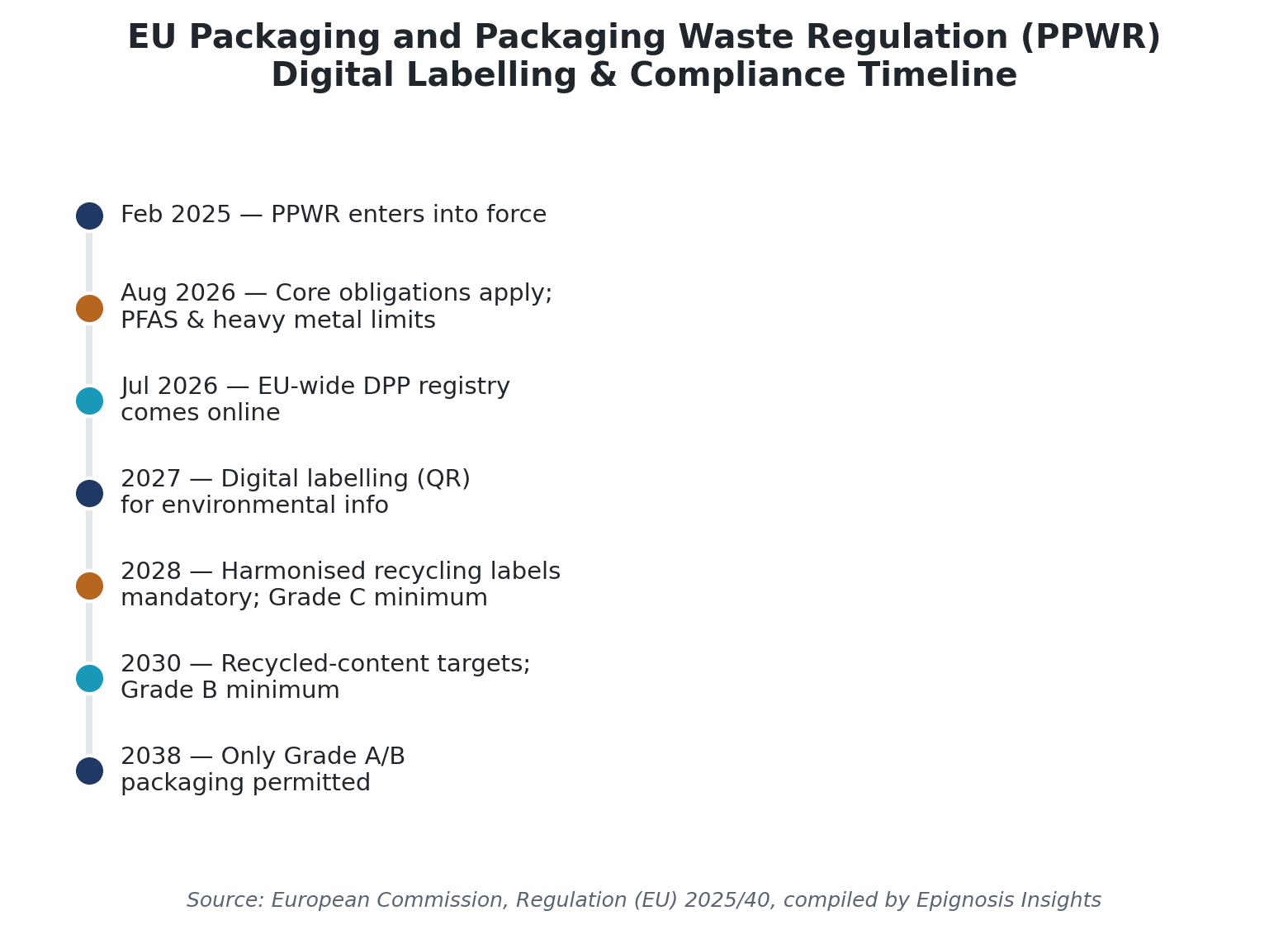
Figure 1: EU Packaging and Packaging Waste Regulation digital labelling and compliance timeline. Source: European Commission, Regulation (EU) 2025/40, Epignosis Insights Research Desk.
What distinguishes the current wave of smart packaging innovation from earlier QR-code marketing gimmicks is that the digital layer is being built to carry genuinely structured, machine-readable data rather than a simple link to a brand's website. Under the PPWR, the digital data carrier must connect to information covering material composition, recyclability, and reuse details, and this infrastructure is explicitly designed to share underlying data requirements with the separate Digital Product Passport framework created under the EU's Ecodesign for Sustainable Products Regulation. In practice, that means a single QR code or GS1 Digital Link embedded during the packaging design phase can simultaneously satisfy environmental disclosure requirements, support consumer-facing product storytelling, and feed downstream recycling and reuse infrastructure — collapsing what were previously three separate packaging workstreams into one integrated data architecture.
Public company disclosures provide a useful real-world check on how quickly intelligent packaging technology is actually being adopted at scale. Avery Dennison's second-quarter 2026 earnings call detailed performance across its enterprise-wide Intelligent Labels platform, which includes RFID and NFC-enabled smart labels: sales in the company's largest category, apparel and general retail, grew approximately 10% year-over-year, driven by continued program expansion and a recovery in general retail demand, while overall enterprise Intelligent Labels sales grew at a low-single-digit rate. Logistics sales, by contrast, declined by double digits, which the company attributed to a difficult comparison against outsized 2025 share gains rather than a structural slowdown. Management specifically flagged that Intelligent Labels growth is projected to accelerate in the second half of 2026, driven by a major U.S. grocery retailer rollout and deepening apparel adoption — concrete evidence that RFID-enabled smart packaging is moving beyond its original apparel-tagging use case into food retail at scale.
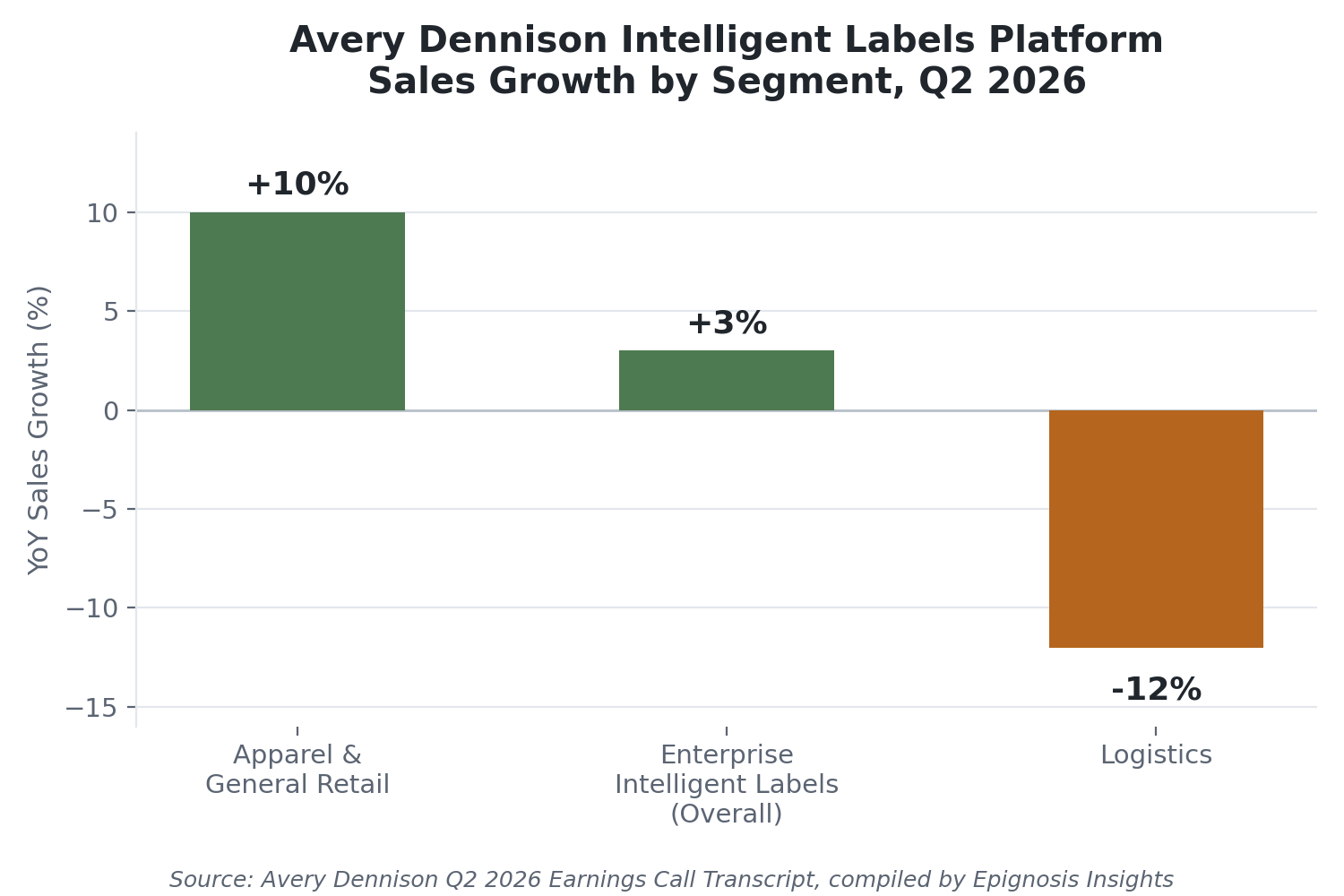
Figure 2: Avery Dennison Intelligent Labels platform sales growth by segment, Q2 2026. Source: Avery Dennison Q2 2026 Earnings Call Transcript, Epignosis Insights Research Desk.
Active packaging technologies, which interact with the product or its environment to actively extend shelf life rather than simply containing it, remain concentrated in oxygen and moisture scavenging applications for food and beverage categories. The policy rationale behind this innovation push is significant: food waste generates 8% to 10% of global greenhouse gas emissions, according to the United Nations Environment Programme, making shelf-life-extending packaging a genuine climate lever rather than a purely commercial one. Newer product innovation in this space is shifting away from loose sachet-based scavengers toward polymer-matrix solutions that integrate the active material directly into the packaging film itself, reducing the foreign-object-debris risk on high-speed packaging lines and improving pack aesthetics that brand managers have historically resisted compromising for functional packaging.
Where active packaging changes a product's environment, intelligent packaging senses and communicates it. Freshness and spoilage indicators, temperature-logging labels for cold-chain biologics, and RFID-based track-and-trace tags collectively represent the fastest-growing segment of the intelligent packaging category, and pharmaceutical applications are a particular focus of current product development: NFC tags that harvest power directly from a smartphone are being integrated into blister packs to authenticate drug origin and trigger dose-reminder mobile applications, addressing both counterfeiting risk and patient adherence in a single physical format. Cold-chain temperature-monitoring labels have also seen accelerating adoption outside their traditional pharmaceutical base, with growing deployment in Gulf state logistics networks handling temperature-sensitive food and medical shipments through extreme ambient heat conditions.
Product innovation teams face a genuine tension between regulatory mandate and consumer willingness to pay. McKinsey's most recent sustainability-in-packaging consumer survey found that sustainability factors, relative to other purchasing considerations, have declined consistently from 2020 to 2025 and now rank among the bottom three considerations for consumers across every region surveyed — even as the same research notes that younger, higher-income consumers remain a meaningful exception. In Germany, for instance, McKinsey's data shows just 1% of high-income Gen X consumers say they would pay a lot more for sustainable packaging, compared with 9% of low-income millennials and 25% of high-income millennials, illustrating that willingness to pay is concentrated in a narrow demographic band rather than distributed evenly across the market. McKinsey's broader conclusion, based on conversations with more than 30 consumer packaged goods executives, is that sustainability-led packaging growth is now concentrated in specific applications and demographics rather than broadly distributed across brand portfolios — meaning regulatory compliance, not consumer pull, is increasingly the primary business case for smart and sustainable packaging investment.
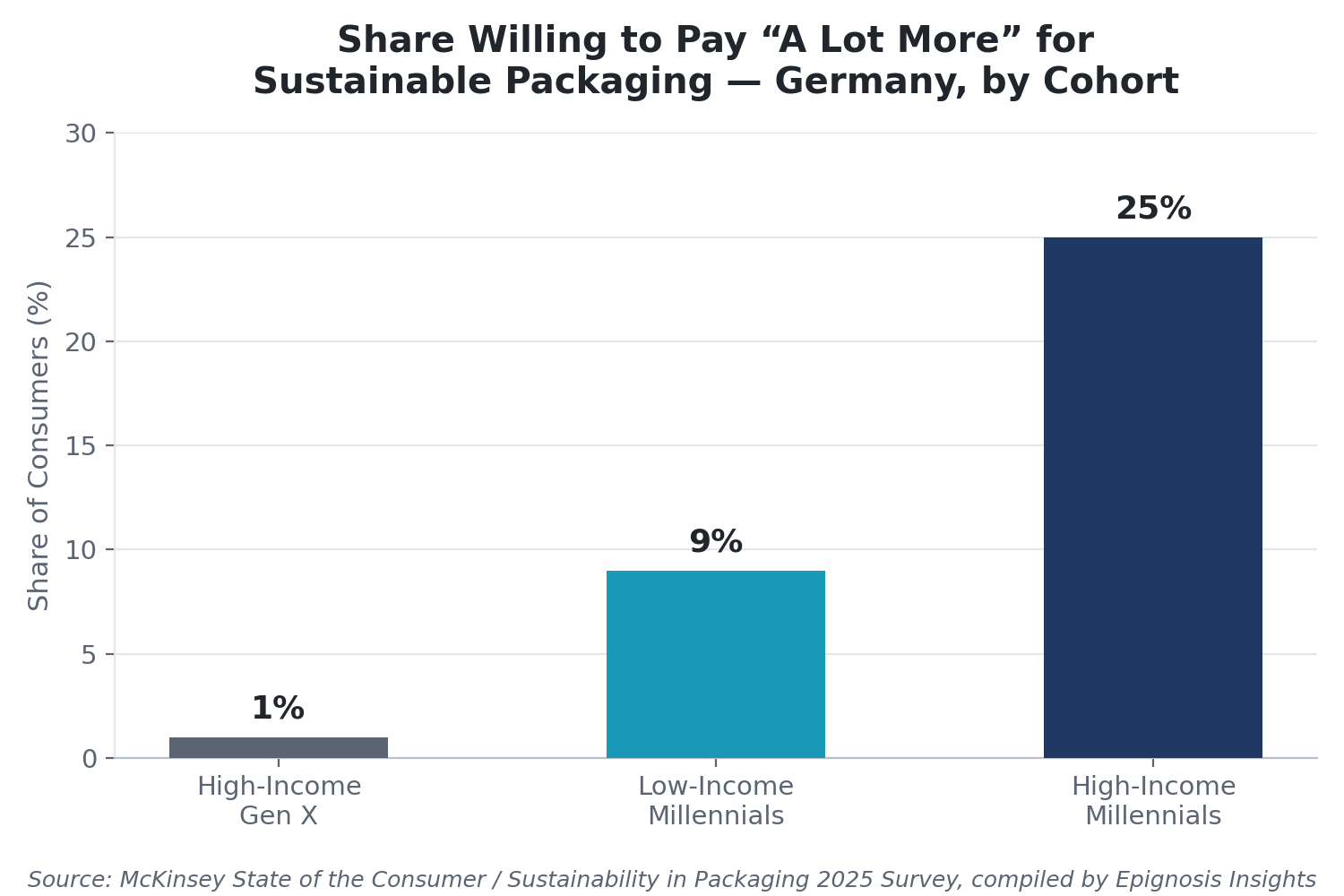
Figure 3: Share of consumers willing to pay “a lot more” for sustainable packaging, Germany, by cohort. Source: McKinsey Sustainability in Packaging 2025 Survey, Epignosis Insights Research Desk.
None of the digital labelling requirements described above function without an underlying data-carrier standard, and global standards body GS1 has positioned its GS1 Digital Link specification as the technical backbone connecting a scanned QR code to structured product data across the retail, recycling, and regulatory systems that need to read it. Because the PPWR explicitly permits GS1 Digital Link-compliant QR codes as a valid digital data carrier, packaging converters and brand owners building compliance infrastructure today are, in most cases, building directly on top of retail barcode standards that already exist at the point of sale — an important continuity that lowers the practical cost of the EU's digital labelling mandate compared with building an entirely new identification system from scratch. This standards continuity also matters for innovation velocity: because GS1 Digital Link resolves the same underlying identifier to different destinations depending on who is scanning it — a consumer reaching product information, a retailer reaching inventory data, a recycler reaching material-composition data — brand owners can layer new smart-packaging use cases onto an existing code without reprinting packaging or issuing a new identifier each time a new application is added, a flexibility that earlier generations of proprietary QR and RFID formats generally lacked.
While the EU's PPWR dominates the current smart-packaging compliance conversation, the United States has its own parallel regulatory driver rooted in pharmaceutical safety rather than environmental disclosure. The U.S. Food and Drug Administration's oversight of active packaging materials treats scavengers, absorbers, and other functional packaging components as food-contact or drug-contact substances subject to premarket notification, meaning any new active-packaging chemistry entering U.S. commerce must clear a federal safety review before a brand can commercialize it. Separately, the FDA's implementation of drug supply chain serialization requirements has pushed unit-level, RFID- and barcode-based traceability deep into pharmaceutical packaging lines over the past several years, creating exactly the kind of item-level authentication infrastructure that NFC-enabled blister packs and smart pharmaceutical labels now build upon. Together, the EU's environmental-disclosure mandate and the US's drug-safety serialization regime illustrate a broader pattern: smart packaging investment is being shaped less by a single global standard than by two structurally different regulatory logics operating in parallel on opposite sides of the Atlantic.
Beyond sustainability and shelf-life applications, brand protection remains one of the most commercially mature use cases for intelligent packaging. Unique, serialized RFID and NFC identifiers allow each individual unit of a product to be authenticated rather than relying on batch-level verification, a capability increasingly central to pharmaceutical serialization mandates in both the United States and European Union aimed at preventing counterfeit medicines from entering legitimate supply chains. Consumer goods brands have adopted a parallel, marketing-oriented version of the same technology, embedding NFC tags that let a smartphone tap verify authenticity while simultaneously launching branded digital content — a dual-purpose design pattern that packaging innovation teams increasingly treat as a baseline expectation rather than a premium feature reserved for luxury categories alone.
Innovation activity is not evenly distributed geographically. Europe's innovation agenda is presently dominated by regulatory compliance engineering tied to the PPWR and Digital Product Passport rollout described above. North America's activity, illustrated by Avery Dennison's grocery-retail RFID rollout, is more retail-operations-led, driven by inventory accuracy and loss-prevention business cases rather than an equivalent binding federal mandate. Asia-Pacific innovation is concentrated in electronics-manufacturing-adjacent capabilities — printed antenna integration during standard flexographic press runs, falling RFID tag unit costs, and QR-based consumer engagement formats popularized initially in retail and food-service contexts before spreading into general packaged goods. This divergence matters for global brand owners: a single smart-packaging product platform increasingly needs to satisfy EU digital-labelling law, North American retail-operations requirements, and Asia-Pacific cost and manufacturing-integration expectations simultaneously, rather than defaulting to whichever regional standard was designed first.
The evidence compiled by Epignosis Insights points toward smart packaging's transition from optional premium feature to baseline regulatory infrastructure accelerating through the remainder of this decade. The EU's phased PPWR deadlines running from August 2026 through 2038 give product and innovation teams a firm compliance runway, but the compressed timeline between now and the 2027 digital-labelling requirement leaves limited room for brands that have not yet begun building the underlying data infrastructure. Company-level evidence from Avery Dennison suggests intelligent labeling adoption is broadening beyond its apparel-tagging origins into grocery retail, while McKinsey's consumer research cautions that this expansion is being driven considerably more by regulatory mandate and operational efficiency than by broad-based consumer willingness to pay a premium for sustainability features. For packaging innovation teams, the practical implication is to treat digital data-carrier infrastructure, not any single sensor or material technology, as the foundational investment priority for the next product-development cycle.