Saudi Arabia Specialty Coffee Price Tracker
Epignosis Insights Research Desk — Monthly Report, August 2026


Epignosis Insights Research Desk — Monthly Report, August 2026
Saudi Arabia's Specialty Coffee Market sits at the intersection of two very different price stories in 2026: a global green-bean market that has spent six consecutive months easing off January's highs, and a domestic retail environment that has stayed almost perfectly flat. This report, compiled by the Epignosis Insights Research Desk from government statistical releases, intergovernmental coffee-trade data, company investor disclosures, and maritime-logistics analysis, tracks how that gap between global commodity softening and domestic price stability is actually being absorbed across the Kingdom's specialty coffee value chain.
According to the International Coffee Organization, the ICO Composite Indicator Price (I-CIP) averaged 248.90 US cents per pound in June 2026, down 2.8% from May and 16.2% below January's 296.89 cents yet Saudi Arabia's General Authority for Statistics recorded consumer price inflation holding at a steady 1.8% year-on-year across most of the same period. That divergence is the central finding of this month's tracker: green-bean costs are falling, but very little of that relief appears to be reaching Saudi menus or retail shelves, largely because freight, currency, and premiumization dynamics are absorbing the difference before it reaches the consumer.
The ICO's Coffee Market Report series provides the cleanest month-by-month benchmark for the raw material costs underlying every cup sold in the Kingdom's more than 5,000 specialty cafés. The I-CIP opened 2026 at 296.89 cents per pound in January, then fell 9.9% to 267.57 cents in February as global green bean exports rose 12.7% year-on-year. March brought a brief 2.3% rebound to 273.70 cents, which the ICO attributed to a market pausing to weigh two opposing forces: rising shipping and hydrocarbon costs tied to the Strait of Hormuz closure since March 4, against an improving global supply outlook. From April onward the downward trend reasserted itself decisively 266.24 cents in April, 256.05 cents in May, and 248.90 cents in June as Brazil's National Supply Company (CONAB) repeatedly raised its 2026/27 production forecast, ultimately reaching a record 66.7 million bags. Notably, the I-CIP briefly touched 231.96 US cents per pound on 9 June, its lowest level in nearly two years, before rebounding 17.4% to close the month at a two-month high of 272.39 cents a swing that illustrates just how thin the market's liquidity has become even as headline averages look calm.
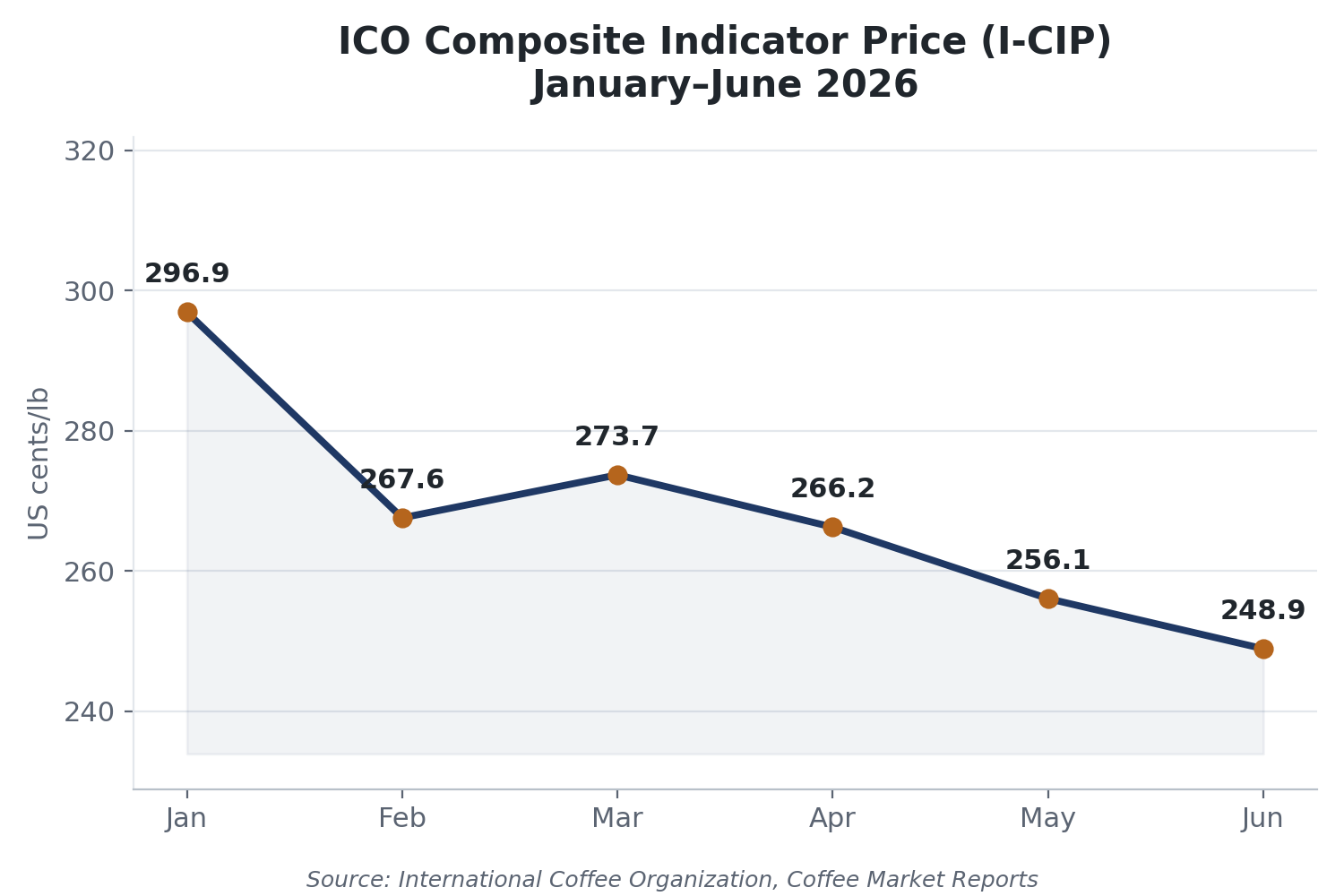
Figure 1: ICO Composite Indicator Price (I-CIP), January–June 2026. Source: International Coffee Organization, Epignosis Insights Research Desk.
Beneath the composite average, the four underlying coffee groups the ICO tracks have moved in noticeably different directions, a distinction that matters directly for Saudi Arabia's specialty segment because premium roasters overwhelmingly source Colombian Milds and Other Milds rather than Robusta. In June 2026, Colombian Milds averaged 324.60 cents per pound, up 0.4% on the month, while Other Milds slipped 2.4% to 307.83 cents. Brazilian Naturals fell the hardest, down 7.4% to 272.01 cents, reflecting the weight of Brazil's record harvest. Robusta, by contrast, gained 1.7% to 169.39 cents, supported by continued strong demand from instant-coffee and blended-format producers navigating elevated Red Sea freight costs. The practical effect for Saudi specialty operators is that the segment of the market they actually buy from high-grade Arabica milds has fallen far less than the composite headline suggests, and Colombian Milds in particular has barely moved at all over the past two months.
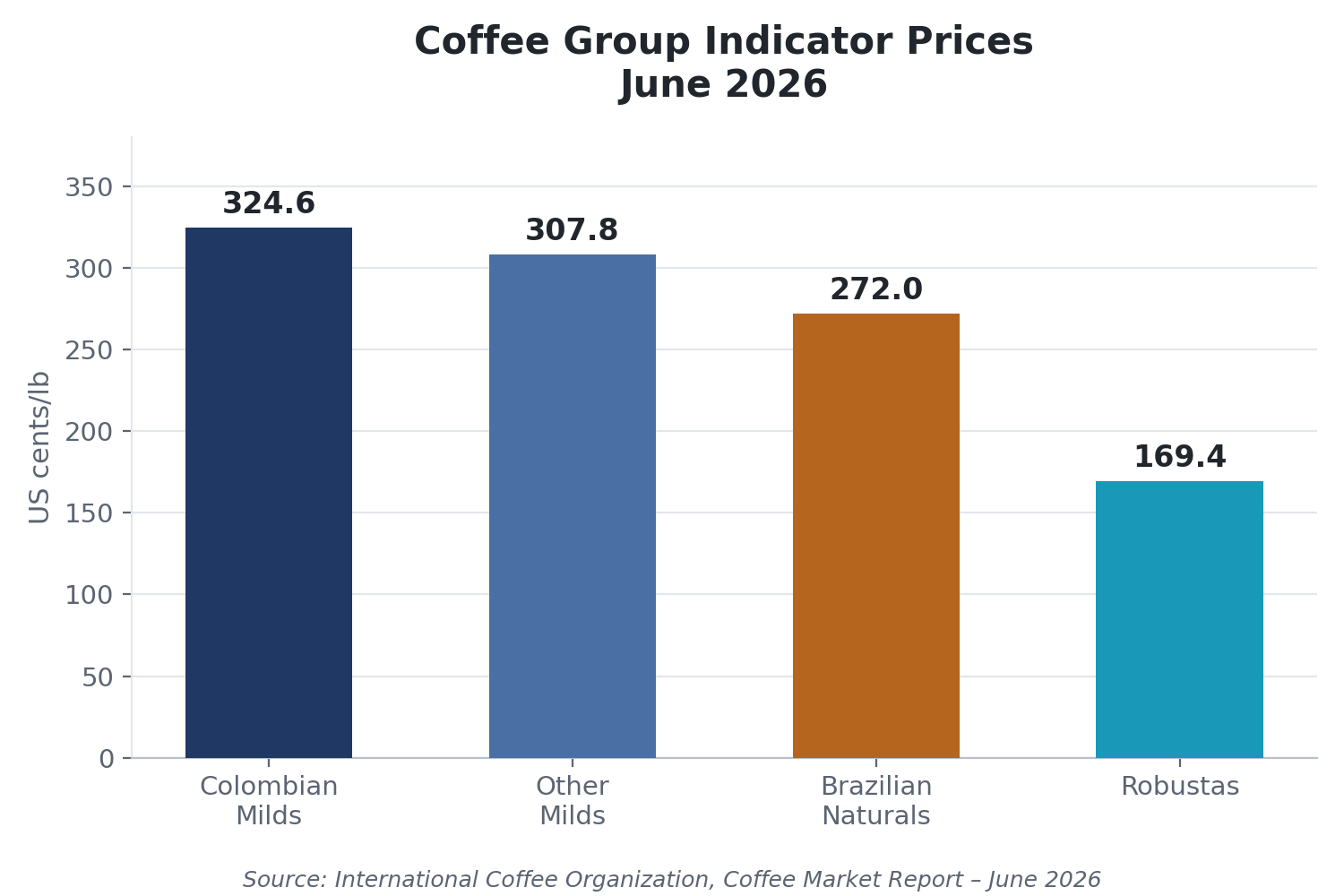
Figure 2: ICO group indicator prices, June 2026. Source: International Coffee Organization, Epignosis Insights Research Desk.
On the ground, Saudi Arabia's own price data tells a story of remarkable stability relative to the volatility upstream. GASTAT's Consumer Price Index recorded annual inflation of 1.8% in January, easing marginally to 1.7% in February before returning to 1.8% and holding there through June a six-month band barely a tenth of a percentage point wide. Food and beverage carries a 22% weight in the CPI basket, the largest single category, meaning coffee-related retail pricing sits inside one of the index's most closely watched components. The Wholesale Price Index tells a more revealing story: WPI rose 4.6% year-on-year in May 2026, up from 2.9% in February, and climbed a further 1.2% month-on-month evidence that pre-retail cost pressure, including imported inputs like green coffee, packaging, and equipment, is building even where retail-facing CPI has stayed flat. That gap between a calm CPI and an accelerating WPI is a classic signal of margin compression working its way through café operators and roasters before it ever reaches a posted menu price.
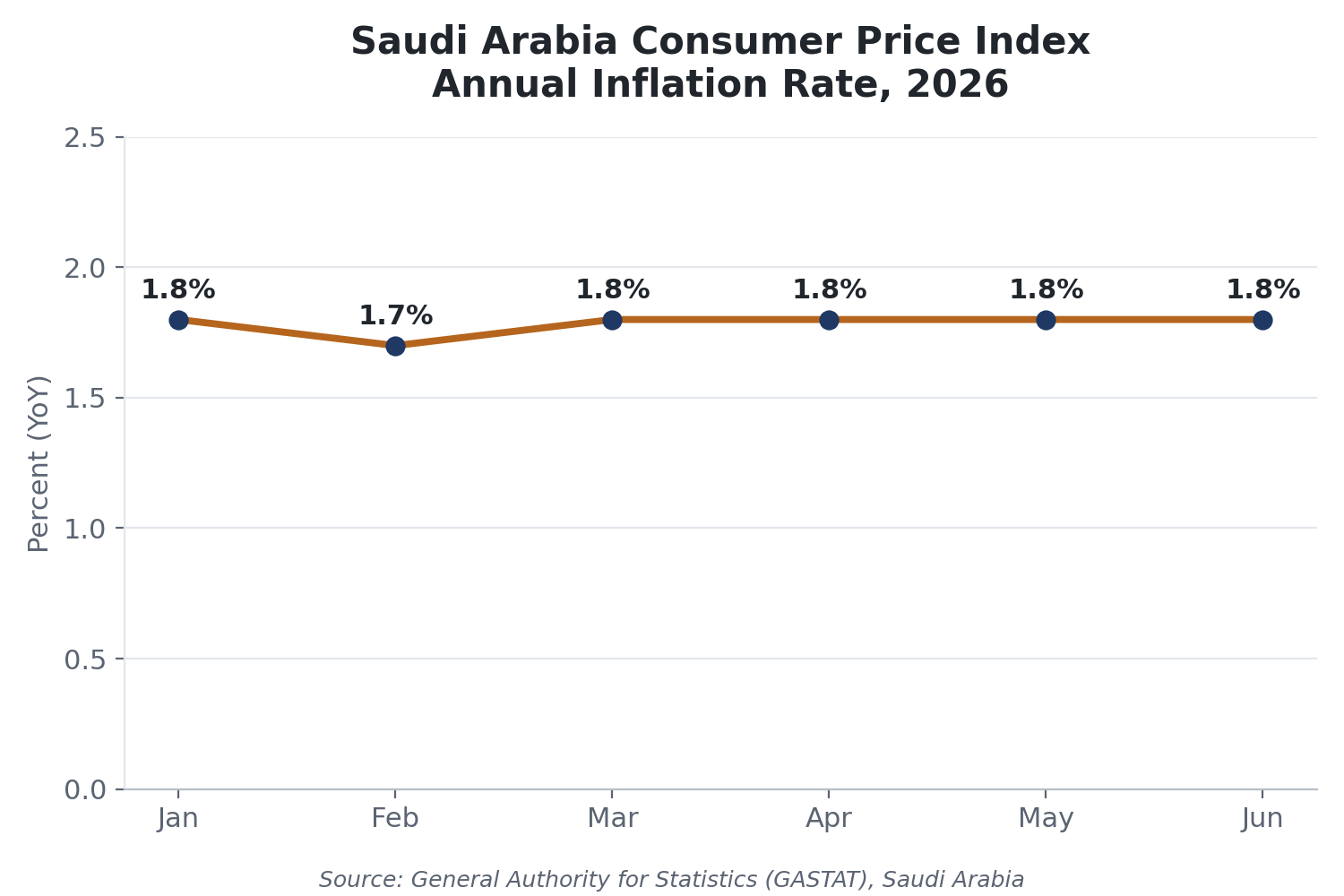
Figure 3: Saudi Arabia Consumer Price Index, annual inflation rate, 2026. Source: General Authority for Statistics (GASTAT).
A meaningful share of the gap between falling global bean prices and flat Saudi retail prices traces back to ocean freight. According to Freightos' 2026 shipping outlook, Red Sea and Bab el-Mandeb disruptions that began in late 2023 have kept most container lines on the longer Cape of Good Hope routing for Asia–Europe and Asia–Gulf lanes, adding 10 to 14 days of transit time and, as of mid-2026, still pricing Asia-Europe lanes 25–40% above pre-crisis baselines. War-risk insurance premiums, while off their 2023–24 peaks, remain elevated for vessels transiting Red Sea-adjacent high-risk zones, and the Joint War Committee's high-risk-area designation covering the southern Red Sea and Gulf of Aden has not been fully lifted. For Saudi importers bringing green coffee through Jeddah Islamic Port, this freight and insurance premium functions as a cost floor that has not eased in step with the ICO's falling composite price which helps explain why GASTAT's wholesale price data is accelerating even as the underlying commodity benchmark softens.
Publicly listed regional operator Americana Restaurants International PLC, which runs several thousand out-of-home dining locations across the Gulf including a substantial Saudi footprint, offers one of the only investor-grade windows into how F&B input costs are actually behaving on the ground. In its first-half 2026 results, Americana reported Saudi Arabia revenue of $336 million, up 7% year-on-year slower growth than the UAE, Kuwait, or Egypt alongside group-wide gross margin expansion of 2.8 percentage points. On its H1 2026 earnings call, management indicated that most of its 2026 commodity contracts were already locked in, providing near-term cost visibility, but flagged that higher logistics, insurance, and inventory costs could still weigh on margins in the second half of the year. That combination contractually hedged input costs paired with rising logistics overhead — mirrors precisely the freight-driven cost layer identified above, and offers a rare company-level confirmation that the wedge between global commodity prices and regional retail prices is a real, currently-widening phenomenon rather than a statistical artifact.
Longer-term, Saudi Arabia's exposure to imported green coffee price volatility is the explicit target of a state-backed industrial strategy. The Public Investment Fund's Saudi Coffee Company, launched in 2022, is investing SAR 1.2 billion over ten years to lift domestic Khawlani coffee production from roughly 300 tons annually to a targeted 2,500 tons, concentrated across more than 2,500 plantations and roughly 400,000 coffee trees in the Jazan, Al Baha, and Aseer regions. In April 2026, the company received formal handover of the Saudi Coffee Development Center in Jazan's Al-Dayr Governorate from Saudi Aramco, and its Jazan model farm spanning one million square meters — is targeting five million coffee trees by 2030. Even at full 2,500-ton capacity, domestic production would cover only a small fraction of a national consumption base the company itself has projected to reach roughly 28,700 tons annually, meaning Saudi Arabia will remain structurally import-dependent for at least the remainder of this decade but the domestic push does signal a long-run strategic hedge against exactly the kind of freight- and commodity-driven volatility this tracker documents.
The Epignosis Insights Research Desk's own primary tracking of the Kingdom's café ecosystem shows the price transmission gap identified above is playing out unevenly across consumption formats. Premium café beverages continue to be priced in a $4–$6 per cup range across Riyadh and Jeddah's specialty outlets, a band that has held essentially flat over the past two quarters despite the swings in upstream green-bean costs documented in Figures 1 and 2— evidence that café operators are treating the ICO's volatility as noise to be absorbed rather than a signal to reprice menus in either direction. At-home specialty formats, including whole-bean retail packs and capsule systems, carry meaningfully lower per-serving costs and have shown more visible movement in line with wholesale pricing trends, since retail-channel buyers negotiate shorter contract cycles than the annual or multi-quarter agreements typical of café supply chains. This is consistent with Americana Restaurants' own disclosure that most 2026 commodity contracts were locked in early, insulating menu pricing from short-term ICO swings while leaving wholesale and retail-channel buyers more exposed to month-to-month movement.
Price behavior is not uniform across Saudi Arabia's major metropolitan markets. Riyadh, which hosts the highest concentration of premium café outlets and the deepest specialty-roaster competition, has the most price-competitive environment among the Kingdom's three largest coffee markets, with new entrants and independent roasters exerting consistent downward pressure on menu prices even as input costs rise. Jeddah's coastal, tourism-driven café culture supports comparatively firmer pricing on cold and specialty beverage formats, where demand is less price-elastic. The Eastern Province, still an emerging specialty market by comparison, shows the widest variance in per-cup pricing as both international chains and newer independent operators compete to establish share, with promotional pricing more common than in the two larger metropolitan markets. For roasters and distributors setting national pricing strategy, this means a single Kingdom-wide price point increasingly understates the degree of regional competitive intensity documented in Epignosis Insights' ongoing café-level tracking.
| Metric | Value | Period |
| ICO Composite Indicator Price (I-CIP) | 248.90 US cents/lb | June 2026 |
| I-CIP monthly change | -2.8% | May–June 2026 |
| I-CIP six-month range | 248.9–296.9 US cents/lb | Jan–Jun 2026 |
| Robusta group price | 169.39 US cents/lb | June 2026 |
| Colombian Milds group price | 324.60 US cents/lb | June 2026 |
| Saudi CPI, annual inflation | 1.8% | June 2026 |
| Saudi Wholesale Price Index, annual | 4.6% | May 2026 |
| Saudi Coffee Company planned investment | SAR 1.2 billion / 10 years | 2022–2032 |
| Saudi domestic production target | 300 → 2,500 tons/year | By early 2030s |
| Red Sea route cost premium, Asia–Europe | 25–40% above pre-crisis | Mid-2026 |
The data compiled in this tracker points toward continued divergence between global and domestic Saudi coffee pricing through the remainder of 2026. On the global side, Brazil's confirmed record 2026/27 harvest and rising Robusta exports from Vietnam suggest the I-CIP's downward bias is likely to persist absent a fresh supply shock, though the 9 June intraday swing to a near two-year low followed by a 17.4% rebound within three weeks shows how quickly sentiment can reverse in a thinly-traded, low-inventory market. On the domestic side, GASTAT's widening gap between a flat 1.8% CPI and an accelerating 4.6% WPI suggests retail-facing coffee prices have room to rise even if commodity costs keep falling, as roasters and café operators work through elevated freight and insurance costs accumulated over the past two years. For procurement teams and specialty roasters operating in the Kingdom, the practical takeaway is that Colombian Milds and Other Milds — the grades that actually matter for premium Saudi café menus — have shown far more price resilience than the headline composite figure suggests, and freight normalization, not the ICO composite price, is likely to be the more consequential variable for Saudi retail pricing over the next two quarters.